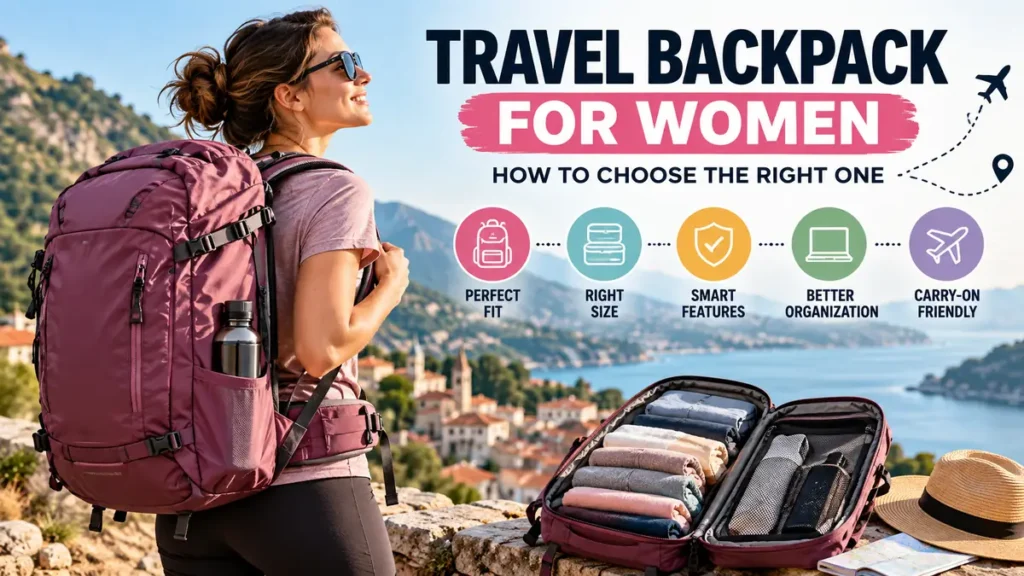
A travel backpack for women should do more than hold clothes. The right backpack should match your torso, distribute weight comfortably, fit the luggage limits for your trip, protect important belongings, and make packing and unpacking simple.
The biggest mistake is choosing a bag based mainly on capacity, appearance, or a “women’s” label. Current travel-backpack guidance increasingly emphasizes torso length, shoulder-harness shape, hip-belt placement, packed dimensions, and realistic loaded comfort as the factors that matter most.
A good travel backpack for women combines the correct torso fit with comfortable shoulder straps, effective load distribution, practical organization, suitable capacity, and dimensions that work for the intended airline. For many trips, roughly 25–40 liters provides a useful balance between packing space and portability, but exterior measurements matter more than advertised volume.
What Makes a Travel Backpack for Women Different?
A genuinely women-specific backpack is not simply a standard backpack offered in different colors.
The meaningful differences are usually found in the suspension system. Depending on the model, these can include a shorter back panel, narrower or more contoured shoulder straps, an adjustable torso system, and a hip belt shaped differently from the equivalent standard pack.
Those changes can improve comfort for people with shorter torsos or narrower shoulders. However, body proportions vary considerably, so a women-specific design is not automatically the right choice for every woman.
Torso length matters more than height alone.
Two people who are exactly the same height can require different backpack sizes because their torso proportions differ. Likewise, some women may get a better fit from a unisex backpack, while some people who would normally shop for a standard or men’s model may find a women-specific harness more comfortable.
Women-Specific vs Unisex Travel Backpacks
| Feature | Women-Specific Backpack | Unisex Backpack |
|---|---|---|
| Torso | Often designed for shorter torso ranges | Usually broader/general sizing |
| Shoulder straps | Frequently narrower and more contoured | Usually more neutral in shape |
| Hip belt | May use different shaping or positioning | General-purpose design |
| Capacity | Similar range | Similar range |
| Organization | Depends on individual model | Depends on individual model |
| Best choice | When the harness matches your body | When the standard harness fits correctly |
Neither category is inherently superior. Fit is the deciding factor.
A well-fitting unisex backpack is better than a poorly fitting women-specific backpack.
How to Find the Correct Backpack Fit
Comfort starts with torso length rather than your overall height.
Your torso is generally measured from the prominent C7 vertebra near the base of your neck down toward the level of your iliac crest at the top of your hip bones. Manufacturers may use slightly different sizing systems, so compare your measurement with the sizing chart for the specific backpack you are considering.
This measurement becomes particularly important when the backpack has a substantial hip belt.
Why Torso Length Matters
When a loaded travel backpack is correctly fitted, the hip belt can transfer a meaningful portion of the load away from the shoulders and toward the hips.
If the torso length is wrong, several problems can appear:
- Shoulder straps may dig into your neck or chest.
- The backpack may pull backward.
- The hip belt may sit too high or too low.
- The load can feel heavier than it actually is.
- The pack may move excessively while walking.
- Pressure points can become uncomfortable during long travel days.
Do not judge a backpack while it is empty.
Load it with approximately the amount of clothing, electronics, toiletries, and other items you expect to carry. Then walk around with it for several minutes.
A backpack that feels perfect with nothing inside can feel completely different once loaded.
How to Adjust a Travel Backpack
For a pack equipped with a proper suspension system, start by positioning and tightening the hip belt. Next, adjust the shoulder straps so the pack stays close to your body without forcing excessive weight onto your shoulders.
Then adjust the load lifters, if present, followed by the sternum strap. Fit guides commonly recommend this general sequence because adjusting the pack in the wrong order can make a suitable harness feel uncomfortable.
The sternum strap should stabilize the shoulder straps rather than squeeze your chest.
Once adjusted, walk, climb stairs, bend down, and turn from side to side. These movements reveal fit problems that are difficult to notice while standing still.
What Size Travel Backpack for Women Is Best?
There is no universal ideal capacity.
Trip duration, climate, laundry access, electronics, footwear, personal packing habits, and airline restrictions all influence how much space you actually need.
A useful general framework is:
| Capacity | Typical Use | Main Advantage |
|---|---|---|
| 15–25L | Day trips, commuting, minimalist overnight trips | Compact and light |
| 25–30L | Weekends and light travel | Easier to manage |
| 30–35L | Multi-day and minimalist one-bag travel | Strong balance of space and mobility |
| 35–40L | Longer trips and larger packing lists | More clothing capacity |
| 40L+ | Bulky gear or longer travel | Maximum space, but harder to keep compact |
Many current travel-backpack guides concentrate on approximately the 25–40L range for carry-on-oriented travel.
But liters can be misleading.
A 40-liter backpack is not automatically carry-on compliant, and a smaller backpack is not automatically a personal item.
Airlines normally care about exterior dimensions and weight—not the capacity number printed on the backpack.
Carry-On Backpack vs Personal-Item Backpack
This distinction is especially important for air travel.
A carry-on backpack normally goes in the overhead compartment. A personal item is generally expected to fit under the seat in front of you.
The exact permitted measurements vary by airline, ticket type, route, and sometimes aircraft.
For that reason, avoid relying on descriptions such as:
- airline approved
- flight approved
- TSA approved size
- universal carry-on
- cabin approved
These phrases do not guarantee that a backpack meets every airline’s baggage policy.
Before flying, check the operating airline’s current baggage rules and compare them with the fully packed external dimensions of your backpack.
This is especially important for expandable backpacks. A bag that meets the required dimensions while compressed may exceed them when fully expanded.
Why Capacity Alone Doesn’t Tell You Whether a Bag Will Fit
Two 35L backpacks can have noticeably different shapes.
One might be long and narrow. Another could be short but deep.
External pockets, stuffed compartments, rigid frames, handles, and overpacking can also increase the effective dimensions.
That is why comparing length, width, and depth is more reliable than choosing a backpack simply because it is marketed as 30L, 35L, or 40L. Current carry-on guides likewise emphasize checking actual dimensions against the specific airline rather than relying solely on liters.
The Most Important Features in a Travel Backpack for Women
It is easy to get distracted by dozens of pockets and accessories. In practice, a relatively small number of features have the greatest effect on comfort and usability.
Adjustable Shoulder Straps
Shoulder straps should sit securely without rubbing your neck or creating uncomfortable pressure across your chest.
Contoured straps can work particularly well for narrower frames, but strap spacing and shape matter more than the marketing category.
Padding should also be considered carefully.
Very thick padding is not automatically more comfortable. Good shape, positioning, structure, and load distribution can matter just as much.
Supportive Hip Belt
A substantial hip belt becomes increasingly valuable as backpack weight increases.
It helps transfer weight toward the hips instead of leaving the shoulders to support the entire load.
This is particularly useful when you expect to:
- walk between train stations and hotels,
- use public transportation,
- navigate airports for long periods,
- walk over uneven streets,
- carry the backpack for extended periods.
For a small, lightly loaded personal-item backpack, a large hip belt may be unnecessary.
Sternum Strap
The sternum strap helps stabilize the shoulder straps and can reduce unwanted movement.
An adjustable sternum strap is preferable because it lets you change its position according to your body shape.
Comfortable Back Panel
A structured back panel can help maintain the backpack’s shape and prevent packed objects from pressing directly against your back.
Ventilation channels or breathable mesh may improve comfort in warm environments, although no back panel completely eliminates sweating.
Load Lifters
Load lifters are small adjustment straps found near the top of some structured backpacks.
They help control how the upper part of the pack sits relative to your shoulders.
They are especially useful on larger travel backpacks with more substantial suspension systems.
Clamshell vs Top-Loading Travel Backpacks
For general travel, opening style can dramatically affect convenience.
Clamshell Opening
A clamshell backpack opens widely, often much like a suitcase.
This makes it easier to see clothing, packing cubes, toiletries, and accessories without removing everything above them.
Current travel-backpack comparisons frequently feature clamshell-style designs because they work particularly well for one-bag and carry-on travel.
A clamshell design is especially useful for:
- hotel stays,
- city breaks,
- business travel,
- international trips,
- organized one-bag packing.
Top-Loading Opening
A traditional top-loading backpack is accessed primarily from the top.
This design is common in hiking and trekking packs because it can be simple and efficient on the trail.
For hotel-based travel, however, an item at the bottom may require removing much of the contents first.
Neither design is universally better. Choose according to how you will actually use the backpack.
Organization: How Many Compartments Do You Need?
More pockets do not necessarily mean better organization.
Too many small compartments can add weight and make it difficult to remember where items are stored.
A practical travel backpack usually benefits from:
- one spacious main compartment,
- a quick-access pocket,
- a secure internal pocket,
- a laptop sleeve when needed,
- at least one practical place for small essentials,
- an external bottle pocket if you regularly carry water.
Packing cubes can handle much of the internal organization without forcing you to buy a backpack with dozens of built-in compartments.
Laptop Compartment
Digital travelers should pay particular attention to laptop storage.
Look for padding and a sleeve that holds the computer securely rather than allowing it to move around.
A false bottom—where the laptop sleeve ends slightly above the bottom of the bag—can provide additional protection if the backpack is dropped.
Also consider airport accessibility. A laptop compartment that can be reached without unpacking clothing is much more convenient during security checks and work stops.
Backpack Weight Matters More Than You Think
Empty backpack weight is often overlooked.
Suppose two backpacks provide approximately the same usable capacity, but one weighs considerably more before anything is packed.
That extra weight reduces the amount of clothing and equipment you can comfortably carry and may matter on airlines with cabin-baggage weight limits.
A heavier backpack can still make sense when the extra weight comes from features you genuinely need, such as:
- a supportive frame,
- a substantial hip belt,
- thicker protective materials,
- laptop protection,
- robust hardware.
The goal is not simply to buy the lightest possible backpack.
It is to avoid carrying weight that provides no useful benefit.
Materials, Durability, and Weather Resistance
A travel backpack experiences constant abrasion.
It gets pushed under seats, placed on airport floors, squeezed into overhead compartments, dragged through stations, and exposed to changing weather.
Look for durable fabric and reinforced stitching around high-stress areas, particularly:
- shoulder-strap attachment points,
- grab handles,
- zipper seams,
- hip-belt connections,
- compression straps.
Materials used in travel bags can include different types of nylon, polyester, recycled fabrics, and specialized laminates.
Fabric name alone does not determine durability. Construction quality, fabric weight, coating, stitching, zipper quality, and reinforcement all matter.
Water-Resistant Does Not Mean Waterproof
These terms should not be treated as interchangeable.
A water-resistant backpack may handle brief rain or splashes but can eventually allow water inside.
A genuinely waterproof system requires much more comprehensive protection, potentially including waterproof materials, sealed seams, and appropriately protected closures.
For most city travelers, strong water resistance combined with a pack cover or internal waterproof pouch for sensitive electronics may be sufficient.
Travel Backpack Security Features
No backpack can make theft impossible, but thoughtful design can reduce unnecessary exposure.
Useful security features may include:
- lockable zipper pulls,
- internal valuables pockets,
- hidden or difficult-to-reach pockets,
- sturdy zippers,
- openings positioned away from easy access.
The most effective security habit, however, is situational awareness.
Keep passports, payment cards, phones, and other critical items in secure locations. Avoid placing valuables in easily opened exterior pockets when moving through crowded stations, markets, airports, or public transportation.
For international travel, a small internal pouch can also help keep your passport, backup payment method, and essential documents together.
Popular Travel Backpack Designs and What They Illustrate
Several well-known travel bags demonstrate the different approaches manufacturers take to this category.
The Osprey Fairview 40, for example, is frequently discussed in women-focused travel-backpack comparisons because it combines a travel-oriented opening with a harness designed around a women-specific fit.
The Cotopaxi Allpa 35L demonstrates another approach, emphasizing suitcase-style organization and divided internal storage. The Patagonia Black Hole Mini MLC 30L represents a smaller travel-oriented format, while packs from Aer, Bellroy, Peak Design, Pacsafe, and similar brands illustrate how manufacturers prioritize features such as laptop storage, organization, security, minimalist styling, or urban travel differently.
These examples are useful because they highlight an important point: there is no single design that works best for every traveler.
The correct question is not simply, “What is the best backpack?”
It is, “Which design matches my body, packing style, transportation, and trip?”
Choosing a Backpack by Trip Type
Your destination matters less than how you intend to travel once you arrive.
Weekend City Break
A 20–30L backpack may provide enough room for a minimalist weekend packing list.
Prioritize:
- low empty weight,
- quick-access pockets,
- easy opening,
- compact dimensions.
You probably do not need a complex suspension system unless you expect to carry substantial weight for hours.
One-Bag International Travel
A 30–40L travel backpack gives many travelers more flexibility for clothing, toiletries, electronics, and packing cubes.
Here, comfort becomes increasingly important.
Look closely at torso adjustment, shoulder straps, hip-belt effectiveness, empty weight, clamshell access, and airline dimensions.
Business Travel
Laptop protection and organization become more important.
A dedicated technology compartment, document storage, restrained exterior design, and quick access to chargers can be more valuable than outdoor-oriented features.
Adventure Travel
If your trip involves extensive walking, hiking, or carrying gear over uneven terrain, prioritize the suspension system.
A backpack designed primarily for airports may not provide the ventilation, load control, and long-distance carrying comfort of a hiking-oriented pack.
Travel backpacks and backpacking packs solve related but different problems.
How to Pack a Travel Backpack Efficiently
A good backpack can still feel uncomfortable when packed badly.
Start by placing dense, heavier objects relatively close to your back rather than at the outer edge of the bag. This helps keep the center of gravity closer to your body.
Medium-weight clothing can fill the central area, while lighter or compressible items can occupy the remaining space.
Packing cubes are particularly useful for separating:
- tops,
- bottoms,
- underwear,
- sleepwear,
- accessories.
They make organization easier, but they do not magically create additional capacity. Overstuffed packing cubes can still produce an overpacked backpack.
Keep Frequently Used Items Accessible
Do not bury everything inside the main compartment.
During a typical travel day, you may repeatedly need:
- passport,
- phone,
- charging cable,
- headphones,
- boarding information,
- medication,
- water bottle,
- light jacket.
Pack these according to when you expect to use them.
Items needed only after reaching your accommodation can go deeper inside.
Common Mistakes When Choosing a Travel Backpack for Women
Buying Based on Appearance Alone
Style matters, especially if you will carry the backpack frequently.
But attractive design cannot compensate for shoulder pain or an incorrectly positioned hip belt.
Fit first. Appearance second.
Assuming “Women’s” Automatically Means Better
Women-specific geometry can be genuinely useful, but the label itself proves nothing about how the backpack will fit your individual body.
Measure your torso and try the bag under load whenever possible.
Choosing the Largest Backpack Available
Extra capacity encourages extra packing.
A larger backpack can become heavier, deeper, and more difficult to fit within airline baggage limits.
Choose enough capacity for your realistic packing list rather than unused “just in case” space.
Ignoring Empty Weight
A backpack’s own weight counts every time you carry it.
Do not pay a permanent weight penalty for features you rarely use.
Trusting “Carry-On Approved” Without Checking
Airlines do not all use identical cabin-baggage limits.
Check your airline’s current rules before departure, especially when traveling with low-cost carriers or using a backpack close to the maximum permitted dimensions.
Testing the Backpack Empty
This is one of the easiest mistakes to avoid.
Load the backpack before evaluating comfort.
A realistic load reveals how the shoulder straps, hip belt, back panel, and frame actually behave.
How to Choose a Travel Backpack for a Petite Frame
Petite travelers should pay particular attention to torso range rather than simply buying the smallest-capacity backpack.
A 35L pack with a short, adjustable harness may fit far better than a 25L backpack with a long fixed back panel.
Check:
- minimum torso setting,
- shoulder-strap spacing,
- hip-belt positioning,
- overall pack width,
- ability to adjust the sternum strap.
The backpack should not feel as though it is controlling your movement.
If the pack repeatedly bumps your head, sits far below the hips, or forces the shoulder straps into an uncomfortable position, its harness may simply be too long.
Is a 40L Backpack Too Big for Women?
Not necessarily.
Backpack capacity does not determine whether it fits a woman’s body.
A properly fitted 40L travel backpack can be more comfortable than a poorly fitted 30L backpack.
The more important considerations are torso compatibility, loaded weight, external dimensions, and the strength of the suspension system.
Current women-focused travel guides commonly include 35–40L bags precisely because that capacity can work well for one-bag travel when the harness and dimensions are appropriate.
The bigger concern is weight.
Forty liters of available space makes it easy to pack more than you comfortably want to carry.
Is 30L Enough for a Week?
For a disciplined light packer, it can be.
A 30L backpack can work for a week when clothing is versatile, bulky footwear is minimized, toiletries are kept compact, and laundry is available.
Trip length does not always require a proportional increase in backpack size.
Once you can wash clothing during a journey, a packing list for two weeks may look surprisingly similar to one for a single week.
Cold-weather travel is more difficult because jackets, sweaters, and other insulating layers consume more space.
Should a Travel Backpack Have a Hip Belt?
It depends on size, load, and how long you will carry it.
For a small personal-item backpack containing a laptop and a few essentials, a large padded hip belt can be unnecessary.
For a heavier 35–40L backpack, a well-positioned hip belt can substantially improve comfort by helping transfer the load toward the hips rather than leaving it concentrated on the shoulders.
The key phrase is well-positioned.
A hip belt that sits in the wrong place because the backpack’s torso is too long or short will provide much less benefit.
Travel Backpack vs Suitcase
A backpack is particularly useful when mobility matters.
It keeps your hands free and is easier to manage on:
- stairs,
- public transportation,
- uneven sidewalks,
- cobblestones,
- busy train platforms,
- routes involving frequent accommodation changes.
A rolling suitcase may be preferable when you have heavier luggage, do little walking with your bag, want rigid protection, or simply prefer not to carry weight on your back.
Some current travel-backpack testing also highlights mobility through transit systems and uneven streets as one of the major advantages of backpack-style luggage.
Neither format is universally better. The right luggage depends on the journey.
A Simple Checklist Before Choosing
Before deciding on a travel backpack for women, verify the factors that will affect the trip rather than focusing only on the product description.
- Measure your torso length.
- Determine the capacity you realistically need.
- Check the backpack’s actual exterior dimensions.
- Compare those dimensions with your airline’s current baggage policy.
- Check the backpack’s empty weight.
- Evaluate shoulder-strap shape and spacing.
- Check whether the hip belt sits correctly.
- Decide between clamshell and top-loading access.
- Confirm your laptop fits if you travel with one.
- Examine zipper and fabric quality.
- Load the backpack with realistic weight.
- Walk with it before deciding whether the fit is comfortable.
A backpack that performs well on these fundamentals will usually be more useful than one chosen because it has the longest feature list.
Final Thoughts
The best travel backpack for women is ultimately the backpack that fits the person carrying it.
Start with torso length and loaded comfort. Then consider capacity, external dimensions, empty weight, hip-belt support, shoulder-strap shape, opening style, laptop protection, security, and organization.
For many travelers, a pack somewhere around 25–40L can provide a practical starting point, but do not treat capacity as an airline guarantee. Check the actual measurements of the packed bag against the baggage policy for each flight.
Most importantly, ignore the idea that a women’s backpack must simply be smaller or styled differently. A useful women-specific design is about fit and ergonomics. Choose the harness that matches your body, pack only what you need, and test the backpack with realistic weight before trusting it on a long trip.