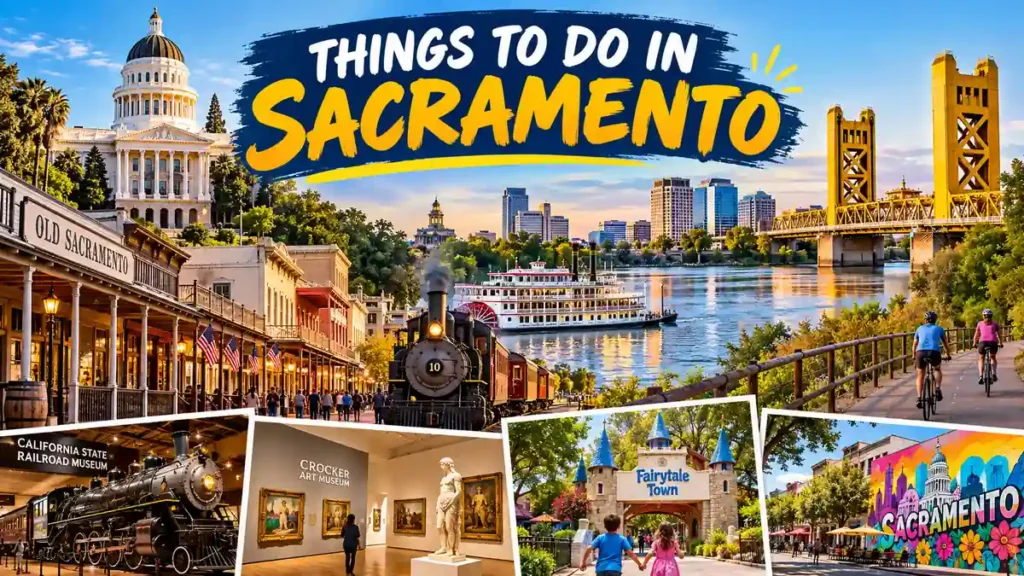
Sacramento is much more than California’s government center. The capital combines Gold Rush history, major museums, leafy parks, two rivers, colorful public art, a strong food scene, and neighborhoods that are easy to explore at a relaxed pace.
If you are searching for things to do in sacramento, start with the Old Sacramento Waterfront and California State Railroad Museum, tour the State Capitol, explore the Crocker Art Museum, walk or cycle the American River Parkway, and make time for Midtown’s restaurants and murals. Families can add Fairytale Town and other kid-friendly attractions to the itinerary.
The best part is variety. A morning spent learning about the Transcontinental Railroad can turn into an afternoon beside the Sacramento River and an evening built around local food or live entertainment.
Best Things to Do in Sacramento for First-Time Visitors
A first visit should mix Sacramento’s three strongest experiences: California history, outdoor recreation, and local culture. Many major attractions are concentrated around Downtown and the waterfront, so you do not have to spend the entire trip driving from one sight to another.
1. Explore Old Sacramento Waterfront
Old Sacramento Waterfront is the natural starting point for understanding the city.
The historic riverfront district covers about 28 acres and contains more than 125 shops, restaurants, and attractions. Its preserved and reconstructed Gold Rush-era atmosphere gives visitors a sense of the period when Sacramento developed into an important commercial and transportation center.
Wooden sidewalks, historic buildings, museums, restaurants, and views of the Sacramento River make it worthwhile even when you do not have a detailed itinerary.
Do not rush through it simply to take photographs. Allow time to walk the side streets and riverfront, visit at least one museum, and look closely at the buildings.
Families can easily combine Old Sacramento with the California State Railroad Museum, while history enthusiasts may also want to explore the Sacramento History Museum.
2. Visit the California State Railroad Museum
The California State Railroad Museum is one of Sacramento’s signature attractions and an especially good choice for anyone interested in engineering, transportation, California history, or the development of the American West.
Its restored locomotives and exhibits explain how railroads transformed travel, commerce, settlement, and everyday life. The museum works well because visitors do not need to be railway enthusiasts to appreciate the scale of the equipment and the stories surrounding it.
Visit California describes it as one of the country’s premier railroad museums, while traveler-interest listings consistently place it among Sacramento’s prominent attractions.
Because it is in the Old Sacramento area, it fits naturally into a half-day devoted to the waterfront.
3. Tour the California State Capitol
Sacramento is California’s capital, so seeing the Capitol adds an important dimension to a visit.
The California State Capitol Museum offers free admission, with exhibits and public tours focused on California’s political and governmental history. The official museum currently lists public hours of 9 a.m. to 5 p.m. Monday through Friday and notes that the Capitol is closed on weekends and most holidays.
That schedule is worth checking again before visiting because access and tour arrangements can change.
Even if you are not deeply interested in politics, the building’s architecture and historical role make it a worthwhile stop.
4. Walk Through Capitol Park
Do not leave immediately after seeing the Capitol building.
Capitol Park provides a quieter outdoor experience right in the government district. Landscaped grounds, mature trees, monuments, and memorials surround the Capitol, making this one of the easiest places to combine sightseeing with a leisurely walk.
It is particularly useful when your itinerary is packed with indoor museums and you want a break outside.
The Capitol and park together can also be an inexpensive addition to a Sacramento trip because visiting the Capitol Museum is free.
Museums and Historic Places in Sacramento
Sacramento rewards museum lovers. The city and surrounding region offer collections covering California history, railroads, art, automobiles, aviation, science, and other subjects.
Visit Sacramento reports more than 30 museums in the city, making museums a substantial part of the local visitor experience rather than a rainy-day backup plan.
5. See Art at the Crocker Art Museum
The Crocker Art Museum is a strong counterpoint to Sacramento’s history-heavy attractions.
Founded in the 19th century, it is recognized as the first public art museum established in the Western United States. Its collections include historic and contemporary California art as well as works from other cultures and periods.
That range makes the Crocker useful for both serious art enthusiasts and casual visitors.
Its location near Downtown and the Sacramento River also means you can pair it with Old Sacramento instead of treating it as an isolated excursion.
Give yourself enough time to explore rather than trying to squeeze it between several other museums.
6. Discover Sacramento’s Gold Rush History
The Gold Rush story extends beyond the architecture of Old Sacramento.
The Sacramento History Museum examines the city’s early development and regional history. One particularly interesting part of Sacramento’s past is the raising of streets and buildings undertaken in response to flooding.
Guided underground experiences in Old Sacramento explore spaces associated with that transformation and provide a different perspective on the streets visitors see today.
This is an excellent option for travelers who enjoy learning why a city looks the way it does rather than simply seeing historic buildings from outside.
7. Visit Sutter’s Fort State Historic Park
Travelers interested in early California history can extend their exploration beyond the waterfront with a visit to Sutter’s Fort State Historic Park.
The fort connects to the period before and during the California Gold Rush and adds context to the broader story told at Sacramento’s museums and historic districts.
It works particularly well when combined with other history-focused attractions instead of being treated as a stand-alone reason to cross the city.
8. Explore the California Automobile Museum
Sacramento’s museum selection is not limited to government and Gold Rush history.
The California Automobile Museum focuses on automobiles and their influence on daily life and society. It can be particularly appealing to families, car enthusiasts, engineering-minded travelers, and visitors looking for something different after seeing Sacramento’s better-known historical attractions.
For a museum-heavy day, pairing it with the Crocker or Old Sacramento attractions creates more variety than visiting several similar history museums back-to-back.
Outdoor Things to Do in Sacramento
Two major rivers—the American and Sacramento—shape the city’s geography and recreational life.
Sacramento also benefits from more than 250 days of sunshine in a typical year, according to the city’s tourism organization, which helps make walking, cycling, paddling, and park visits practical parts of many itineraries.
9. Bike the American River Parkway
For active travelers, the American River Parkway is one of the best things to do in Sacramento.
The Jedediah Smith Memorial Trail, commonly called the American River Bike Trail, extends for more than 30 miles and connects parks and recreational areas between Sacramento and Folsom.
You do not need to tackle the whole route.
Choose a manageable section for cycling, running, or walking and turn around whenever you have had enough. That flexibility makes the trail useful for both serious cyclists and visitors who simply want an hour outdoors.
Carry water during hot weather, particularly if you plan a longer ride.
10. Spend Time Along the Sacramento River
You do not need a strenuous outdoor activity to enjoy Sacramento’s rivers.
A simple riverside walk around the waterfront can provide a pleasant change of pace after visiting museums. Late afternoon and sunset are particularly natural times to include the river in your itinerary.
Visitors who want more activity can investigate seasonal opportunities for kayaking, paddleboarding, boating, and other water recreation in the Sacramento region.
Always check current water, weather, rental, and access conditions before planning a river activity.
11. Relax at William Land Park
William Land Park is especially convenient for families because several attractions are concentrated in the same general area.
The park is associated with family destinations including Fairytale Town and the Sacramento Zoo, making it possible to combine structured attractions with open outdoor space.
Instead of scheduling every minute, families can use the park as breathing room between activities.
Pack snacks or a picnic when appropriate and leave children some unstructured time outdoors.
12. Visit Discovery Park
Discovery Park offers another opportunity to experience Sacramento’s river environment.
Its open spaces and riverfront setting make it useful for picnics and outdoor recreation. Visit Sacramento also highlights it as a family-friendly outdoor destination.
Event schedules can affect the atmosphere and access at major parks, so checking current conditions before your visit is sensible.
Things to Do in Sacramento With Kids
Sacramento works surprisingly well as a family destination because many attractions are educational without feeling like classroom assignments.
Trains, animals, storybook play areas, parks, interactive museums, and riverfront walks give families enough variety to adjust the day according to children’s ages and energy levels.
13. Explore Fairytale Town
Fairytale Town has long been one of Sacramento’s recognizable children’s attractions.
The experience is built around imaginative play and familiar stories, making it particularly suitable for younger children rather than teenagers seeking thrill rides.
Its location in the William Land Park area makes planning easier. Families can build a day around this part of the city instead of repeatedly loading children into the car.
For younger families, that convenience can matter as much as the attraction itself.
14. Try a Hands-On Science Experience
Families interested in interactive learning can consider the SMUD Museum of Science and Curiosity.
Sacramento’s tourism organization includes it among the city’s prominent museums and family attractions, providing a science-focused alternative to the railroad and history museums.
Hands-on attractions are particularly useful when traveling with children who lose interest in traditional display cases.
A good family itinerary alternates between looking, touching, walking, eating, and playing instead of scheduling museum after museum.
15. Make Trains Part of the Day
For children fascinated by trains, the California State Railroad Museum deserves more time than a typical museum stop.
Its enormous locomotives turn transportation history into something physical and easy to understand. Families can then continue walking through Old Sacramento, where the historic surroundings reinforce what children have just seen inside.
That combination makes the railroad museum and waterfront one of the simplest family itineraries in Sacramento.
Food, Neighborhoods, and Local Culture
Not every memorable Sacramento experience comes with an admission ticket.
Some of the best ways to understand the city involve eating local food, exploring neighborhoods, discovering murals, or visiting a farmers market.
16. Explore Sacramento’s Farm-to-Fork Food Scene
Sacramento promotes itself as America’s Farm-to-Fork Capital, reflecting the agricultural abundance surrounding the city and the connection between regional farms and local restaurants.
The area supports more than 40 farmers markets, according to Visit Sacramento, alongside restaurants ranging from casual neighborhood establishments to more ambitious dining rooms.
Instead of searching only for one famous restaurant, think about Sacramento food as part of the overall trip.
Visit a farmers market, choose a restaurant emphasizing seasonal ingredients, or simply leave room in the schedule to explore somewhere that catches your attention.
17. Walk Through Midtown and Downtown
Midtown and Downtown show a more contemporary side of Sacramento.
These neighborhoods contain restaurants, bars, shops, cultural venues, galleries, entertainment spaces, and public art. They are useful areas to explore when you have finished the major historical attractions but do not want the sightseeing day to end.
Sacramento’s tourism organization also highlights the city’s extensive mural scene, with hundreds of murals found across its neighborhoods.
A self-guided mural walk is a good option when you want something flexible and inexpensive.
18. Visit a Farmers Market
A farmers market can be more revealing than another souvenir shop.
Sacramento’s location in one of America’s major agricultural regions means markets can showcase seasonal produce and local food products while offering a glimpse of everyday community life.
The Midtown Farmers Market is among the markets specifically highlighted by Sacramento’s tourism organization.
Market days and operating hours can vary by season, so verify the schedule before building your morning around one.
Free and Cheap Things to Do in Sacramento
A Sacramento trip does not have to revolve around paid admission.
Some of the city’s most enjoyable experiences involve walking, architecture, parks, public art, and neighborhoods.
19. Create a Free Downtown Walking Route
A budget-friendly route can combine Capitol Park, Downtown streets, public art, and the Old Sacramento Waterfront.
The California State Capitol Museum itself currently offers free admission, providing a substantial indoor attraction without adding to the sightseeing budget.
Add a picnic or inexpensive lunch and you can fill much of a day without spending heavily.
20. Search for Sacramento’s Murals
Sacramento’s mural scene gives visitors another free way to experience the city.
Rather than viewing public art from a car, choose one neighborhood and explore on foot. This naturally leads you past cafés, shops, architecture, and small details that are easy to miss when moving quickly between major attractions.
Visit Sacramento reports more than 800 murals throughout the city, making street art a meaningful part of Sacramento’s contemporary visual identity.
What to Do in Sacramento at Night
Sacramento does not shut down when museums close.
Downtown and Midtown offer restaurants, bars, music venues, performing arts, and sporting events. Golden 1 Center hosts major entertainment and Sacramento Kings games, while smaller venues support the local and touring music scene.
Seasonal concerts and festivals can also change what is available during a particular weekend.
If nightlife matters to you, check the event calendar for your actual travel dates instead of relying on a static list. A major concert, sports game, festival, or performance may be more memorable than a generic evening itinerary.
Best Day Trips From Sacramento
Sacramento’s location makes it a useful base for exploring more of Northern California.
Gold Country destinations are roughly 45 minutes from the city in some cases, while larger destinations such as Lake Tahoe and San Francisco are also within reach for longer day trips, depending on traffic and conditions.
Gold Country
Historic communities east of Sacramento can extend the Gold Rush story beyond city museums.
A Gold Country excursion is particularly worthwhile if history is one of the main reasons for your trip. Instead of seeing the Gold Rush only through artifacts, you can experience landscapes and towns shaped by that period.
Lake Tahoe
Lake Tahoe can work as a longer excursion for visitors with enough time, but driving conditions and seasonal traffic matter.
Winter weather can dramatically change travel times, while busy summer weekends can also produce congestion. Treat Tahoe as a full-day commitment rather than trying to squeeze it into an already crowded Sacramento itinerary.
San Francisco
San Francisco is another possible extension of a Sacramento trip, although it deserves more than a rushed few hours when your schedule permits.
If Sacramento is your main destination, consider spending your limited time locally first. Old Sacramento, the Capitol, Crocker Art Museum, river trails, and Midtown can easily occupy a weekend without requiring a long drive.
How Many Days Do You Need in Sacramento?
Two days is a comfortable starting point for first-time visitors.
On day one, focus on Old Sacramento Waterfront, the California State Railroad Museum, the Sacramento River area, and Crocker Art Museum.
On day two, visit the State Capitol and Capitol Park, explore Midtown, eat somewhere that highlights the city’s farm-to-fork identity, and spend part of the afternoon outdoors.
Families might substitute Fairytale Town or another kid-focused attraction for one of the art or history stops.
With three days, you can slow the pace, cycle part of the American River Parkway, visit additional museums, or explore neighborhoods beyond the central tourist area.
When Is the Best Time to Visit Sacramento?
Spring and fall are comfortable periods for combining museums, neighborhoods, and outdoor activities, while summer offers long days but can bring substantial heat.
Winter can still work well for museum-focused trips, though weather and seasonal schedules should be considered.
Rather than choosing dates solely around average weather, check Sacramento’s events calendar too. Concerts, food events, festivals, professional sports, and exhibitions can significantly change what there is to do during a particular visit.
Practical Tips for Visiting Sacramento
Keep your itinerary geographically organized. Old Sacramento, Downtown, the Capitol area, and the Crocker Art Museum can be combined more efficiently than attractions scattered across the region.
Reserve extra time for the places that match your interests rather than trying to collect every attraction. History lovers could spend much of a day around Old Sacramento, while cyclists may prefer several hours on the American River Parkway.
Check official attraction websites shortly before visiting. Hours, admission policies, tours, exhibits, seasonal programs, and event-related closures can change.
During hotter periods, schedule outdoor activities earlier in the morning and save air-conditioned museums for the warmer part of the afternoon.
Finally, leave some unscheduled time. Sacramento is particularly enjoyable when you have room for a riverside walk, an unexpected mural, a farmers market, or a restaurant you discover while exploring.
Final Thoughts on Things to Do in Sacramento
The best things to do in sacramento reveal several versions of the city at once. Old Sacramento and the California State Railroad Museum tell the story of California’s growth, while the State Capitol represents its modern political role. The Crocker Art Museum adds culture, and the American and Sacramento rivers provide space to slow down outdoors.
For a first visit, prioritize Old Sacramento Waterfront, the railroad museum, State Capitol and Capitol Park, Crocker Art Museum, the American River Parkway, and at least one meal or market experience connected to Sacramento’s farm-to-fork culture.
Add family attractions, murals, sporting events, live music, or a Gold Country excursion according to your interests, and Sacramento becomes much more than a stop between better-known California destinations.