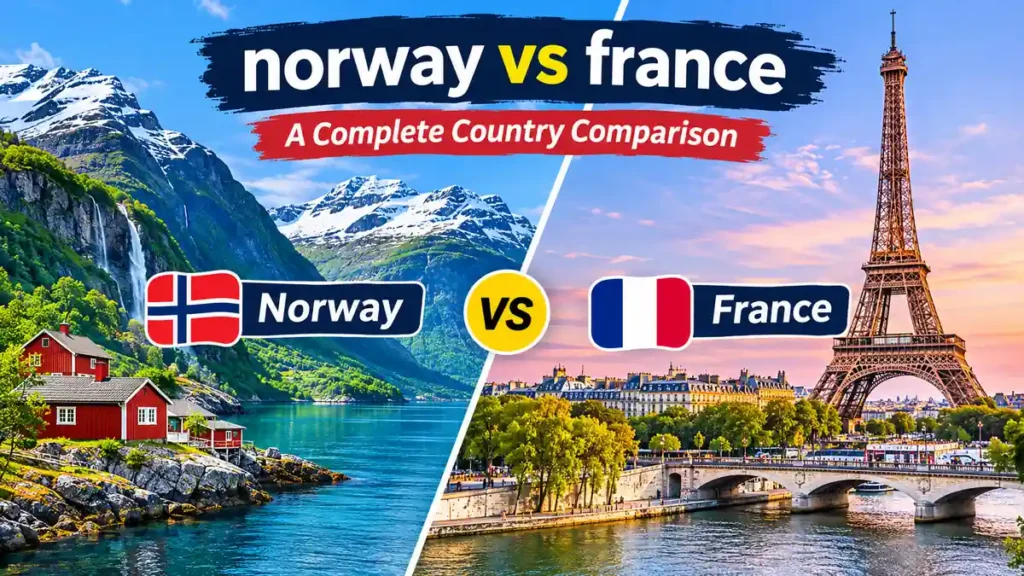
Norway and France are two of Europe’s most prosperous and influential countries, yet they offer remarkably different experiences. Norway is known for its dramatic fjords, high living standards, and Nordic welfare system, while France stands out for its cultural heritage, diverse landscapes, and major role in European politics.
The norway vs france comparison reveals two developed European nations with different strengths. Norway has a smaller population, substantial energy resources, and exceptionally high income per person. France has a much larger economy, greater population, extensive transport networks, and global cultural influence. Both offer strong public services and distinctive lifestyles.
Understanding these differences requires looking beyond tourism and national stereotypes. Geography, economic structure, employment, education, healthcare, climate, and government policies all help explain how the two countries compare.
Norway vs France: Quick Comparison
| Feature | Norway | France |
|---|---|---|
| Official name | Kingdom of Norway | French Republic |
| Capital | Oslo | Paris |
| Region | Northern Europe | Western Europe |
| Population | Approximately 5.6 million | Approximately 68–69 million |
| Mainland European area | About 324,000 km² | About 552,000 km² |
| Official language | Norwegian | French |
| Currency | Norwegian krone (NOK) | Euro (EUR) |
| Government | Constitutional monarchy | Semi-presidential republic |
| European Union membership | No | Yes |
| Schengen Area | Yes | Yes |
| NATO membership | Yes | Yes |
| Major industries | Oil, gas, hydropower, seafood, maritime services | Aerospace, tourism, manufacturing, luxury goods, agriculture |
| Climate | Cool temperate to subarctic | Oceanic, continental, Mediterranean, and alpine |
| Major cities | Oslo, Bergen, Trondheim, Stavanger | Paris, Marseille, Lyon, Toulouse |
| Famous landmarks | Geirangerfjord, Lofoten Islands, Northern Lights | Eiffel Tower, Louvre Museum, Palace of Versailles |
Population figures are rounded estimates; geographic area comparisons use mainland Norway and metropolitan France rather than all overseas territories.
The most obvious distinction is scale. France has more than twelve times Norway’s population and a significantly larger domestic market. Norway, however, has greater natural-resource wealth per resident and a smaller, more geographically dispersed population.
Both countries rank among highly developed economies, but their political systems, public finances, and social environments have evolved differently.
Geography and Natural Landscapes
I fiordi norvegesi in auto: itinerario di 2 settimane – Lonely Planet
Norway’s mountainous fjord landscape
Vente photo de la région de Provence – Photographies d’art de la Provence
France’s diverse countryside
Norway’s Geography
Norway occupies the western portion of the Scandinavian Peninsula and shares land borders with Sweden, Finland, and Russia. Its coastline extends along the North Atlantic Ocean and the Barents Sea.
The country is particularly famous for its fjords, deep valleys carved by glaciers and subsequently flooded by seawater.
Notable natural attractions include:
- Geirangerfjord, a UNESCO World Heritage landscape.
- Sognefjord, Norway’s longest and deepest fjord.
- Lofoten Islands, known for fishing villages and dramatic mountain scenery.
- Jotunheimen National Park, home to some of Northern Europe’s highest mountains.
- Svalbard, an Arctic archipelago with glaciers and distinctive wildlife.
Norway’s northern location also creates opportunities to experience the aurora borealis, commonly called the Northern Lights.
France’s Geography
France has a more varied geographic profile. Metropolitan France borders Belgium, Luxembourg, Germany, Switzerland, Italy, Monaco, Spain, and Andorra.
Its landscapes include the Alps, Pyrenees, Mediterranean coastline, Atlantic beaches, agricultural plains, and extensive river valleys.
Mont Blanc, situated on the French-Italian border, is among Western Europe’s highest mountains.
Major geographic features include the Seine, Loire, Rhône, and Garonne rivers. These waterways have played important roles in settlement, agriculture, trade, and industrial development.
Key difference: Norway is especially associated with rugged coastal and Arctic landscapes, while France offers a wider range of temperate, Mediterranean, alpine, and agricultural environments.
Norway vs France: Population and Demographics
Population size influences everything from housing demand to employment opportunities and public infrastructure.
Norway had approximately 5.61 million residents in 2025, according to World Bank data. France’s population was approximately 68–69 million.
Norway’s population is concentrated around major urban centers and the southern coastline. Large northern and inland regions have relatively low population densities.
France has a substantially larger urban network, with Paris serving as its leading metropolitan and economic center.
Urban Life and Population Distribution
Oslo is Norway’s capital and largest city. Bergen, Trondheim, and Stavanger are important regional centers, particularly for maritime industries, education, technology, and energy.
France has several major metropolitan areas beyond Paris. Lyon is associated with industry and gastronomy, Marseille with Mediterranean commerce, and Toulouse with aerospace engineering.
France’s larger population supports a broader domestic market, more extensive intercity transportation, and greater variation between regional economies.
Norway’s smaller population can support a different community environment, although major cities still face housing pressures and infrastructure challenges.
Neither population size nor density alone determines quality of life. Local employment, transport accessibility, housing affordability, and public services matter more for individual residents.
Economy, GDP, and Employment
The economic comparison between Norway and France illustrates the difference between overall economic scale and prosperity per resident.
2025 GDP per capita, current US dollars
$0$25K$50K$75K$100KNorwayFrance
Source: World Bank, 2025
According to World Bank figures for 2025, Norway’s nominal GDP was approximately $531 billion, compared with France’s $3.37 trillion. However, Norway’s GDP per capita was approximately $94,594, versus $48,986 for France. Data+1
These figures measure economic output, not average take-home pay. They also do not account fully for differences in living costs.
Norway’s Economy
Norway’s economy benefits significantly from petroleum and natural gas production in the North Sea and surrounding offshore areas.
Its major industries include energy, seafood, shipping, aquaculture, hydropower, maritime technology, and specialized manufacturing.
An especially important institution is the Government Pension Fund Global, managed by Norges Bank Investment Management. The fund invests Norway’s petroleum revenues internationally to support long-term public wealth.
This arrangement helps Norway manage revenue from finite natural resources, although petroleum prices, currency movements, and global financial markets still influence the economy.
France’s Economy
France has a much larger and more diversified economy.
Major sectors include aerospace, automotive manufacturing, pharmaceuticals, financial services, agriculture, tourism, energy, and luxury goods.
Internationally recognized French companies include Airbus, LVMH, Renault, and TotalEnergies.
France is also a major agricultural producer within the European Union, with significant output in cereals, dairy products, and wine.
Its economic challenges include public debt, fiscal pressures, unemployment, and differences in economic opportunities between regions.
Which Country Has Better Employment Opportunities?
The answer depends on qualifications, language ability, and professional specialization.
Norway can offer attractive opportunities in engineering, energy, maritime services, healthcare, and technology. However, its smaller labor market and Norwegian-language requirements can limit some positions.
France provides a larger selection of industries and metropolitan employment markets. French-language proficiency is important for many jobs, although international companies sometimes operate partly in English.
Norway generally offers higher nominal earnings, while France provides a broader range of industries and employers.
Cost of Living: Is Norway More Expensive Than France?
Yes. On average, Norway has higher consumer price levels than France, although differences depend on location and spending habits.
Statistics Norway’s European price comparison reports a 2025 household consumption price-level index of 128.6 for Norway and 110.3 for France, with the EU average set at 100. This puts Norway’s overall price level approximately 17% above France’s on that measure. SSB
| Expense | Norway | France |
|---|---|---|
| Groceries | Generally higher | Generally lower |
| Restaurant dining | Expensive | More varied price options |
| Alcohol | Particularly expensive | Generally less expensive |
| Public transport | Reliable, potentially costly | Extensive, varied pricing |
| Housing | High in major cities | Very high in Paris; varies elsewhere |
| Healthcare | Publicly supported, with some patient charges | Public insurance with reimbursement and supplementary coverage |
| Utilities | Sensitive to electricity prices and season | Varies by housing and energy contract |
Housing Costs
Housing expenses depend heavily on the city.
Oslo and Bergen have expensive rental markets relative to many smaller Norwegian towns. In France, central Paris is especially costly, while smaller cities and rural regions can offer substantially cheaper accommodation.
Comparing a central Paris apartment with a rural Norwegian property would therefore be misleading.
Purchasing Power
Higher salaries in Norway can offset part of its higher living costs.
For a meaningful comparison, consider net salary after taxes, housing expenses, transportation, childcare, and household size.
Purchasing power parity, or PPP, is useful because it adjusts economic comparisons for price differences.
World Bank figures for 2025 place Norway’s GDP per capita at approximately $104,044 in PPP terms, compared with $63,975 for France. Data
That does not mean every Norwegian household enjoys greater disposable income. Personal circumstances and income distribution still matter.
Healthcare and Education Systems
Both Norway and France maintain comprehensive public healthcare and education systems, but their funding and administration differ.
Healthcare in Norway
Norway operates a predominantly publicly funded healthcare system.
Residents generally access primary care through general practitioners, while regional health authorities organize specialist and hospital services.
Many medical services involve patient co-payments, with annual protection mechanisms for eligible expenses.
Norway invests heavily in healthcare. The OECD’s Health at a Glance 2025 reported health expenditure of approximately $9,393 per person in purchasing-power-adjusted terms, equivalent to 9.7% of GDP. OECD
The system offers broad coverage, although waiting times for non-emergency specialist treatment can be a concern.
Healthcare in France
France operates a statutory health insurance system commonly known as Assurance Maladie.
Patients typically receive reimbursement for covered medical expenses, and many residents use supplementary insurance, known as mutuelle, to reduce remaining costs.
France has an extensive network of public hospitals, private clinics, pharmacies, and medical professionals.
Access and waiting times vary by region, particularly in areas experiencing shortages of general practitioners or specialists.
Education in Norway
Norway provides publicly funded primary and secondary education.
Its education system emphasizes student development, inclusion, and broad access to learning.
Public higher education institutions generally charge tuition to many Norwegian and EU/EEA students, while students from outside the EU/EEA normally face tuition fees unless an exemption applies.
The University of Oslo and Norwegian University of Science and Technology are prominent higher education institutions.
Education in France
France also offers publicly funded schooling and an extensive higher education system.
Its universities coexist with selective institutions known as grandes écoles, which play important roles in engineering, business, public administration, and research.
Notable institutions include Sorbonne University, Université Paris-Saclay, and École Polytechnique.
Public university fees are often comparatively modest for eligible students, although international tuition rules, exemptions, and institutional policies vary.
Quick takeaway: Both countries provide strong educational and healthcare infrastructure. Norway emphasizes a predominantly tax-funded welfare model, while France combines statutory insurance, public provision, and supplementary coverage.
Norway vs France: Climate and Weather
Northern Lights Forecast in Tromsø | Tromsø App
Winter in northern Norway
French Riviera: Where To Stay And Things To Do – La Jolla Mom
Mediterranean climate in southern France
Climate is one of the most noticeable differences between the two countries.
Norway’s Climate
Norway’s climate varies dramatically with latitude, altitude, and distance from the sea.
Coastal regions benefit from the moderating influence of the North Atlantic Current, making some locations milder than their northern latitude might suggest.
Northern inland areas experience colder winters and larger seasonal temperature differences.
During summer, regions above the Arctic Circle can experience the midnight sun. During winter, some northern areas experience polar night, when the sun remains below the horizon.
Bergen is particularly known for frequent precipitation, while Oslo has more pronounced seasonal temperature changes.
France’s Climate
France experiences several climatic zones.
Western regions generally have an oceanic climate, with relatively mild temperatures and regular rainfall.
Eastern areas experience greater seasonal temperature variation. Mountain regions have alpine conditions, while the Mediterranean coast features hot, dry summers and comparatively mild winters.
Cities such as Nice and Marseille typically experience more sunshine than Paris or Lille.
Which Has Better Weather?
France is generally more suitable for people seeking warmer summers and milder Mediterranean winters.
Norway appeals to those who enjoy cooler temperatures, snow sports, dramatic seasonal light changes, and Arctic environments.
However, neither country has a uniform climate. Coastal Norway can be relatively mild, while high-altitude France can experience severe winter conditions.
Culture, Food, and Everyday Lifestyle
Cultural differences between Norway and France extend beyond cuisine and language.
Norwegian Culture
Norwegian society places considerable emphasis on outdoor recreation, social trust, personal independence, and work-life balance.
The concept of friluftsliv, meaning outdoor life, reflects the importance of spending time in nature.
Hiking, skiing, cycling, and cabin holidays are popular activities.
Traditional Norwegian foods include salmon, cod, brown cheese (brunost), and fårikål, a lamb-and-cabbage dish.
Norway also celebrates Constitution Day on May 17, marked by parades and community festivities.
French Culture
France is internationally recognized for its contributions to literature, philosophy, fashion, cinema, architecture, and gastronomy.
Food plays a central role in social life, with regional specialties ranging from Provençal dishes to Breton crêpes and Alpine cheeses.
French cuisine includes baguettes, croissants, ratatouille, coq au vin, and numerous regional cheeses.
The country’s cultural institutions include the Louvre Museum, Musée d’Orsay, and Palace of Versailles.
France celebrates its national day on July 14, commonly known in English as Bastille Day.
Language and Social Integration
Norwegian is the principal language used in public life in Norway, although English proficiency is widespread.
France primarily uses French, and the language remains particularly important in administration, education, employment, and everyday social interaction.
Learning the local language significantly improves long-term integration in either country.
Government, European Union, and International Relations
Norway and France are both parliamentary democracies in the broader sense of having elected legislatures, but their constitutional structures differ.
Norway is a constitutional monarchy with a parliamentary system. Its legislature is the Storting, and executive government is led by the prime minister.
France is a semi-presidential republic. Executive responsibilities are divided between the president and prime minister according to constitutional arrangements and political circumstances.
Is Norway Part of the European Union?
No. Norway is not an EU member.
However, it participates in the European Economic Area through the EEA Agreement, giving it access to much of the EU single market.
Norway is also part of the Schengen Area, which facilitates travel across participating European countries.
France is a founding member of the European integration project and belongs to the EU, eurozone, and Schengen Area.
Both countries are NATO members and participate in European security cooperation.
International Influence
France holds a permanent seat on the United Nations Security Council and possesses nuclear weapons. It is also a major diplomatic and military power.
Norway is internationally active in peace diplomacy, humanitarian assistance, energy cooperation, and Arctic affairs.
France generally exercises greater global geopolitical influence, while Norway has an important role in European energy security and regional diplomacy.
Tourism: Norway or France?
Lofoten Islands, Norway
Eiffel Tower (Paris) – Height & Construction Facts
Paris, France
Both countries are major European travel destinations, but they appeal to different interests.
Why Visit Norway?
Norway is particularly attractive for nature-focused travel.
Visitors can explore fjords, glaciers, mountain trails, fishing villages, and Arctic landscapes.
Popular experiences include:
- Exploring Geirangerfjord and Nærøyfjord.
- Visiting the Lofoten Islands.
- Watching the Northern Lights around Tromsø.
- Hiking to Preikestolen.
- Traveling on scenic railway routes.
- Experiencing Arctic wildlife and winter landscapes.
Norway’s travel expenses can be high, particularly for accommodation, restaurants, and organized excursions.
Why Visit France?
France offers an unusually broad combination of urban tourism, historic architecture, beaches, mountain resorts, and culinary experiences.
Popular destinations include Paris, the French Riviera, Provence, Normandy, Bordeaux, and the French Alps.
Travelers can visit major museums, historic castles, vineyards, coastal villages, and UNESCO World Heritage sites.
France’s high-speed TGV rail network also makes travel between major cities relatively convenient.
Which Country Is Better for Tourists?
Norway is especially suitable for visitors who prioritize dramatic landscapes, hiking, fjord cruises, and Arctic experiences.
France is generally better suited to travelers seeking art, museums, cuisine, architecture, historic cities, and varied regional destinations.
Both offer excellent outdoor activities, including skiing and mountain hiking.
Sports and Football: Norway vs France
Football is another prominent point of comparison between these European countries.
France has a considerably more successful history in international men’s football, while Norway has produced several internationally recognized players.
France’s Football Achievements
The French national team, commonly known as Les Bleus, has won the FIFA World Cup twice, in 1998 and 2018.
France also won the UEFA European Championship in 1984 and 2000.
Major French football figures include Zinedine Zidane, Thierry Henry, Antoine Griezmann, and Kylian Mbappé.
France has a well-established domestic football system, with Ligue 1 serving as its top professional division.
Norway’s Football Development
Norway’s national team has historically enjoyed less tournament success.
However, Norwegian football has produced notable players such as Erling Haaland, Martin Ødegaard, and former international striker John Carew.
Haaland’s goalscoring ability and Ødegaard’s technical quality have helped increase international interest in Norwegian football.
Norway’s domestic top division is the Eliteserien.
Norway vs France Head-to-Head Results
Historical head-to-head records show that France has generally held the advantage.
Notable matches include:
| Date | Match | Result |
|---|---|---|
| 16 June 1987 | Norway vs France | Norway won 2–0 |
| 25 February 1998 | France vs Norway | 3–3 draw |
| 11 August 2010 | Norway vs France | Norway won 2–1 |
| 27 May 2014 | France vs Norway | France won 4–0 |
| 26 June 2026 | Norway vs France | France won 4–1 |
The June 2026 FIFA World Cup match added another victory to France’s record. 11v11+1
France’s historical advantage reflects its greater tournament experience, deeper player pool, and long-established international football infrastructure.
Nevertheless, individual matches remain unpredictable, and Norway has demonstrated its ability to defeat France in previous encounters.
Quality of Life: Which Country Is Better?
Quality of life is influenced by income, healthcare, safety, housing, working conditions, environmental quality, and personal preferences.
Both Norway and France provide high living standards by international measures.
Norway is frequently associated with strong public institutions, relatively high earnings, social protection, and access to natural environments.
France offers extensive healthcare coverage, cultural amenities, developed public transportation, and greater geographic and economic variety.
Work-Life Balance
Norway’s working culture generally emphasizes predictable schedules, paid leave, and balancing professional responsibilities with personal life.
France also provides substantial employee protections, paid holidays, and a statutory 35-hour reference workweek for many employees, although actual working hours vary.
Both countries have employment regulations covering leave, working conditions, and workplace protections.
Family Life
Norway provides extensive parental leave arrangements and subsidized childcare, subject to eligibility rules.
France also maintains family benefits, childcare support, and public education services.
The better choice for a family depends on income, eligibility for benefits, housing, language, and access to childcare.
Safety and Social Conditions
Both countries are generally safe by international standards.
Norway is often associated with lower levels of violent crime and high social trust. France has a larger population and more varied urban environments, so local conditions differ considerably.
National averages should not replace research into specific cities or neighborhoods.
Final Verdict: norway vs france
The norway vs france comparison does not produce one universal winner. Each country has distinct advantages shaped by geography, economic development, culture, and public policy.
Norway stands out for its high GDP per capita, natural landscapes, energy wealth, and Nordic social model. It may appeal particularly to people who value outdoor recreation, smaller communities, and relatively high earnings.
France offers a much larger economy, broader cultural attractions, diverse climates, extensive transportation infrastructure, and a wider variety of urban environments.
For travelers, the choice often comes down to Norway’s fjords and Arctic scenery versus France’s historic cities, cuisine, and Mediterranean landscapes. For residents, practical factors such as employment, language, housing, and family needs are more important.
Ultimately, understanding the strengths and limitations of both countries provides a better basis for comparison than declaring either nation superior.