Need to convert a measurement from centimeters to feet but aren’t sure whether the answer should be in decimal feet or feet and inches? The distinction matters, especially when measuring height, furniture, or room dimensions.
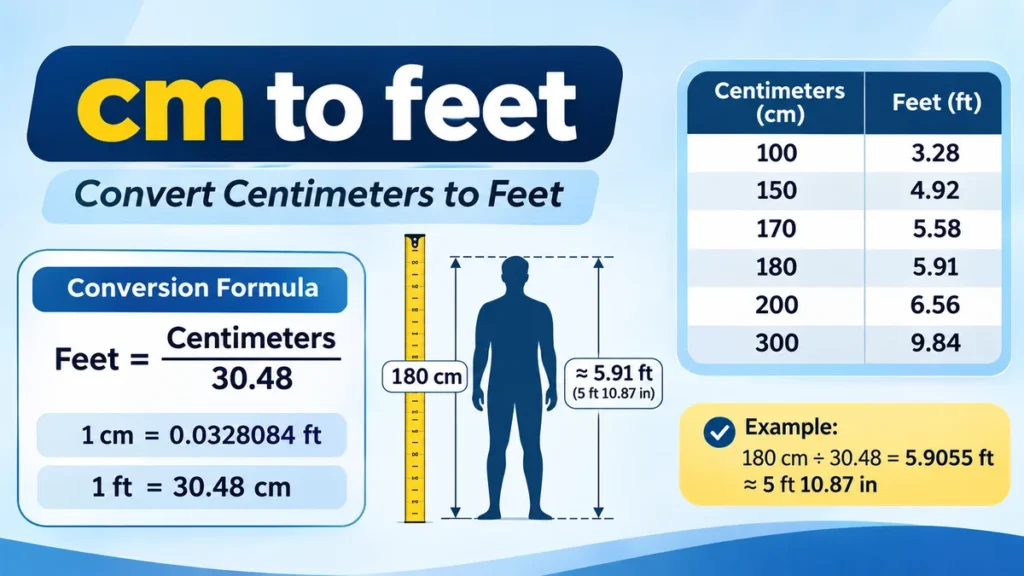
To convert cm to feet, divide the centimeter measurement by 30.48. One foot equals exactly 30.48 centimeters, so 1 centimeter equals approximately 0.0328084 feet. For example, 180 cm equals 5.9055 feet, or approximately 5 feet 10.87 inches. The formula works for any length measured in centimeters.
cm to feet Conversion Formula
The conversion from centimeters to feet uses a fixed relationship between two units of length in the metric and imperial measurement systems.
CONVERSION FORMULA
\[ \text{Feet}=\frac{\text{Centimeters}}{30.48} \]
1 centimeter
0.0328084 feet
1 foot
30.48 centimeters
To convert a measurement, follow three steps:
- Write down the length in centimeters.
- Divide that number by 30.48.
- Round the result to the number of decimal places needed.
For example, converting 150 cm:
\[ 150\div30.48=4.92126\text{ feet} \]
Therefore, 150 cm is approximately 4.92 feet.
The calculation is based on the international foot, which is defined as exactly 0.3048 meters. Since one meter contains 100 centimeters, one foot contains exactly 30.48 centimeters.
Interactive cm to feet Converter
Enter length in centimeters (cm)
cm
BothDecimal feetFeet & inches
Decimal feet
5.5774 ft
Feet and inches
5 ft 6.93 in
Calculated using 1 ft = 30.48 cm Copy
cm to feet Conversion Chart
A conversion chart makes it easier to check common measurements without performing the calculation each time.
The following table shows centimeter values converted into decimal feet, rounded to four decimal places.
| Centimeters (cm) | Feet (ft) |
|---|---|
| 1 | 0.0328 |
| 5 | 0.1640 |
| 10 | 0.3281 |
| 15 | 0.4921 |
| 20 | 0.6562 |
| 25 | 0.8202 |
| 30 | 0.9843 |
| 40 | 1.3123 |
| 50 | 1.6404 |
| 60 | 1.9685 |
| 70 | 2.2966 |
| 80 | 2.6247 |
| 90 | 2.9528 |
| 100 | 3.2808 |
| 120 | 3.9370 |
| 150 | 4.9213 |
| 160 | 5.2493 |
| 170 | 5.5774 |
| 180 | 5.9055 |
| 190 | 6.2336 |
| 200 | 6.5617 |
| 250 | 8.2021 |
| 300 | 9.8425 |
These values are useful for comparing metric measurements with feet used in the United States and other places where imperial or US customary units are common.
Common centimeter conversions
Some measurements appear frequently in height charts, furniture specifications, and construction plans.
100 cm
3.28 ft
150 cm
4.92 ft
170 cm
5.58 ft
180 cm
5.91 ft
200 cm
6.56 ft
300 cm
9.84 ft
How to Convert cm to Feet and Inches
Decimal feet and feet-and-inches notation describe the same length, but they use different formats.
For example, 5.5 feet means 5 feet and 6 inches, not 5 feet and 5 inches. This is because each foot contains 12 inches rather than 10.
To convert centimeters into feet and inches:
- Divide the centimeter measurement by 2.54 to obtain total inches.
- Divide the total inches by 12.
- Use the whole number as the feet measurement.
- Convert the remaining fraction into inches.
Example: Convert 175 cm to feet and inches
First, convert centimeters to inches:
\[ 175\div2.54=68.8976\text{ inches} \]
Next, divide by 12:
\[ 68.8976\div12=5.7415\text{ feet} \]
The whole-number portion is 5 feet. Subtract 60 inches from the total:
\[ 68.8976-60=8.8976\text{ inches} \]
Result: 175 cm is approximately 5 feet 8.90 inches, commonly rounded to 5 feet 9 inches.
Decimal feet vs. feet and inches
| Decimal feet | Feet and inches |
|---|---|
| 5.25 ft | 5 ft 3 in |
| 5.50 ft | 5 ft 6 in |
| 5.75 ft | 5 ft 9 in |
| 6.00 ft | 6 ft 0 in |
| 6.50 ft | 6 ft 6 in |
Decimal feet are useful in calculations, while feet-and-inches notation is often more familiar for human height, household measurements, and building dimensions.
Height Conversion: cm to feet for Common Heights
Human height is one of the most common reasons people convert centimeters to feet.
Medical records, school measurements, and international documents often use centimeters, while everyday conversations in the United States commonly express height in feet and inches.
For example, someone measuring 170 cm tall may describe their height as approximately 5 feet 7 inches.
Centimeters to feet height chart
| Height (cm) | Decimal feet | Feet and inches (rounded) |
|---|---|---|
| 140 | 4.5932 | 4 ft 7 in |
| 145 | 4.7572 | 4 ft 9 in |
| 150 | 4.9213 | 4 ft 11 in |
| 155 | 5.0853 | 5 ft 1 in |
| 160 | 5.2493 | 5 ft 3 in |
| 165 | 5.4134 | 5 ft 5 in |
| 170 | 5.5774 | 5 ft 7 in |
| 175 | 5.7415 | 5 ft 9 in |
| 180 | 5.9055 | 5 ft 11 in |
| 185 | 6.0696 | 6 ft 1 in |
| 190 | 6.2336 | 6 ft 3 in |
| 195 | 6.3976 | 6 ft 5 in |
| 200 | 6.5617 | 6 ft 7 in |
The feet-and-inches column rounds to the nearest whole inch. More precise results may contain fractional inches.
Is 170 cm equal to 5 feet 7 inches?
170 cm equals approximately 5 feet 6.93 inches, which rounds to 5 feet 7 inches.
The equivalent decimal measurement is 5.5774 feet.
Is 180 cm equal to 6 feet?
No. A height of 180 cm equals approximately 5 feet 10.87 inches, commonly rounded to 5 feet 11 inches.
Exactly 6 feet equals 182.88 cm.
This small difference is worth remembering when comparing height measurements.
Understanding Centimeters, Feet, and Inches
Centimeters and feet both measure length, but they belong to different measurement systems.
What is a centimeter?
A centimeter is a metric unit of length equal to one-hundredth of a meter.
The abbreviation is cm, and its relationship to other metric units is straightforward:
- 1 centimeter = 10 millimeters
- 100 centimeters = 1 meter
- 1 centimeter = approximately 0.393701 inches
The centimeter is derived from the meter, the SI base unit of length maintained within the International System of Units by organizations including the International Bureau of Weights and Measures (BIPM).
Centimeters are commonly used for measuring body height, clothing dimensions, furniture, and smaller objects.
What is a foot?
A foot is a unit of length used in the imperial and US customary measurement systems.
Its abbreviation is ft, and it has the following relationships:
- 1 foot = 12 inches
- 1 foot = 30.48 centimeters
- 1 foot = 0.3048 meters
- 3 feet = 1 yard
- 5,280 feet = 1 mile
The modern international foot was standardized in 1959 through an agreement involving several English-speaking countries.
The US National Institute of Standards and Technology (NIST) documents the international foot and its relationship to SI units.
The exact conversion factor means that converting centimeters into feet does not inherently introduce measurement error. Differences arise only when results are rounded. metric-conversions.org+1
Metric vs. imperial length measurements
| Metric measurement | Imperial/US customary equivalent |
|---|---|
| 1 mm | 0.03937 in |
| 1 cm | 0.39370 in |
| 10 cm | 3.93701 in |
| 30.48 cm | 1 ft |
| 1 m | 3.28084 ft |
| 1 km | 3,280.84 ft |
The metric system uses powers of ten, making conversions between millimeters, centimeters, and meters relatively simple.
The imperial and US customary systems use relationships such as 12 inches per foot and 3 feet per yard.
How to Convert Feet Back to Centimeters
The reverse conversion is just as straightforward.
Instead of dividing by 30.48, multiply the feet measurement by 30.48.
\[ \text{Centimeters}=\text{Feet}\times30.48 \]
For example, converting 6 feet into centimeters:
\[ 6\times30.48=182.88\text{ cm} \]
Therefore, 6 feet equals exactly 182.88 centimeters.
For a measurement containing both feet and inches, convert each component separately.
Suppose a person’s height is 5 feet 8 inches.
First, convert feet to centimeters:
\[ 5\times30.48=152.4\text{ cm} \]
Then convert inches:
\[ 8\times2.54=20.32\text{ cm} \]
Add the results:
\[ 152.4+20.32=172.72\text{ cm} \]
Thus, 5 feet 8 inches equals exactly 172.72 cm.
Quick Estimation and Common Conversion Mistakes
For everyday situations, an approximate result may be sufficient. However, precise conversions are preferable when measurements affect fit, clearance, or calculations.
How to estimate cm to feet without a calculator
A convenient mental shortcut is to divide centimeters by 30 instead of 30.48.
For example:
\[ 180\div30=6\text{ feet} \]
The exact result is approximately 5.9055 feet.
The shortcut slightly overestimates the length by about 1.6%, so it should only be used for rough estimates.
Another method is to multiply centimeters by 0.033.
For 150 cm:
\[ 150\times0.033=4.95\text{ feet} \]
The exact answer is approximately 4.9213 feet.
Both approaches are helpful for quick mental calculations, but neither replaces the exact conversion factor.
Mistake 1: Treating decimal feet as feet and inches
A measurement of 5.8 feet does not mean 5 feet 8 inches.
To convert the decimal portion:
\[ 0.8\times12=9.6\text{ inches} \]
Therefore, 5.8 feet equals 5 feet 9.6 inches.
Mistake 2: Multiplying by 30.48 instead of dividing
When converting centimeters to feet, always divide by 30.48.
Multiplication is used for the reverse conversion, from feet to centimeters.
Mistake 3: Rounding too early
Consider a measurement of 182 cm.
Its decimal equivalent is approximately 5.9711 feet.
Rounding immediately to 6 feet may be acceptable for a rough estimate, but it loses information.
For accurate work, retain additional decimal places until the final calculation.
Mistake 4: Confusing inches with centimeters
One inch equals exactly 2.54 cm, not 2.5 cm.
Using 2.5 instead of 2.54 repeatedly can create noticeable differences in larger measurements.
How many decimal places should you use?
The appropriate precision depends on the purpose.
| Application | Suggested precision |
|---|---|
| Casual height comparison | Nearest inch |
| General furniture dimensions | 1–2 decimal places in feet |
| Classroom calculations | As required by the problem |
| Construction measurements | Precision required by the plan |
| Scientific calculations | Appropriate significant figures |
A conversion can be mathematically exact even when the original measurement is approximate. Reporting excessive digits does not make the original measurement more precise.
Practical Uses of cm to feet Conversion
Understanding centimeter-to-foot conversions is useful beyond personal height.
Furniture and interior design
Furniture specifications may be listed in centimeters, while room dimensions are recorded in feet.
For example, a wardrobe measuring 200 cm tall is approximately 6.56 feet high.
Converting both measurements into the same unit helps determine whether furniture will fit beneath a ceiling or inside a particular space.
For actual installation, allow for assembly clearance and other physical constraints rather than relying solely on rounded dimensions.
Construction and architecture
Architectural drawings may use meters or centimeters, while contractors work with feet and inches.
A wall measuring 300 cm high is approximately 9.84 feet, or 9 feet 10.11 inches.
Using consistent units helps prevent errors when comparing drawings, calculating dimensions, and checking material requirements.
Sports and fitness
Athlete heights may be published in different measurement systems depending on the country or organization.
Converting centimeters to feet makes international height comparisons easier.
For example, a basketball player listed at 198 cm is approximately 6 feet 5.95 inches, commonly rounded to 6 feet 6 inches.
Education and mathematics
Length conversion problems help students understand unit relationships, multiplication, division, and dimensional analysis.
One useful approach is to write the units directly into the calculation:
\[ 150\text{ cm}\times\frac{1\text{ ft}}{30.48\text{ cm}} \]
The centimeter units cancel, leaving the result in feet.
This technique also works for converting meters to feet, inches to centimeters, and many other physical quantities.
Final Thoughts on cm to feet Conversion
Converting cm to feet requires one simple calculation: divide the centimeter value by 30.48.
For measurements expressed as feet and inches, convert centimeters to total inches using 2.54, then separate the result into whole feet and remaining inches.
Remember these essential relationships: 1 foot equals exactly 30.48 cm, 1 inch equals exactly 2.54 cm, and 12 inches make 1 foot.
Use the conversion chart for common measurements or the calculator above for any custom value. For accurate results, keep the original measurement’s precision in mind and round only after completing the calculation.