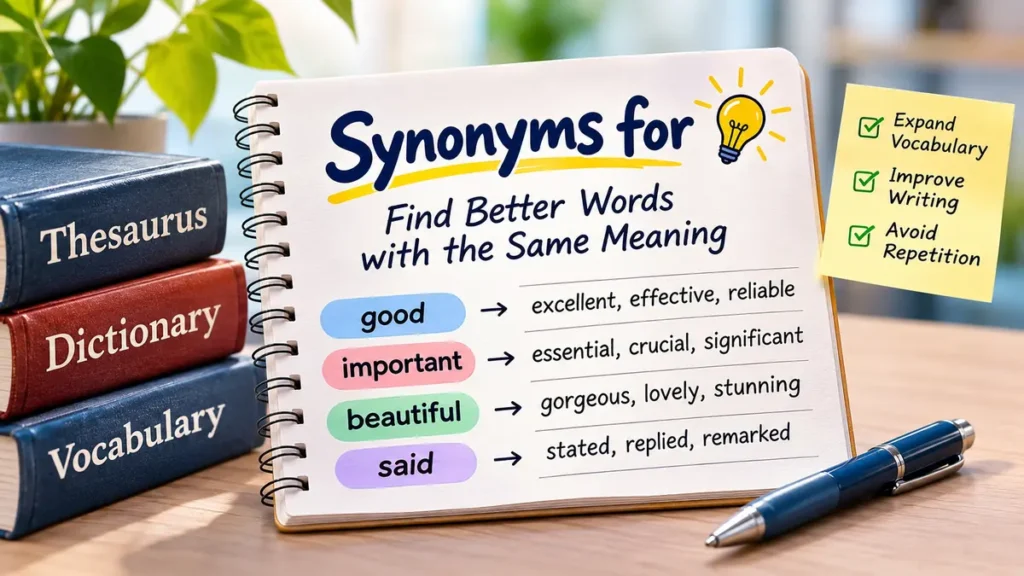
Searching for “synonyms for” is often the first step toward finding a better word. You might be writing an essay, editing an email, improving a resume, or trying to avoid repeating the same expression. The challenge isn’t simply finding another word. It’s choosing one that communicates exactly what you mean.
Synonyms are words or expressions that have the same or nearly the same meaning as another word. For example, happy has synonyms such as joyful, cheerful, and delighted. However, these alternatives differ in intensity, tone, and context. The most suitable synonym preserves the intended meaning while making a sentence clearer and more natural.
This guide explains how synonyms work, where to find them, and how to select alternatives that fit different writing situations.
What Does “synonyms for” Mean?
The phrase “synonyms for” introduces a request for words that have similar meanings to a particular word or expression.
For example:
- Synonyms for beautiful: attractive, gorgeous, lovely, stunning.
- Synonyms for important: significant, essential, crucial, meaningful.
- Synonyms for good: excellent, positive, beneficial, satisfactory.
- Synonyms for said: stated, replied, remarked, explained.
- Synonyms for happy: cheerful, joyful, delighted, pleased.
The phrase normally requires another word after “for.” When someone searches for “synonyms for,” they are generally looking for a dictionary, thesaurus, or vocabulary resource that helps them discover alternative wording.
What is the difference between a synonym and an antonym?
A synonym has a similar meaning, while an antonym expresses an opposite meaning.
| Word | Synonyms | Antonyms |
|---|---|---|
| Happy | Joyful, cheerful | Sad, unhappy |
| Fast | Quick, rapid | Slow, sluggish |
| Beautiful | Lovely, attractive | Ugly, unattractive |
| Strong | Powerful, sturdy | Weak, fragile |
| Easy | Simple, straightforward | Difficult, complicated |
| Brave | Courageous, fearless | Cowardly, timid |
| Quiet | Silent, peaceful | Loud, noisy |
Understanding both relationships makes vocabulary more flexible and helps writers recognize subtle differences between words.
Common synonyms for Everyday English Words
English contains numerous alternatives for frequently used words. Some are interchangeable in particular sentences, while others communicate a different degree of emotion, formality, or precision.
Synonyms for good
The word good can describe quality, behavior, results, or usefulness.
| Alternative | Best used when |
|---|---|
| Excellent | Something is exceptionally high quality |
| Outstanding | Something performs especially well |
| Beneficial | Something produces a positive effect |
| Reliable | Something can be depended upon |
| Satisfactory | Something meets expectations |
| Admirable | Someone’s behavior deserves respect |
| Effective | Something achieves its intended result |
For example, instead of writing “The new policy is good,” you might write “The new policy is effective” if it produces the desired outcome.
Synonyms for important
The word important is common in academic and professional writing, but more precise alternatives often improve clarity.
- Essential: Absolutely necessary.
- Crucial: Extremely important to an outcome.
- Significant: Meaningful or worthy of attention.
- Vital: Necessary for success, functioning, or survival.
- Fundamental: Forming the foundation of something.
- Influential: Capable of affecting decisions or outcomes.
- Noteworthy: Deserving particular attention.
Compare “Sleep is important for health” with “Sleep is essential for maintaining physical and mental health.” The second sentence communicates a stronger relationship.
Synonyms for beautiful
The best alternative depends on whether you’re describing a person, place, object, experience, or artistic creation.
| Synonym | Typical meaning |
|---|---|
| Gorgeous | Strikingly beautiful |
| Elegant | Graceful and refined |
| Stunning | Exceptionally impressive |
| Lovely | Pleasantly attractive |
| Picturesque | Visually charming, especially scenery |
| Exquisite | Delicately or exceptionally beautiful |
| Radiant | Appearing bright or glowing |
| Breathtaking | Beautiful enough to inspire amazement |
A picturesque village, an elegant design, and a breathtaking mountain view all express beauty in different ways.
Synonyms for said
Dialogue and reported speech benefit from carefully chosen reporting verbs.
Common alternatives include stated, explained, replied, mentioned, remarked, announced, whispered, and shouted.
However, these words are not universally interchangeable.
“She whispered the answer” indicates quiet speech, whereas “She announced the answer” suggests a public or emphatic statement.
In fiction, said is often preferable because it is unobtrusive. Replacing every instance can make dialogue feel unnatural.
Types of Synonyms in English
Not all synonyms have exactly the same meaning. Linguistics distinguishes several kinds of semantic relationships.
Absolute synonyms
Absolute synonyms would have identical meanings in every context without changing the message, style, or implications.
True absolute synonyms are extremely rare because words typically differ in usage, register, connotation, or specialized meaning.
Even apparently equivalent expressions may not be interchangeable in every sentence.
Partial synonyms
Partial synonyms share a substantial part of their meanings but differ in certain contexts.
For example, big and large are close synonyms.
- A big house.
- A large house.
Both sentences sound natural.
But “a big mistake” is more idiomatic than “a large mistake.” This demonstrates why context matters.
Near synonyms
Near synonyms express related ideas but may differ noticeably in intensity or emotional meaning.
Consider angry, annoyed, furious, and irritated.
These words all relate to displeasure, but furious suggests much stronger emotion than annoyed.
Using a stronger synonym than the situation warrants can distort the message.
Contextual synonyms
Contextual synonyms are expressions that can replace each other within a particular sentence, even though their meanings are not identical in general.
For example:
“The room was cold.”
“The room was chilly.”
Both may describe the same situation, although chilly usually suggests a moderately uncomfortable temperature.
Context determines whether a substitution works.
How to Find Accurate synonyms for Any Word
Finding alternatives is easy. Identifying the right one requires attention to meaning, grammar, and tone.
Follow these five steps:
- Identify the original meaning. Determine what the word communicates in its sentence. A word such as bright might describe intelligence, light, or color.
- Consult a reliable thesaurus. Look for alternatives grouped by meaning rather than selecting the first result.
- Check the dictionary definition. Confirm that the alternative expresses the intended idea.
- Compare tone and intensity. Decide whether the replacement sounds formal, informal, neutral, emotional, or technical.
- Read the revised sentence aloud. Check whether the word sounds natural and fits grammatically.
For instance, consider:
“The scientist made a big discovery.”
Possible alternatives for big include large, major, significant, and substantial.
“The scientist made a significant discovery” is more natural in academic writing than “The scientist made a large discovery.”
The best choice depends on the noun being modified, not just the dictionary definition.
Best Online Tools for Finding Synonyms
Several established reference resources help readers explore word meanings and alternatives.
Thesaurus.com
Thesaurus.com offers synonym and antonym lists organized around different meanings. It is useful for exploring alternatives quickly, particularly for common English words.
Merriam-Webster
The Merriam-Webster Thesaurus provides definitions, synonyms, related words, and distinctions between different senses.
Its dictionary entries can help confirm whether a suggested replacement fits the sentence.
Cambridge Dictionary
The Cambridge Dictionary includes definitions, usage examples, and thesaurus-style resources. It is particularly helpful for English learners who need to understand how words appear in real sentences.
Oxford Learner’s Dictionaries
Oxford Learner’s Dictionaries provides learner-focused definitions, pronunciation guidance, and examples that help distinguish related vocabulary.
WordHippo
WordHippo helps users explore synonyms, antonyms, word forms, and related vocabulary.
No single tool can determine the best word for every sentence. A thesaurus generates candidates; a dictionary and the surrounding context help validate them.
How to Use Synonyms in Different Types of Writing
Choosing alternative words can improve readability, but the appropriate vocabulary depends on the audience and purpose.
Academic writing
Academic writing generally benefits from precision, neutrality, and clear relationships between ideas.
| Common word | Academic alternative | Example |
|---|---|---|
| Show | Demonstrate, indicate | The results indicate a clear pattern. |
| Help | Assist, facilitate | The program facilitates learning. |
| Think | Consider, hypothesize | Researchers hypothesize that temperature affects growth. |
| Use | Employ, utilize | The study employed a qualitative method. |
| Find | Identify, discover | The researchers identified three factors. |
| Change | Modify, alter | The treatment altered the response. |
| Explain | Clarify, illustrate | The findings illustrate the relationship. |
More formal vocabulary is not automatically better. For example, use is usually clearer than utilize unless the latter communicates a specific distinction.
Professional emails and business communication
Business writing benefits from direct, courteous language.
Instead of “I want information,” write “I would appreciate more information.”
Instead of “We need to fix this problem,” write “We need to resolve this issue.”
Instead of “Tell me your decision,” write “Please let me know your decision.”
These changes can soften the tone without changing the underlying request.
However, excessively formal language can sound distant. A straightforward sentence is often more effective than one filled with elaborate synonyms.
Creative writing and storytelling
Creative writing uses vocabulary to create imagery, establish atmosphere, and reveal emotion.
Consider the sentence:
“The man walked into the room.”
Different verbs produce different impressions:
- “The man strolled into the room” suggests a relaxed movement.
- “The man rushed into the room” suggests urgency.
- “The man crept into the room” suggests secrecy or caution.
- “The man staggered into the room” suggests difficulty maintaining balance.
These are not exact synonyms for walked. They are more specific movement verbs.
This distinction matters because descriptive writing often improves through precision rather than simple word replacement.
Resume and cover letter writing
Action verbs help describe professional responsibilities and accomplishments.
| General expression | More specific alternative |
|---|---|
| Worked on | Developed, contributed to |
| Helped manage | Coordinated, supported |
| Made | Created, produced |
| Improved | Enhanced, optimized |
| Led | Directed, supervised |
| Checked | Reviewed, evaluated |
| Started | Initiated, launched |
Choose verbs that accurately represent your contribution. For example, led should not replace assisted unless you genuinely directed the work.
Understanding Connotation, Denotation, and Word Choice
Two words can share a dictionary definition while creating different impressions.
Denotation refers to a word’s direct meaning. Connotation refers to the additional associations or feelings that the word may suggest.
Consider these three adjectives:
- Slim often has a positive association.
- Thin is relatively neutral in many contexts.
- Skinny can sound negative or informal.
All three may describe a person with relatively little body fat, but they are not equally appropriate in every situation.
Positive, negative, and neutral synonyms
| Neutral word | More positive expression | More negative expression |
|---|---|---|
| Confident | Self-assured | Arrogant |
| Careful | Thorough | Overcautious |
| Inexpensive | Affordable | Cheap |
| Unusual | Distinctive | Strange |
| Persistent | Determined | Stubborn |
| Talkative | Sociable | Long-winded |
These words overlap in meaning but do not always describe exactly the same qualities. A positive or negative alternative may introduce a judgment absent from the original sentence.
Formal and informal synonyms
Register describes the level of formality associated with language.
For example:
| Informal | Neutral or formal |
|---|---|
| Kid | Child |
| Buy | Purchase |
| Ask for | Request |
| Find out | Discover |
| Put off | Postpone |
| Get | Obtain |
| Talk about | Discuss |
Formal alternatives are useful in certain contexts, but natural language should remain the priority.
A sentence such as “Please obtain some water” may sound unnecessarily formal in an ordinary conversation.
Can Every Word Be Replaced With a Synonym?
No. Some words have highly specialized meanings, and others appear in expressions where substitution changes the meaning or produces unnatural language.
Words with multiple meanings
The word light demonstrates why dictionary senses matter.
| Meaning | Suitable alternatives |
|---|---|
| Not heavy | Lightweight |
| Not intense | Mild, gentle |
| Brightness | Illumination |
| Pale in color | Pale, faint |
| To ignite | Kindle, ignite |
A synonym that works for one meaning may be completely unsuitable for another.
For example, “a light suitcase” can become “a lightweight suitcase,” but “light a candle” cannot become “lightweight a candle.”
Idioms and fixed expressions
An idiom is an expression whose meaning cannot always be understood by interpreting its individual words literally.
Consider “break the ice.”
Replacing break with shatter produces “shatter the ice,” which does not normally carry the same idiomatic meaning.
Similarly, “make a decision” is natural, but “create a decision” is generally not.
These combinations are called collocations: words that commonly occur together.
Technical and scientific terminology
In medicine, law, engineering, and science, closely related terms may have distinct definitions.
For example, accuracy and precision are sometimes treated as everyday synonyms, but they have different technical meanings in measurement.
Accuracy concerns closeness to a correct or reference value. Precision concerns consistency among repeated measurements.
Replacing one with the other in a scientific report can create a factual error.
The same caution applies to legal terms, mathematical concepts, and specialized industry vocabulary.
Common Mistakes When Looking for synonyms for Words
A thesaurus is helpful, but using it without considering context can weaken writing.
Choosing the most complicated alternative
Writers sometimes assume that longer words sound more intelligent.
For example:
Original: “The teacher used a simple method.”
Unnecessarily complicated: “The educator utilized an uncomplicated methodology.”
Improved: “The teacher used a straightforward method.”
The improved sentence preserves the meaning without introducing unnecessary complexity.
Ignoring grammatical differences
Synonyms must fit the grammatical structure of a sentence.
For example, decision and decide are related, but one is a noun and the other is a verb.
Correct: “They made a decision.”
Correct: “They decided.”
Incorrect: “They made a decide.”
A good synonym search should account for the word’s part of speech, including nouns, verbs, adjectives, and adverbs.
Changing emotional intensity
Replacing concerned with terrified significantly increases the emotional intensity.
Similarly, disappointed and devastated do not express the same degree of distress.
Choose alternatives that reflect the actual situation rather than making a statement more dramatic.
Replacing words simply to avoid repetition
Repetition is not always a problem.
In instructional writing, repeating an important technical term may improve clarity.
For example, a guide about a computer’s processor should not repeatedly replace processor with unrelated expressions merely to create variety.
Consistency is particularly important when explaining complex subjects.
How Synonyms Help Improve Vocabulary and Communication
Learning synonyms develops more than a larger vocabulary. It improves the ability to distinguish meanings and communicate accurately.
Build vocabulary through word families
Rather than memorizing isolated alternatives, group related words by meaning.
For example, consider vocabulary associated with happiness:
| Word | Meaning or intensity |
|---|---|
| Content | Quietly satisfied |
| Pleased | Happy about something |
| Cheerful | Noticeably positive and happy |
| Joyful | Experiencing strong happiness |
| Delighted | Very pleased |
| Ecstatic | Extremely happy or excited |
These differences help speakers express their feelings more precisely.
Learn words through example sentences
A dictionary definition explains meaning, but an example demonstrates usage.
Consider rapid and quick.
“The company experienced rapid growth” sounds natural.
“She gave a quick answer” also sounds natural.
Although rapid and quick are related, they have different common collocations.
Studying example sentences makes these distinctions easier to recognize.
Practice replacing words without changing meaning
A useful exercise involves rewriting one sentence using several alternatives.
Original sentence:
“The movie was very interesting.”
Possible revisions:
“The movie was fascinating.”
“The movie was engaging.”
“The movie was captivating.”
Each version emphasizes a slightly different quality.
Fascinating suggests strong intellectual interest, engaging suggests sustained attention, and captivating suggests an ability to hold someone’s attention completely.
This exercise develops awareness of nuance rather than encouraging random substitution.
Use context to remember new vocabulary
Vocabulary is easier to apply when it is learned in meaningful situations.
Instead of memorizing ten alternatives for angry, write sentences that demonstrate their differences.
For example:
“She was irritated by the noise.”
“He was furious about the unfair decision.”
“They were annoyed by the delay.”
This approach connects vocabulary with situations and helps prevent inappropriate word choices.
Synonyms, Related Words, and Other Language Relationships
A thesaurus may display several kinds of related vocabulary. Understanding these relationships helps avoid confusion.
| Relationship | Definition | Example |
|---|---|---|
| Synonym | Similar meaning | Happy / joyful |
| Antonym | Opposite meaning | Happy / sad |
| Homonym | Same spelling or pronunciation, different meaning | Bank (financial institution / riverbank) |
| Homophone | Same pronunciation, different meaning | Sea / see |
| Homograph | Same spelling, potentially different pronunciation or meaning | Lead (metal / to guide) |
| Hypernym | Broader category term | Animal / dog |
| Hyponym | More specific category member | Dog / animal |
Hypernyms and hyponyms are particularly useful when organizing concepts.
For example, vehicle is a hypernym of car, while car is a hyponym of vehicle.
These are hierarchical relationships, not synonym relationships.
Linguists study such connections through lexical semantics, the field concerned with word meanings and their relationships.
Using Synonyms for Better Search and Research
Synonyms also help when searching for information online.
A researcher investigating “car safety” might find useful information through related expressions such as “vehicle safety,” “automobile safety,” or “road vehicle protection.”
However, these phrases do not necessarily produce identical search results.
Different wording may emphasize different concepts, audiences, or technical definitions.
Search using meaning rather than repetition
When a search does not return useful information, try:
- Identifying the central concept.
- Replacing a broad term with a more specific one.
- Searching for established alternative terminology.
- Adding context that clarifies the intended meaning.
- Comparing sources to confirm that the results address the same subject.
For example, someone researching “ways to save electricity” could also explore “reduce energy consumption” and “household energy efficiency.”
These related expressions broaden the research without requiring exact synonymy.
Are synonyms and keywords the same thing?
No. A keyword is a word or phrase used to represent a topic or search query. A synonym is a word or expression with a similar meaning to another.
Some keywords are synonyms, but many are broader topics, narrower concepts, questions, or related expressions.
For instance, “running shoes” and “athletic footwear” overlap in meaning, while “how to choose running shoes” is a related informational query rather than a synonym.
Understanding this distinction is useful in research, writing, and information retrieval.
Final Thoughts on Finding synonyms for Any Word
Finding synonyms is about communicating meaning accurately, not simply replacing familiar words with more sophisticated ones.
A reliable approach combines a thesaurus, dictionary definitions, example sentences, and an understanding of context. Pay particular attention to connotation, formality, grammatical function, and common word combinations.
The next time you search for “synonyms for” a particular word, begin by identifying what that word means in your sentence. Then compare a few alternatives and choose the one that communicates your idea most clearly.
The strongest vocabulary is not necessarily the most complicated. It is the vocabulary that expresses exactly what you intend.