The phrase “what is” appears in everyday conversations, classroom questions, online searches, and professional discussions. It is one of the most common ways English speakers ask for information, explanations, definitions, and clarification.
But what does “what is” actually mean, and how should you use it?
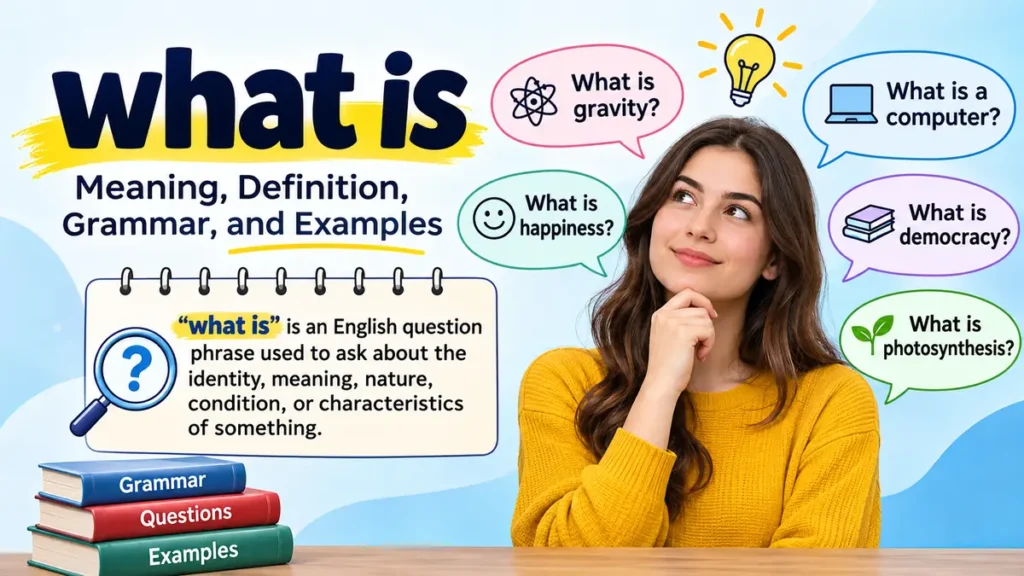
“What is” is an English question phrase formed from the interrogative word “what” and the present-tense verb “is.” It is used to ask about the identity, meaning, nature, condition, or characteristics of something. For example, “What is gravity?” asks for an explanation of a scientific concept.
Understanding this phrase helps English learners ask clearer questions, recognize different question structures, and communicate more naturally.
What Is the Meaning of “what is”?
The expression “what is” introduces a question that asks someone to identify, define, describe, or explain something.
The word “what” requests information, while “is” connects the subject of the question to its identity, description, or state.
Consider these examples:
- What is your name?
- What is the weather like?
- What is the meaning of happiness?
- What is a computer?
- What is happening outside?
Although each question begins with the same two words, the information requested differs.
“What is your name?” asks for identification. “What is a computer?” asks for a definition. “What is happening outside?” asks about an ongoing event.
The grammatical role of “what”
“What” is an interrogative word. Depending on its position and function, it can act as a pronoun or determiner.
As an interrogative pronoun, it can stand for information the speaker does not know:
“What is inside the box?”
As an interrogative determiner, it appears before a noun:
“What color is the box?”
In both cases, the speaker is requesting specific information.
The grammatical role of “is”
“Is” is the third-person singular present-tense form of the verb “be.”
It commonly appears with singular subjects such as “he,” “she,” “it,” or a singular noun.
Examples include:
- The sky is blue.
- She is a teacher.
- The answer is correct.
- The machine is working.
In questions beginning with “what is,” the verb often appears before the subject, following the usual English pattern for direct questions.
How Is “what is” Used in English Grammar?
English speakers use this phrase in several grammatical constructions.
Understanding these patterns makes it easier to form accurate questions.
Asking for a definition
One of its most familiar uses is requesting the meaning of a word, expression, or concept.
Examples:
- What is democracy?
- What is artificial intelligence?
- What is photosynthesis?
- What is a metaphor?
These questions usually expect an explanation rather than a simple yes-or-no answer.
For instance:
Question: What is photosynthesis?
Answer: Photosynthesis is the process through which plants, algae, and certain bacteria use light energy to produce chemical energy.
The question identifies a subject, while the answer explains its meaning.
Asking for identification
The phrase also helps identify an unfamiliar object, person, sound, or situation.
Examples:
- What is that building?
- What is this device?
- What is the noise upstairs?
- What is your favorite book?
The response identifies the requested information.
Asking about a condition or state
Questions beginning with “what is” can also request information about a situation.
For example:
“What is the problem?”
This question asks someone to explain an issue.
“What is the current temperature?”
This asks for a measurable condition.
“What is the difference between these methods?”
This requests a comparison.
Asking about an ongoing action
When followed by a subject and a verb ending in “-ing,” the construction can form a present continuous question.
Examples:
- What is she reading?
- What is the dog doing?
- What is happening?
- What is the company developing?
Here, “is” functions as an auxiliary verb rather than the main linking verb.
The structure is:
What + is + subject + verb-ing + ?
For example, “What is she cooking?” asks about an action occurring around the present time.
What Is the Difference Between “what is” and “what are”?
Both expressions ask for information, but they generally differ in grammatical number.
“What is” usually accompanies singular subjects or uncountable nouns. “What are” generally accompanies plural subjects.
| Expression | Typical use | Example |
|---|---|---|
| What is | Singular noun | What is this object? |
| What are | Plural noun | What are these objects? |
| What is | Uncountable noun | What is information? |
| What are | Multiple items | What are the requirements? |
| What is | Present continuous, singular subject | What is he doing? |
| What are | Present continuous, plural subject | What are they doing? |
When should you use “what is”?
Use it when asking about a single thing, an individual concept, or a subject that takes a singular verb.
Examples include “What is your address?” and “What is the purpose of this tool?”
However, the grammatical subject matters more than the number of objects mentioned elsewhere in the sentence.
For example, “What is the difference between cats and dogs?” is correct because “difference” is singular, even though “cats” and “dogs” are plural.
When should you use “what are”?
Use “what are” when the grammatical subject is plural.
“What are the differences between cats and dogs?” is correct because “differences” is plural.
This distinction is particularly useful for English language learners who are practicing subject-verb agreement.
What Is the Difference Between “what is” and “what does”?
These two question structures perform different grammatical functions.
“What is” often asks about identity, definition, condition, or an ongoing action. “What does” commonly asks about an action, function, or meaning expressed by another verb.
Compare these examples:
| What is | What does |
|---|---|
| What is this machine? | What does this machine do? |
| What is your occupation? | What does your job involve? |
| What is this word? | What does this word mean? |
| What is she doing? | What does she do? |
The distinction becomes especially clear in the last example.
“What is she doing?” asks about an activity happening now or around the present time.
“What does she do?” can ask about her regular activities or occupation.
Why is “what does it mean?” correct?
The verb “mean” expresses the action or relationship being questioned, so English uses the auxiliary “does” with a third-person singular subject.
The correct structure is:
What + does + subject + base verb + ?
For example:
“What does this expression mean?”
The sentence “What is this expression mean?” is grammatically incorrect because it combines “is” with the base verb “mean” in an unsuitable construction.
However, “What is the meaning of this expression?” is correct because “meaning” functions as a noun.
How to Form Correct Questions Using “what is”
Many common questions follow a straightforward pattern.
Basic question structure
What
Question word
is
Verb
the answer?
Subject
The exact structure depends on the information requested.
Pattern 1: What + is + noun phrase?
This pattern asks about identity or definition.
Examples:
- What is the answer?
- What is a noun?
- What is the main objective?
- What is your opinion?
The noun phrase identifies the subject being questioned.
Pattern 2: What + is + subject + doing?
This structure asks about an ongoing activity.
Examples:
- What is the teacher explaining?
- What is your brother studying?
- What is the computer processing?
The “-ing” verb describes an activity in progress or a temporary situation.
Pattern 3: What + noun + is + subject?
In this construction, “what” modifies a noun that specifies the type of information requested.
Examples:
- What time is the meeting?
- What color is your car?
- What size is the package?
- What day is the examination?
These questions are more specific than a general request for identification.
Pattern 4: What is + adjective or participle?
Some questions begin with “what is” followed by an adjective or participle, particularly when the questioned element itself is the subject.
For example:
“What is required for admission?”
Here, “what” asks which things are required, and “required” is a past participle used in a passive construction.
“What is available?” similarly asks which things are available.
Understanding these variations is more useful than memorizing one rigid sentence formula. Cambridge Dictionary+1
What Is the Difference Between Direct and Indirect Questions?
A direct question asks for information explicitly.
An indirect question embeds the request within another sentence or clause. It may sound more polite, less abrupt, or more suitable for formal communication.
Consider the difference:
Direct: What is the price?
Indirect: Could you tell me what the price is?
Notice how the word order changes in the indirect question.
The direct question places “is” before “the price.” The embedded question places “the price” before “is.”
| Direct question | Indirect question |
|---|---|
| What is your name? | Could you tell me what your name is? |
| What is the problem? | Do you know what the problem is? |
| What is the answer? | I wonder what the answer is. |
| What is the deadline? | Can you explain what the deadline is? |
The same principle applies when the embedded question appears inside a statement.
For example:
“I don’t know what the answer is.”
This is a statement containing an embedded question clause, not a direct question.
Common indirect-question mistake
Incorrect: “Can you tell me what is the problem?”
Correct: “Can you tell me what the problem is?”
The corrected version follows ordinary embedded-question word order when “the problem” is the subject.
There is an important exception: when “what” itself is the subject, the word order may remain unchanged.
For example, “Can you tell me what is happening?” is correct.
How Is “what is” Shortened to “what’s”?
In everyday spoken and informal written English, “what is” is frequently shortened to “what’s.”
This shortened form is called a contraction.
Examples:
- What is your name? → What’s your name?
- What is happening? → What’s happening?
- What is the problem? → What’s the problem?
- What is your favorite food? → What’s your favorite food?
The apostrophe represents omitted letters.
Is “what’s” always the same as “what is”?
No. “What’s” can also represent “what has” in certain grammatical constructions.
Compare:
“What’s the answer?” means “What is the answer?”
“What’s happened?” means “What has happened?”
The surrounding words determine which meaning is intended.
Formal and informal usage
Both full and contracted forms are grammatically acceptable.
The full form may be preferred when writing formal questions, emphasizing a particular word, or preparing educational material.
The contraction sounds natural in conversation, informal messages, and many ordinary questions.
Neither form is inherently more correct than the other.
What Is the Difference Between “what,” “which,” “who,” and “why”?
English contains several interrogative words, commonly called WH-words. Each directs attention toward a different type of information.
| Question word | Main purpose | Example |
|---|---|---|
| What | Identify or explain | What is this? |
| Which | Select from a particular set | Which is yours? |
| Who | Identify a person | Who is the manager? |
| Why | Explain a reason | Why is the door open? |
| Where | Identify a location | Where is the station? |
| When | Identify a time | When is the meeting? |
| How | Explain manner or condition | How is the machine working? |
| Whose | Identify possession | Whose is this? |
“What” generally requests information from an open range of possible answers.
“Which” is often used when the available choices are limited or already understood.
For example:
“What is your favorite book?” allows an unrestricted answer.
“Which is your favorite book, the first or the second?” asks the listener to choose between two identified options.
This distinction is explained in the Cambridge Grammar guide to interrogative pronouns and the British Council’s guide to what and which.
Common Mistakes When Using “what is”
Even experienced English learners occasionally make errors with question formation, contractions, and subject-verb agreement.
Recognizing these mistakes can improve both spoken and written communication.
Incorrect subject-verb agreement
Incorrect: “What is these things?”
Correct: “What are these things?”
The plural subject “these things” requires “are.”
Incorrect word order
Incorrect: “What your name is?”
Correct: “What is your name?”
A direct question normally requires the appropriate question word order.
The original word order can appear correctly inside an embedded clause, as in “I know what your name is.”
Incorrect auxiliary verb
Incorrect: “What is he do every day?”
Correct: “What does he do every day?”
For habitual actions expressed with an ordinary lexical verb, use “does” with a third-person singular subject.
Missing articles
Incorrect: “What is computer?”
Correct: “What is a computer?”
A singular countable noun such as “computer” normally requires an article or another suitable determiner.
Confusing “what’s” with “whats”
Incorrect: “Whats your name?”
Correct: “What’s your name?”
The contraction requires an apostrophe.
These errors are usually easy to correct once you identify the subject, verb, and information being requested.
Practical Examples of “what is” in Everyday Life
The phrase appears in many different contexts, from casual conversation to academic research.
Education and learning
Students frequently use definition questions when encountering unfamiliar subjects.
Examples include:
- What is a fraction?
- What is the scientific method?
- What is an ecosystem?
- What is the difference between mass and weight?
These questions encourage explanation and conceptual understanding.
Technology and computing
Technology-related questions often begin with the same expression.
For example:
- What is cloud computing?
- What is a web browser?
- What is an operating system?
- What is cybersecurity?
Such questions typically ask for definitions, explanations of functions, or descriptions of technical processes.
Workplace communication
In professional settings, the phrase helps clarify responsibilities, expectations, and procedures.
Examples:
- What is the project deadline?
- What is the purpose of this report?
- What is the next step?
- What is the company’s policy?
A specific question often produces a more useful answer than a vague request for information.
Everyday conversations
People also use this structure to ask about ordinary situations.
“What is for dinner?” asks about a planned meal.
“What is wrong?” asks whether there is a problem.
“What is that smell?” asks someone to identify an unfamiliar odor.
“What is going on?” requests an explanation of a situation.
The grammar remains broadly consistent even as the subject matter changes.
How to Ask Better Questions Using “what is”
A grammatically correct question is not necessarily a useful one. The quality of the answer often depends on how clearly the question identifies the information needed.
Consider the question:
“What is energy?”
This is grammatically correct, but it covers a broad scientific concept.
A more focused version might be:
“What is kinetic energy in physics?”
The revised question identifies a particular concept and its subject area.
Similarly, “What is a network?” could refer to computer systems, professional relationships, transportation, or other interconnected structures.
“What is a computer network?” removes much of that ambiguity.
Add context when necessary
Useful context can include the subject, situation, intended audience, or type of explanation needed.
For example:
“What is inflation?” asks for a general definition.
“What is inflation, and how does it affect purchasing power?” requests both a definition and an explanation of its effects.
Ask one clear question at a time
Combining several unrelated questions can make an answer difficult to follow.
Instead of asking, “What is the system, why is it broken, and how can everything be fixed?” begin by identifying the system and the specific problem.
A sequence of focused questions often leads to a clearer explanation.
Request examples when learning unfamiliar concepts
Examples connect abstract definitions to recognizable situations.
For instance:
“What is a metaphor? Can you give three examples?”
This encourages an explanation supported by practical illustrations.
Why Is “what is” Important for Learning English?
Questions are essential to communication because they allow speakers to obtain information rather than simply make statements.
The phrase is especially useful for beginners because it introduces several fundamental grammar concepts at once.
These include interrogative pronouns, the verb “be,” subject-verb agreement, question formation, and contractions.
Learning the phrase also prepares students for more complex constructions, including indirect questions and the present continuous tense.
According to the British Council’s English grammar reference, “what” is used to ask questions about things, while related interrogative words help identify people, choices, and possession.
A simple practice exercise
Test your understanding
0 of 4 answered
1. ___ your favorite subject?What isWhat areWhat does
2. ___ these objects?What isWhat areWhat does
3. ___ this word mean?What isWhat doesWhat are
4. Could you tell me ___?what the answer iswhat is the answerwhat does the answer
Check answers
Reset
Final Thoughts on “what is”
The phrase “what is” is a fundamental English question structure used to request definitions, identify things, describe conditions, and ask about ongoing activities.
Its meaning depends on the words that follow it, while its grammatical structure follows established rules for questions and the verb “be.”
Understanding the differences between “what is,” “what are,” “what does,” and related WH-question forms makes communication more accurate and natural.
The most effective way to master the expression is to practice forming meaningful questions, check subject-verb agreement, and recognize how direct questions differ from embedded questions. With regular use, this simple phrase becomes a reliable tool for learning, explaining, and understanding new information.