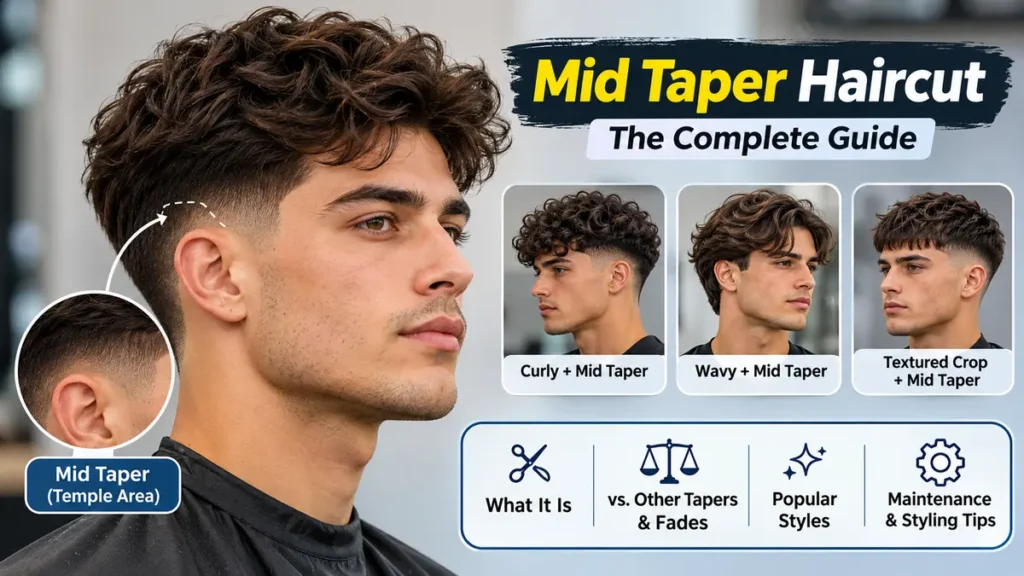
Want a haircut that looks clean around the ears without sacrificing the volume on top? The mid taper offers a balanced approach. It creates a noticeable but controlled transition between longer hair and shorter sides, making it suitable for everything from textured crops to natural curls.
A mid taper is a men’s haircut that gradually shortens the hair around the temples, sideburns, and neckline, with the transition beginning at approximately mid-temple height. It sits between a low and high taper, providing moderate contrast while preserving more hair on the sides than a full mid fade.
The appeal is flexibility. You can combine the cut with straight, wavy, curly, or coily hair, and adjust the shortest length to achieve anything from a natural shadow finish to a sharper skin-close appearance.
What Is a mid taper Haircut?
A mid taper is a variation of the traditional taper haircut in which hair transitions from longer lengths to shorter lengths around the sides and back of the head.
The word mid describes the approximate height of the transition. Rather than keeping the shortest section very low around the ears or extending it high toward the crown, the barber begins the graduation around the temple area.
Three characteristics define the haircut:
- Mid-level placement: The blend generally begins around the temples, above the ear.
- Gradual graduation: Hair becomes progressively shorter toward the sideburns and neckline.
- Preserved upper length: Much of the hair above the transition remains long enough to support different hairstyles.
Unlike a uniform buzz cut, the hair does not have one consistent length throughout the head. The barber creates a smooth progression using clippers, adjustable guards, and sometimes scissors.
How Does a mid taper Look From Different Angles?
From the front, the haircut typically appears relatively natural. The hairline and temple area look tidy, but the longer hair on top remains the main feature.
From the side, the graduated transition becomes more noticeable. Hair near the temples blends into shorter sections around the sideburns and ears.
From the back, the neckline is carefully tapered. Depending on the requested finish, the nape may retain a soft, natural outline or feature a more defined edge.
The result depends on the person’s hair density, head shape, growth patterns, and the barber’s blending technique.
mid taper vs. Low Taper vs. High Taper
The difference between low, mid, and high tapers primarily concerns how far upward the graduated section extends.
| Feature | Low Taper | Mid Taper | High Taper |
|---|---|---|---|
| Starting position | Near ears and neckline | Around temples | Higher toward upper temples |
| Contrast | Subtle | Moderate | More pronounced |
| Side volume | Most preserved | Moderately reduced | More removed |
| Appearance | Traditional and understated | Balanced and defined | Bold and structured |
| Grow-out visibility | Generally less noticeable | Moderate | Often more noticeable |
| Suitable styles | Classic side parts | Textured tops and curls | Short crops and voluminous tops |
Low Taper vs. mid taper
A low taper concentrates the shortest hair near the natural hairline. Most of the sides retain their original length, creating a subtle finish.
The mid taper takes the graduation higher and removes more bulk around the temples.
For someone with thick hair that expands outward around the ears, the mid-level transition can create a more controlled silhouette.
However, a low taper may be preferable when preserving side coverage is the priority.
High Taper vs. mid taper
A high taper moves the graduated section farther upward.
This produces stronger visual contrast between the shorter sides and longer top, particularly on thick or curly hair.
A mid taper preserves more side weight and generally produces a softer transition.
If you are unsure about the appropriate height, starting slightly lower is sensible. A barber can remove more hair during the appointment, but cannot immediately restore length that has been cut.
mid taper vs. Mid Fade: What’s the Difference?
Although the terms are frequently used interchangeably, a taper and a fade are not necessarily identical.
A traditional taper gradually reduces length, particularly around the sideburns and neckline, while preserving more of the surrounding hair.
A full mid fade generally shortens a broader area of the sides and back, creating a more visible transition.
| Feature | mid taper | Mid Fade |
|---|---|---|
| Main focus | Temples, sideburns, neckline | Broader sides and back |
| Hair preservation | More side length retained | More side length removed |
| Visual effect | Softer and more natural | Stronger contrast |
| Skin exposure | Optional | Common, but not required |
| Grow-out | Often less obvious | Can become noticeable sooner |
A fade does not always reach bare skin. A shadow fade, for example, leaves short stubble, while a skin fade reaches the scalp.
Similarly, a taper can finish very close to the skin around the perimeter.
The distinction is therefore not determined by clipper length alone. It also depends on how much of the head is graduated.
Barber terminology varies between shops, so describing the desired shape and showing a reference photograph is more reliable than using the haircut name alone. Jonny the Barber Williamsville+2
Popular mid taper Haircut Styles
The mid-level taper can support many different hairstyles because the upper hair is styled independently from the graduated sides.
1. Classic mid taper
The classic variation keeps a natural amount of hair on top while creating a clean transition around the temples and neckline.
It works particularly well with a short side part, combed-back top, or simple everyday hairstyle.
The defining feature is restraint: the transition is visible without dominating the overall haircut.
2. mid taper Fade
A mid taper fade combines the localized shape of a taper with a closer fade finish.
The hair around the temples and neckline may gradually shorten toward very short stubble or skin, depending on the desired contrast.
This variation creates a sharper appearance than a traditional shadow taper.
3. mid taper With Curly Hair
Curly hair naturally creates volume and movement, especially around the crown.
A mid taper reduces bulk near the sides while allowing the curls above to retain their shape.
The contrast between the closely trimmed perimeter and textured upper section gives the hairstyle definition.
For best results, the barber should consider curl shrinkage before deciding how much length to remove.
4. mid taper With Straight Hair
Straight hair makes changes in length relatively easy to see.
A carefully blended taper can create a smooth, polished appearance without requiring dramatic contrast.
The upper hair may be styled into a side part, textured fringe, quiff, or loose forward sweep.
Because straight hair can reveal uneven graduation, precise blending is particularly important.
5. mid taper With Wavy Hair
Wavy hair provides natural movement that complements the clean shape of a taper.
Keeping moderate length on top allows the waves to form while the shorter sides prevent excessive bulk.
A lightweight styling cream or sea salt spray can enhance texture without making the hair appear stiff.
6. Textured Crop With mid taper
A textured crop features relatively short hair on top, usually styled forward with visible separation between strands.
Combining it with a mid taper produces a tidy outline while preserving texture through the crown and fringe.
This variation can be practical for people who prefer quick daily styling.
7. Fluffy mid taper
The fluffy variation emphasizes volume and a soft, airy texture on top.
The upper hair is typically longer and styled upward or forward, while the taper controls the sides.
Blow-drying with moderate heat and using a small amount of lightweight styling product can help create the desired lift.
Excessive wax or heavy pomade may flatten the hairstyle.
8. mid taper With a Middle Part
A middle-part hairstyle, sometimes called curtain hair, features longer front sections separated near the center.
The taper removes bulk around the ears and temples while preserving the face-framing movement of the upper hair.
This style is particularly suitable for straight or wavy hair with enough length to form a natural part.
9. Buzz Cut With mid taper
A buzz cut uses clippers to keep the upper hair relatively short.
Adding a mid taper creates variation around the temples and neckline rather than leaving the entire head at one length.
This provides a more structured finish while retaining the simplicity of a short haircut.
10. mid taper With a Quiff
A quiff features hair styled upward and slightly backward at the front.
The shorter perimeter creates contrast with the elevated top.
The hairstyle can appear more dramatic when the upper hair is thick, although fine hair can also form a softer quiff with appropriate styling.
11. mid taper With a Pompadour
A pompadour uses longer hair swept upward and backward to create volume toward the front.
The taper keeps the sides controlled without requiring the extensive hair removal associated with some high fades.
This combination works well when the barber preserves enough length around the upper sides to connect naturally with the pompadour.
12. mid taper With a Lineup or Hair Design
A lineup uses a trimmer to create a more defined outline around the forehead or temples.
Some people also combine a taper with shaved lines or geometric patterns.
These details can make the haircut appear sharper, but they usually require more frequent maintenance because new growth quickly softens their definition.
Avoid forcing an unnaturally straight hairline if it requires cutting deeply into the natural growth pattern.
Choosing a mid taper for Your Hair Type
Hair texture affects how the haircut blends, how much volume remains, and how frequently styling is needed.
| Hair Type | Suggested Approach | Main Consideration |
|---|---|---|
| Straight | Soft gradient with textured top | Avoid visible clipper lines |
| Wavy | Preserve natural wave length | Control side bulk |
| Curly | Maintain curl definition above taper | Account for shrinkage |
| Coily | Shape perimeter while preserving crown | Avoid unnecessary removal of density |
| Thick | Remove excess weight near temples | Maintain balanced proportions |
| Fine | Use a softer transition | Avoid exposing too much scalp |
Curly and Coily Hair
Curls and coils can shrink significantly when dry, making the apparent length different from the stretched length.
A barber experienced with textured hair should consider this when shaping the top and blending the sides.
The taper should complement the natural curl pattern rather than create an abrupt disconnect.
Moisturizing conditioners and appropriate curl products can help maintain definition.
Fine or Thin Hair
A mid taper can work with fine hair, but an extremely short finish may expose more scalp than expected.
A shadow taper that leaves some visible hair around the temples may produce a fuller-looking result.
If the hairline is receding, the barber should assess whether the chosen height draws unwanted attention to the temples.
Thick Hair
Thick hair often benefits from careful weight removal around the sides.
However, taking too much length from the upper side sections can create a disconnected appearance.
The barber should blend the taper into the heavier hair above rather than leaving a visible shelf.
Which Face Shapes Suit a mid taper?
A mid taper can be adapted to many face shapes, but the length and volume on top influence the overall result as much as the taper itself.
Oval Face
Oval faces generally accommodate a wide range of upper hairstyles.
A classic taper with a textured top, side part, or short quiff can maintain balanced proportions.
Round Face
A round face may benefit from some height on top and controlled volume around the sides.
A quiff or textured hairstyle can create a more elongated visual effect.
However, an extremely narrow silhouette is not necessary; moderate contrast often looks more natural.
Square Face
Square faces feature relatively angular jawlines.
A mid taper can complement these angles, particularly when paired with a short crop or neatly styled top.
Softer upper texture can also balance a strongly defined jaw.
Long or Rectangular Face
Excessive height on top can make an already long face appear more elongated.
A textured fringe, moderate top volume, or side-swept hairstyle may create more balanced proportions.
Heart or Diamond Face
These shapes may have wider cheekbones or forehead areas relative to the jaw.
Preserving some volume around the upper sides can help avoid making the lower face appear disproportionately narrow.
Face-shape guidance is a styling starting point, not a fixed rule. Personal preference, hairline, density, and growth direction matter more than rigid classifications.
How to Ask Your Barber for a mid taper
The clearest way to communicate the haircut is to describe the placement, shortest length, top style, and neckline.
A useful instruction is:
“I’d like a mid taper around the temples and neckline. Keep most of the length on top, blend the sides smoothly, and leave a natural finish rather than taking the whole side down to skin.”
You can then specify whether you want a shadow finish or a closer skin taper.
Understand Clipper Guard Numbers
Clipper guards help barbers control cutting length.
Common approximate lengths include:
| Guard Number | Hair Length |
|---|---|
| #0.5 | 1.5 mm |
| #1 | 3 mm |
| #1.5 | 4.5 mm |
| #2 | 6 mm |
| #3 | 10 mm |
| #4 | 13 mm |
These are approximate values. Actual cutting lengths vary with clipper brands, blade adjustment, and cutting technique.
A mid taper does not require one universal guard combination.
For example, a barber might use a #1 near the bottom and blend into #2 and #3 lengths above. Another variation may start much shorter.
The desired finished appearance should determine the tools and guard settings, not the other way around.
Five Details to Discuss Before the Cut
- Taper height: Identify where the transition should begin around the temples.
- Shortest length: Decide whether the perimeter should remain dark, show stubble, or reach skin.
- Top length: Explain how much hair should remain for your preferred style.
- Neckline: Choose a natural tapered neckline or a more defined outline.
- Sideburns: Specify whether they should be blended softly or finished with sharper edges.
Bring reference photographs showing the front, sides, and back whenever possible.
A side-view image alone may not communicate the intended neckline or the amount of hair to preserve behind the ears.
How Barbers Create a mid taper
A professional barber typically builds the haircut in stages rather than removing all the hair at once.
Step 1: Assess the Hair and Head Shape
The barber examines density, growth direction, hairline, and the shape of the head.
Cowlicks, prominent occipital bones, and uneven growth patterns can affect the final blend.
Step 2: Establish the Taper Area
The barber identifies the desired height around the temples and the corresponding transition at the nape.
The taper should follow the head’s natural contours rather than relying on an identical straight line for every client.
Step 3: Create the Shortest Section
Using clippers or trimmers, the barber establishes the shortest length around the sideburns and neckline.
The initial guideline should be conservative because removing hair too high can change the intended haircut.
Step 4: Blend Into Longer Hair
The barber works upward using longer guards, clipper lever adjustments, and controlled cutting strokes.
Clipper-over-comb or scissor-over-comb techniques may be used to connect the taper with the heavier hair above.
The goal is a smooth graduation without obvious horizontal lines.
Step 5: Shape the Top
The upper hair is cut according to the selected style.
For example, a textured crop may require point cutting, while a quiff or pompadour needs sufficient front length.
Curly hair may require special attention to shrinkage and shape.
Step 6: Refine the Outline
The barber checks the transition from multiple angles, cleans up stray hairs, and finishes the neckline.
A final mirror check helps identify uneven blending or unexpected differences between the two sides.
The process requires practice, particularly when blending close to skin. Attempting a detailed taper at home without clipper experience can easily create uneven patches or remove more hair than intended.
How to Style a mid taper Haircut
Daily styling depends primarily on the length and texture of the hair above the taper.
The shorter sides generally require little styling, but the upper section may need a product that provides appropriate hold or moisture.
Styling Products and Their Uses
| Product | Main Purpose | Suitable Hair |
|---|---|---|
| Matte clay | Texture and medium-to-strong hold | Straight, thick, short-to-medium |
| Pomade | Smooth finish and controlled shape | Side parts, quiffs, pompadours |
| Styling cream | Flexible control | Wavy and medium-length |
| Curl cream | Curl definition and moisture | Curly and coily |
| Mousse | Lightweight volume | Fine and wavy |
| Sea salt spray | Loose, textured finish | Straight and wavy |
| Light hairspray | Hold after styling | Voluminous or structured styles |
Simple Everyday Styling Routine
- Start with clean or slightly damp hair.
- Apply a small amount of product suited to your hair texture.
- Distribute the product evenly rather than concentrating it at the front.
- Use your fingers, a comb, or a brush to create the desired direction.
- Allow the hair to air-dry or use a blow-dryer with controlled heat.
- Make final adjustments once the hair has settled.
For curls, excessive brushing after drying can disrupt definition and increase frizz.
For fine hair, lightweight products usually work better than heavy waxes.
Heat protectant is advisable when regularly using a blow-dryer at elevated temperatures.
How Often Should You Maintain a mid taper?
Most people who want to preserve a sharp mid taper benefit from a touch-up approximately every two to three weeks.
However, maintenance frequency depends on hair growth, taper length, and the desired appearance.
A soft shadow taper may remain presentable longer than a skin-close variation with sharply defined edges. KNIGHTSMEN+2
What Happens as the Hair Grows?
| Time After Haircut | Typical Appearance | Suggested Care |
|---|---|---|
| First week | Sharp transition and clean outline | Normal styling |
| Second week | Slightly softer edges | Check neckline and sideburns |
| Third week | More visible regrowth | Consider a taper touch-up |
| Fourth week | Reduced definition | Full trim may be appropriate |
| Fifth to sixth week | Noticeably grown-out shape | Reassess length and style |
These are general expectations, not exact growth milestones.
Hair growth varies between individuals, and a longer taper may retain its shape more naturally than a skin-close finish.
Maintaining the Neckline
The neckline is particularly noticeable as short hair grows.
A natural tapered neckline generally grows out more softly than a sharply squared outline.
If cleaning up the neckline at home, avoid cutting into the established taper. Removing hair above the original boundary can create an uneven result that requires a barber to correct.
Keeping Hair and Scalp Healthy
Regular cleansing, appropriate conditioning, and gentle styling help maintain the appearance of the haircut.
People with dry curls may benefit from more moisturizing products, while those with fine or oily hair may prefer lighter formulas.
Clean clippers and trimmers are also important, especially when cutting close to the scalp.
Avoid shaving over irritated skin, inflamed bumps, or active scalp lesions.
Common mid taper Haircut Mistakes
Even a technically simple-looking taper can appear unbalanced when the placement or blending is incorrect.
Starting the Taper Too High
A taper that extends beyond the intended temple area can resemble a high taper or full fade.
This removes more side coverage and may change the overall proportions of the hairstyle.
Better approach: Agree on the upper boundary before the barber starts cutting.
Creating a Visible Weight Line
A weight line is an obvious boundary between longer and shorter hair.
It can appear when the barber does not adequately connect the upper side section to the taper.
Careful clipper-over-comb work and gradual guard transitions can reduce this problem.
Removing Too Much Hair From the Crown
The crown often contains growth patterns that influence how the hair sits.
Cutting it too short may cause sections to stand up or appear uneven.
The crown should be shaped according to growth direction rather than automatically matched to the shortest side length.
Choosing the Wrong Finish for Hair Density
An extremely close taper on sparse temple hair can expose more scalp than intended.
Conversely, leaving excessive weight on dense sides may make the hairstyle appear bulky.
The best finish balances the natural density with the desired contrast.
Overusing Styling Products
Heavy product buildup can flatten the upper hair and make the style look greasy.
Begin with a small quantity and add more only when needed.
Ignoring the Back of the Haircut
A haircut may look excellent from the front while the neckline remains uneven or poorly blended.
Always inspect the back with a mirror before the appointment is finished.
Can You Get a mid taper With Long Hair?
Yes. A mid taper can be combined with long hair because the taper primarily changes the perimeter rather than requiring the top to be short.
Longer hairstyles that can work with a tapered perimeter include:
- Shoulder-length hair worn loose
- Long curls or coils
- Braids and twists
- Longer middle-part hairstyles
- Tied-back hairstyles
- Undercut-inspired styles with a softer transition
The main consideration is how the long hair falls over the shorter sections.
When worn loose, the taper may be partly hidden. When tied back, the graduated temples and neckline become more visible.
For braids or twists, the barber should coordinate the taper placement with the planned sections so the haircut does not remove hair needed for the style.
Does a mid taper Work With a Receding Hairline?
A mid taper can work with a receding hairline, but the outcome depends on the recession pattern and how much hair remains around the temples.
Because the taper creates a shorter area near the temples, it may emphasize an already receding hairline if the transition is too high or too close to skin.
A softer taper can preserve more visual coverage.
For someone concerned about temple recession, a low taper may be a better starting point.
The upper hairstyle also matters. A textured fringe or natural side-swept style may provide a different visual balance than a slicked-back haircut.
A taper changes the appearance of existing hair; it does not prevent or reverse hair loss.
Is a mid taper Suitable for School or Professional Settings?
A traditional mid taper can create a neat, understated appearance appropriate for many schools and workplaces.
The haircut retains enough hair through the upper sides to avoid the dramatic contrast of some high skin fades.
However, dress codes vary.
A conservative version with a shadow finish, natural neckline, and modest top length is generally less conspicuous than a skin-close variation with shaved designs.
For professional settings, the hairstyle on top often has a greater effect on the overall appearance than the taper height itself.
A neatly styled side part may look more formal, while a fluffy or highly textured top creates a more casual impression.
How Long Does a mid taper Haircut Take?
A mid taper haircut commonly takes around 20–45 minutes, depending on the complexity of the style and the barber’s workflow.
A simple cleanup may take less time, while a detailed skin-close blend, longer scissor cut, or shaved design can require more.
Factors influencing the appointment include hair density, curl pattern, desired top length, and the amount of blending required.
The most important consideration is the quality of the transition. A carefully executed taper should look smooth from the front, side, and back rather than simply appearing short around the ears.
Is a mid taper a Good Choice for Your Next Haircut?
A mid taper is a versatile option for someone who wants a cleaner outline without committing to the extensive side shortening of a full fade.
It can be adapted to different hair textures, face shapes, and styling preferences. Straight hair can achieve a polished gradient, curly hair can retain its natural volume, and thicker hair can benefit from controlled bulk around the temples.
The main trade-off is maintenance. A sharper, shorter finish requires more frequent attention, while a softer shadow taper grows out more gradually.
For the best result, choose the transition height and shortest length according to your natural hair characteristics, then communicate those details clearly to your barber.
A well-executed mid taper should complement the hairstyle above it, preserve balanced proportions, and remain practical for your everyday routine.