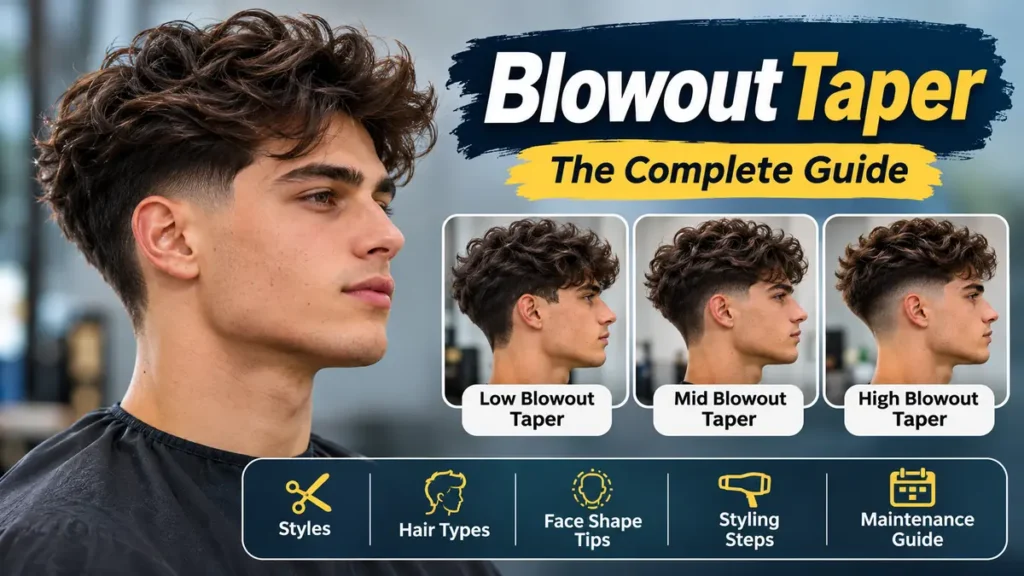
The blowout taper has become a popular men’s haircut because it combines clean, gradually tapered edges with natural volume and texture on top. It can look sharp without being overly formal, and it works with straight, wavy, curly, and coily hair.
A blowout taper is a men’s hairstyle that combines a gradual shortening of hair around the temples and neckline with a fuller, voluminous top. The blowout creates height and movement, while the taper provides a clean outline. It can be customized with low, mid, or high taper placements and different hair textures.
Unlike a full skin fade, the blowout taper typically preserves more hair around the sides and back, creating a softer transition between the longer top and shorter edges.
What Is a blowout taper Haircut?
A blowout taper is a combination of two haircutting and styling techniques: the blowout and the taper.
The blowout refers to the lifted, airy appearance of the hair, often created with a blow dryer, brush, or styling product. The taper refers to hair gradually becoming shorter near the sideburns, temples, and neckline.
Together, they produce a hairstyle with three defining characteristics:
- Volume on top: Hair is left long enough to create lift, shape, and movement.
- Gradual tapering: The barber blends shorter hair into longer hair around the edges.
- Natural texture: The top can be fluffy, curly, messy, spiky, or more controlled.
The result is a haircut that looks structured around the perimeter but relaxed through the crown and fringe.
How Is It Different From a Traditional Taper?
A traditional taper focuses primarily on reducing hair length around the sides and neckline. The hair on top may be short, medium, or long.
A blowout taper adds a particular styling direction: volume and a fuller silhouette.
For example, two people could receive similar low taper haircuts, but the person who styles the top upward with a blow dryer and lightweight mousse will have a more recognizable blowout appearance.
Why Has the Hairstyle Become Popular?
The style has gained visibility through barbershop content, social media hairstyle tutorials, and short-form videos on platforms such as TikTok, Instagram, and YouTube.
Its appeal comes from its adaptability. A blowout taper can be worn with a loose textured fringe, curly top, fluffy middle part, or a more sculpted quiff.
It also offers a compromise between a dramatic fade and a longer, less structured haircut.
Popular blowout taper Styles
There is no single version of the blowout taper. The final appearance depends on taper height, hair length, texture, and styling preferences.
1. Low Blowout Taper
The low blowout taper keeps the shortest areas close to the ears, sideburns, and lower neckline.
20 Top Examples of Blowout Taper, the Young Men’s Haircut of 2026
20 Top Examples of Blowout Taper, the Young Men’s Haircut of 2026
De Beste Kapper Voor Een Taper Fade – Waarom Je Naar Barbier Rogier Moet Komen
12
This variation creates a subtle, natural-looking transition while preserving fullness around the upper sides.
It is particularly suitable for someone who wants noticeable volume without a strong contrast between the top and sides.
2. Mid Blowout Taper
A mid blowout taper places the transition higher around the temple area than a low taper.
Mid Taper Fade Blowout Guide for Curly, Straight & Wavy Hair
Textured Blowout Fringe with Mid Taper
Textured Blowout Fringe with Mid Taper
13
The slightly higher placement makes the shape more visible and can give the haircut a sharper, more defined appearance.
It works well with medium-length hair and textured styling.
3. High Blowout Taper
A high blowout taper brings the tapered area farther up the sides, producing a more noticeable contrast with the longer top.
Taper Fade Haircuts for Black Men: Styles, Variations & Grooming Tips
Blowout Taper with Textured Fringe and Other Blowout Styles for Men
Blowout Taper Haircut: Top 27 Clean Cuts & Sharp Transitions
15
This version creates a bolder silhouette, especially when the top is styled upward or outward.
However, a high taper is not automatically the same as a high fade. A taper still concentrates on specific perimeter areas, while a full fade generally extends across more of the sides and back.
4. Curly Blowout Taper
The curly blowout taper combines naturally defined curls with a clean perimeter.
20 Top Examples of Blowout Taper, the Young Men’s Haircut of 2026
30 Top Blowout Taper Haircuts for Men | Forte Series
20 Top Examples of Blowout Taper, the Young Men’s Haircut of 2026
12
The curls provide much of the volume, so extensive heat styling may not be necessary.
A curl cream, lightweight leave-in conditioner, or diffuser can help preserve definition while reducing frizz.
5. Textured or Fluffy Blowout Taper
The fluffy blowout taper emphasizes soft movement, an airy fringe, and a less polished finish.
Textured Blowout Fringe with Mid Taper
23 idées de coupe Blowout Taper + Définition – Petits Soins
14
It is particularly popular with medium-length straight and wavy hair.
The key is avoiding heavy products that flatten the top or make individual strands appear greasy.
6. Blowout Taper With a Middle Part
This variation combines a center-parted hairstyle with tapered temples and neckline.
The top is kept long enough to separate naturally into two sections, while the shorter perimeter prevents the haircut from appearing excessively bulky.
A middle-part blowout is especially effective when the hair has enough length to bend and flow away from the face.
7. Blowout Taper With a Textured Fringe
A textured fringe brings some of the top hair forward toward the forehead rather than directing all the volume upward.
This can soften the overall appearance and give the hairstyle a relaxed finish.
The fringe can be choppy, wavy, or loosely separated depending on hair density and texture.
blowout taper vs. Fade: Key Differences
The words taper and fade are often used interchangeably, but they describe different approaches to shortening hair.
| Feature | Blowout Taper | Blowout Fade |
|---|---|---|
| Main focus | Tapered temples and neckline | Broader faded sections |
| Side coverage | Usually more length retained | Often shorter over a larger area |
| Contrast | Subtle to pronounced | Often more dramatic |
| Top styling | Lifted, textured, or fluffy | Lifted, textured, or fluffy |
| Grow-out | Often softer at the perimeter | Short areas may become noticeable sooner |
| Overall finish | Natural with clean edges | More visibly contrasted |
Neither option is inherently better. The distinction depends on the shape you want and how much length you prefer to retain.
A burst fade is another related style. It creates a curved faded section around the ear, often leaving more length toward the back. It should not be confused with a standard temple taper.
Similarly, a drop fade follows a descending line toward the back of the head, while a skin fade blends down to exposed skin.
Understanding these terms makes it easier to communicate the desired haircut to a barber.
Which Hair Types Work Best With a Blowout Taper?
One reason this haircut is versatile is that it can be adapted to different hair textures. However, the styling technique and final shape will not be identical for everyone.
| Hair Type | Recommended Approach | Styling Products |
|---|---|---|
| Straight | Add root lift and texture | Volumizing mousse, matte clay |
| Wavy | Enhance natural movement | Sea salt spray, light styling cream |
| Curly | Preserve curl definition and volume | Curl cream, diffuser |
| Coily | Shape the top while maintaining moisture | Leave-in conditioner, curl cream |
| Fine | Create lift without excess weight | Lightweight mousse, texture powder |
| Thick | Remove excess bulk selectively | Matte paste, light styling cream |
Straight Hair
Straight hair can achieve a fluffy blowout, although it may need more deliberate styling to maintain height.
A blow dryer and round brush can help lift the roots, while a small amount of matte clay provides separation and control.
Avoid applying excessive wax or pomade, as heavy products can make the hair collapse.
Wavy Hair
Wavy hair naturally provides movement and texture, making it well suited to a relaxed blowout.
A lightweight styling cream or sea salt spray can emphasize the waves. However, salt sprays can feel drying on some hair types, so they should not replace regular conditioning.
Curly and Coily Hair
Curly and coily hair can create impressive volume without requiring a perfectly straight blow-dried finish.
A diffuser helps distribute airflow more gently, while curl cream supports definition.
Because curls shrink as they dry, the barber should account for the difference between wet and dry length when shaping the top. Taper Empire+1
For tightly coiled hair, a rounded blowout shape can also be created using a pick and controlled drying, depending on the desired finish.
Fine or Thinning Hair
Fine hair can benefit from a textured blowout because lift at the roots creates the appearance of greater fullness.
However, a very high taper may expose more scalp and emphasize areas with low density.
A softer taper and moderate top volume often provide a more balanced appearance.
Choosing a Blowout Taper for Your Face Shape
Face shape is a useful starting point, but it should not be treated as a strict rule. Hair density, growth direction, forehead proportions, and personal preference are equally relevant.
Round Face
A blowout with moderate height can visually lengthen a round face.
A mid taper may also reduce some fullness around the temples, creating a slightly narrower silhouette.
Avoid excessive width at the sides if your goal is a more elongated appearance.
Oval Face
Oval faces generally accommodate a wide range of blowout styles.
Low, mid, and high tapers can all work, depending on the desired contrast.
The main consideration is maintaining proportions between the top, sides, and forehead.
Square Face
A square face often has a defined jawline and relatively angular features.
A textured or wavy blowout can soften the overall appearance, while a clean taper maintains structure around the temples.
Long or Oblong Face
Very tall hairstyles can make an already elongated face appear longer.
A lower blowout with more width and less vertical height may provide better balance.
A forward textured fringe is another option worth considering.
Heart or Diamond Face
Faces that are wider around the forehead or cheekbones and narrower toward the chin may benefit from retaining some fullness near the temples.
A low taper can help preserve that width, while a softer, less vertical top creates a balanced silhouette.
How to Ask Your Barber for a blowout taper
Clear communication matters because the phrase blowout taper does not describe one universally standardized haircut. Different barbers may interpret the taper height and styling shape differently. barber.style+1
A useful description is:
I want a low blowout taper with enough length on top for volume and texture. Keep the taper mainly around the sideburns and neckline, preserve fullness on the upper sides, and blend everything smoothly. I want a natural, fluffy finish rather than a high skin fade.
You can adjust that description to suit your preferred variation.
Decide How Much Length to Keep on Top
There is no universal minimum length for a blowout taper.
For many medium-length blowout styles, approximately 3–5 inches (7.5–12.5 cm) on top provides enough hair to create visible lift and movement. Shorter or naturally curly hair can also work, but the resulting silhouette will differ. Taper Trends+1
If you already have the desired length, ask for shaping rather than significant shortening.
Specify the Taper Height and Shortest Length
Tell the barber whether you want a low, mid, or high taper.
Also explain whether the shortest section should be skin-close, stubble-length, or a longer clipper length.
Clipper guard numbers can help, but they should be agreed upon with the barber rather than treated as universal formulas.
Bring Reference Photos
A front-facing photograph may show the hairstyle’s volume but hide the taper.
For better communication, use images showing:
- The front, including the fringe and top shape.
- The side, showing the transition around the temples.
- The back, showing the neckline and overall silhouette.
Ideally, choose references featuring hair texture and density similar to your own.
How to Style a blowout taper at Home
The haircut provides the foundation, but styling determines how much volume and movement the finished look has.
Step 1: Start With Slightly Damp Hair
Wash or rinse your hair as needed, then gently towel-dry it. Avoid aggressive rubbing, particularly if your hair is curly or prone to frizz.
Haircare Tips for More Vibrant Hair
Step 2: Apply a Lightweight Styling Product
Use a small amount of mousse or volumizing spray for straight hair. For curly hair, distribute curl cream or leave-in conditioner evenly.
How to Use Our Famous Thick Hair Control System – BluMaan
Step 3: Create Root Lift
Apply heat protectant before blow-drying. Use low or medium heat and direct airflow upward at the roots. A round brush can help with straight or wavy hair, while a diffuser is useful for curls.
JAAAM Texture Clay 50ml | JAAAM HONG KONG | 髮型|洗顏|剃須
Step 4: Shape the Top
Use your fingers to separate strands and create the desired direction. Apply a small amount of matte paste or clay if additional hold is needed.
Traditional Barber Shop | No 1 Barbers
Step 5: Set the Finish
Let the hair cool in its final position. Use a light mist of flexible-hold hairspray if needed, avoiding excessive product buildup.
Can You Style It Without a Blow Dryer?
Yes, although the result depends on your natural hair texture.
Wavy, curly, and coily hair may develop sufficient volume through air-drying, especially when supported by lightweight styling products.
Straight hair usually needs more manipulation to create pronounced root lift.
If you prefer a low-maintenance routine, ask for a shape that looks balanced even when the top is not fully blown out.
How Often Does a Blowout Taper Need Maintenance?
A blowout taper generally needs periodic trimming to preserve its shape.
The exact schedule depends on hair growth, taper height, and how sharp you want the edges to appear.
| Maintenance Task | Typical Interval |
|---|---|
| Temple and neckline cleanup | Every 2–3 weeks |
| Full haircut and reshaping | Every 3–6 weeks |
| Washing | According to scalp and hair needs |
| Conditioning | Regularly, especially for dry or curly hair |
| Styling | As desired |
These are practical starting points, not mandatory schedules. A very short skin-level taper may lose its sharp appearance sooner, while a softer low taper can grow out more gradually. Taper Empire+1
Keeping the Neckline Clean
The neckline is an important part of the haircut because visible regrowth can make the taper appear less defined.
A barber can refresh the nape without substantially changing the top.
Avoid repeatedly shaving or reshaping the hairline at home unless you are confident using clippers. Taking the neckline too high can alter the intended haircut shape.
Preventing Heat Damage
Frequent blow-drying at high temperatures can contribute to dryness and breakage.
To reduce unnecessary heat exposure:
- Use a heat-protectant product before heated styling.
- Keep the dryer moving rather than concentrating heat on one area.
- Choose lower temperatures when possible.
- Avoid repeatedly stretching fragile or damaged curls.
- Allow occasional air-drying when your hairstyle permits.
A blowout does not need extreme heat to look full.
Common Blowout Taper Mistakes
Even a well-executed taper can look disappointing when the top is cut or styled incorrectly.
Cutting the Top Too Short
If the goal is a tall, fluffy blowout, removing too much length can make the desired shape difficult to achieve.
Before the haircut begins, explain how you normally style the top and how much height you want.
Taking the Taper Too High
A high taper removes more side fullness and may create a different silhouette from the one shown in your reference photograph.
If you are unsure, starting with a lower taper is often safer because the barber can gradually increase the height.
Using Too Much Product
Heavy waxes, thick pomades, and excessive styling cream can weigh down the hair.
Begin with a small amount, distribute it evenly, and add more only when necessary.
Ignoring Natural Hair Growth
Cowlicks, crown patterns, and the direction of the hairline influence how the top behaves.
A style that looks effortless on one person may require a different cutting or drying technique on another.
Working with the natural growth pattern generally produces a more manageable result than forcing the hair into an unsuitable direction.
Over-Thinning Thick or Curly Hair
Removing bulk can improve movement, but excessive thinning may create frizz, uneven ends, or unwanted gaps.
Curly hair in particular benefits from thoughtful shaping that considers how the curls settle after drying.
Is a Blowout Taper Suitable for School, Work, and Everyday Wear?
A blowout taper can be adapted to casual and more conservative environments.
For school or workplaces with stricter grooming expectations, a low taper with moderate volume and a tidy neckline may be more suitable than a dramatic high-contrast version.
A textured fringe or natural curly top can create a relaxed appearance, while a controlled blowout styled slightly backward may look more polished.
The haircut is also practical for people who prefer to keep some length on top without maintaining long hair throughout the sides and back.
However, a highly styled blowout may require daily attention. People who prefer minimal grooming can retain the tapered edges while allowing the top to follow its natural texture.
How to Grow Out or Change a Blowout Taper
A blowout taper is relatively adaptable as it grows.
If you want longer hair, ask your barber to maintain the perimeter while leaving the top and upper sides largely untouched.
This approach can help you transition toward a longer textured hairstyle, middle part, or curly layered cut.
If you prefer a shorter style, the top can gradually be reshaped into a textured crop, quiff, or classic taper.
The main consideration is preserving enough length for the next hairstyle rather than repeatedly cutting the top back to its original shape.
Final Thoughts on the blowout taper
The blowout taper combines the clean edges of a tapered haircut with the movement and volume of a longer top. Its versatility comes from the ability to adjust taper height, hair length, texture, and styling direction.
A low taper offers a softer transition, a mid taper creates more visible definition, and a high taper produces stronger contrast. Straight hair may benefit from blow-drying and lightweight products, while curls and waves can provide much of the volume naturally.
For the most reliable result, choose reference photographs that match your hair texture, communicate the desired taper height clearly, and establish a styling routine you can realistically maintain.