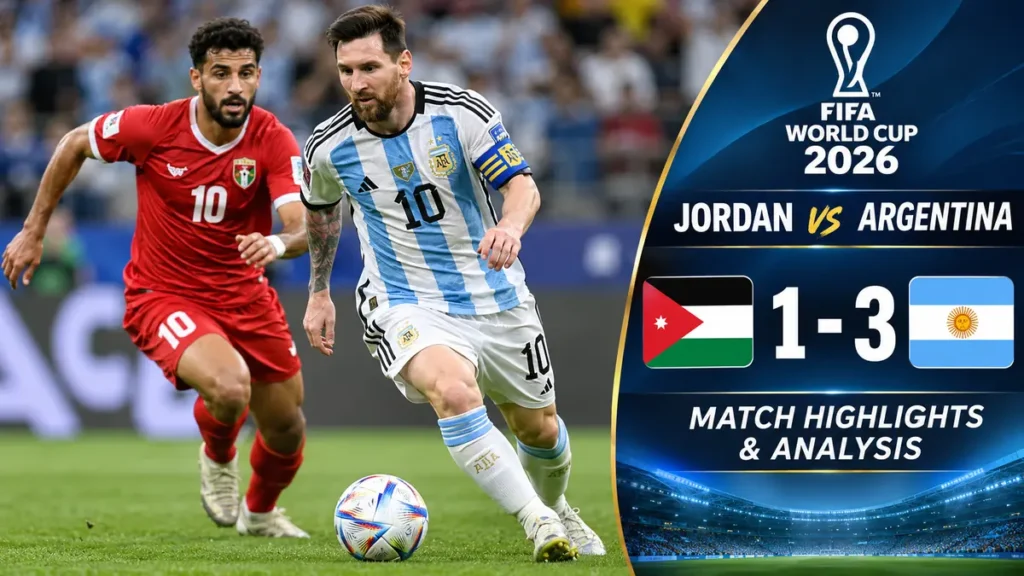
The jordan vs argentina match at the 2026 FIFA World Cup brought together two national teams with very different football histories. Argentina entered the competition as defending world champions, while Jordan celebrated its first appearance at football’s biggest international tournament.
Their first-ever meeting produced four goals, a determined second-half response from Jordan, and another memorable Lionel Messi moment.
Argentina defeated Jordan 3-1 on June 27, 2026, in their FIFA World Cup Group J encounter at AT&T Stadium in Arlington, Texas. Giovani Lo Celso, Lautaro Martínez, and Lionel Messi scored for Argentina, while Mousa Al-Taamari scored Jordan’s only goal. The result gave Argentina its first head-to-head victory against Jordan. Match report and highlights+1
jordan vs argentina Match Overview
The Group J encounter was more than a routine fixture between an established football power and a World Cup newcomer. It represented a milestone for Jordanian football and another chapter in Argentina’s attempt to defend its world title.
Jordan
1
Главу Ассоциации футбола Аргентины задержали в США — Реальное время
Argentina
3
Full time · FIFA World Cup 2026 · Group J
| Match detail | Information |
|---|---|
| Competition | FIFA World Cup 2026 |
| Date | June 27, 2026 |
| Venue | AT&T Stadium, Arlington, Texas |
| Group | J |
| Final score | Jordan 1–3 Argentina |
| Half-time score | Jordan 0–2 Argentina |
| Referee | István Kovács |
| Attendance | 70,649 |
| Jordan manager | Jamal Sellami |
| Argentina manager | Lionel Scaloni |
The match was played at 9:00 p.m. local time. Although some international listings display June 28 because of time-zone differences, the official local match date was June 27. FBRef+1
Who scored in Jordan vs Argentina?
| Minute | Player | Team | Score |
|---|---|---|---|
| 19′ | Giovani Lo Celso | Argentina | 0–1 |
| 31′ | Lautaro Martínez (penalty) | Argentina | 0–2 |
| 55′ | Mousa Al-Taamari | Jordan | 1–2 |
| 80′ | Lionel Messi | Argentina | 1–3 |
Argentina’s two first-half goals established control, but Jordan’s second-half strike briefly reduced the deficit to one goal. Messi then secured the result with a late free-kick. Match report and highlights+1
jordan vs argentina Match Highlights and Key Moments
The match developed in three distinct phases: Argentina’s strong opening half, Jordan’s response after the interval, and Messi’s decisive contribution in the closing stages.
First half: Argentina establishes control
Argentina took the lead in the 19th minute through Giovani Lo Celso. The midfielder’s goal gave Lionel Scaloni’s side an early advantage and forced Jordan to consider taking greater attacking risks.
Twelve minutes later, Lautaro Martínez converted a penalty to double Argentina’s lead.
By half-time, the defending champions were ahead 2-0. Jordan faced a difficult challenge against an opponent with considerable international tournament experience.
Argentina’s advantage also reflected its ability to convert attacking opportunities into goals. Rather than relying exclusively on individual brilliance, the team benefited from contributions across its midfield and forward line.
Second half: Jordan fights back
Jordan manager Jamal Sellami made two substitutions at half-time, introducing Mousa Al-Taamari and Mahmoud Al-Mardi.
The changes helped Jordan produce its most important attacking moment of the game.
In the 55th minute, Al-Taamari scored following an assist from Ihsan Haddad, reducing Argentina’s advantage to 2-1.
For Jordan, the goal carried particular significance. Scoring against the defending world champions during the country’s debut World Cup campaign was an achievement regardless of the eventual result.
It also changed the immediate match situation. With only one goal separating the teams, Argentina could no longer treat its lead as completely comfortable.
Messi enters and seals the victory
Lionel Messi began the match on the substitutes’ bench as Scaloni rotated his starting lineup.
In the 60th minute, Messi replaced Lautaro Martínez. Thiago Almada also entered for Lo Celso, while Alexis Mac Allister followed shortly afterward.
The decisive moment arrived in the 80th minute.
Messi scored from a free-kick, restoring Argentina’s two-goal advantage and making the score 3-1.
According to FIFA, it was Messi’s sixth goal of the 2026 tournament and extended his scoring streak to seven consecutive World Cup matches, a new record. Match report and highlights+1
The goal illustrated why Argentina remained dangerous even when several established starters were rested. Scaloni could introduce elite attacking talent without sacrificing the team’s competitive structure.
Jordan vs Argentina Head-to-Head Record
Before the 2026 World Cup, Jordan and Argentina had never met in a senior men’s international match.
Their Group J encounter therefore established the first official result in the rivalry.
| Head-to-head statistic | Record |
|---|---|
| Total matches | 1 |
| Argentina wins | 1 |
| Jordan wins | 0 |
| Draws | 0 |
| Argentina goals | 3 |
| Jordan goals | 1 |
| Goal difference | Argentina +2 |
The historical record is straightforward: Argentina leads the series following its 3-1 victory in Arlington. 11v11+1
Had Jordan ever played Argentina before 2026?
No. The 2026 World Cup fixture was their first senior international meeting, including both competitive and friendly matches.
This makes their head-to-head history unusually short compared with Argentina’s established rivalries against South American and European opponents.
It also means that any future encounter will add to a record that began at the 2026 World Cup.
Argentina National Football Team: Strengths and Playing Style
Argentina’s success against Jordan was consistent with the qualities that helped the national team win the 2022 FIFA World Cup in Qatar.
Under Lionel Scaloni, Argentina developed a balanced approach combining technical midfield play, coordinated pressing, defensive organization, and attacking flexibility.
Midfield control and attacking combinations
Argentina’s midfield options included players capable of retaining possession, changing the direction of attacks, and creating opportunities between defensive lines.
Giovani Lo Celso’s opening goal highlighted the attacking contribution available from midfield.
Nico Paz also featured in the starting team, while Alexis Mac Allister and Thiago Almada were introduced during the second half.
This depth gave Argentina tactical flexibility throughout the contest.
Lautaro Martínez and Argentina’s forward options
Lautaro Martínez provided Argentina’s second goal from the penalty spot.
His contribution demonstrated the importance of reliable finishing in tournament football. Against organized defensive opponents, chances can be limited, making efficient finishing particularly valuable.
Argentina also had Julián Álvarez among its attacking options, while José Manuel López entered late in the game.
Lionel Messi’s continuing influence
Messi’s appearance against Jordan showed that his impact was not limited to starting matches.
Coming off the bench, he scored the goal that confirmed Argentina’s victory.
His ability to influence a match through set pieces remained especially important. Direct free-kicks can create scoring opportunities even when an opposing team maintains a compact defensive shape.
The Jordan match added another individual milestone to Messi’s extraordinary international career.
Jordan National Football Team: Performance and Tactical Approach
Jordan entered the 2026 World Cup after achieving a historic qualification breakthrough.
The national team, commonly known as Al-Nashama, had also established its competitive credentials by reaching the final of the 2023 AFC Asian Cup, which was played in 2024.
Jordan finished runner-up to Qatar, losing the final 3-1.
That performance demonstrated the progress of Jordanian football before its first World Cup appearance. fifa.com
Defensive organization against Argentina
Jordan used a 5-4-1 formation against Argentina, according to the match record.
This structure allowed the team to position five players across its defensive line and provide additional midfield protection.
The system was designed to limit space and make it harder for Argentina to attack through central areas.
However, defensive formations cannot eliminate every opportunity. Argentina’s first-half goals showed how difficult it can be to contain a technically accomplished opponent for an entire match.
Mousa Al-Taamari’s attacking contribution
Mousa Al-Taamari was one of Jordan’s most influential attacking players.
His introduction at half-time provided an immediate benefit when he scored in the 55th minute.
The goal also highlighted the value of direct attacking players who can capitalize on limited opportunities.
Against stronger opponents, a team may spend long periods defending. When possession is recovered, quick movement into attacking areas becomes essential.
Al-Taamari’s goal demonstrated Jordan’s ability to create a meaningful attacking moment despite the eventual defeat.
The importance of Jordan’s World Cup debut
Jordan’s participation represented a landmark in the country’s football history.
Qualification for the tournament provided experience against international opposition and exposed the national team to the demands of football’s highest-profile competition.
Although Jordan lost to Argentina, the match offered several lessons:
- Maintaining defensive concentration against elite attackers.
- Managing transitions after winning possession.
- Responding tactically when trailing.
- Using substitutions to change attacking momentum.
- Improving performance through experience against established national teams.
For Jordan, the longer-term value of its debut extended beyond any single result.
Jordan vs Argentina Tactical Comparison
The two teams approached the encounter from different positions of experience and competitive strength.
Argentina had the advantage in squad depth, technical resources, and tournament experience. Jordan relied on defensive organization and opportunities to attack when space became available.
| Tactical factor | Jordan | Argentina |
|---|---|---|
| Starting formation | 5-4-1 | 4-1-4-1 |
| General approach | Compact defensive structure | Possession and attacking combinations |
| Attacking emphasis | Transitions and direct movement | Midfield creativity and varied finishing |
| Key scorer | Mousa Al-Taamari | Lo Celso, Martínez, Messi |
| Second-half changes | More attacking options | Experienced substitutes |
| Final outcome | Defeat | Victory |
The formations and substitutions are recorded in the match reports. FBRef+1
Why Argentina’s squad depth mattered
One of the clearest differences was Argentina’s ability to rotate players while retaining substantial attacking quality.
Scaloni made nine changes from the lineup used against Austria, according to FIFA.
Despite those changes, Argentina scored twice before half-time.
Messi then entered in the second half and scored the final goal.
This illustrates a major advantage for established tournament contenders: the capacity to manage playing time and maintain performance across several matches.
What Jordan did well
Jordan deserves credit for responding after falling two goals behind.
Rather than allowing Argentina to control the entire second half without resistance, Sellami made adjustments that produced a goal.
The team’s response demonstrated determination and showed that a lower-ranked side can still create problems for an experienced opponent.
However, Jordan could not find an equalizer before Messi restored Argentina’s two-goal advantage.
What separated the teams?
The decisive difference was finishing and control of key moments.
Argentina scored twice in the opening 31 minutes and responded to Jordan’s goal with a further strike.
Jordan showed that it could threaten Argentina, but it could not sustain enough attacking pressure to change the final outcome.
The match therefore demonstrated both the competitive gap between the sides and Jordan’s ability to contribute positively to the contest.
FIFA World Cup 2026 Group J Context
Argentina and Jordan competed in Group J alongside Austria and Algeria.
The group brought together teams representing three continental confederations: CONMEBOL, AFC, and UEFA, with Algeria representing CAF.
Argentina entered the tournament as the defending champion following its victory over France in the 2022 World Cup final.
Jordan, by contrast, was participating in its first World Cup.
Jordan’s Group J results
| Opponent | Result |
|---|---|
| Austria | Lost 1–3 |
| Algeria | Lost 1–2 |
| Argentina | Lost 1–3 |
Jordan finished fourth in the group after losing all three matches. The team scored once in each fixture but conceded eight goals overall. FBRef
Although the results were disappointing, reaching the tournament remained a historic achievement.
Argentina’s position in Group J
Argentina finished first in Group J, while Austria and Algeria also advanced to the knockout stage.
The victory against Jordan completed Argentina’s group-stage schedule and reinforced its position at the top of the standings. fifa.com
For the defending champions, the encounter also offered an opportunity to rotate players before the knockout rounds.
That context helps explain why Messi started on the bench rather than appearing in the initial lineup.
What the Jordan vs Argentina Result Means for Both Teams
The result carried different implications for the two national teams.
For Argentina, the victory was another example of the squad’s ability to handle the demands of a major international tournament.
For Jordan, the match provided experience against one of the most successful teams in football history.
Lessons for Argentina
Argentina demonstrated several strengths that are valuable in World Cup competition.
The team converted early opportunities, adjusted personnel during the second half, and maintained sufficient attacking quality to secure the result.
However, conceding after half-time also showed that opponents could create chances when Argentina’s defensive structure was challenged.
That is an area any tournament contender must continue to manage.
Lessons for Jordan
Jordan’s performance offered evidence of both progress and the work still required to compete consistently against elite opposition.
The team showed attacking potential through Al-Taamari’s goal and responded positively to tactical changes.
At the same time, conceding three goals highlighted the difficulty of defending against opponents with multiple sources of attacking quality.
The experience can inform future preparation, particularly in defensive coordination, possession management, and attacking transitions.
Why this first meeting was significant
The encounter linked two very different stages of national-team development.
Argentina was attempting to extend a period of international success. Jordan was experiencing the World Cup for the first time.
That contrast made the fixture historically notable even before kick-off.
It also provided Jordanian supporters with a memorable occasion: their national team competing against Argentina and scoring a goal on the World Cup stage.
Final Thoughts on jordan vs argentina
The jordan vs argentina encounter ended with a 3-1 victory for the defending world champions, but the match was about more than the scoreline.
Argentina demonstrated squad depth, attacking efficiency, and the continuing influence of Lionel Messi. Goals from Giovani Lo Celso, Lautaro Martínez, and Messi secured the result after Jordan’s Mousa Al-Taamari briefly reduced the deficit.
For Jordan, the fixture marked its first-ever meeting with Argentina during a historic debut World Cup campaign.
The result established Argentina’s 1-0 lead in the head-to-head record while giving Jordan valuable experience against elite international opposition.
For readers examining the match, the central takeaway is clear: Argentina’s quality proved decisive, but Jordan’s second-half response ensured that its first encounter with the three-time world champions included a moment of genuine achievement.