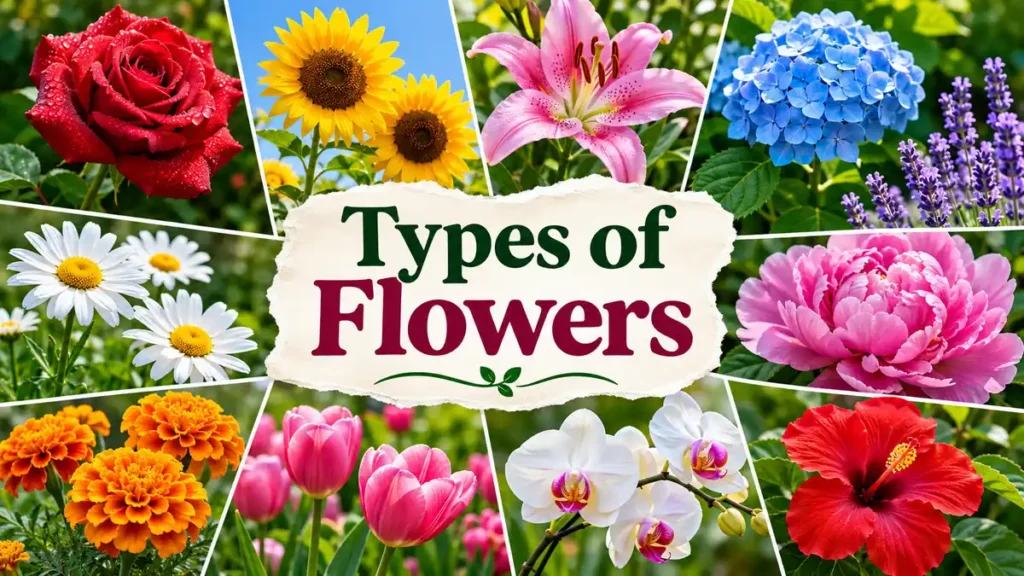
From delicate daisies to dramatic dahlias, flowers come in an extraordinary range of colors, shapes, sizes, and fragrances. Some bloom for just a few weeks, while others brighten gardens for months. Knowing the differences makes it easier to choose plants that suit your climate, available space, and gardening experience.
There are thousands of types of flowers, including annuals, perennials, biennials, bulbs, wildflowers, and flowering shrubs. Popular examples include roses, tulips, lilies, sunflowers, orchids, and hydrangeas. Each has distinctive growing requirements, flowering seasons, and characteristics, making different varieties suitable for gardens, containers, bouquets, and natural landscapes.
This guide explores 50 beautiful flowering plants, explains their classifications, and provides practical advice on selecting and growing them.
Understanding the Main types of flowers
Flowers can be grouped in several ways: by their life cycle, botanical family, growing conditions, blooming season, or flower structure.
These classifications overlap. For example, a tulip is a bulbous perennial, while a sunflower is usually grown as an annual.
Annual Flowers
Annuals complete their life cycle within one growing season. They germinate, grow, flower, produce seeds, and eventually die.
Popular annual flowers include:
- Marigolds
- Zinnias
- Cosmos
- Petunias
- Annual sunflowers
- Sweet peas
Annuals are particularly useful for adding continuous seasonal color. Many flower repeatedly when spent blooms are removed, a practice called deadheading.
Perennial Flowers
Perennials live for more than two years, although their aboveground growth may die back during winter.
Common examples include peonies, coneflowers, hostas, daylilies, and black-eyed Susans.
Perennials often require less replanting than annuals, but they do not necessarily bloom throughout the growing season. Combining early-, mid-, and late-season varieties helps create a garden with changing displays.
Biennial Flowers
Biennials typically take two growing seasons to complete their life cycle.
During the first season, they develop leaves and roots. During the second, they flower, set seed, and die.
Foxgloves, sweet William, and some hollyhocks are familiar examples, although certain varieties behave as short-lived perennials.
Bulbous Flowers
Bulbous plants store energy in underground structures that support future growth.
Gardeners often group true bulbs, corms, rhizomes, and tubers under the general term “flower bulbs,” even though these structures are botanically different.
Examples include tulips, daffodils, crocuses, irises, gladioli, and dahlias.
Flowering Shrubs and Climbers
Not all flowering plants are small bedding plants. Some develop woody stems and grow into substantial shrubs, vines, or trees.
Hydrangeas, azaleas, camellias, wisteria, and climbing roses can provide height, privacy, and structural interest.
50 Popular types of flowers With Names and Characteristics
The following varieties include familiar garden favorites, fragrant blossoms, wildflowers, tropical plants, and unusual ornamental species.
Blooming seasons refer broadly to temperate Northern Hemisphere climates. Actual flowering periods depend on location, weather, and cultivar.
1. Rose (Rosa spp.)
Roses are among the world’s most recognizable ornamental flowers. Their layered petals, distinctive fragrance, and wide color range make them popular in gardens and floral arrangements.
Roses include hybrid teas, floribundas, climbers, shrub roses, and miniature varieties.
- Colors: Red, pink, white, yellow, orange, purple
- Blooming season: Spring through autumn, depending on variety
- Sunlight: Generally six or more hours of direct sun
- Growing tip: Provide good airflow and water at soil level to reduce leaf diseases.
Most modern repeat-flowering roses bloom several times during the growing season, while many old garden roses flower once annually.
2. Tulip (Tulipa spp.)
Tulips are spring-flowering bulbs famous for their elegant cup-shaped blossoms.
They originated across regions of Central Asia and became especially associated with Dutch horticulture.
- Colors: Almost every color except true blue
- Blooming season: Spring
- Sunlight: Full sun to partial shade
- Growing tip: Plant bulbs in autumn in well-drained soil.
In warm climates, tulip bulbs may require prechilling to flower reliably.
3. Sunflower (Helianthus annuus)
Sunflowers are known for their large, bright flower heads and strong upright stems.
What appears to be a single flower is actually a composite head containing numerous small florets.
- Colors: Yellow, gold, orange, burgundy, cream
- Blooming season: Summer to early autumn
- Sunlight: Full sun
- Growing tip: Choose a sunny site and provide support for very tall cultivars.
Young sunflower buds often track the sun, a behavior called heliotropism. Mature flower heads generally settle into a fixed orientation.
4. Lily (Lilium spp.)
True lilies grow from bulbs and produce striking trumpet-shaped, bowl-shaped, or recurved flowers.
Asiatic, Oriental, trumpet, and martagon lilies offer different appearances and fragrances.
- Colors: White, pink, orange, yellow, red
- Blooming season: Late spring through summer
- Sunlight: Full sun to partial shade
- Growing tip: Keep roots cool with mulch while providing sufficient light aboveground.
Safety note: True lilies and daylilies are highly toxic to cats. Even pollen exposure can be dangerous.
5. Daisy (Bellis perennis and related species)
Daisies are valued for their simple, cheerful appearance, often featuring white ray florets surrounding a yellow center.
The name also describes many related members of the Asteraceae family.
- Colors: White, pink, yellow, purple
- Blooming season: Spring through summer
- Sunlight: Full sun to partial shade
- Growing tip: Remove faded blooms to encourage tidy growth.
Shasta daisies are particularly popular for perennial borders.
6. Orchid (Orchidaceae family)
Orchids belong to one of the largest flowering plant families and display remarkable diversity.
Popular cultivated groups include Phalaenopsis, Dendrobium, Cattleya, and Oncidium.
- Colors: White, pink, purple, yellow, green, patterned
- Blooming season: Varies by species
- Sunlight: Usually bright, indirect light for common indoor varieties
- Growing tip: Use an appropriate orchid medium rather than ordinary garden soil for epiphytic varieties.
Moth orchids are particularly suitable for indoor cultivation when given suitable temperatures and watering.
7. Marigold (Tagetes spp.)
Marigolds are easy-growing annuals with warm-colored flowers and aromatic foliage.
French and African marigolds are widely cultivated in flower beds and containers.
- Colors: Yellow, orange, gold, red combinations
- Blooming season: Summer through autumn
- Sunlight: Full sun
- Growing tip: Avoid excessive nitrogen fertilizer, which encourages foliage at the expense of blooms.
Marigolds are often planted near vegetables, although they do not universally repel every garden pest.
8. Lavender (Lavandula spp.)
Lavender is a fragrant perennial shrub known for its narrow leaves and spikes of small flowers.
It is particularly attractive to bees and other nectar-feeding insects.
- Colors: Purple, violet, blue, pink, white
- Blooming season: Late spring through summer
- Sunlight: Full sun
- Growing tip: Provide excellent drainage and avoid persistently wet soil.
English lavender generally tolerates colder conditions than many Spanish or French lavender types.
9. Hibiscus (Hibiscus spp.)
Hibiscus flowers feature large, showy petals and a prominent central staminal column.
The genus includes tropical shrubs and hardy perennial species.
- Colors: Red, pink, yellow, white, orange
- Blooming season: Summer through autumn, sometimes year-round in tropical climates
- Sunlight: Full sun to partial shade
- Growing tip: Keep tropical varieties protected from frost.
Individual hibiscus flowers may last only a day or two, but healthy plants can produce many successive blooms.
10. Peony (Paeonia spp.)
Peonies produce lush, often fragrant blossoms that can be single, semi-double, or fully double.
They are long-lived garden plants when grown in suitable conditions.
- Colors: Pink, white, red, coral, yellow
- Blooming season: Late spring to early summer
- Sunlight: Full sun
- Growing tip: Avoid planting herbaceous peony crowns too deeply.
Many herbaceous peonies need a period of winter chilling to bloom well.
11. Hydrangea (Hydrangea spp.)
Hydrangeas are flowering shrubs with large clusters of small blossoms.
Their flower heads may be rounded, conical, or lacecap-shaped.
- Colors: Pink, blue, purple, white, green
- Blooming season: Summer into autumn
- Sunlight: Morning sun with afternoon shade in warmer regions
- Growing tip: Identify the species before pruning because flowering wood differs.
In many bigleaf hydrangeas, soil pH and aluminum availability influence whether flowers appear pink or blue. This effect does not apply equally to every species.
12. Daffodil (Narcissus spp.)
Daffodils are dependable spring-flowering bulbs with distinctive trumpet-like or cup-shaped centers.
They are often among the earliest signs of spring.
- Colors: Yellow, white, orange, pink-accented
- Blooming season: Late winter through spring
- Sunlight: Full sun to partial shade
- Growing tip: Allow foliage to yellow naturally after flowering.
All parts of daffodils are poisonous if eaten, especially the bulbs.
13. Carnation (Dianthus caryophyllus)
Carnations are famous for their ruffled petals, spicy fragrance, and long-lasting cut flowers.
They belong to the Dianthus genus, which also includes pinks and sweet William.
- Colors: Pink, red, white, yellow, purple, green
- Blooming season: Spring through summer
- Sunlight: Full sun
- Growing tip: Grow in well-drained soil and avoid overcrowding.
14. Chrysanthemum (Chrysanthemum × morifolium)
Chrysanthemums, commonly called mums, are prized for their abundant autumn blooms.
Cultivars range from small daisy-like flowers to large decorative forms.
- Colors: Yellow, bronze, white, pink, purple, red
- Blooming season: Late summer through autumn
- Sunlight: Full sun
- Growing tip: Pinch young shoots in spring or early summer for bushier plants.
Many chrysanthemums respond to shortening day length, which helps trigger flowering.
15. Jasmine (Jasminum spp.)
Jasmine is admired for its delicate flowers and, in many species, intensely sweet fragrance.
Different species grow as shrubs or climbing vines.
- Colors: White, yellow, occasionally pink
- Blooming season: Depends on species
- Sunlight: Full sun to partial shade
- Growing tip: Provide a trellis for climbing varieties.
Not every plant commonly called jasmine belongs to the Jasminum genus.
16. Lotus (Nelumbo nucifera)
Lotus is an aquatic perennial known for its large flowers and water-repellent leaves.
It carries cultural significance in several Asian traditions.
- Colors: Pink, white
- Blooming season: Summer
- Sunlight: Full sun
- Growing tip: Grow in a large aquatic container or suitable pond with adequate warmth.
Lotus differs botanically from water lilies, although both are aquatic flowering plants.
17. Water Lily (Nymphaeaceae family)
Water lilies float their leaves on the water surface and produce elegant blossoms above or near the surface.
Hardy and tropical varieties have different temperature requirements.
- Colors: White, pink, yellow, red, blue, purple
- Blooming season: Usually summer
- Sunlight: Full sun for abundant flowering
- Growing tip: Select a variety appropriate for the depth and size of your pond.
18. Poppy (Papaver spp.)
Poppies are recognized by their delicate, often papery petals and distinctive seed capsules.
Common ornamental species include Oriental poppies and Iceland poppies.
- Colors: Red, orange, pink, white, yellow
- Blooming season: Spring to summer
- Sunlight: Full sun
- Growing tip: Many poppies prefer direct sowing because they dislike root disturbance.
19. Iris (Iris spp.)
Irises have distinctive flower structures with upright petals called standards and downward-facing sepals called falls.
Bearded, Siberian, and Japanese irises are popular garden groups.
- Colors: Purple, blue, yellow, white, pink, nearly black
- Blooming season: Spring to early summer
- Sunlight: Full sun for many varieties
- Growing tip: Keep bearded iris rhizomes near the soil surface.
20. Dahlia (Dahlia spp.)
Dahlias are renowned for their extraordinary variety of flower shapes and sizes.
Decorative, cactus, pompon, ball, and dinnerplate dahlias offer different garden effects.
- Colors: Nearly every color except true blue
- Blooming season: Summer until frost
- Sunlight: Full sun
- Growing tip: Stake tall varieties and lift tubers where winters are too cold for them to survive outdoors.
21. Zinnia (Zinnia spp.)
Zinnias are colorful annuals that thrive in sunny summer gardens.
They are popular with butterflies and make excellent cut flowers.
- Colors: Pink, orange, yellow, red, white, purple, green
- Blooming season: Summer through autumn
- Sunlight: Full sun
- Growing tip: Space plants generously to improve airflow and reduce powdery mildew.
22. Petunia (Petunia × atkinsiana)
Petunias are widely used in hanging baskets, containers, and bedding displays.
Their trumpet-shaped flowers may be single, double, striped, or patterned.
- Colors: Pink, purple, white, red, yellow, multicolored
- Blooming season: Spring through autumn
- Sunlight: Full sun
- Growing tip: Water containers regularly and feed during active growth.
23. Begonia (Begonia spp.)
Begonias include thousands of species and cultivars with ornamental foliage and colorful flowers.
Wax begonias, tuberous begonias, and cane begonias have different growing habits.
- Colors: Red, pink, orange, yellow, white
- Blooming season: Depends on variety
- Sunlight: Partial shade or bright indirect light for many varieties
- Growing tip: Avoid waterlogged compost and excessive direct afternoon sun.
24. Geranium (Pelargonium spp.)
The familiar bedding plants called geraniums usually belong to the genus Pelargonium, rather than the true geranium genus.
They are valued for colorful flower clusters and relatively drought-tolerant growth.
- Colors: Red, pink, white, salmon, purple
- Blooming season: Spring through autumn
- Sunlight: Full sun to partial shade
- Growing tip: Let the upper soil layer dry slightly between waterings.
25. Camellia (Camellia spp.)
Camellias are evergreen shrubs with glossy leaves and elegant rose-like blossoms.
They provide valuable color during cooler months.
- Colors: White, pink, red, variegated
- Blooming season: Autumn through spring, depending on species
- Sunlight: Partial shade
- Growing tip: Plant in acidic, well-drained soil and protect from harsh drying winds.
26. Azalea (Rhododendron spp.)
Azaleas belong to the rhododendron group and are famous for spectacular spring displays.
They can be evergreen or deciduous.
- Colors: Pink, red, white, orange, purple
- Blooming season: Spring, with some reblooming cultivars
- Sunlight: Partial shade
- Growing tip: Use acidic soil and avoid allowing shallow roots to dry completely.
27. Magnolia (Magnolia spp.)
Magnolias are ancient flowering plants with large, often fragrant blossoms.
Some species bloom before their leaves emerge, creating a dramatic spring display.
- Colors: White, pink, purple, yellow
- Blooming season: Late winter through summer, depending on species
- Sunlight: Full sun to partial shade
- Growing tip: Choose the planting location carefully because established magnolias dislike root disturbance.
28. Gardenia (Gardenia jasminoides)
Gardenias are evergreen shrubs prized for creamy white flowers and powerful fragrance.
They are often grown in warm-climate gardens or as container plants.
- Colors: White to creamy yellow
- Blooming season: Late spring through summer
- Sunlight: Bright light with protection from intense afternoon sun
- Growing tip: Maintain acidic soil and consistent moisture.
29. Freesia (Freesia hybrids)
Freesias produce arching stems of fragrant, funnel-shaped flowers.
They are widely appreciated in floral arrangements.
- Colors: White, yellow, pink, purple, red, orange
- Blooming season: Spring under many growing conditions
- Sunlight: Full sun to light shade
- Growing tip: Plant corms in free-draining soil and protect them from severe frost.
30. Gladiolus (Gladiolus spp.)
Gladioli grow tall spikes of flowers that open progressively along the stem.
Their upright habit makes them especially useful in cutting gardens.
- Colors: Almost every color
- Blooming season: Summer
- Sunlight: Full sun
- Growing tip: Plant corms in successive batches for a longer flowering period.
31. Ranunculus (Ranunculus asiaticus)
Persian buttercups are admired for their densely layered petals and rounded flowers.
They resemble miniature peonies or roses.
- Colors: White, yellow, orange, pink, red, purple
- Blooming season: Spring
- Sunlight: Full sun
- Growing tip: Grow in cool conditions with excellent drainage.
32. Anemone (Anemone spp.)
Anemones include spring-flowering woodland plants and autumn-blooming garden perennials.
The popular florist’s anemone, Anemone coronaria, features a dark central disc.
- Colors: White, pink, red, blue, purple
- Blooming season: Spring or autumn, depending on species
- Sunlight: Full sun to partial shade
- Growing tip: Match the variety to your soil moisture and seasonal conditions.
33. Crocus (Crocus spp.)
Crocuses are small flowering plants that often emerge when winter is ending.
Some species bloom in autumn rather than spring.
- Colors: Purple, yellow, white, striped
- Blooming season: Late winter to spring or autumn
- Sunlight: Full sun to partial shade
- Growing tip: Plant corms in autumn for spring-flowering varieties.
Saffron comes from the autumn-flowering species Crocus sativus.
34. Bluebell (Hyacinthoides non-scripta)
English bluebells form graceful clusters of nodding, bell-shaped flowers.
They are associated with spring woodland landscapes.
- Colors: Violet-blue, occasionally white or pink
- Blooming season: Spring
- Sunlight: Partial shade
- Growing tip: Grow in humus-rich soil beneath deciduous trees.
In areas where English bluebells are native, avoid introducing potentially invasive Spanish bluebells or hybrids into natural woodland.
35. Hyacinth (Hyacinthus orientalis)
Hyacinths produce dense spikes of strongly fragrant flowers.
They are commonly grown in spring borders and containers.
- Colors: Blue, purple, pink, white, yellow
- Blooming season: Spring
- Sunlight: Full sun to partial shade
- Growing tip: Plant bulbs in autumn and wear gloves if their sap irritates your skin.
36. Foxglove (Digitalis purpurea)
Foxgloves grow tall spikes of tubular flowers, often marked with spots inside.
They are particularly attractive to bumblebees.
- Colors: Purple, pink, white, cream
- Blooming season: Late spring through summer
- Sunlight: Partial shade to full sun
- Growing tip: Allow selected plants to self-seed for future displays.
Safety note: Foxgloves contain toxic cardiac glycosides and must never be eaten.
37. Delphinium (Delphinium spp.)
Delphiniums produce impressive vertical flower spikes, often in shades of blue rarely found in other garden plants.
They are traditional favorites in cottage gardens.
- Colors: Blue, purple, pink, white
- Blooming season: Early to midsummer
- Sunlight: Full sun
- Growing tip: Stake tall plants and protect young growth from slugs.
All parts of delphiniums are potentially poisonous.
38. Hollyhock (Alcea rosea)
Hollyhocks produce tall stems lined with large, open flowers.
They are particularly suited to walls, fences, and traditional cottage gardens.
- Colors: Pink, red, white, yellow, purple, nearly black
- Blooming season: Summer
- Sunlight: Full sun
- Growing tip: Maintain airflow to reduce hollyhock rust.
39. Sweet Pea (Lathyrus odoratus)
Sweet peas are climbing annuals known for their delicate, fragrant blossoms.
They make excellent cut flowers when harvested regularly.
- Colors: Pink, purple, red, white, blue-toned
- Blooming season: Spring to early summer in many climates
- Sunlight: Full sun
- Growing tip: Provide support and keep roots cool during warm weather.
Ornamental sweet pea seeds are toxic and should not be confused with edible garden peas.
40. Morning Glory (Ipomoea spp.)
Morning glories are vigorous climbers with trumpet-shaped flowers.
Many varieties open in the morning and close later in the day.
- Colors: Blue, purple, pink, white, red
- Blooming season: Summer through autumn
- Sunlight: Full sun
- Growing tip: Provide climbing support and check local invasive plant guidance before planting.
41. Bougainvillea (Bougainvillea spp.)
Bougainvillea is a tropical climbing shrub known for brilliant papery bracts surrounding tiny true flowers.
It thrives in warm, sunny climates.
- Colors: Magenta, purple, pink, orange, red, white
- Blooming season: Repeatedly in warm climates
- Sunlight: Full sun
- Growing tip: Avoid excessive watering and nitrogen fertilizer.
42. Wisteria (Wisteria spp.)
Wisteria produces cascading clusters of fragrant pea-like flowers.
Its woody vines can become extremely heavy with age.
- Colors: Purple, lavender, white, pink
- Blooming season: Spring, sometimes with lighter repeat flowering
- Sunlight: Full sun
- Growing tip: Use strong structural supports and prune regularly.
Some wisteria species are invasive in parts of North America. Native alternatives may be preferable.
43. Clematis (Clematis spp.)
Clematis is a diverse group of climbing plants with star-shaped, bell-shaped, or open flowers.
Different varieties flower at different times.
- Colors: Purple, blue, pink, white, red
- Blooming season: Spring through autumn, depending on cultivar
- Sunlight: Sun to partial shade
- Growing tip: Determine the correct pruning group before cutting back established plants.
44. Passion Flower (Passiflora spp.)
Passion flowers have unusually intricate floral structures, including a distinctive corona of filaments.
Some species produce edible passion fruit.
- Colors: Purple, blue, white, red, pink
- Blooming season: Summer to autumn
- Sunlight: Full sun to partial shade
- Growing tip: Provide a trellis and protect frost-sensitive species.
45. Bird of Paradise (Strelitzia reginae)
Bird of paradise is a tropical perennial with striking flowers resembling a colorful bird’s head.
It is widely used in warm-climate landscapes.
- Colors: Orange and blue
- Blooming season: Often winter through spring in suitable climates
- Sunlight: Full sun to bright partial shade
- Growing tip: Provide warmth, good drainage, and sufficient light.
46. Coneflower (Echinacea purpurea)
Purple coneflowers are hardy North American perennials with prominent cone-shaped centers.
Their flowers attract bees and butterflies, while seed heads can provide food for birds.
- Colors: Purple-pink, white, orange, yellow, red cultivars
- Blooming season: Summer through early autumn
- Sunlight: Full sun
- Growing tip: Leave some seed heads standing through winter.
47. Black-Eyed Susan (Rudbeckia hirta)
Black-eyed Susans feature golden-yellow ray florets surrounding dark central discs.
They are popular in pollinator gardens and naturalistic planting schemes.
- Colors: Yellow, gold, orange, reddish combinations
- Blooming season: Summer through autumn
- Sunlight: Full sun
- Growing tip: Allow some plants to set seed for future growth.
Depending on climate and cultivar, Rudbeckia hirta may behave as an annual, biennial, or short-lived perennial.
48. Cosmos (Cosmos bipinnatus)
Cosmos are airy annuals with finely divided foliage and delicate daisy-like flowers.
They thrive in sunny, relatively lean soil.
- Colors: Pink, white, magenta, crimson
- Blooming season: Summer through autumn
- Sunlight: Full sun
- Growing tip: Avoid overfertilizing because rich soil can encourage leaves rather than flowers.
49. Snapdragon (Antirrhinum majus)
Snapdragons produce colorful spikes of tubular, two-lipped flowers.
The blossoms resemble a dragon’s mouth when gently squeezed.
- Colors: Red, pink, yellow, orange, white, purple
- Blooming season: Spring and autumn in cool climates
- Sunlight: Full sun
- Growing tip: Grow during cooler weather for the best flowering performance.
50. Bleeding Heart (Lamprocapnos spectabilis)
Bleeding hearts are shade-loving perennials recognized by their dangling, heart-shaped flowers.
They are especially attractive in woodland-style gardens.
- Colors: Pink and white, or pure white
- Blooming season: Spring to early summer
- Sunlight: Partial to full shade
- Growing tip: Maintain moist, well-drained soil and avoid disturbing the roots.
Their foliage often dies back during summer dormancy, which is normal.
Different types of flowers by Color
Flower color is one of the easiest ways to organize a garden. Colors can create contrast, establish a peaceful atmosphere, or attract attention to a particular area.
Red Flowers
Red flowers create bold focal points and are traditionally associated with love, passion, and courage.
Popular red varieties include roses, poppies, carnations, dahlias, hibiscus, and red tulips.
Red blossoms work especially well alongside white flowers or dark green foliage.
Pink Flowers
Pink flowers range from soft pastel shades to vivid magenta.
Popular examples include peonies, cherry blossoms, pink roses, cosmos, carnations, and hydrangeas.
Pale pink combines beautifully with lavender, white, and blue flowers.
White Flowers
White flowers brighten shaded areas and remain visually striking in evening gardens.
Popular examples include gardenias, jasmine, white lilies, daisies, magnolias, and white roses.
Fragrant white flowers are particularly effective near patios, pathways, and seating areas.
Yellow Flowers
Yellow flowers add warmth and visual energy.
Sunflowers, daffodils, marigolds, yellow roses, black-eyed Susans, and coreopsis are familiar choices.
Yellow pairs naturally with purple or blue for strong color contrast.
Blue and Purple Flowers
True blue is relatively uncommon among flowering plants, making blue blossoms particularly desirable.
Examples include delphiniums, bluebells, irises, hydrangeas, and certain morning glories.
Purple flowers include lavender, clematis, violets, alliums, and some orchids.
Flower color may vary according to cultivar, growing conditions, and, in certain species, soil chemistry.
types of flowers by Blooming Season
A successful flower garden does not depend on one spectacular display. It uses different plants to maintain interest throughout the year.
| Season | Popular flowers | Main characteristics |
|---|---|---|
| Spring | Tulips, daffodils, hyacinths, peonies, irises | Fresh growth and early color |
| Summer | Roses, lilies, zinnias, sunflowers, dahlias | Abundant flowers and vibrant colors |
| Autumn | Chrysanthemums, asters, dahlias, Japanese anemones | Late-season color |
| Winter | Camellias, hellebores, winter jasmine, snowdrops | Flowers during cooler months in suitable climates |
These seasonal categories are approximate. In tropical and subtropical regions, flowering calendars can be significantly different.
Spring-Blooming Flowers
Spring flowers often emerge from bulbs or established perennial roots.
Tulips, crocuses, daffodils, and hyacinths are especially useful for early displays.
Many spring bulbs require a period of cold weather to develop normally. Gardeners in warmer regions may need to select heat-adapted alternatives or use prechilled bulbs.
Summer-Blooming Flowers
Summer is the main flowering season for many garden annuals and warm-weather perennials.
Zinnias, cosmos, marigolds, sunflowers, dahlias, and coneflowers thrive when their sunlight and moisture needs are met.
For continuous summer color, combine plants with different flowering periods and remove spent blossoms from varieties that respond well to deadheading.
Autumn-Blooming Flowers
Autumn flowers extend garden interest as temperatures begin to decline.
Chrysanthemums, asters, Japanese anemones, and late-flowering dahlias are useful choices.
Some autumn-blooming plants also provide important nectar and pollen when fewer flowers are available.
Winter-Blooming Flowers
Winter flowers are especially valuable because they bring color during a relatively quiet gardening season.
Camellias, hellebores, winter jasmine, and snowdrops are well-known examples.
Their suitability depends on local winter temperatures, rainfall, and frost exposure.
Choosing Flowers for Different Growing Conditions
Selecting flowers according to their growing environment is more reliable than choosing by appearance alone.
Best Flowers for Full Sun
Full sun generally means at least six hours of direct sunlight daily.
Good choices include:
- Sunflowers
- Zinnias
- Marigolds
- Lavender
- Coneflowers
- Cosmos
- Black-eyed Susans
In extremely hot climates, even sun-loving plants may benefit from protection during the most intense afternoon heat. MU Extension
Best Flowers for Partial Shade
Partial shade is suitable for plants that benefit from some direct sunlight but do not tolerate intense exposure throughout the day.
Consider begonias, hydrangeas, azaleas, camellias, and certain irises.
Morning sunlight with afternoon shade is particularly useful in hot regions.
Best Flowers for Shady Gardens
Shade gardening requires more careful plant selection, but attractive flowers are still possible.
Bleeding hearts, woodland anemones, hellebores, and certain begonias can perform well in suitable shaded conditions.
Very deep shade limits flowering, so consider foliage plants alongside flowering species.
Best Drought-Tolerant Flowers
Some flowering plants tolerate dry conditions once their roots are established.
Examples include lavender, cosmos, coneflowers, blanket flowers, and certain salvias.
Drought tolerance does not mean plants require no water. Newly planted specimens need regular moisture until established.
Best Flowers for Containers
Containers are useful for balconies, patios, terraces, and small gardens.
Petunias, geraniums, begonias, marigolds, dwarf zinnias, and miniature roses are popular options.
Choose pots with drainage holes and use a growing medium appropriate for the plant. Container soil generally dries faster than garden soil, particularly during hot weather.
Fragrant Flowers for Gardens and Indoor Spaces
Fragrance adds another dimension to flowering plants. Some release their strongest scent during daylight, while others become more fragrant in the evening.
| Flower | Typical fragrance | Suitable location |
|---|---|---|
| Rose | Sweet, floral, sometimes fruity | Borders and pathways |
| Jasmine | Rich, sweet | Trellises and patios |
| Gardenia | Strong, creamy, sweet | Warm-climate gardens and containers |
| Lavender | Herbal, aromatic | Sunny borders |
| Freesia | Sweet, lightly citrus-like | Cutting gardens |
| Hyacinth | Rich, sweet | Spring containers |
| Sweet pea | Delicate, sweet | Fences and cutting gardens |
| Peony | Sweet or rose-like in fragrant cultivars | Perennial borders |
Fragrance intensity varies considerably between cultivars. Some modern roses, for example, have little noticeable scent despite their attractive flowers.
Position strongly scented plants near places where their fragrance can be enjoyed without overwhelming enclosed spaces.
Flower Meanings and Symbolism
Flowers have carried symbolic meanings across cultures for centuries. Their associations may differ by country, religion, historical period, and occasion.
| Flower | Common symbolic meaning |
|---|---|
| Red rose | Romantic love |
| White rose | Purity, remembrance |
| Sunflower | Admiration, happiness |
| Lily | Purity, renewal |
| Daisy | Innocence, simplicity |
| Lotus | Spiritual growth, purity |
| Lavender | Calmness, devotion |
| Peony | Prosperity, romance |
| Forget-me-not | Remembrance |
| Chrysanthemum | Longevity or remembrance, depending on culture |
| Orchid | Beauty, refinement |
| Tulip | Love, renewal |
These meanings are cultural traditions rather than botanical properties.
For example, chrysanthemums are associated with celebration and longevity in some East Asian contexts, while certain European traditions connect them with remembrance and mourning.
Best Flowers for Bees, Butterflies, and Other Pollinators
Flowers play an essential role in supporting pollinators. Bees, butterflies, moths, hoverflies, beetles, and some birds visit flowers to collect nectar or pollen.
However, not every ornamental flower provides the same ecological value.
Flowers That Attract Bees
Bee-friendly plants include lavender, coneflowers, sunflowers, cosmos, borage, and many salvias.
Single-flowered varieties are often easier for pollinators to access than heavily doubled flowers.
Native flowering plants are particularly valuable because they may support specialized local insects.
Flowers That Attract Butterflies
Butterflies frequently visit zinnias, coneflowers, asters, cosmos, and certain milkweed species.
Adult butterflies need nectar, but their caterpillars often require specific host plants.
For example, monarch butterfly caterpillars depend on milkweeds in the genus Asclepias.
A successful butterfly garden therefore includes both nectar sources and appropriate host plants.
Creating a Pollinator-Friendly Flower Garden
A few practical choices can make a significant difference:
- Choose a variety of flower shapes and colors.
- Include plants that bloom in spring, summer, and autumn.
- Prioritize locally native species where possible.
- Avoid unnecessary insecticide applications, especially during flowering.
- Provide shallow water sources and suitable nesting habitat.
- Leave some seed heads and undisturbed stems for wildlife.
A garden containing several complementary plant species generally provides more diverse resources than one dominated by a single ornamental variety.
How to Choose the Right Flowers for Your Garden
Choosing flowering plants becomes easier when you consider environmental conditions before appearance.
Step 1: Check Your Climate
Determine whether your area experiences freezing winters, intense summer heat, high humidity, or prolonged dry periods.
In the United States, USDA Plant Hardiness Zones provide guidance about average annual extreme minimum winter temperatures.
These zones help assess winter survival but do not describe summer heat, rainfall, or every other growing condition.
Step 2: Measure Available Sunlight
Observe your garden at different times of day.
A location receiving six or more hours of direct sun is generally considered full sun, while a position receiving fewer hours may be classified as partial sun or shade.
Buildings, trees, and seasonal changes can affect the amount of light reaching plants.
Step 3: Examine Soil and Drainage
Soil texture and drainage strongly influence plant health.
Sandy soils drain quickly, while clay-rich soils often retain moisture longer.
Most common garden flowers prefer soil that drains well without drying excessively. However, aquatic plants, bog plants, and moisture-loving woodland species have different requirements.
Step 4: Consider Mature Plant Size
A small nursery plant may eventually grow several feet tall or wide.
Check its expected mature height and spread before planting.
Tall delphiniums and hollyhocks work well at the back of borders, while compact marigolds and begonias can fill the front.
Step 5: Plan for Continuous Blooms
Combine flowers with different flowering periods.
For example, a temperate garden might feature daffodils in early spring, peonies in late spring, coneflowers in summer, and asters in autumn.
Mixing annuals and perennials is an effective way to fill seasonal gaps. missouribotanicalgarden.org
How to Grow Healthy Flowers: Essential Care Tips
Even easy-to-grow flowering plants benefit from consistent care.
Watering
Water according to the needs of the species, soil, and weather.
Deep, less frequent watering often encourages stronger root development in established garden plants, although seedlings and container plants may need more frequent attention.
Check soil moisture before watering rather than following a rigid schedule.
Fertilizing
Flowering plants need essential nutrients, including nitrogen, phosphorus, and potassium.
Nitrogen supports leafy growth, phosphorus contributes to several plant functions, and potassium helps regulate important physiological processes.
Excessive fertilizer can cause weak growth, nutrient imbalances, or fewer flowers.
A soil test is the best starting point for determining whether additional nutrients are necessary.
Mulching
Organic mulch can help conserve soil moisture, suppress weeds, and moderate soil temperature.
Compost, shredded leaves, and suitable bark materials are common choices.
Keep mulch away from plant crowns and woody stems to reduce moisture-related problems.
Deadheading
Deadheading means removing faded flowers.
It encourages additional flowering in many annuals and repeat-blooming perennials by reducing seed production.
However, leave selected flower heads intact if you want seeds for propagation or food for birds.
Pruning
Pruning requirements vary widely.
Roses may benefit from seasonal pruning, while some hydrangeas bloom on old wood and can lose their flower buds if cut at the wrong time.
Always identify the plant and its flowering habit before pruning.
Managing Pests and Diseases
Common flower garden problems include aphids, powdery mildew, rust, slugs, and root rot.
Prevention begins with healthy growing conditions.
Adequate spacing, appropriate watering, clean gardening tools, and regular inspection can reduce many problems.
Use targeted, low-impact pest management methods where practical rather than treating every insect as harmful.
Common Mistakes When Growing Different types of flowers
Many disappointing flower displays result from a few avoidable problems.
Planting in the wrong light conditions: Sun-loving flowers often produce weak growth and fewer blooms in deep shade. Shade-adapted plants may suffer leaf scorch in intense sunlight.
Overwatering: Constantly saturated soil can limit oxygen around roots and encourage root diseases.
Ignoring mature size: Overcrowded plants compete for light, moisture, and nutrients while reducing airflow.
Using excessive nitrogen fertilizer: This may produce lush leaves but relatively few flowers in some species.
Pruning at the wrong time: Cutting spring-flowering shrubs after their flower buds have formed can remove the following season’s blooms.
Choosing plants unsuitable for the climate: Tropical hibiscus and bougainvillea, for example, cannot reliably survive freezing winters without protection.
Overlooking toxicity: Lilies, foxgloves, daffodils, and several other ornamental plants can pose serious risks to pets or people if ingested.
Understanding these limitations helps gardeners avoid unnecessary expense and frustration.
Annual vs. Perennial vs. Bulb Flowers: Key Differences
These groups are frequently confused because they describe different aspects of plant growth.
| Feature | Annuals | Perennials | Bulbous plants |
|---|---|---|---|
| Life cycle | One growing season | Multiple years | Often perennial |
| Replanting | Usually each year | Usually unnecessary | Depends on species and climate |
| Flowering duration | Often prolonged | Varies by species | Often seasonal |
| Examples | Zinnia, cosmos, marigold | Peony, coneflower, lavender | Tulip, daffodil, lily |
| Maintenance | Seasonal planting and care | Ongoing care and occasional division | Planting, dormancy, sometimes lifting |
| Best use | Quick seasonal color | Long-term garden structure | Distinctive seasonal displays |
Bulbous plants are not a separate life-cycle category. Most are perennials, but gardeners sometimes treat them as annuals when local conditions prevent reliable reblooming.
The Royal Horticultural Society also distinguishes true bulbs from other underground storage organs, such as corms and tubers. RHS Advice+1
Which Flowers Are Easiest for Beginners?
For gardeners planting their first flower bed, reliable growth and straightforward maintenance matter more than unusual appearance.
Zinnias, marigolds, cosmos, sunflowers, and nasturtiums are useful starting points for sunny locations.
These plants generally germinate readily from seed under suitable conditions and provide visible results within a single growing season.
For longer-term planting, consider coneflowers, daylilies, and other perennials adapted to your region.
The Royal Horticultural Society recommends annuals as practical plants for filling borders and containers with seasonal color, while perennials can provide repeat displays over multiple years. RHS+1
A manageable beginner garden might combine three plant types: a low-growing annual for border color, a medium-height perennial for structure, and a taller flowering plant for visual interest.
Start with a small number of varieties, learn how they respond to your local conditions, and expand gradually.
Final Thoughts on types of flowers
The remarkable diversity of flowering plants means there is a suitable choice for almost every garden style, climate, and growing space.
Roses and peonies provide classic beauty, sunflowers and zinnias bring cheerful summer color, orchids offer intricate blossoms, and flowering shrubs such as hydrangeas and camellias create lasting structure.
The most successful flower gardens combine appearance with practical growing requirements. Sunlight, drainage, temperature, flowering season, mature size, and maintenance needs all deserve consideration.
By understanding the different types of flowers and selecting varieties suited to your environment, you can create a colorful, healthy, and rewarding garden that changes beautifully throughout the seasons.