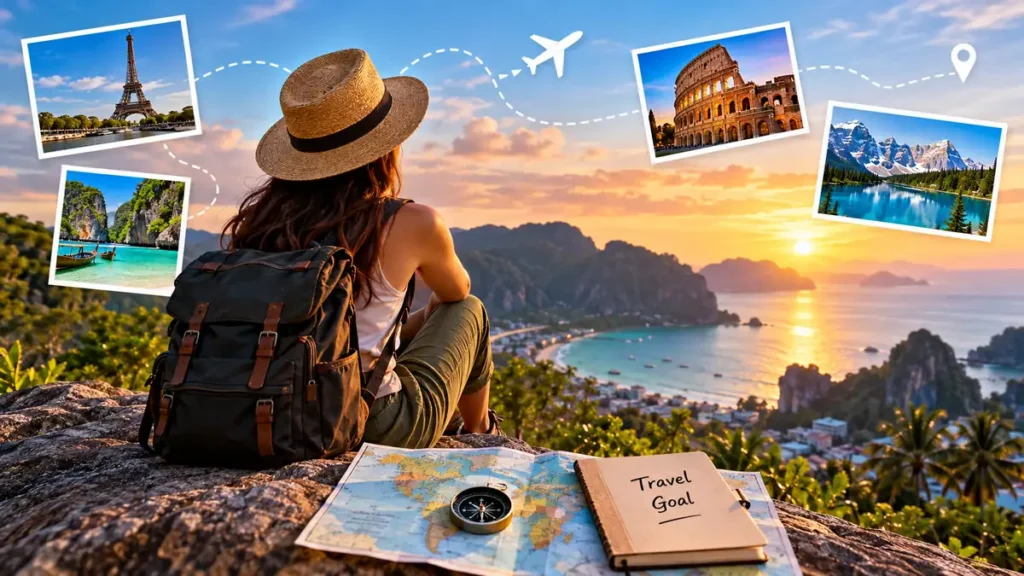
Travel becomes more rewarding when you know what you want to experience, not just where you want to go. A trip might be about exploring another culture, spending quality time with family, learning a language, or finally visiting a destination you’ve dreamed about for years.
A travel goal gives those ambitions direction. Instead of keeping a vague wish to travel more, you can identify meaningful experiences, establish priorities, create a realistic budget, and work toward achievable milestones.
A travel goal is a specific objective someone wants to accomplish through travel. It may involve visiting a particular destination, experiencing a new culture, completing an adventure, improving personal well-being, or traveling more sustainably. Effective travel goals combine personal motivation with practical planning, including a timeline, budget, and measurable outcome.
What Is a travel goal?
A travel goal is an intention or achievement you want to pursue through traveling. It helps answer three essential questions: Where do you want to go, why does the experience matter, and what will you do to make it happen?
Travel goals can be simple or ambitious. Someone might want to take their first solo trip, while another person dreams of visiting every continent.
The important distinction is that a goal provides more direction than a general travel wish.
For example:
- Travel wish: I want to visit Europe someday.
- Travel goal: I want to spend ten days exploring Italy within the next two years.
- Action plan: Save a fixed amount monthly, research transportation, check entry requirements, and develop an itinerary.
A clear objective helps transform an exciting possibility into something you can prepare for.
Travel goals vs. travel bucket lists
Although the terms are often used interchangeably, they serve slightly different purposes.
| Travel goal | Travel bucket list |
|---|---|
| Focuses on a specific achievement | Collects desired experiences |
| Usually includes a timeline | May have no deadline |
| Encourages actionable planning | Encourages inspiration |
| Considers practical limitations | May include distant dreams |
| Measures progress | Tracks experiences completed |
A bucket list can provide the inspiration behind a travel goal. Selecting one item and creating a practical plan turns that dream into an objective.
Why Setting Travel Goals Matters
Travel goals are useful because time, money, and personal responsibilities often compete with the desire to explore.
Without priorities, it’s easy to postpone a trip indefinitely or spend money on experiences that don’t match your interests.
Creates a sense of purpose
Purposeful travel helps you decide what matters most.
A history enthusiast may prefer visiting archaeological sites, while someone seeking relaxation might prioritize quiet coastal destinations.
Neither approach is better. The right choice depends on what you hope to gain.
Improves financial planning
Travel involves transportation, accommodation, food, activities, insurance, and unexpected expenses.
Having a defined objective allows you to estimate costs and develop a savings plan.
For example, if your estimated trip budget is $2,400 and you have 12 months to save, setting aside $200 monthly would meet that target, assuming costs remain unchanged.
Encourages personal development
Travel can introduce unfamiliar environments, languages, and social situations.
Experiences such as navigating public transportation abroad or communicating across language barriers may strengthen confidence, adaptability, and problem-solving skills.
These benefits are possibilities rather than guaranteed outcomes. Much depends on the experiences you choose and how you engage with them.
Makes experiences more memorable
A meaningful objective encourages you to participate actively rather than simply visit attractions.
Learning traditional cooking techniques, exploring local history, or completing a challenging hiking route may create a stronger personal connection to a destination.
15 Inspiring travel goal Examples
Travel ambitions don’t have to involve expensive international journeys. They can focus on adventure, education, relationships, cultural understanding, or experiences close to home.
1. Visit a new country every year
Exploring one unfamiliar country annually can introduce you to different cultures, landscapes, and traditions.
The number of destinations matters less than the quality of your experiences.
2. Take your first solo trip
Solo travel provides an opportunity to practice independent decision-making.
Begin with a familiar or relatively accessible destination, especially if you’ve never traveled alone.
3. Explore all seven continents
Visiting Asia, Africa, Europe, North America, South America, Australia, and Antarctica is a long-term ambition for some travelers.
This goal requires substantial financial planning, especially for remote destinations such as Antarctica.
4. Experience a famous natural wonder
Examples include the Grand Canyon, Victoria Falls, the Great Barrier Reef, and the Northern Lights.
Each offers a different experience, from geological landscapes to wildlife and atmospheric phenomena.
5. Learn a language through travel
Visiting a place where your target language is spoken can provide opportunities for practical conversation.
You might set a goal of attending a short language course or practicing everyday communication during your stay.
6. Complete an adventure challenge
Adventure-focused objectives might include trekking in Nepal, walking part of the Camino de Santiago, or completing a multi-day cycling route.
Match the challenge to your fitness, experience, and safety requirements.
7. Plan a family vacation annually
Family travel can provide opportunities for shared experiences outside everyday routines.
The destination doesn’t need to be far away. A weekend trip to a nearby national park can be meaningful.
8. Discover your own country
Domestic tourism offers opportunities to explore regional food, heritage sites, natural attractions, and communities.
It can also reduce some of the costs and administrative requirements associated with international travel.
9. Attend an international cultural festival
Events such as Carnival in Rio de Janeiro, Oktoberfest in Munich, and Japan’s traditional matsuri festivals attract travelers interested in cultural celebrations.
Research local customs, event schedules, and accommodation availability before planning.
10. Visit a UNESCO World Heritage Site
The UNESCO World Heritage List includes cultural and natural sites recognized for their outstanding universal value.
Examples include Machu Picchu, the Taj Mahal, and the historic center of Rome.
A possible goal is to explore three World Heritage Sites over the next two years.
11. Try slow travel
Slow travel emphasizes spending more time in fewer places.
Instead of visiting five cities in one week, you might spend several days exploring one destination’s neighborhoods, markets, food, and daily life.
12. Travel more sustainably
Sustainable travel goals may include choosing lower-emission transportation where practical, reducing waste, respecting wildlife, and supporting locally owned businesses.
The objective is to reduce negative impacts while contributing positively to destinations.
13. Take a digital detox vacation
A digital detox trip involves intentionally reducing screen time and online distractions.
You could spend a weekend hiking, reading, or relaxing without regularly checking social media.
Keep essential communication and emergency navigation available.
14. Explore world cuisines
Food-focused travel allows you to discover culinary traditions through local markets, cooking classes, and regional restaurants.
A specific goal might be learning to prepare three traditional dishes during a visit to Thailand.
15. Create a travel photography project
Photography can provide a creative purpose for exploring.
For example, you could document traditional architecture, local landscapes, or public markets across several destinations.
Remember to respect people’s privacy and local photography restrictions.
How to Set a Realistic travel goal Step by Step
Setting a travel goal works best when you combine personal motivation with realistic planning. A structured approach helps you understand what you want, estimate what it requires, and measure your progress.
Step 1: Identify your travel motivation
Before choosing a destination, consider what you want from the experience.
You might want to relax, reconnect with loved ones, develop a new skill, explore history, or challenge yourself physically.
Your motivation influences the destination, travel style, activities, and budget.
For example, someone interested in cultural immersion may enjoy staying longer in one city rather than moving between several countries.
Step 2: Apply the SMART goal framework
SMART stands for Specific, Measurable, Achievable, Relevant, and Time-bound. This framework helps turn broad ambitions into practical objectives.
Cruise America
+1
| SMART element | Travel planning example |
|---|---|
| Specific | Visit Japan for a cultural vacation |
| Measurable | Spend seven days exploring Tokyo and Kyoto |
| Achievable | Save enough to cover estimated expenses |
| Relevant | Experience Japanese culture and history |
| Time-bound | Complete the trip by October 2027 |
A complete SMART travel goal could be:
I will save $3,000 over the next 12 months to fund a seven-day trip to Japan, where I will explore cultural landmarks and experience local cuisine.
The amount is an illustrative budget, not a verified estimate for every traveler.
Step 3: Research destinations carefully
Destination research should extend beyond popular attractions.
Investigate seasonal weather, local transportation, accommodation options, accessibility, safety considerations, and cultural expectations.
Also check official entry requirements. Visa rules can vary according to nationality, passport type, and travel purpose.
Government travel advisories and official immigration websites are useful starting points.
Step 4: Calculate your travel budget
A practical travel budget accounts for both predictable expenses and unexpected costs.
Example travel budget calculatorAdjust the amounts to estimate the savings needed for your own trip. USD, illustrative values.Transportation ($)Accommodation ($)Food ($)Activities and other ($)Savings period
12 months
Total budget including 15% contingency
$2,185
Monthly savings target
$182.08
A contingency fund provides flexibility if transportation prices increase or unexpected expenses arise.
For international trips, remember to account for visas, travel insurance, currency conversion costs, and any required medical preparations.
Step 5: Create a realistic timeline
Divide your larger objective into manageable stages.
For a trip planned one year ahead, the timeline might look like this:
- Months 1–3: Research destinations and estimate expenses.
- Months 4–6: Build savings and check documentation requirements.
- Months 7–9: Compare routes, accommodation, and activities.
- Months 10–11: Finalize arrangements when appropriate.
- Month 12: Review essential documents and prepare for departure.
Some destinations require earlier applications or reservations. Always adjust the timeline to official requirements and actual availability.
Step 6: Track your progress
Progress tracking helps maintain motivation and identify problems early.
A spreadsheet, travel journal, budgeting app, or simple checklist can record savings, completed preparations, and remaining tasks.
Review your progress monthly rather than waiting until your departure date.
Different Types of Travel Goals
Not every traveler measures success by the number of destinations visited. Travel objectives generally fall into several categories.
| Goal category | Main purpose | Example |
|---|---|---|
| Adventure | Physical challenge | Complete a mountain trek |
| Cultural | Learn about communities | Attend a traditional festival |
| Educational | Develop knowledge | Take a language course abroad |
| Wellness | Rest and recovery | Spend a week at a quiet retreat |
| Relationship | Strengthen connections | Plan a multigenerational family trip |
| Financial | Travel within available resources | Complete a vacation without borrowing |
| Environmental | Reduce negative impacts | Choose lower-impact travel options |
| Personal growth | Build independence | Complete a first solo journey |
Short-term vs. long-term travel goals
Short-term goals are generally achievable within weeks or months. They might include visiting a nearby city, taking a weekend hiking trip, or saving for a domestic vacation.
Long-term goals may take several years. Examples include visiting every continent, completing a major international trekking route, or exploring multiple UNESCO World Heritage Sites.
Combining both types creates balance. Smaller achievements provide motivation while you work toward larger ambitions.
How to Achieve a travel goal on a Limited Budget
Travel doesn’t have to involve luxury hotels, long-distance flights, or expensive attractions.
The most effective budget strategy is to match the experience to your available resources rather than force your finances to accommodate an unrealistic itinerary.
Choose destinations strategically
Consider places with affordable accommodation, accessible transportation, and activities that interest you.
Domestic destinations and nearby countries may offer lower transportation costs, although total expenses depend on where you live.
Travel during less expensive periods
Shoulder seasons—the periods between peak and low tourism seasons—may offer lower accommodation costs and fewer crowds.
However, weather conditions, seasonal closures, and regional holidays can affect the experience.
Research the destination rather than assuming that every off-peak period offers good value.
Prioritize meaningful experiences
A memorable trip doesn’t require a packed schedule.
Walking through historic neighborhoods, visiting public parks, exploring markets, or learning about regional traditions can provide rewarding experiences at relatively low cost.
Avoid unnecessary debt
Borrowing heavily for a vacation can create financial pressure long after the experience ends.
Consider postponing the trip, shortening its duration, or choosing a more affordable destination if the planned expenses exceed your resources.
A financially sustainable trip is often more enjoyable than one that creates prolonged repayment obligations.
Sustainable and Responsible Travel Goals
Responsible tourism considers how travel affects the environment, cultural heritage, local economies, and communities.
UN Tourism promotes responsible, sustainable, and accessible tourism, while UNESCO supports tourism approaches that help protect cultural and natural heritage.
untourism.int
+1
Reduce your environmental impact
Consider practical objectives such as using trains or public transportation when suitable, avoiding unnecessary single-use plastics, and following established trails in natural areas.
When visiting wildlife habitats, avoid activities that encourage harmful interactions with animals.
Respect local cultures
Learn basic phrases, understand dress expectations at religious or cultural sites, and request permission before photographing people.
Respecting local customs helps create more considerate interactions between visitors and residents.
Support local communities
Choosing locally owned accommodation, restaurants, and guides can help direct some tourism spending toward destination communities.
However, local ownership alone doesn’t guarantee responsible practices. Fair employment conditions, environmental standards, and community involvement also matter.
Protect cultural and natural heritage
Historic sites, archaeological landmarks, and protected ecosystems require careful visitor behavior.
Follow site regulations, avoid touching fragile structures, and never remove natural or archaeological objects.
These practices support the conservation objectives emphasized by UNESCO’s sustainable tourism programs.
Sustainable Tourism Toolkit
Common Mistakes When Setting Travel Goals
Even carefully planned travel ambitions can become difficult when expectations are unrealistic.
Setting too many goals simultaneously
Trying to visit numerous destinations, complete multiple adventures, and maintain an ambitious savings target can become overwhelming.
Choose one primary objective and a few supporting activities.
Ignoring hidden expenses
Travel budgets sometimes overlook baggage fees, local taxes, transportation transfers, insurance, or currency exchange charges.
Review the full estimated cost before committing to major reservations.
Planning around social media expectations
A destination may look impressive in photographs without matching your personal interests.
Choose experiences based on your preferences rather than popularity alone.
Creating overly rigid itineraries
Unexpected weather, transportation disruptions, fatigue, and changing circumstances can affect travel plans.
Allow flexible time between major activities.
Measuring success only by destinations visited
Visiting more countries doesn’t automatically produce more meaningful experiences.
A thoughtful week in one location may be more rewarding than rushing through several cities.
How to Track and Measure Your Travel Goals
A travel goal tracker provides a simple way to organize progress before, during, and after a journey.
Consider recording the following information:
| Tracking element | Example |
|---|---|
| Main objective | Visit Japan |
| Target completion | October 2027 |
| Estimated budget | $3,000 |
| Current savings | $1,200 |
| Main milestone | Complete required travel documentation |
| Progress measure | Savings accumulated and preparations completed |
| Success indicator | Complete the planned seven-day cultural trip |
Reviewing these details regularly helps you identify what still needs attention.
What if you don’t achieve your goal?
Missing a deadline doesn’t mean the entire objective has failed.
Financial circumstances, family responsibilities, health, or destination conditions may require changes.
Reassess your timeline, modify the budget, or choose a more accessible alternative.
The purpose of goal-setting is to guide meaningful experiences, not create unnecessary pressure.
Reflect after completing your trip
Once you return, consider what you learned and whether the experience matched your expectations.
Ask yourself which activities felt meaningful, what you would plan differently, and whether your travel priorities have changed.
Reflection turns completed trips into useful experience for future planning.
How to Create a Personal Travel Goal List
Start with three categories: experiences you can achieve soon, journeys that require more preparation, and long-term dreams.
For example, your personal list might include a weekend nature trip within three months, an international cultural vacation within two years, and a multi-country journey within five years.
Rank each goal according to personal significance, estimated cost, available time, and practical feasibility.
Then choose the objective that best matches your current circumstances.
You don’t need to plan every future trip immediately. A short list of meaningful ambitions is more useful than dozens of destinations with no clear reason for visiting them.
Final Thoughts on Your travel goal
A meaningful travel goal isn’t simply about visiting more places. It’s about choosing experiences that reflect your interests, values, and circumstances.
Clear objectives, realistic budgets, practical timelines, and flexible planning make travel ambitions easier to pursue. Cultural exploration, outdoor adventures, family connections, and personal development can all provide worthwhile reasons to travel.
Start by choosing one experience that genuinely matters to you. Define what success looks like, estimate the resources required, and identify your first practical step.
The most rewarding travel goal is not necessarily the biggest or most expensive. It’s one that helps you experience the world in a way that feels meaningful to you.