Vancouver is one of those rare cities where you can spend the morning beside the ocean, eat lunch in a bustling public market, explore galleries in the afternoon, and watch the sunset with mountains filling the horizon. If you’re searching for things to do in vancouver, the hardest part is deciding what deserves your limited vacation time.
The best things to do in Vancouver include cycling the Stanley Park Seawall, eating your way through Granville Island, exploring Gastown, relaxing at English Bay, visiting the Museum of Anthropology, and crossing to the North Shore for Capilano Suspension Bridge and Grouse Mountain. Nature, food, culture, and city sightseeing fit easily into the same trip.
Vancouver sits between the Pacific Ocean and the Coast Mountains, which explains why outdoor experiences feature so prominently in the city’s identity. Yet Vancouver is not simply a base for hiking and skiing. Its neighborhoods, Indigenous culture, museums, beaches, markets, gardens, restaurants, and waterfront districts deserve just as much attention.
1. Explore Stanley Park
For most first-time visitors, Stanley Park is the natural place to begin.
This enormous urban park occupies roughly 400 hectares of West Coast rainforest beside downtown Vancouver. Instead of feeling like a manicured city garden, much of Stanley Park feels genuinely wild, with towering trees, forest trails, beaches, waterfront viewpoints, and abundant birdlife.
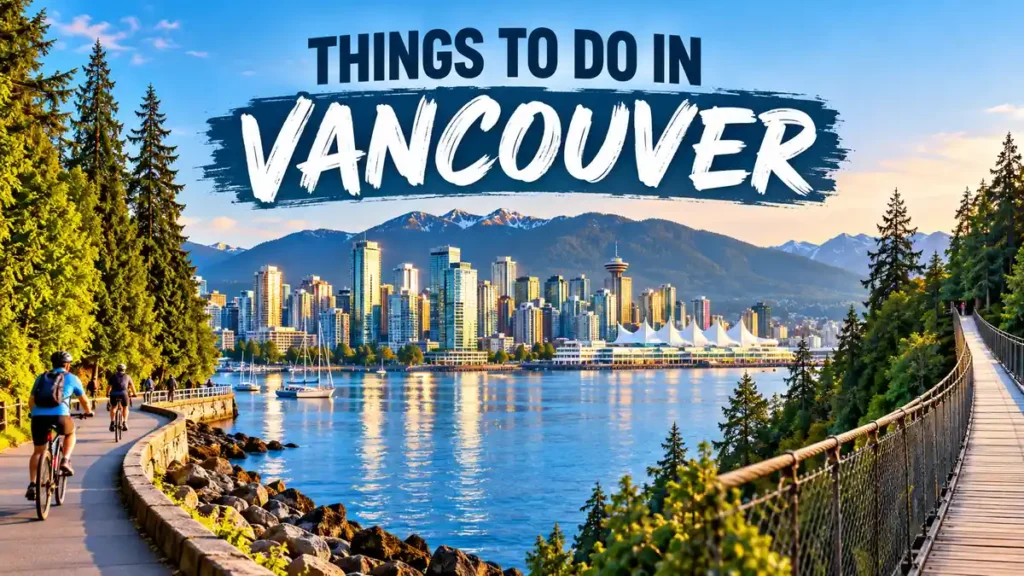
One of the best ways to experience the park is by bicycle. Rent a bike near the park entrance and follow the Seawall around the peninsula. You’ll pass Coal Harbour, Brockton Point, Lions Gate Bridge views, Siwash Rock, Third Beach, and English Bay.
Don’t rush straight through the park, though. Leave the waterfront route occasionally to explore the forested interior.
Popular stops include:
- Brockton Point and the First Nations totem poles
- Prospect Point
- Beaver Lake
- Lost Lagoon
- Second Beach
- Third Beach
- Siwash Rock
- Vancouver Aquarium
Early morning is particularly rewarding when the paths are quieter.
2. Walk or Cycle the Vancouver Seawall
The Seawall is more than a Stanley Park attraction. Vancouver’s seaside greenway stretches approximately 28 kilometres from the Vancouver Convention Centre to Spanish Banks, making it an excellent way to understand how closely the city is connected to the water.
The Stanley Park section alone is about nine kilometres. The City of Vancouver estimates roughly two to three hours for walking it or around one hour for cycling.
You don’t need to complete the whole route. Choose a section depending on your itinerary.
Coal Harbour offers skyscraper and marina views, False Creek combines urban scenery with access to Granville Island, while Kitsilano and Spanish Banks provide more open views across the water toward downtown and the mountains.
Pedestrian and cycling lanes are separated along much of the route, so pay attention to signs, particularly during busy summer weekends.
3. Eat Your Way Around Granville Island
Despite its name, Granville Island isn’t really an island. It’s a former industrial district beneath Granville Bridge that has evolved into one of Vancouver’s best food, arts, and shopping destinations.
Its centerpiece is Granville Island Public Market.
Inside, stalls sell fresh produce, baked goods, cheeses, seafood, prepared meals, chocolates, coffee, and regional specialties. Rather than arriving immediately after a large breakfast, come hungry and sample several smaller items.
Beyond the market, explore artisan workshops, galleries, independent shops, theaters, and waterfront spaces.
The official Granville Island visitor information suggests anything from a couple of hours to a full day depending on your interests.
One particularly enjoyable way to arrive is aboard one of the small passenger ferries that cross False Creek. The short ride turns transportation into part of the experience.
4. Wander Through Historic Gastown
Gastown provides a striking contrast to Vancouver’s glass towers.
Cobblestone-style streets, brick buildings, restaurants, boutiques, galleries, and heritage architecture make this one of downtown’s most recognizable districts.
Water Street is the main route for first-time visitors. You’ll inevitably encounter the Gastown Steam Clock, which has become one of Vancouver’s most photographed landmarks.
But don’t make the clock your only reason for visiting.
Walk slowly through the surrounding blocks, browse independent stores, stop for coffee, and look toward the waterfront and North Shore mountains from nearby streets.
Gastown is particularly atmospheric around dusk when the historic-style street lamps come on and restaurants begin filling up.
As in any downtown district, remain aware of your surroundings, particularly when wandering farther east beyond the main visitor area.
5. Cross the Capilano Suspension Bridge
Few Vancouver-area attractions create quite the same immediate reaction as stepping onto the Capilano Suspension Bridge.
Located in North Vancouver, the bridge stretches 137 metres across the canyon, approximately 70 metres above the Capilano River.
The suspension bridge may be the headline attraction, but the park offers considerably more.
Treetops Adventure takes visitors through the forest canopy on elevated bridges, while Cliffwalk follows a series of narrow walkways along the canyon wall.
Together, these experiences make Capilano much more than a quick photo stop.
Allow several hours rather than trying to squeeze it into an already packed morning. Arriving earlier can also make the experience more pleasant during peak travel periods.
If you’re uncomfortable with heights, know that the main bridge moves as people walk across it. The surrounding forest and other areas of the park can still be enjoyable, but this attraction is naturally best suited to travelers comfortable with elevated walkways.
6. Ride Up Grouse Mountain
Vancouver’s mountains aren’t just scenery.
Grouse Mountain makes the North Shore alpine environment accessible even to travelers who aren’t serious hikers. Visitors can travel up by gondola or Skyride and look back across Metro Vancouver, the Strait of Georgia, and surrounding mountain ranges.
Activities vary by season and operating conditions. Depending on when you visit, possibilities can include scenic lookouts, wildlife programs, guided walks, ziplines, ropes courses, skiing, snowboarding, snowshoeing, and other mountain activities.
The mountain’s grizzly bear habitat is another popular attraction.
Experienced hikers may know Grouse Mountain for the Grouse Grind, the famously steep trail climbing the mountain. Don’t mistake it for a casual sightseeing walk. It requires appropriate fitness, footwear, and conditions.
For most first-time visitors, riding up and spending a few hours exploring the mountaintop is the easier option.
Because weather can dramatically affect visibility, check current mountain conditions before leaving downtown.
7. Relax at English Bay Beach
You don’t have to leave downtown to find a proper beach.
English Bay Beach sits beside the West End and is easily reached on foot from downtown hotels. Its accessibility makes it ideal when you want a break between sightseeing stops.
Come for a waterfront walk, sit on a log facing the ocean, or stay for sunset.
On clear evenings, the sky over English Bay can be spectacular. Summer evenings become busy, so arrive earlier if you want a comfortable spot near the water.
From here, you can continue along the Seawall toward Stanley Park in one direction or Sunset Beach and False Creek in the other.
8. Discover Indigenous Art and History at the Museum of Anthropology
Anyone interested in understanding British Columbia beyond its scenery should make time for the Museum of Anthropology at the University of British Columbia.
The museum is especially recognized for its collections and presentations relating to First Nations cultures of the Pacific Northwest Coast, while its broader collections represent cultures from around the world.
Its setting on the UBC campus also makes the journey worthwhile.
Rather than treating Indigenous art simply as historical decoration, spend time reading the interpretation surrounding the works. The cultural traditions represented here are living traditions connected to contemporary Indigenous communities.
Combine the museum with other UBC attractions to turn the journey west into a half-day or full-day excursion.
9. Visit Canada Place and Vancouver’s Waterfront
Canada Place is one of Vancouver’s most recognizable waterfront landmarks.
Its white sail-like roof stands beside Vancouver Harbour, where cruise ships frequently dock during the Alaska cruise season.
The surrounding promenade provides excellent views of Stanley Park, North Vancouver, the harbor, floatplanes, and the Coast Mountains.
From Canada Place, walk west toward Coal Harbour or east toward Gastown.
It’s also a useful starting point if you have only a few hours in Vancouver because several major downtown attractions are within walking distance.
10. Spend an Afternoon in Kitsilano
Known locally as Kits, Kitsilano combines beaches, restaurants, residential streets, independent businesses, and mountain views.
Kitsilano Beach is the obvious attraction.
On sunny days, locals come here to swim, play volleyball, picnic, exercise, or simply enjoy the views toward downtown and the North Shore.
The neighborhood behind the beach is worth exploring too. West 4th Avenue is lined with restaurants, cafés, shops, and fitness-focused businesses.
Kits feels distinctly different from downtown. Spending an afternoon here gives you a better sense of everyday Vancouver life rather than simply moving between major tourist attractions.
11. Explore Chinatown
Vancouver’s Chinatown has played an important role in the city’s history and remains one of Canada’s most significant historic Chinese communities.
The Dr. Sun Yat-Sen Classical Chinese Garden is one of its best-known landmarks. Its architecture, rocks, water, plants, and carefully composed spaces offer a peaceful contrast to the surrounding streets.
Explore the neighborhood with an appreciation for both its cultural significance and its ongoing changes.
Food is another reason to visit. Chinatown and nearby areas offer Chinese restaurants, bakeries, cafés, and newer independent businesses.
As with nearby parts of the Downtown Eastside, street conditions can change quickly from block to block. Visitors should remain aware of their surroundings rather than wandering without a route.
12. Visit the Vancouver Aquarium
Located inside Stanley Park, the Vancouver Aquarium is particularly useful for families or for days when Vancouver’s rain makes extended outdoor sightseeing less appealing.
Its exhibits focus on marine life, conservation, aquatic ecosystems, and animals from British Columbia and farther afield.
Pairing the aquarium with Stanley Park makes logistical sense. Explore the park during the clearer part of the day and move indoors if rain arrives.
Families can easily devote several hours to the aquarium, so avoid treating it as a 30-minute add-on.
13. See Science World
The geodesic dome at the eastern end of False Creek is impossible to miss.
Science World is built around interactive exhibits and demonstrations, making it one of the strongest Vancouver attractions for families with children.
Current visitor guidance recommends allowing about two hours, though curious kids can easily stay longer.
Science World is also conveniently connected to the rest of Vancouver by SkyTrain, cycling routes, and the False Creek waterfront.
Even if you don’t go inside, the surrounding waterfront provides a memorable view of the dome, particularly after dark.
14. Walk Around Queen Elizabeth Park
For one of the best elevated perspectives within Vancouver itself, head to Queen Elizabeth Park.
The park occupies one of the city’s highest points and provides broad views toward downtown and the North Shore mountains.
Its landscaped gardens make it especially appealing in spring and summer.
The Bloedel Conservatory adds an indoor tropical environment filled with exotic plants and birds, making it a useful option when the weather turns wet or cold.
Photographers should consider visiting near sunset when the mountains and skyline can catch the evening light.
15. Explore VanDusen Botanical Garden
VanDusen Botanical Garden is quieter than many of Vancouver’s headline attractions, and that’s part of its appeal.
The large garden brings together plants from different parts of the world in beautifully designed landscapes connected by walking paths.
Seasonal changes make each visit different. Spring brings fresh blossoms, summer produces lush gardens, autumn adds changing foliage, and winter traditionally brings special light displays.
VanDusen works particularly well for couples, photographers, garden enthusiasts, families, and anyone wanting a slower few hours away from downtown.
16. Take the SeaBus to North Vancouver
One of Vancouver’s best inexpensive sightseeing experiences is actually public transportation.
The SeaBus connects Waterfront Station in downtown Vancouver with Lonsdale Quay in North Vancouver.
During the crossing, you get open views across Burrard Inlet toward the downtown skyline, port facilities, mountains, and waterfront.
Once in North Vancouver, explore Lonsdale Quay and the Shipyards District.
The area has food, public spaces, waterfront views, events, and restaurants. It’s particularly attractive in the evening when downtown Vancouver lights up across the harbor.
You can then return by SeaBus without needing a car.
17. Discover Commercial Drive
Commercial Drive, commonly called “The Drive,” shows a different side of Vancouver.
Historically associated with the city’s Italian community and generations of immigrants, the area now has an eclectic mix of cafés, international restaurants, independent stores, pubs, music venues, and neighborhood businesses.
It’s less polished than downtown shopping districts, which is precisely why many visitors enjoy it.
Come hungry. The concentration of food from different cultures makes Commercial Drive a good place to choose dinner without committing to a formal sightseeing attraction.
18. Spend Time on Main Street
Main Street is another excellent neighborhood for travelers interested in local Vancouver rather than only major landmarks.
Independent clothing stores, vintage shops, breweries, coffee shops, restaurants, bakeries, and small businesses are spread along the corridor.
The stretch around Mount Pleasant is especially easy to explore on foot.
Street art is another highlight. Murals appear across buildings and side streets, giving the neighborhood a colorful visual identity.
Main Street pairs naturally with Queen Elizabeth Park or Science World depending on your route.
19. Visit the Vancouver Art Gallery
If rain appears—and in Vancouver it often does—the Vancouver Art Gallery provides a central indoor escape.
Its exhibitions change throughout the year and can include historical and contemporary art from British Columbia, Canada, and international artists.
Because it sits in the heart of downtown, the gallery is easy to combine with Robson Street, the waterfront, Gastown, or nearby restaurants.
Check current exhibitions before visiting rather than assuming the permanent experience will always be the same.
20. Explore False Creek by Ferry
Vancouver looks different from the water.
Small passenger ferries move around False Creek, linking areas such as Granville Island, Yaletown, the West End, Olympic Village, and other waterfront stops.
You can use them simply as transportation, but riding a few stops also functions as a miniature sightseeing cruise.
This is particularly useful if your feet are tired after a day of walking.
A good route is to visit Granville Island, take a ferry across False Creek, and continue exploring the Seawall on the opposite shore.
21. Watch the Sunset at Spanish Banks
For a more spacious beach experience than English Bay, travel west to Spanish Banks.
At low tide, the shoreline can seem enormous, with broad stretches of exposed sand and distant views of downtown Vancouver.
The setting is excellent for picnics and sunset watching.
Spanish Banks is farther from the downtown tourist core, so it rewards travelers willing to spend more time getting there. Combine it with UBC, the Museum of Anthropology, or nearby Pacific Spirit Regional Park to make the journey efficient.
22. Hike in Pacific Spirit Regional Park
You don’t need to drive deep into British Columbia to experience a forest.
Pacific Spirit Regional Park surrounds much of the University of British Columbia campus and contains an extensive network of forest trails.
The towering trees and shaded paths can make downtown Vancouver feel surprisingly far away.
Most trails are more approachable than demanding North Shore mountain hikes, making this a good choice for visitors who want forest scenery without a strenuous climb.
Wear shoes you don’t mind getting muddy, especially after rain.
23. Experience Vancouver’s Food Scene
Sightseeing in Vancouver without exploring its food would leave out one of the city’s defining characteristics.
The city’s population and Pacific location have produced an unusually diverse dining scene.
Look beyond generic “Canadian food” and try the cuisines that reflect Vancouver itself.
Japanese food is particularly prominent, from sushi and ramen to izakaya-style dining. Chinese cuisine is another major part of the region’s culinary identity, with exceptional options across Vancouver and neighboring Richmond.
You’ll also find Korean, Vietnamese, Filipino, Indian, Persian, Italian, Mexican, and many other cuisines.
Seafood naturally plays a major role too. Depending on the season and restaurant, look for Pacific salmon, spot prawns, oysters, Dungeness crab, and other regional seafood.
Granville Island is ideal for casual sampling, while neighborhoods such as Richmond, Commercial Drive, Main Street, Chinatown, and the West End reward more focused food exploration.
24. Take a Day Trip to Richmond
Richmond sits immediately south of Vancouver and is easily reached by the Canada Line.
For food-focused travelers, it’s one of the best additions to a Vancouver itinerary.
Richmond has a large Asian Canadian population and an extraordinary concentration of Chinese restaurants, along with Japanese, Korean, Taiwanese, and other Asian cuisines.
Steveston, a historic fishing village in southwest Richmond, offers a completely different atmosphere.
Walk along the waterfront, explore the village, learn about the area’s fishing history, and enjoy seafood near the harbor.
Combining Richmond’s food scene with Steveston makes an excellent full-day excursion.
25. See Vancouver from the Water
The Pacific is central to Vancouver’s identity, so one of the most memorable things to do in Vancouver is simply getting onto the water.
Options range from kayaking and paddleboarding to harbor cruises and whale-watching excursions.
False Creek is one of the easiest areas for beginners interested in paddling in relatively protected urban surroundings.
Wildlife tours travel farther into the waters around the Strait of Georgia and Salish Sea. Sightings are never guaranteed, so choose operators that set realistic expectations and follow responsible wildlife-viewing practices.
Even a short ferry ride can change your perspective on the city. From the water, Vancouver’s unusual geography becomes obvious: dense urban development squeezed between ocean, forest, and mountains.
Best Free Things to Do in Vancouver
Vancouver can become expensive once paid attractions, restaurants, and accommodation are added together. Fortunately, many of its defining experiences cost nothing.
Walking through Stanley Park, exploring beaches, watching the sunset at English Bay, wandering Gastown, visiting Canada Place, walking the Seawall, exploring Commercial Drive, browsing Main Street, and hiking in Pacific Spirit Regional Park can all fill substantial portions of an itinerary without admission fees.
For a nearly free sightseeing day, start at Canada Place, walk through Coal Harbour into Stanley Park, follow part of the Seawall, and finish at English Bay around sunset.
Another inexpensive day could combine Queen Elizabeth Park, Main Street, False Creek, and the Olympic Village waterfront.
The key is remembering that Vancouver’s landscape itself is one of its major attractions.
Things to Do in Vancouver When It Rains
Rain shouldn’t ruin a Vancouver itinerary.
In fact, having an indoor backup plan is essential, particularly outside summer.
Science World, the Vancouver Aquarium, Vancouver Art Gallery, Museum of Anthropology, Bloedel Conservatory, and Granville Island’s Public Market are all useful rainy-day choices.
A light rainy day can also be surprisingly atmospheric in Stanley Park. The rainforest becomes greener, trails are quieter, and mist often hangs around the mountains.
Bring a waterproof outer layer rather than relying entirely on an umbrella. Vancouver rain is frequently persistent rather than dramatic, and suitable clothing makes it much easier to continue exploring.
Things to Do in Vancouver With Kids
Families don’t need a completely separate Vancouver itinerary.
Many of the city’s strongest attractions work for adults and children simultaneously.
Stanley Park offers beaches, trails, playgrounds, cycling, and the Vancouver Aquarium. Science World is specifically designed around interactive learning, while Granville Island has food, shops, entertainment, and kid-friendly spaces.
Grouse Mountain can also work well for families because visitors can reach mountain scenery without requiring children to complete a difficult hike. Its official visitor itineraries include family-friendly attractions and wildlife experiences.
Beaches are an easy option when children need unstructured time after museums and sightseeing.
What Are the Best Things to Do in Vancouver in One Day?
With only one day, resist the temptation to cross the entire metropolitan area.
Start early at Stanley Park and either walk or cycle part of the Seawall. Continue toward Coal Harbour and Canada Place before walking through Gastown.
Around midday, travel to Granville Island for lunch at the Public Market.
Spend the afternoon exploring False Creek or Kitsilano before finishing at English Bay for sunset.
That route provides a surprisingly complete introduction to Vancouver: rainforest, ocean, skyline, historic streets, local food, public markets, beaches, and mountain views.
Save Capilano Suspension Bridge and Grouse Mountain for another day because traveling to the North Shore adds time.
How Many Days Do You Need in Vancouver?
Three days is a practical minimum for a first visit.
With three days, you can devote one day to downtown and Stanley Park, another to Granville Island and Vancouver’s neighborhoods, and a third to North Vancouver.
Four or five days provide a more relaxed experience and allow time for UBC, museums, gardens, beaches, Richmond, hiking, or weather-related changes.
A simple structure works well:
| Day | Suggested Focus |
|---|---|
| Day 1 | Stanley Park, Seawall, Coal Harbour, Gastown, Canada Place |
| Day 2 | Granville Island, False Creek, Kitsilano, English Bay |
| Day 3 | Capilano Suspension Bridge and Grouse Mountain |
| Day 4 | UBC, Museum of Anthropology, Pacific Spirit, Spanish Banks |
| Day 5 | Local neighborhoods, Richmond, gardens, or seasonal activities |
Avoid scheduling every hour. Vancouver is particularly enjoyable when you have time to stop at a beach, walk an unexpected trail, or stay longer over lunch.
When Is the Best Time to Visit Vancouver?
There isn’t one universally best season.
Summer generally provides the easiest conditions for beaches, cycling, hiking, outdoor dining, and long sightseeing days. It’s also one of the busiest periods.
Spring brings milder weather and blossoms throughout the city, though rain remains possible.
Autumn can be beautiful, particularly in September and early October, with cooler temperatures and fewer peak-summer crowds.
Winter is wetter at sea level but transforms nearby mountains into winter-sports destinations. This unusual combination means you can explore a relatively mild coastal city and reach snow-covered mountain terrain on the same day.
Whatever the season, conditions can change quickly between downtown and the North Shore mountains. Check current operating information before planning mountain activities. Grouse Mountain, for example, adjusts attractions and schedules according to season and conditions.
How to Get Around Vancouver
A rental car isn’t necessary for most first-time visitors.
Downtown Vancouver is compact enough to explore extensively on foot. The SkyTrain connects downtown with other parts of the metropolitan area, while buses fill many of the gaps.
The Canada Line connects central Vancouver with Vancouver International Airport and Richmond.
The SeaBus provides a convenient connection between Waterfront Station and North Vancouver.
Cycling is another practical option thanks to Vancouver’s bike infrastructure and waterfront routes. The Seawall is particularly enjoyable by bike, though busy periods require patience and attention to lane rules.
Small False Creek ferries are useful for reaching Granville Island and nearby waterfront neighborhoods.
A car becomes more useful if your itinerary includes destinations beyond the urban transit network.
Practical Tips for Visiting Vancouver
Vancouver rewards flexible planning more than rigid schedules.
First, build your itinerary geographically. Combining Stanley Park with the West End makes sense. Granville Island pairs naturally with False Creek and Kitsilano. Capilano Suspension Bridge and Grouse Mountain both lie in North Vancouver, so visiting them on the same day can reduce unnecessary travel.
Second, prepare for changing weather. A sunny morning downtown doesn’t guarantee clear mountain conditions several hours later.
Third, book major paid attractions ahead during busy periods. This is especially useful when your itinerary depends on a specific date or time.
Fourth, bring comfortable walking shoes. Even visitors using transit often accumulate substantial walking distances because Vancouver’s neighborhoods and waterfront are best explored on foot.
Finally, don’t spend your entire trip chasing attractions. Vancouver’s appeal comes partly from the transitions between them: walking beside the ocean, stopping at an independent café, discovering a neighborhood park, or seeing the mountains suddenly appear between downtown buildings.
Final Thoughts on Things to Do in Vancouver
The best things to do in vancouver aren’t limited to a checklist of famous attractions. The city’s real strength is how naturally different experiences connect.
You can cycle through Stanley Park’s rainforest, follow the waterfront into downtown, eat lunch at Granville Island, explore a museum, relax on a beach, and finish the day watching the sun disappear behind the Pacific.
First-time visitors should prioritize Stanley Park, the Seawall, Granville Island, Gastown, and at least one North Shore experience such as Capilano Suspension Bridge or Grouse Mountain. Current Vancouver visitor guides consistently place these among the city’s defining attractions.
Then leave enough room for the Vancouver that exists between the landmarks. Explore a neighborhood, ride the SeaBus, try food you didn’t plan on ordering, or simply sit beside the water for an hour. Those unscheduled moments often become the part of Vancouver people remember most.