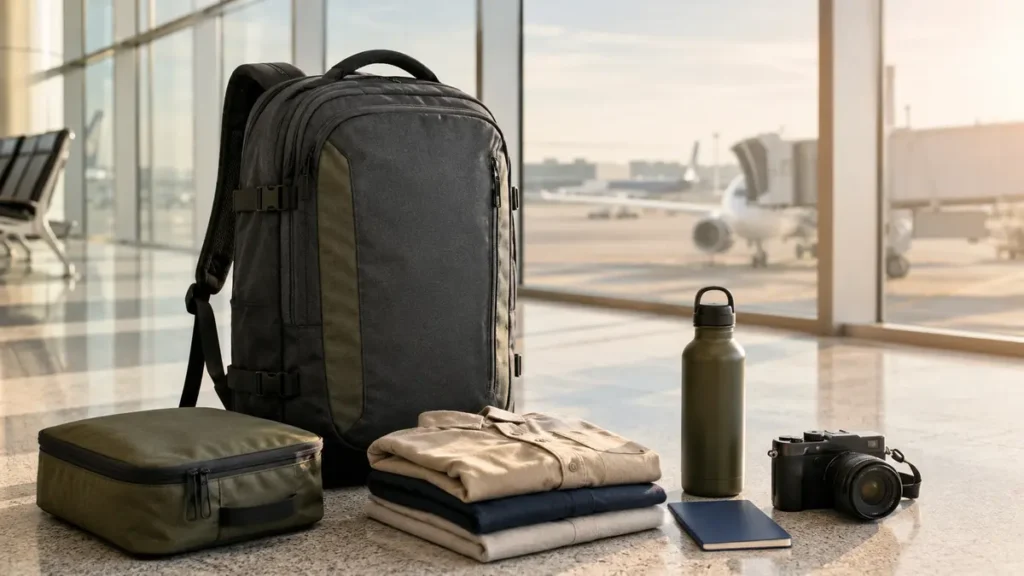
A backpack can appear perfect online yet become uncomfortable before you reach the airport gate. Capacity is only one consideration. Fit, packed dimensions, empty weight, opening style, organization, and airline restrictions often matter more.
A travel backpack is a soft-sided bag designed to carry clothing, electronics, toiletries, and documents while providing hands-free mobility. For many travelers, a 30–40-liter panel-loading backpack offers the best balance of capacity and portability, provided its packed measurements comply with the airline’s cabin-baggage limits.
What Is a Travel Backpack?
A travel backpack combines the portability of a conventional backpack with the wide opening and internal organization of a suitcase. It is normally rectangular, allowing it to use cabin-baggage space more efficiently than a tall, narrow hiking pack.
Common features include:
- Panel-loading or clamshell access
- Padded laptop and tablet storage
- Internal compression straps
- Lockable zipper pulls
- Stowable shoulder straps
- Top and side grab handles
- A sternum strap and hip belt
- Quick-access document pockets
- Water-bottle storage
- A luggage pass-through sleeve
These features are useful only when they support the way you travel. Every divider, buckle, padded panel, and zipper adds weight and occupies space.
Travel Backpack vs. Hiking Backpack
Travel and hiking backpacks are built around different priorities.
| Bag type | Typical design | Best use | Main limitation |
|---|---|---|---|
| Travel backpack | Rectangular and panel-loading | Flights, trains and city travel | May provide less ventilation |
| Hiking backpack | Tall, narrow and often top-loading | Trails and outdoor trips | Less convenient clothing access |
| Daypack | Small and lightweight | Sightseeing and daily essentials | Limited multi-day capacity |
| Backpacking pack | Framed with technical suspension | Carrying camping equipment | Usually too large for cabin use |
| Rolling suitcase | Structured case with wheels | Airports and hotels | Awkward on stairs and rough streets |
Hiking packs prioritize balance, hydration compatibility, ventilation, and outdoor load transfer. Travel packs prioritize airport handling, clothing organization, electronics access, and carry-on-friendly proportions.
Hybrid bags combine a suitcase-style opening with an adjustable outdoor harness. They can work well for trips involving cities and trails, although the suspension system adds weight and bulk.
What Size Travel Backpack Do You Need?
Capacity is measured in liters, but manufacturers do not calculate volume in exactly the same way. Padding, compartments, curved panels, and measurement methods can make two 35L bags feel noticeably different.
| Capacity | Suitable use | Main consideration |
|---|---|---|
| 10–20L | Day trips and sightseeing | Holds essentials rather than a wardrobe |
| 20–30L | Weekends and minimalist travel | Requires careful packing |
| 30–40L | Carry-on and one-bag travel | Versatile for most trips |
| 40–45L | Longer trips or bulky clothing | Can become heavy or oversized |
| 50L+ | Trekking or checked baggage | Rarely suitable for cabin travel |
20–30 Liters
A 20–30L backpack works for weekends, warm climates, and travelers who wash clothing regularly. It is easier to carry through public transport and may fit under an airline seat if its external dimensions meet the personal-item allowance.
The main limitation is footwear and cold-weather clothing. A spare pair of shoes or thick jacket can occupy much of the available space.
30–40 Liters
The 30–40L range offers the best balance for many people. It can hold several days of clothing, basic toiletries, a laptop, chargers, and a lightweight outer layer without becoming excessively bulky.
A 35L bag is often more manageable than a maximum-size cabin backpack. Its smaller capacity also discourages packing items that are unlikely to be used.
40–45 Liters
A 40–45L backpack may work as an overhead carry-on when its proportions match the airline’s allowance. However, it can exceed the permitted depth when fully packed.
Frames, handles, hip belts, and bulging exterior pockets count toward the bag’s dimensions. Capacity alone never guarantees carry-on compliance.
How Many Liters Are Needed for a Week?
Most travelers can pack for one week in 30–40 liters by limiting footwear, coordinating clothing, and using laundry facilities. Winter layers, formal clothes, photography equipment, or sports gear may require additional room.
Trip duration becomes less important when laundry is available. The same compact wardrobe can support a one-week holiday or a multi-month journey.
Quick takeaway: Base capacity on climate, planned activities, laundry access, and equipment—not simply the number of travel days.
How to Choose a Carry-On Travel Backpack
Airlines evaluate the packed bag’s height, width, depth, and sometimes weight. They do not use its advertised liter capacity.
The International Air Transport Association explains that allowances vary by airline, route, aircraft, fare, and cabin class. It lists 56 × 45 × 25 centimeters (22 × 18 × 10 inches) as a general reference used by many airlines, while noting that some weight limits begin around 5 kilograms. Always verify the operating carrier’s current policy.
Many U.S. airlines use approximately 22 × 14 × 9 inches, but international and low-cost carriers may impose smaller limits.
Before departure, check:
- Maximum external dimensions
- Maximum packed weight
- Whether the fare includes overhead baggage
- The separate personal-item allowance
- Whether handles and exterior pockets are included
- The policy of each carrier on a connecting itinerary
Carry-On vs. Personal Item
A carry-on usually goes in the overhead compartment. A personal item must fit beneath the seat in front of the passenger.
Basic economy and low-cost fares may include only a personal item. Underseat limits vary considerably, so labels such as “flight approved” or “personal-item size” should not replace checking the airline’s measurements.
Soft-sided bags offer some flexibility, but overpacking makes them bulge. A rigid frame may prevent the backpack from compressing inside a baggage sizer.
Measuring Your Backpack Correctly
Pack the bag as you would for the trip, then measure its maximum external height, width, and depth. Include filled pockets, straps, handles, and any part that cannot be compressed safely.
Weigh the complete bag with a luggage scale. A backpack can satisfy the dimensional allowance and still exceed the weight restriction.
How Should a Travel Backpack Fit?
Torso length matters more than overall height when fitting a framed backpack. Two people of equal height may need different harness sizes.
To measure your torso:
- Tilt your head forward and locate the prominent C7 vertebra where the neck meets the shoulders.
- Place your hands on top of the hip bones, known as the iliac crest.
- Imagine a horizontal line running between your thumbs.
- Measure along the spine from the C7 vertebra to that line.
- Compare the measurement with the manufacturer’s size chart.
REI identifies torso length as the key pack-size measurement and recommends positioning the hip belt over the top of the hip bones.
Adjusting the Harness
Load the bag with realistic travel weight before making adjustments:
- Position and tighten the hip belt.
- Pull the shoulder straps snug.
- Fasten the sternum strap.
- Adjust the load lifters.
- Tighten compression straps to stabilize the contents.
- Walk and check for pressure points.
The hip belt should transfer some weight from the shoulders to the pelvis. Shoulder straps should follow the body without pinching the neck, while the sternum strap should stabilize them without restricting breathing.
A thin webbing waist strap can prevent movement, but it transfers little weight. A padded hip belt becomes more valuable on a heavily loaded 35–45L bag.
Travel Backpack Features That Matter
The best features solve problems you encounter regularly. More features do not automatically produce a better bag.
Panel-Loading or Clamshell Opening
A panel-loading backpack opens around three sides. A clamshell model opens into two broad halves. Both make clothing easier to see and work well with packing cubes.
Top-loading bags can be lighter and more weather-resistant, but reaching an item at the bottom requires unpacking everything above it. They are generally better suited to hiking than hotel-to-hotel travel.
Laptop Compartment
A useful laptop compartment should:
- Fit the device’s actual measurements
- Suspend it above the bottom of the bag
- Keep it close to the back panel
- Prevent movement
- Offer protection from internal pressure
- Remain accessible at airport security
Screen size alone is not enough. Two laptops advertised as 16-inch models can have different exterior dimensions.
Compression Straps
Internal straps keep clothes in place when the bag opens. External straps reduce bulk and stabilize a partly filled backpack.
Compression does not reduce weight. Tightening an overpacked bag can also cause it to expand in another direction and exceed an airline limit.
Quick-Access Pockets
A quick-access pocket is useful for boarding passes, earphones, charging cables, and sunglasses. Passports, cash, and backup cards are safer in an interior pocket that cannot be opened easily by someone behind you.
Water-Bottle Storage
A bottle pocket should remain usable when the main compartment is full. Stretch mesh accommodates different bottle sizes but can tear. Zippered fabric pockets offer more security but may hold fewer shapes.
Test whether the bottle remains secure when the backpack is placed sideways beneath a seat or inside an overhead bin.
Stowable Straps and Grab Handles
Stowable shoulder straps reduce the chance of the harness catching on baggage equipment if the bag must be checked.
Top and side handles make the backpack easier to lift into an overhead compartment. These handles should be reinforced where they join the body of the bag.
Security Features
Lockable zipper pulls discourage casual access but do not make a soft bag theft-proof. Fabric can be cut, and some zippers can be forced open.
Practical security comes from:
- Keeping valuables in internal pockets
- Monitoring the bag in crowded places
- Positioning zipper openings where they are visible
- Using a small lock when appropriate
- Keeping essential medication and documents with you
Materials and Durability
A fabric specification cannot reveal the complete durability of a backpack. Weave, fiber quality, coating, stitching, hardware, and reinforcement all influence performance.
Common materials include:
- Nylon: Strong and abrasion-resistant for its weight
- Polyester: Affordable and resistant to ultraviolet exposure
- Ballistic nylon: A dense fabric associated with high abrasion resistance
- Ripstop: A reinforced weave that limits the spread of small tears
- Canvas: Durable but generally heavier
- Laminated fabric: Uses bonded layers for weather and abrasion resistance
Denier refers to yarn weight or thickness. A higher-denier material is not automatically stronger because construction and fiber quality also matter.
Water-Resistant Is Not Waterproof
Most travel bags are water-resistant rather than waterproof. Coated fabric may withstand a short shower, but water can enter through untreated zippers and seams.
For wet conditions, consider:
- Coated or laminated fabric
- Water-resistant zippers
- Covered zipper tracks
- Sealed seams
- A fitted rain cover
- Waterproof pouches for documents and electronics
Unless a backpack has been designed and tested as a dry bag, it should not be trusted during prolonged rain or submersion.
Check the Hardware
Zippers are among the most stressed parts of a travel bag. They should operate smoothly around corners without catching.
Inspect shoulder-strap anchors, handles, hip-belt connections, and compression-strap attachment points. Bar tacks and reinforced stitching help these areas tolerate repeated loads.
How Heavy Should a Travel Backpack Be?
A heavy empty backpack uses part of the airline allowance before anything is packed. Some structured models weigh more than two kilograms because of frames, thick padding, hardware, and organization panels.
Ultralight designs save weight but may become uncomfortable when loaded. The right balance depends on the expected carrying distance and total load.
REI uses a general outdoor guideline of keeping a loaded backpacking pack at no more than approximately 20% of body weight. This is not a universal comfort rule, but it illustrates how quickly weight becomes demanding.
Urban travelers may need to lift the bag overhead, climb stairs, change trains, and walk across uneven streets. A backpack that becomes uncomfortable after ten minutes at home will feel worse during a long transfer.
How to Pack a Travel Backpack
Good packing improves balance, access, and protection. It does not mean filling every available space.
1. Build a Compact Wardrobe
Choose clothes that can be layered and combined. Pack for roughly one week and wash items during longer trips.
A practical list might include:
- Three to five tops
- Two or three bottoms
- Several sets of underwear and socks
- One warm layer
- One lightweight weather layer
- Sleepwear
- Activity-specific clothing
- One spare pair of shoes
Wear the bulkiest shoes and outer layer during transit when practical.
2. Use Packing Cubes Selectively
Packing cubes organize clothes and prevent loose items from shifting. Compression cubes reduce bulk but do not reduce weight.
Avoid compressing everything into rigid blocks. Small cubes, soft pouches, and rolled garments can fit irregular spaces more efficiently.
3. Keep Heavy Items Close to Your Back
Place dense objects near the middle of the bag and close to the back panel. This keeps the center of gravity closer to the body.
Light, bulky items can sit near the bottom or front. Frequently needed objects belong near the top or in an accessible compartment.
4. Separate Liquids
Keep toiletries in a sealed pouch away from clothing and electronics. At U.S. airport checkpoints, the Transportation Security Administration generally restricts carry-on liquids, aerosols, gels, creams, and pastes to containers of 3.4 ounces or 100 milliliters inside one quart-sized bag.
Medication and certain child-related liquids may receive exceptions. Requirements can differ by country and airport.
5. Keep Batteries in the Cabin
Spare lithium batteries and power banks belong in cabin baggage rather than checked luggage. IATA states that batteries up to 100 watt-hours are generally permitted in carry-on baggage, while those between 100 and 160 watt-hours may require airline approval. Battery terminals should be protected against short circuits.
If a smart backpack contains a battery, confirm that it is removable in case the bag must be checked.
6. Leave Spare Capacity
A completely full backpack is difficult to close, compress, and reorganize. Overpacking also increases pressure on seams and zippers.
Leave room for a jacket, food, laundry, or small items acquired during the trip.
Quick takeaway: Keep dense equipment close to your spine, protect liquids and electronics, make documents accessible, and leave some unused space.
Common Travel Backpack Mistakes
Choosing Capacity Instead of Dimensions
A 40L label does not guarantee carry-on compliance. Airlines evaluate the bag’s packed dimensions and weight.
Buying the Largest Possible Bag
Unused capacity encourages overpacking. Choose for the trips you take regularly rather than a hypothetical expedition.
Testing the Backpack Empty
Load it with realistic weight and walk for at least 20 minutes. Climb stairs, sit down, and lift it above your shoulders.
Look for slipping hip belts, neck pressure, restricted arm movement, and a back panel that leans away from the body.
Ignoring Empty Weight
Frames, metal stays, heavy fabric, and extensive organization can make a backpack cumbersome before it is packed.
Assuming More Pockets Are Better
Fixed compartments reduce flexibility and consume space even when empty. A simple main compartment with removable pouches often adapts better to different journeys.
Relying Entirely on Built-In Security
Hidden pockets and zipper locks are deterrents rather than complete protection. Valuable documents should remain under your control.
How to Test a Backpack Before Traveling
A realistic home test can reveal most problems:
- Pack the items from a normal trip.
- Weigh the fully loaded bag.
- Measure its widest dimensions.
- Adjust the harness from the hip belt upward.
- Walk for 20–30 minutes.
- Climb stairs and sit in a confined space.
- Lift the bag onto a high shelf.
- Remove the laptop and toiletry pouch.
- Open and repack it without using a large table.
- Check for pressure points and difficult zippers.
Wear the jacket you expect to use during the trip because thick clothing changes how the shoulder and sternum straps fit.
Choosing a Travel Backpack for Different Trips
Weekend City Break
A 20–30L panel-loading bag is generally sufficient. Prioritize low weight, convenient access, and comfortable shoulder straps.
One-Bag International Travel
A 30–40L model with conservative external dimensions provides flexibility across multiple airlines. Internal compression, secure document storage, and a supportive harness are useful.
Business Travel
Look for structured electronics protection, document storage, restrained styling, and a main compartment that keeps folded clothing in place.
Digital-Nomad Travel
Laptop protection, cable organization, weather resistance, and load distribution become central. Computers, cameras, chargers, and adapters create a dense load even when the bag is not full.
Train and Bus Travel
A compact profile, secure zippers, and multiple grab handles help in narrow aisles and crowded terminals. Large hip belts are less convenient unless they can be stowed.
Adventure Travel
Prioritize adjustable suspension, a supportive hip belt, abrasion-resistant material, and effective weather protection. A travel-hiking hybrid may work better than a boxy urban pack.
Final Travel Backpack Checklist
Before selecting a bag, confirm that it:
- Fits your torso and hips
- Remains comfortable when loaded
- Meets your airline’s packed dimensions
- Stays within the weight allowance
- Provides enough capacity without encouraging excess
- Opens in a practical way
- Protects your laptop and electronics
- Keeps dense items close to your back
- Uses durable zippers and reinforced stitching
- Provides realistic rain protection
- Includes secure document storage
- Has useful rather than excessive organization
- Fits in the intended overhead or underseat space
- Can be lifted comfortably
- Leaves a small amount of spare capacity
Choosing the Right Travel Backpack
The right travel backpack fits your body, accommodates your actual packing list, and complies with the baggage restrictions governing your journey. Capacity matters, but it should never be separated from external dimensions, packed weight, harness quality, and internal layout.
Start with the strictest airline allowance on your itinerary. Choose the smallest practical capacity, measure your torso, and test the loaded bag at home. A comfortable, balanced backpack that is easy to open, carry, and lift will serve you better than one with the longest feature list.