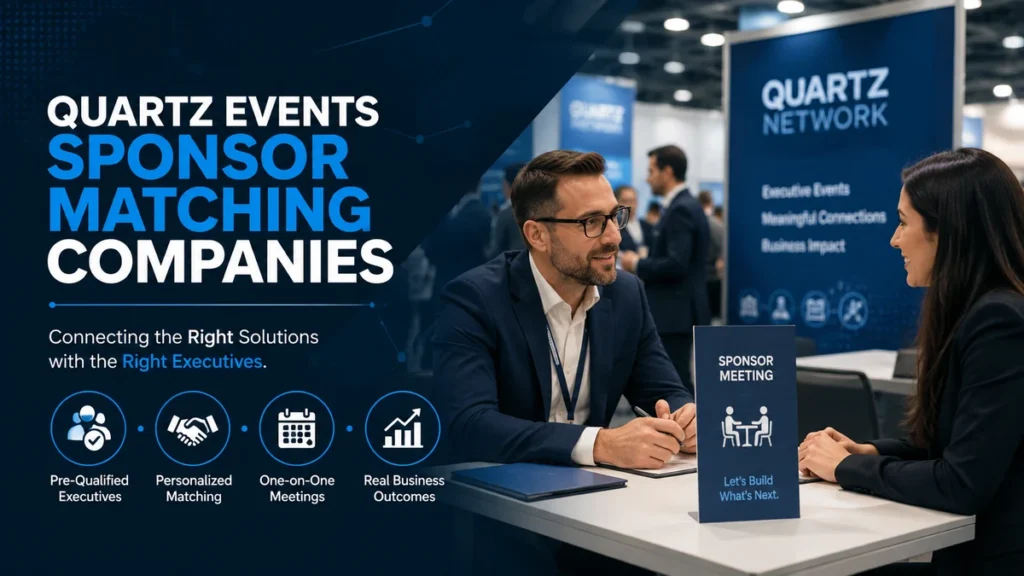
Traditional business conferences often rely on exhibition booths, broad networking sessions, and the hope that the right buyer happens to walk past the right vendor. Quartz Network takes a more structured approach. Instead of leaving important introductions largely to chance, it collects information about executive priorities and uses that information to arrange relevant meetings with solution providers.
That process explains the growing interest around quartz events sponsor matching companies. The phrase generally refers to the sponsor-to-buyer matchmaking model associated with Quartz Network events, where qualified executives and B2B solution providers are connected through planned one-on-one meetings rather than ordinary exhibition-floor networking. Quartz says its sponsorship programs can include guaranteed meetings with pre-vetted senior decision-makers.
Quick answer: Quartz events sponsor matching companies work by identifying the business challenges of participating executives, reviewing the solutions offered by event sponsors, and arranging relevant one-on-one meetings. The goal is to create higher-intent conversations between senior corporate buyers and vendors whose products or services address their stated priorities.
What Are Quartz Events Sponsor Matching Companies?
The easiest way to understand quartz events sponsor matching companies is to think of the model as curated B2B matchmaking.
On one side are senior corporate professionals researching technology, services, strategies, or operational solutions. On the other are solution providers that want access to organizations with relevant needs.
Quartz Network sits between those groups and facilitates introductions.
The company describes its events as invitation-only experiences designed around executive networking, education, and solution research. Its history dates to 2006, with its first SCOPE event following in 2007. Quartz says it has since expanded into events serving departments such as information technology, marketing, finance, human resources, procurement, supply chain, smart manufacturing, data strategy and analytics, and operations.
This matters because the matchmaking is not simply:
Sponsor pays → sponsor gets random meetings.
Instead, the intended process is closer to:
Executive priorities → solution requirements → relevant providers → selected meetings → scheduled conversations.
That distinction separates curated meeting-based events from conventional sponsorship models.
How Quartz Events Sponsor Matching Companies Work
The matching process begins before attendees arrive at an event.
Quartz states that its events are personalized around participants’ priorities. Executives provide information about their current challenges and areas of interest, allowing the event team to identify solution providers that may be relevant. For its online CFO summit, for example, Quartz explains that participants describe their challenges during registration and are then matched with a tailored set of solution providers.
1. Executives Are Qualified
Audience quality is central to the model.
Quartz Network describes its community as invitation-only and says it is reserved for senior-level professionals. Prospective members go through a qualification process rather than simply purchasing unrestricted access to the executive community.
For sponsors, this screening is significant.
A conventional event may generate thousands of visitors, but many could have little authority over corporate purchasing. A curated executive event tries to reduce that uncertainty by concentrating on professionals with relevant responsibilities.
Depending on the event, participants can include people working in roles related to:
- Information technology
- Cybersecurity
- Finance
- Human resources
- Marketing
- Procurement
- Supply chain
- Data and analytics
- Operations and transformation
- Smart manufacturing
The exact audience varies by summit.
2. Business Challenges and Priorities Are Identified
Job title alone does not make two companies a useful match.
A CFO might currently need financial planning software, while another CFO may be researching automation, cybersecurity, tax technology, ERP systems, or cost reduction.
Quartz therefore gathers information about business priorities.
This creates an important additional qualification layer.
Instead of asking only:
“Is this person a CFO?”
the matching process can effectively ask:
“What is this CFO trying to solve?”
Quartz’s finance sponsorship material, for example, lists areas of responsibility ranging from budgeting and forecasting to FP&A, ERP software, financial reporting, automation, compliance, risk management, cybersecurity, and professional services.
That level of segmentation makes more targeted matching possible.
3. Sponsors Are Evaluated Against Relevant Needs
Sponsors are generally B2B solution providers rather than consumer-facing advertisers.
A participating vendor might provide software, consulting, technology infrastructure, outsourcing, analytics, cybersecurity, marketing technology, HR systems, supply-chain solutions, or another corporate service.
The sponsor’s offering must make sense for the audience being targeted.
For example, Quartz’s CONNECT CMO sponsorship program covers areas such as account-based marketing, customer experience, demand generation, marketing technology, product marketing, sales enablement, content strategy, market research, and customer engagement.
Its HR program covers areas including recruiting, talent management, HR technology and analytics, benefits, compensation, employee engagement, leadership development, retention, and wellbeing.
This departmental structure helps narrow the matching pool before individual meetings are arranged.
4. Potential Matches Are Created
Once Quartz knows what an executive needs and what participating solution providers offer, potential matches can be identified.
Imagine an executive responsible for enterprise cybersecurity.
Their priorities might include:
- Data security
- Disaster recovery
- Cloud infrastructure
- Compliance
- Business continuity
A vendor selling an unrelated payroll platform would have little reason to meet that executive.
A cybersecurity provider whose platform addresses the stated security project, however, could represent a logical match.
This is the practical value of sponsor matching: relevance replaces random prospecting.
Quartz’s information-technology sponsorship materials specifically identify areas such as data security, disaster recovery, cloud and virtualization, compliance, business intelligence, telecommunications systems, and software development among the responsibilities represented by its audience.
5. Participants Have Visibility Into Meetings
Another important part of the model is that sponsors can receive information before meetings.
Quartz says sponsors know who is attending ahead of time and can handpick the people they want to meet. It also says sponsors receive qualification information that can help them understand prospects before conversations occur.
That changes meeting preparation considerably.
Instead of entering a conversation with nothing more than someone’s name and company, a sales representative can potentially prepare around the prospect’s role and stated business requirements.
A productive conversation can therefore start with:
“You mentioned that improving forecasting accuracy is a priority…”
rather than:
“So, what does your company do?”
That difference may seem small, but it can save a substantial portion of a short executive meeting.
6. One-on-One Meetings Are Scheduled
The resulting conversations take place as structured one-on-one meetings.
Quartz describes these as qualified meetings between solution providers and decision-makers. Its sponsorship page currently advertises packages involving guaranteed volumes ranging from 15 to 120 meetings, depending on the sponsorship arrangement.
Meeting-based sponsorship therefore provides a more measurable deliverable than basic logo exposure.
A traditional sponsor might purchase:
| Traditional Sponsorship | Meeting-Based Sponsorship |
|---|---|
| Exhibition booth | Scheduled executive meetings |
| Logo placement | Direct buyer conversations |
| General attendee traffic | Qualified participants |
| Broad brand exposure | Targeted engagement |
| Uncertain booth visits | Defined meeting volume |
| Limited prospect context | Qualification information |
| Networking by chance | Curated introductions |
Neither approach is automatically better in every situation. They simply optimize for different outcomes.
Large exhibition sponsorships can be useful for awareness. Meeting-based events are designed more directly around relationship building and solution discovery.
Why Pre-Qualified Meetings Matter
The real problem that quartz events sponsor matching companies attempt to solve is not a shortage of business contacts.
Most B2B organizations already have access to enormous databases.
The harder problem is identifying people who have all three of these characteristics:
- Relevant responsibility
- A current business need
- Willingness to discuss possible solutions
Traditional outbound sales often identifies only the first.
A salesperson can find a CIO, CMO, CFO, CHRO, procurement director, or supply-chain executive through company websites and professional databases. What they usually cannot determine immediately is whether that person currently needs the particular solution being offered.
Event matchmaking adds intent information to the equation.
Role + Need + Timing = Stronger Match
Consider two prospects with identical titles.
Prospect A: CIO at a large enterprise, but no active cybersecurity initiative.
Prospect B: CIO at another enterprise currently reviewing security infrastructure.
A cybersecurity company would normally place much greater value on a conversation with Prospect B.
That is why business priorities are as important as seniority.
How Quartz Network Differs From a Lead Database
It is also useful to distinguish the Quartz model from ordinary lead-generation databases.
A database primarily gives a sales team information.
A matchmaking event facilitates an interaction.
With a lead database, the vendor still needs to:
- Identify relevant contacts
- Determine their needs
- Start outreach
- Get a response
- Qualify interest
- Schedule a meeting
With a curated event model, several of those steps can occur before the actual conversation.
Quartz describes its broader QN Solutions platform in a similar way from the buyer’s perspective: executives create projects or provide information about their requirements, receive a shortlist of vetted solution providers, and can meet selected companies directly.
That makes the model closer to facilitated solution discovery than simple contact-list generation.
Which Executives and Departments Participate?
Quartz Network operates across several corporate functions rather than focusing on one narrow industry.
Its current network highlights departments including finance, human resources, information technology, marketing, procurement, supply chain, smart manufacturing, operations and transformation, and data strategy and analytics.
Different event brands serve different audiences.
VISIONS
VISIONS events are associated with technology-focused executive audiences, including IT and information-security leadership.
Relevant solution categories can include cloud infrastructure, cybersecurity, analytics, software development, business intelligence, data storage, disaster recovery, mobility, compliance, and telecommunications.
CONNECT
CONNECT events serve several executive functions, including marketing, finance, and human resources.
The matching logic changes accordingly.
A marketing executive may be evaluating customer experience technology or demand-generation platforms, while an HR executive may be researching talent-management software. A finance leader could be exploring FP&A, automation, ERP, compliance, or financial reporting solutions.
SCOPE
SCOPE is tied to supply chain, logistics, and procurement. Quartz identifies SCOPE as its first event, launched in 2007, and continues to list it within its sponsorship portfolio.
This event-specific structure matters because successful matchmaking requires more than grouping everyone under a broad “business executive” label.
What Sponsors Receive From the Matching Process
For sponsors, the most distinctive benefit is predictable access to selected executives.
Quartz currently describes several elements of its event sponsorship model:
- Guaranteed qualified meetings
- Pre-event prospect information
- Ability to select desired attendees
- One-on-one conversations
- Educational and thought-leadership opportunities
- Networking activities
- Multiple event formats
- Tiered sponsorship packages
The company says its events operate both in person and online and cover the United States and United Kingdom.
This creates several possible objectives for solution providers.
Some sponsors may prioritize pipeline development. Others may want conversations with a particular executive function, while another company may use the event primarily to learn about the problems large enterprises are currently trying to solve.
What Executives Get From Sponsor Matching
It would be easy to view the system entirely from the sponsor’s perspective, but successful matchmaking requires value on both sides.
Executives do not want to spend an event sitting through irrelevant sales pitches.
Quartz describes its community as solicitation-free and says members retain control over their experience. Its event pages frame one-on-one sessions as research meetings where attendees can explore solutions connected to their stated challenges.
For an executive, a well-matched meeting can reduce the time required to research potential vendors.
Instead of independently finding 30 companies, reviewing their websites, completing contact forms, arranging demonstrations, and qualifying each provider, an executive can potentially meet a smaller group of relevant vendors within the event environment.
That is the other half of the model.
Sponsors want qualified buyers. Buyers want qualified solutions.
Matchmaking works only when both objectives overlap.
Are Meetings Randomly Assigned?
Not according to Quartz’s description of its process.
Quartz says sponsors can review attendees and select the people they want to meet, while event participants provide information about their current challenges so suitable providers can be identified.
That makes the process materially different from speed networking, where participants may simply rotate between tables.
The objective is relevance rather than maximum meeting volume alone.
However, a scheduled meeting should not be confused with a guaranteed business opportunity.
An executive may be interested enough to investigate a solution without being ready to purchase it. They may already be comparing several vendors, have budget limitations, or simply be gathering information for a future project.
A matched meeting therefore represents qualified access, not a guaranteed sale.
Does Sponsor Matching Guarantee Sales?
No.
This is one of the most important distinctions when evaluating the model.
A meeting guarantee and a revenue guarantee are completely different things.
Quartz can facilitate access to relevant executives, but what happens afterward depends on factors such as:
- Product-market fit
- Pricing
- Competitive positioning
- Sales execution
- Buying timeline
- Budget availability
- Technical requirements
- Procurement processes
- Follow-up quality
Quartz reports that 99% of attendees follow up with at least one solution provider after an event and that 97% of sponsors would recommend a Quartz Network event to peers. These are Quartz’s own published sponsorship statistics and should be interpreted as company-reported performance indicators rather than independent guarantees of sales results.
That distinction is important when assessing return on investment.
How Should Companies Measure Event Sponsorship ROI?
Counting meetings alone gives an incomplete picture.
A sponsor that holds 30 meetings and creates no meaningful opportunities may perform worse than a company that holds 15 meetings and develops three serious enterprise opportunities.
Useful metrics include:
| Metric | What It Shows |
|---|---|
| Meetings completed | Actual engagement volume |
| Relevant accounts met | ICP alignment |
| Follow-up rate | Post-event interest |
| Sales-qualified opportunities | Commercial potential |
| Pipeline generated | Estimated opportunity value |
| Deals influenced | Sponsorship’s role in sales |
| Closed revenue | Direct financial outcome |
| Cost per qualified meeting | Acquisition efficiency |
| Pipeline-to-cost ratio | Broader sponsorship ROI |
Companies should ideally establish these measurements before attending.
Otherwise, a busy event can feel successful even when it contributes little to the sales pipeline.
What Actually Makes Sponsor Matching Effective?
Matching technology and qualification data help, but they cannot compensate for poor preparation.
Several practical factors determine whether a scheduled executive meeting becomes useful.
Understand the Prospect Before the Meeting
If qualification information is available, use it.
Review the executive’s company, role, likely responsibilities, stated challenges, and relevant product use cases.
The purpose of pre-event information is wasted if the representative still begins every conversation with a generic pitch.
Discuss the Problem Before Demonstrating the Product
A common mistake is treating a matched meeting like a shortened sales presentation.
The better approach is usually to validate the buyer’s problem first.
A useful opening might explore:
- What triggered the project?
- What solution is currently being used?
- What is not working?
- Who is involved in the decision?
- What outcome matters most?
- Is there a defined implementation timeline?
The product discussion becomes much more relevant after those questions have answers.
Avoid Treating Every Match as Sales-Ready
Interest exists on a spectrum.
One executive may be actively selecting a vendor.
Another may be building next year’s budget.
A third may simply want to understand available technology.
Treating all three as immediate opportunities creates unrealistic expectations and can damage otherwise useful relationships.
Follow Up With Context
Generic post-event emails throw away much of the value created by qualification.
A stronger follow-up references the actual discussion, agreed next step, business challenge, and any information the executive requested.
That is where a curated introduction can become a real sales opportunity.
What Are the Limitations of the Model?
Meeting-based sponsorship has advantages, but it also has limitations.
First, relevance is never perfect. Business requirements can change between registration and the event.
Second, executive interest does not necessarily mean purchasing authority for every project.
Third, the quality of a meeting depends heavily on both participants. Even a perfectly matched executive and vendor can have an unproductive conversation if preparation is poor.
Fourth, companies should evaluate the economics carefully. Guaranteed meetings can make event costs easier to model, but the meaningful metric is the value created from those meetings.
Finally, event-generated opportunities may have long sales cycles. Enterprise technology, consulting, procurement, and transformation projects rarely move from introduction to contract immediately.
A realistic evaluation should therefore examine pipeline influence over time rather than expecting instant revenue.
Quartz Events Sponsor Matching Companies vs. Traditional Conferences
The core difference comes down to how connections are created.
Traditional conferences create an environment where connections can happen.
The Quartz model attempts to determine which connections should happen and schedules them.
That difference changes the sponsor experience.
Instead of investing primarily in booth location, foot traffic, signage, giveaways, and spontaneous conversations, participating companies can focus more heavily on account relevance and meeting preparation.
For executives, the model reduces the need to walk through an exhibition hall searching for potentially relevant suppliers.
Neither format eliminates networking. Quartz events also include educational sessions, executive networking, and other event experiences. The one-on-one meeting structure simply adds a more deliberate solution-discovery layer.
The Bigger Idea Behind Quartz’s Matching Model
The interesting part of quartz events sponsor matching companies is not simply that meetings are scheduled.
Businesses have scheduled conference meetings for decades.
The more meaningful idea is using information about both sides of a B2B interaction before deciding who should meet.
A senior title alone is not enough.
A good match requires alignment between:
Executive role + active challenge + organizational priorities + vendor capability + timing.
When those elements overlap, a 20-minute targeted conversation may be more useful than dozens of random exhibition-floor interactions.
Quartz Network has built its event and solution-discovery model around that principle, combining invitation-only executive communities, business-needs research, vetted solution providers, and pre-arranged meetings.
For anyone researching quartz events sponsor matching companies, that is the key takeaway: the model is not simply traditional event sponsorship with extra networking. It is a structured B2B matchmaking system designed to connect executives researching solutions with providers that are relevant to their stated business challenges.