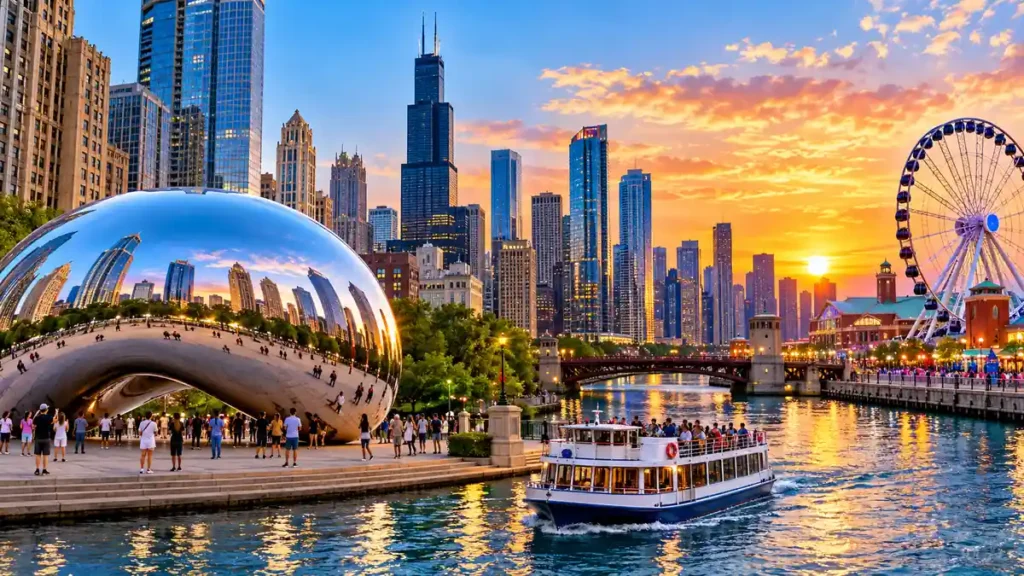
Chicago is a city where world-class architecture, beautiful lakefront scenery, historic neighborhoods, and exceptional food come together. From the towering skyscrapers of downtown to peaceful parks beside Lake Michigan, the Windy City offers memorable experiences for first-time visitors and returning travelers alike.
The best things to do in chicago include visiting Millennium Park, seeing Cloud Gate, exploring the Art Institute of Chicago, taking a Chicago River architecture cruise, walking along Navy Pier, and enjoying Lake Michigan’s beaches. Visitors can also discover famous museums, historic neighborhoods, observation decks, comedy clubs, and authentic Chicago cuisine.
This guide explores Chicago’s most worthwhile attractions, including free activities, family-friendly destinations, outdoor adventures, and practical tips for planning your visit.
1. Explore Chicago’s Iconic Downtown Attractions

1. Visit Millennium Park
The Loop · Free admission
Millennium Park is one of Chicago’s most recognizable public spaces. Located in the heart of downtown, it combines innovative architecture, public artwork, landscaped gardens, and seasonal entertainment.
The park’s centerpiece is Cloud Gate, nicknamed “The Bean.” Designed by artist Anish Kapoor, this reflective sculpture creates fascinating distortions of Chicago’s skyline.
Other highlights include Crown Fountain, Lurie Garden, and the Jay Pritzker Pavilion, which hosts outdoor concerts and community events.

2. Discover Navy Pier
Streeterville · Free entry; attractions may cost extra
Navy Pier extends into Lake Michigan and offers lakefront views, restaurants, public spaces, and family entertainment.
The Centennial Wheel is a popular attraction, offering elevated views of the city and water. Visitors can also explore seasonal installations, watch performances, or enjoy a sightseeing cruise.
Navy Pier is particularly enjoyable in the evening when the skyline begins to glow.

3. Walk Along the Chicago Riverwalk
Downtown · Free
The Chicago Riverwalk follows the Chicago River through the center of downtown, giving pedestrians remarkable views of bridges, skyscrapers, and passing boats.
Its waterfront setting makes it ideal for photography, sightseeing, and relaxing between attractions. Restaurants and outdoor seating areas add to its appeal during warmer months.
A morning walk is often quieter, while late afternoon brings beautiful reflections across the river.
4. Take a Chicago Architecture River Cruise
Chicago is internationally recognized for its architectural heritage, and an architecture cruise is among the most informative ways to experience it.
Guided boat tours explain how the city’s buildings evolved after the Great Chicago Fire of 1871 and how Chicago became a center of modern skyscraper design.
Notable landmarks along common cruise routes include:
- Wrigley Building
- Tribune Tower
- Marina City
- Merchandise Mart
- Historic movable bridges
- Modern riverfront skyscrapers
The Chicago Architecture Center offers a well-known architectural river cruise aboard Chicago’s First Lady Cruises.
Most standard architecture tours last around 75–90 minutes, although individual itineraries vary.
Choose Chicago
+1
5. Enjoy Panoramic Views from Skydeck Chicago
Located inside Willis Tower, formerly known as the Sears Tower, Skydeck Chicago provides sweeping views from the building’s 103rd floor.
Its famous attraction, The Ledge, features glass balconies extending beyond the exterior of the skyscraper.
Standing above the city creates a dramatic perspective on Chicago’s street grid, Lake Michigan, and surrounding neighborhoods.
Best time to visit: Late afternoon offers daylight views, with sunset providing an especially memorable experience when conditions are clear.
6. Visit 360 CHICAGO Observation Deck
360 CHICAGO occupies the 94th floor of the former John Hancock Center at 875 North Michigan Avenue.
Unlike Skydeck, which offers a central downtown perspective, 360 CHICAGO is especially impressive for its views of Lake Michigan and the northern shoreline.
Visitors seeking an additional thrill can experience TILT, a moving enclosed viewing platform that angles outward from the building.
For travelers deciding between the two observation decks:
| Feature | Skydeck Chicago | 360 CHICAGO |
|---|---|---|
| Building | Willis Tower | 875 N. Michigan |
| Viewing floor | 103rd | 94th |
| Signature experience | The Ledge | TILT |
| Especially good for | Downtown panorama | Lakefront views |
Both are worthwhile, but visiting one is usually sufficient for a short trip.
2. Experience the Best Museums and Cultural Attractions

7. Explore the Art Institute of Chicago
Grant Park · Paid admission
The Art Institute of Chicago houses an internationally celebrated collection spanning centuries and artistic traditions.
Famous works include Georges Seurat’s A Sunday on La Grande Jatte, Grant Wood’s American Gothic, and Edward Hopper’s Nighthawks.
Visitors interested in Impressionism, modern art, sculpture, or photography can easily spend several hours here.
Allow at least two to three hours for a highlights-focused visit.

8. Discover Natural History at the Field Museum
Museum Campus · Paid admission
The Field Museum explores natural history, biodiversity, ancient civilizations, and the evolution of life on Earth.
Its best-known resident is SUE, one of the largest and most complete Tyrannosaurus rex specimens ever discovered.
Visitors can explore dinosaur fossils, ancient Egyptian artifacts, gemstones, and exhibits explaining Earth’s natural environments.
This museum is particularly rewarding for families and science enthusiasts.

9. Experience Marine Life at Shedd Aquarium
Museum Campus · Paid admission
Shedd Aquarium introduces visitors to aquatic ecosystems ranging from freshwater habitats to tropical reefs and ocean environments.
Exhibits feature fish, sharks, rays, and numerous other aquatic species.
Educational presentations explain conservation, biodiversity, and the importance of protecting marine habitats.
Because the aquarium sits beside Lake Michigan, the surrounding Museum Campus also offers excellent skyline photography opportunities.
10. Explore Space at Adler Planetarium
Adler Planetarium combines astronomy exhibits, immersive sky shows, and educational experiences about the universe.
Its exhibitions explore planets, stars, space exploration, and scientific discoveries.
The planetarium is especially appealing to families with school-age children and anyone interested in astronomy.
Even visitors who do not enter the museum can enjoy the surrounding lakefront paths, which provide one of Chicago’s most photographed skyline viewpoints.
11. Visit the Griffin Museum of Science and Industry
Located in Hyde Park, the Griffin Museum of Science and Industry is one of Chicago’s most interactive educational attractions.
Its exhibits explore transportation, engineering, weather, human biology, and scientific innovation.
Highlights include the historic U-505 submarine, model railroads, and hands-on displays.
Because the museum is large, visitors should plan several hours rather than attempting to rush through every exhibition.
12. Discover Chicago’s Cultural Heritage
Chicago’s cultural institutions tell stories extending beyond its famous skyscrapers.
The DuSable Black History Museum and Education Center in Washington Park explores African American history, cultural achievements, and artistic expression.
In Pilsen, the National Museum of Mexican Art presents Mexican and Mexican American art and cultural traditions.
The Chicago History Museum in Lincoln Park offers another perspective, covering the city’s development, neighborhoods, and major historical events.
These museums help visitors understand the communities that shaped Chicago’s identity.
Choose Chicago
+1
3. Enjoy Chicago’s Parks, Beaches, and Outdoor Activities
13. Relax at North Avenue Beach

North Avenue Beach is one of Chicago’s most popular summer destinations.
Located along Lake Michigan near Lincoln Park, the beach features sandy shoreline, recreational areas, and panoramic skyline views.
During the warmer months, visitors can enjoy sunbathing, beach volleyball, walking, and swimming when designated swimming areas are open.
Chicago’s beaches offer an unusual experience: relaxing beside a large freshwater lake while skyscrapers rise in the distance.
14. Walk or Cycle the Lakefront Trail
Chicago’s Lakefront Trail stretches approximately 18 miles along Lake Michigan, connecting parks, beaches, museums, and neighborhoods.
The trail is popular among runners, cyclists, and walkers.
You do not need to complete the entire route to appreciate it. Short sections around Grant Park, Museum Campus, or Lincoln Park offer excellent scenery.
Cyclists should follow posted lane markings and remain aware of pedestrians, especially during busy summer weekends.
15. Explore Lincoln Park Zoo
Lincoln Park Zoo is one of the city’s best free attractions.
The zoo houses animals from different habitats and offers educational programs focused on wildlife and conservation.
Its location within Lincoln Park makes it easy to combine a zoo visit with nearby gardens, walking paths, and lakefront views.
General zoo admission is free, although certain experiences and events may have separate charges.
16. Discover Garfield Park Conservatory
The Garfield Park Conservatory is an indoor botanical attraction filled with tropical plants, ferns, palms, and seasonal displays.
Its greenhouse environments provide a welcome escape from Chicago’s colder weather.
The conservatory is particularly attractive to plant lovers, photographers, and visitors seeking a quieter experience away from the busiest downtown attractions.
Check current admission and reservation requirements before visiting.
17. Have Fun at Maggie Daley Park
Located near Millennium Park, Maggie Daley Park offers imaginative playgrounds, landscaped walking paths, and seasonal recreation.
Popular activities include rock climbing, mini golf, and skating, depending on the season.
Its skating ribbon is especially distinctive in winter, offering a winding route rather than a conventional rectangular rink.
The park is a practical addition to a family itinerary because of its central location.
4. Explore Chicago’s Famous Neighborhoods and Hidden Gems
18. Experience the Energy of Wicker Park and Bucktown
Wicker Park and Bucktown are known for independent shops, restaurants, cafes, galleries, and creative culture.
Milwaukee Avenue is a useful starting point for exploring the area.
Visitors can also walk or cycle along The 606, an elevated recreational trail built on a former railway corridor.
These neighborhoods offer a different atmosphere from the skyscraper-filled Loop and provide a glimpse of everyday Chicago life.
19. Discover Chinatown and Ping Tom Memorial Park
Chicago’s Chinatown is an excellent destination for cultural exploration and dining.
Visitors can walk through Chinatown Square, browse local businesses, and discover Chinese cuisine ranging from dim sum to regional specialties.
Nearby, Ping Tom Memorial Park offers peaceful riverside paths and views of the surrounding city.
The neighborhood is especially enjoyable when combined with a relaxed lunch and an afternoon walk.
20. Explore Hyde Park’s History and Architecture
Hyde Park, on Chicago’s South Side, is known for its academic institutions, historic architecture, and cultural attractions.
The neighborhood is home to the University of Chicago and Frank Lloyd Wright’s Frederick C. Robie House.
Visitors can also explore the nearby Jackson Park area and the historic landscape surrounding the Museum of Science and Industry.
Hyde Park works well as a half-day or full-day destination because it offers several attractions within the same general area.
21. Visit Pullman National Historical Park
Pullman National Historical Park preserves an important chapter of American industrial and labor history.
The historic district was developed as a planned industrial community associated with railroad sleeping-car manufacturing.
Its preserved architecture and interpretive exhibits explore the lives of workers, the Pullman Company, and major labor struggles.
This destination is particularly worthwhile for visitors interested in architecture, social history, and lesser-known Chicago landmarks.
5. Discover Chicago’s Food, Music, and Entertainment
22. Try Chicago’s Famous Local Foods

Chicago’s food culture is a major reason to visit the city.
Deep-dish pizza is perhaps its most recognizable dish, with a thick crust, generous cheese, and tomato sauce layered on top.
Other classic foods include:
- Chicago-style hot dog: Traditionally topped with mustard, relish, onion, tomato, pickle, sport peppers, and celery salt.
- Italian beef sandwich: Thinly sliced seasoned beef served on a roll, often with giardiniera.
- Jibarito: A sandwich that uses fried plantains instead of bread.
- Chicago-style popcorn: A popular combination of caramel and cheese popcorn.
- Tavern-style pizza: Thin-crust pizza commonly cut into squares.
Chicago also has a diverse dining scene reflecting Mexican, Polish, Chinese, Indian, African American, and many other culinary traditions.
Neighborhood exploration is often the best way to discover the city’s food beyond its famous downtown restaurants.
Choose Chicago
+1
23. Watch a Chicago Cubs Game at Wrigley Field
Wrigley Field is one of Major League Baseball’s most historic stadiums.
Home to the Chicago Cubs, it is famous for its ivy-covered outfield walls, classic scoreboard, and neighborhood setting.
Even travelers who are not dedicated baseball fans may appreciate the atmosphere around Wrigleyville on game days.
During the baseball season, attending a game provides an opportunity to experience Chicago’s sports culture firsthand.
24. Enjoy Live Jazz, Blues, and Comedy
Chicago has a long history of musical innovation, particularly in blues, jazz, gospel, and house music.
Visitors can experience live performances at historic and contemporary venues throughout the city.
Notable examples include Green Mill Cocktail Lounge for jazz and Kingston Mines for blues.
Comedy is another major part of Chicago’s entertainment identity. The Second City is internationally known for improvisational comedy and sketch performances.
Checking a venue’s calendar before visiting is advisable because schedules, admission policies, and age restrictions vary.
25. Explore the Magnificent Mile and Chicago Theatre District
The Magnificent Mile stretches along North Michigan Avenue and is known for shopping, architecture, hotels, and historic landmarks.
Even without shopping, walking this avenue reveals impressive buildings and busy city streets.
Farther south, Chicago’s Theatre District includes historic performance venues such as the Chicago Theatre and Auditorium Theatre.
Visitors interested in Broadway productions, concerts, and stage performances will find a wide range of entertainment options.
6. Best Free Things to Do in Chicago
Chicago can be surprisingly affordable for visitors who focus on its public spaces, cultural landmarks, and lakefront.
Many of the best things to do in chicago do not require an admission ticket.
| Free attraction | What makes it worthwhile |
|---|---|
| Millennium Park | Cloud Gate, public art, gardens |
| Chicago Riverwalk | Waterfront scenery and architecture |
| Lincoln Park Zoo | Wildlife exhibits and park surroundings |
| Lakefront Trail | Walking, cycling, and lake views |
| North Avenue Beach | Swimming season and skyline photography |
| Chicago Cultural Center | Architecture, exhibitions, public programs |
| Maggie Daley Park | Gardens, walking, playgrounds |
| National Museum of Mexican Art | Art and cultural exhibitions |
| Garfield Park Conservatory | Botanical displays; reservation rules may apply |
| Harold Washington Library Center | Architecture and public spaces |
Some locations offer free general admission but charge for special activities, exhibitions, or equipment.
The Chicago Cultural Center is particularly worth visiting. Its elegant interior and Tiffany glass dome make it one of the city’s most impressive free architectural attractions.
Travelers on a limited budget can spend an entire day exploring downtown public spaces without purchasing major attraction tickets.
7. How to Plan Your Chicago Visit
What are the best things to do in chicago for first-time visitors?
First-time visitors should prioritize attractions that represent Chicago’s architecture, cultural heritage, and lakefront.
For a short trip, the strongest combination is Millennium Park, an architecture river cruise, the Chicago Riverwalk, the Art Institute of Chicago, and one observation deck.
These experiences provide a balanced introduction without requiring extensive travel between neighborhoods.
Suggested one-day Chicago itinerary
| Time | Activity | Area |
|---|---|---|
| 9:00 AM | Millennium Park and Cloud Gate | Loop |
| 10:30 AM | Art Institute of Chicago | Loop |
| 1:00 PM | Lunch featuring Chicago cuisine | Downtown |
| 2:30 PM | Architecture river cruise | Chicago River |
| 4:30 PM | Chicago Riverwalk | Downtown |
| 6:00 PM | Skydeck or 360 CHICAGO | Downtown |
| Evening | Dinner or live entertainment | River North or Loop |
This schedule is a planning example, not a list of confirmed operating hours. Adjust it around museum opening times, cruise departures, and sunset.
How to spend three days in Chicago

Day 1: Downtown Chicago
Explore Millennium Park, the Art Institute, the Riverwalk, an architecture cruise, and a skyline observation deck.

Day 2: Museums and Lake Michigan
Choose the Field Museum, Shedd Aquarium, or Adler Planetarium. Spend the afternoon along the lakefront and finish at Navy Pier.

Day 3: Neighborhoods and Local Culture
Explore Lincoln Park, Wicker Park, Pilsen, or Chinatown. Finish with a neighborhood restaurant and a jazz, blues, or comedy performance.
The biggest planning mistake is trying to visit too many distant neighborhoods in one day. Chicago is large, and travel between attractions can take longer than expected.
8. Best Time to Visit Chicago
Chicago experiences four distinct seasons, and each offers a different atmosphere.
| Season | Typical conditions | Best experiences |
|---|---|---|
| Spring (March–May) | Cool to mild, changeable weather | Museums, parks, architecture |
| Summer (June–August) | Warm to hot, lively lakefront | Beaches, festivals, outdoor dining |
| Fall (September–November) | Mild early, colder later | Neighborhood walks, parks, museums |
| Winter (December–February) | Cold, windy, possible snow | Indoor attractions, holiday events, skating |
Is Chicago worth visiting in winter?
Yes. Winter offers a different experience, particularly for travelers interested in museums, theatre, restaurants, and seasonal celebrations.
Outdoor sightseeing requires warm clothing, especially near Lake Michigan, where wind can make conditions feel significantly colder.
Ice skating, holiday decorations, and indoor cultural attractions can make a winter trip rewarding.
Which month is best for sightseeing?
May, June, September, and early October are generally attractive choices for travelers seeking a balance between outdoor activities and comfortable sightseeing conditions.
July and August are excellent for lakefront recreation, although popular attractions may be crowded.
Chicago’s summer festivals also bring a lively atmosphere, including major music events and neighborhood celebrations.
Travelers should check official event calendars because festival dates and seasonal schedules can change.
9. Practical Chicago Travel Tips
How to get around Chicago
Chicago’s public transportation network makes it possible to visit many major attractions without renting a car.
The Chicago Transit Authority (CTA) operates elevated and subway trains, commonly called the “L,” along with an extensive bus network.
The Blue Line connects O’Hare International Airport with downtown, while the Orange Line serves Midway International Airport.
Walking is convenient in the Loop, River North, and many neighborhood commercial districts.
For suburban travel, Metra commuter rail may be useful.
Where should first-time visitors stay?
The best area depends on your interests.
- The Loop: Convenient for museums, architecture, Millennium Park, and public transportation.
- River North: Popular for restaurants, nightlife, and central sightseeing.
- Streeterville: Convenient for Navy Pier, the lakefront, and Michigan Avenue.
- Lincoln Park: Attractive for parks, neighborhood dining, and a quieter atmosphere.
- West Loop: Known for restaurants and a contemporary urban setting.
For a first visit focused on major attractions, the Loop or River North is generally a practical base.
How many days do you need in Chicago?
Two to three days is enough to experience several major highlights, but four or five days allows more time for museums, neighborhoods, and local entertainment.
A single day works best when focused on downtown attractions rather than attempting to cover the entire city.
Is Chicago family-friendly?
Chicago offers numerous activities suitable for children, including Lincoln Park Zoo, Maggie Daley Park, Shedd Aquarium, the Field Museum, and the Griffin Museum of Science and Industry.
Families should plan around children’s interests and allow breaks between major attractions.
Museum Campus is particularly useful because several family-friendly institutions are located close together.
Is Chicago safe for tourists?
Millions of people visit Chicago’s downtown attractions, parks, and cultural institutions. As in any major city, safety varies by location, time, and circumstances.
Visitors should remain aware of their surroundings, keep valuables secure, use reliable transportation, and check current local guidance when exploring unfamiliar areas.
It is more useful to evaluate specific neighborhoods and travel routes than to make assumptions about the entire city.
Final Thoughts on the best things to do in chicago
Chicago offers an impressive combination of architecture, history, art, food, entertainment, and natural scenery.
For first-time visitors, Millennium Park, the Chicago Riverwalk, an architecture cruise, and the Art Institute provide an excellent introduction. Travelers with more time can explore the city’s beaches, world-class museums, historic neighborhoods, and thriving music scene.
The best things to do in chicago are not limited to famous landmarks. Some of the most memorable experiences come from walking along Lake Michigan, discovering a neighborhood restaurant, enjoying free public art, or watching the skyline light up after sunset.
A well-planned visit that balances iconic attractions with neighborhood exploration will reveal why Chicago remains one of America’s most rewarding cities to experience.