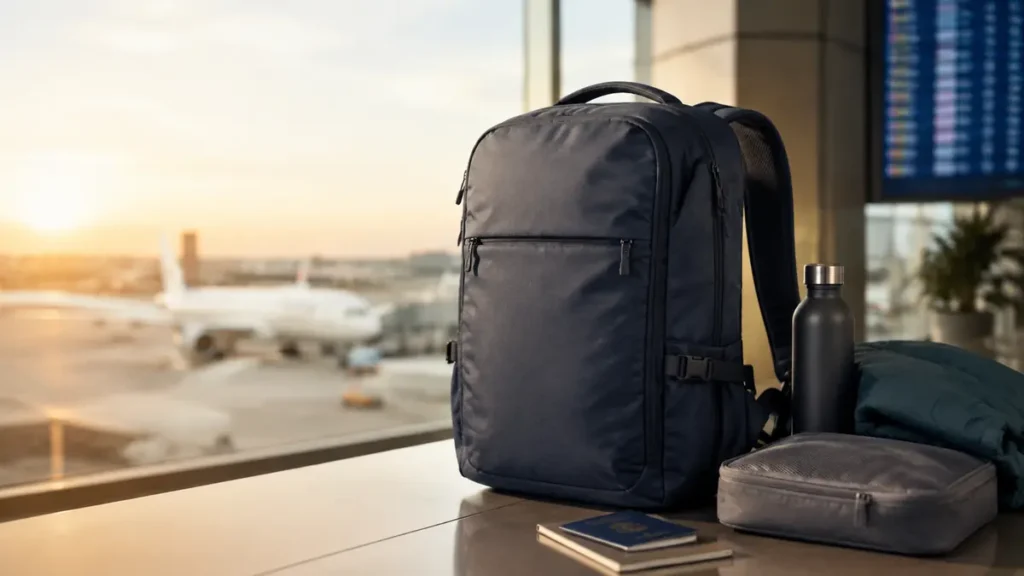
A backpack can look perfect online and become painfully uncomfortable after 20 minutes in an airport. Capacity alone does not tell you how well it carries, whether it fits an airline sizer, or how easily you can reach your passport.
These travel backpack recommendations match different bags and features to real travel styles. For most travelers, a 30–40-liter clamshell backpack with an adjustable harness, padded laptop compartment, manageable empty weight, and dimensions within the airline’s allowance provides the most practical balance of space, comfort, and carry-on compatibility.
Travel Backpack Recommendations at a Glance
There is no single best backpack for every traveler. A business traveler carrying a laptop has different requirements from a backpacker moving between hostels or a passenger trying to avoid budget-airline baggage fees.
| Travel need | Recommended capacity | Useful design | Representative models |
|---|---|---|---|
| Personal-item travel | 18–28L | Compact clamshell or panel loader | Cotopaxi Allpa 28L, Osprey Daylite 26+6 |
| Weekend trips | 25–32L | Lightweight clamshell | Patagonia Black Hole Mini MLC 30L |
| General carry-on travel | 30–40L | Clamshell with supportive harness | Osprey Farpoint/Fairview 40, Cotopaxi Allpa 35L |
| Work and business trips | 25–35L | Separate laptop and admin sections | Aer Travel Pack, Peak Design Travel Backpack 30L |
| Long-term one-bag travel | 35–40L | Adjustable harness and compression | Osprey Farpoint/Fairview 40 |
| Outdoor-heavy trips | 30–45L | Ventilated suspension and hip belt | REI Co-op Ruckpack, Osprey travel packs |
| Photography travel | 25–45L | Removable camera cube and side access | Peak Design Travel Backpack |
| Lightweight international travel | 25–35L | Low empty weight and simple interior | Patagonia Mini MLC, lightweight CabinZero models |
Treat these capacities as starting points rather than guarantees. Backpack volume is not measured consistently across manufacturers, and two nominally 35-liter bags can have noticeably different usable space.
How Large Should a Travel Backpack Be?
The right size depends more on your packing habits and airline rules than the number of days you will be away. Laundry access, climate, footwear, electronics, and medication can matter more than trip duration.
18–25 liters: personal-item and minimalist travel
A pack in this range works for an overnight trip, a warm-weather weekend, or disciplined minimalist travel. It may fit beneath an airline seat when its external dimensions comply with the carrier’s personal-item limit.
The advantages are significant:
- Lower risk of overpacking
- Easier movement through trains and crowded streets
- Less strain on your shoulders
- Potentially no paid carry-on fee
- Space for essentials without excessive bulk
The trade-off is limited room for extra shoes, bulky clothing, camera equipment, or souvenirs. A heavily structured 24-liter bag can also hold less than a simple bag of the same stated capacity.
26–32 liters: the versatile middle ground
For many travelers, this is the most useful range. It can handle a weekend comfortably and may support longer trips if you pack light and wash clothing along the way.
A 30-liter backpack is particularly suitable for:
- Three-to-five-day city trips
- Business travel with a laptop
- Warm-weather vacations
- Travelers with a compact capsule wardrobe
- People who want a main bag that can still function as a large daypack
This category usually offers a better weight-to-capacity ratio than feature-heavy 40-liter bags.
33–40 liters: the carry-on sweet spot
A 35–40-liter travel pack gives most people enough room for a week or longer without automatically forcing them to check luggage. It is also where supportive hip belts, adjustable torso systems, load lifters, and stronger frames become more valuable.
Choose this size if you need to carry:
- Cold-weather layers
- A second pair of shoes
- A larger laptop and accessories
- Clothing for multiple settings
- Medical supplies or specialist equipment
The bag must still match your airline’s dimensional and weight rules. Capacity in liters does not determine carry-on eligibility.
More than 40 liters: useful but risky for cabin travel
A 45-liter pack may work on airlines with generous allowances, but it sits near the upper edge of carry-on dimensions. Soft bags can bulge beyond their stated measurements when overfilled.
Larger packs also encourage unnecessary packing. Once loaded, they may become uncomfortable during long walks and difficult to lift into an overhead bin. They make more sense for checked luggage, specialized equipment, or trips where cabin compliance is not a priority.
Quick takeaway: Choose the smallest backpack that holds your non-negotiable gear comfortably. For most one-bag travelers, that means approximately 30–40 liters.
Travel Backpack Recommendations for Different Travelers
The models below illustrate useful design approaches. Product specifications and airline policies can change, so verify current measurements before traveling.
Osprey Farpoint 40 and Fairview 40: supportive all-rounders
The Osprey Farpoint 40 and women’s-specific Fairview 40 are strong choices for travelers who prioritize carrying comfort. Their adjustable torso systems, padded hip belts, frames, and load-supporting harnesses make them better suited to extended walking than many suitcase-style backpacks.
The clamshell main compartment is straightforward to pack, while compression straps help control the load. The harness can also be covered when the bag is checked or placed in storage.
Potential drawbacks include the bag’s relatively substantial empty weight and less elaborate internal organization. Travelers who prefer a pocket for every accessory may need packing cubes or a small tech organizer.
Best suited to:
- Long-term one-bag travel
- Interrail and multi-city trips
- Travelers walking between accommodations
- People who need an adjustable harness
Cotopaxi Allpa 35L: strong built-in organization
The Cotopaxi Allpa 35L uses a suitcase-style opening with divided internal compartments. This layout works well for travelers who want their clothing, footwear, and accessories separated without relying entirely on packing cubes.
Its distinctive appearance is easy to recognize, and the capacity suits many carry-on trips. The divided design, however, can feel restrictive when packing unusually shaped equipment. Some travelers may also prefer a more adjustable suspension system for heavy loads.
Best suited to:
- Travelers who value internal organization
- Multi-stop vacations
- People who frequently unpack in small rooms
- Those who prefer zippered sections over one large cavity
Patagonia Black Hole Mini MLC 30L: practical and adaptable
The Patagonia Black Hole Mini MLC combines backpack straps, grab handles, and briefcase-style carrying options. Its 30-liter size works for shorter trips, minimalist packing, and travelers who want one bag for both work and leisure.
A clamshell opening provides clear access to clothing, while the separate technology area helps isolate a laptop, tablet, charger, and documents. The rectangular shape packs efficiently, although it is less sculpted and ventilated than a hiking-oriented backpack.
Best suited to:
- Weekend and short business trips
- Minimalist international travel
- Laptop users
- Travelers wanting several carrying modes
Aer Travel Pack: organized for technology
Aer’s Travel Pack series is designed around urban and business travel. It typically offers a structured exterior, separate laptop access, an administrative section, compression, and multiple pockets for technology.
This organization reduces the need for separate pouches, but it adds weight. Numerous compartments can also reduce usable clothing space and tempt travelers to carry more accessories than they need.
Best suited to:
- Digital nomads
- Business travelers
- People carrying chargers, cables, drives, and peripherals
- Travelers who prefer a structured, understated design
Peak Design Travel Backpack: flexible for cameras and work gear
The Peak Design Travel Backpack is particularly relevant to photographers and creators. Its broad access points and compatibility with camera cubes make it easier to configure around lenses, bodies, drones, or general travel equipment.
The bag is structured and versatile, but that structure comes with an empty-weight penalty. A fully loaded camera pack can become very heavy, so shoulder comfort and hip-belt effectiveness deserve careful testing.
Best suited to:
- Photographers and videographers
- Travelers who want modular storage
- Remote workers carrying delicate equipment
- Users who value multiple access points
Osprey Daylite 26+6: compact and expandable
An expandable pack such as the Osprey Daylite 26+6 can operate as a compact personal-item-style bag on one trip and provide extra space on another. This flexibility is useful when the outbound load is small but additional room may be needed later.
Expansion does not guarantee airline compliance. When fully opened and tightly packed, the bag may exceed a carrier’s underseat dimensions.
Best suited to:
- Budget-airline travelers
- Short trips
- Minimalist packers
- Travelers who want flexible capacity
Budget travel backpacks: judge construction carefully
Affordable bags from CabinZero, Decathlon’s Quechua line, and similar brands can provide useful capacity without premium pricing. Some models use simple interiors and lighter harnesses, while others include clamshell access, laptop sleeves, and removable hip belts.
A lower price is not automatically a problem. Examine the parts most likely to fail:
- Main zipper operation
- Stitching around shoulder-strap anchors
- Fabric abrasion resistance
- Buckle quality
- Handle reinforcement
- Laptop protection
- Warranty coverage
A simple, well-constructed bag is often more dependable than an inexpensive pack overloaded with weak pockets and hardware.
Carry-On and Personal-Item Rules Matter More Than Liters
Airlines assess external dimensions and sometimes weight—not the capacity printed on a product label. The International Air Transport Association notes that allowances vary by airline, cabin class, and aircraft. It gives 56 × 45 × 25 centimeters (22 × 18 × 10 inches) as a general reference used by many carriers, while warning that some airlines apply limits starting around 5 kilograms.
Many major US airlines use approximately 22 × 14 × 9 inches for standard carry-on luggage. International and low-cost airlines often impose narrower dimensions or stricter weight limits.
A personal item is different from a full-size carry-on. It normally must fit beneath the seat, and the free allowance on some budget fares may be much smaller than a 30–40-liter backpack.
Before choosing a bag:
- Identify the airlines you use most often.
- Check the allowance attached to your actual fare.
- Record the permitted height, width, depth, and weight.
- Compare those limits with the backpack’s external measurements.
- Include packed bulges, handles, and rigid back panels.
- Weigh the completed load before leaving home.
Do not rely on labels such as “TSA approved,” “flight approved,” or “cabin size.” The Transportation Security Administration screens baggage but does not establish a universal backpack size for every airline.
Why soft backpacks still fail baggage sizers
A soft-sided pack appears forgiving, but an overfilled front compartment can increase its depth substantially. External water bottles, jackets under compression cords, and poorly positioned shoes can also make it too large.
Compression straps are helpful only when they actually reduce the bag’s profile. They cannot compensate for rigid frames or overpacked compartments.
Quick takeaway: Check the strictest airline on your itinerary. A backpack accepted on a long-haul flight may be too large or heavy for a connecting low-cost carrier.
Comfort and Fit Should Guide Travel Backpack Recommendations
A bag that fits poorly will feel heavier than it is. Fit becomes especially important once the load exceeds roughly 7–8 kilograms or you expect to walk for more than a few minutes.
Start with torso length
Backpack fit is determined primarily by torso length, not overall height. Measure from the prominent vertebra at the base of your neck to the point level with the top of your hip bones.
An adjustable harness allows the shoulder straps and hip belt to align with your body. Fixed-length travel bags can still work well, but you should try them with realistic weight before committing to one.
Check the shoulder straps
Good shoulder straps should curve around the body without cutting into the neck. Dense foam usually performs better than thick but overly soft padding, which can compress quickly.
The attachment points should sit close to the top of your shoulders. Large gaps can indicate that the torso setting or bag shape is wrong.
Understand what a hip belt does
A functional hip belt transfers part of the load from the shoulders to the pelvis. It should wrap around the top of the hip bones and remain secure when tightened.
Thin webbing straps may stabilize a small pack but provide little meaningful load transfer. On a 35–40-liter backpack, a padded and correctly positioned belt can make a major difference.
Use the sternum strap correctly
The sternum strap prevents the shoulder straps from spreading and helps stabilize the load. It should sit comfortably across the upper chest without restricting breathing.
More tension is not always better. Overtightening can distort the harness and create pressure around the neck.
Inspect the back panel
Mesh-covered foam channels improve airflow, although no backpack completely eliminates sweat in hot weather. A rigid or semi-rigid back panel helps prevent hard objects from pressing into your spine.
Highly ventilated trampoline-style suspension is common in hiking packs but less common in rectangular travel bags because it can reduce usable interior space.
Travel Backpack Recommendations Based on Essential Features
Features should solve problems you genuinely have. Every divider, zipper, and padded panel adds material, cost, and usually weight.
Clamshell opening
A clamshell backpack opens around three sides like a suitcase. This is usually the easiest design for travel because clothing remains visible and accessible.
Traditional top-loading backpacks work well outdoors but can be frustrating in hotels when an item at the bottom is needed. Panel-loading designs provide a useful compromise between travel access and everyday appearance.
Laptop compartment
A good laptop sleeve should:
- Fit the device without excessive movement
- Include padding on both sides
- Sit above the bottom of the bag
- Be accessible without exposing clothing
- Avoid placing excessive pressure on the screen
Check the actual compartment dimensions rather than trusting a generic “fits 16-inch laptops” claim. Devices with the same screen size can have different bodies.
Compression straps
Internal compression holds clothing in place. External compression reduces depth and improves load stability, but straps positioned across the main zipper may slow access.
If compression is essential, test the bag when it is partially filled. Some systems work only when the compartment is packed to a particular shape.
Water-bottle pocket
A bottle pocket should remain useful when the main compartment is full. Stretch mesh is convenient but can snag or loosen, while fabric pockets are more durable but less flexible.
For air travel, remember that bottles must generally be empty when passing through security. Refill them afterward where facilities are available.
Lockable zippers
Lockable zipper pulls deter casual tampering but do not make a fabric backpack theft-proof. A small travel lock may be useful in hostels or transit, though determined thieves can cut fabric or manipulate many coil zippers.
Keep passports, payment cards, and medication in a concealed compartment that remains under your control.
Weather resistance
Water-resistant fabric protects against light rain and short exposure. It does not mean the entire backpack is waterproof. Water can enter through seams and ordinary zippers.
For consistently wet destinations, use a rain cover or waterproof internal liner. Electronics and documents can also be placed in sealed pouches.
Stowable harness
Shoulder straps can catch on conveyor systems when a backpack is checked. A harness cover reduces that risk and gives the bag a cleaner shape in overhead storage.
The cover itself needs somewhere to go. Permanently attached panels are harder to lose than detachable ones.
Durable materials and hardware
Fabric denier describes yarn thickness but does not independently prove durability. Weave, coating, fiber quality, stitching, and construction all matter. Common materials include nylon, polyester, recycled fabrics, TPU laminates, and Cordura-branded textiles.
YKK zippers are widely used and generally dependable, but size and application remain important. A heavily loaded main compartment needs stronger hardware than a small interior pocket.
Organization: Built-In Compartments or Packing Cubes?
Highly organized backpacks provide assigned spaces for cables, documents, toiletries, and clothing. They work well when your packing list remains consistent.
A simpler main compartment is more adaptable. Packing cubes can create removable organization without permanently dividing the available space.
| Organization style | Advantages | Limitations |
|---|---|---|
| Built-in dividers | Fast access and less movement | Added weight; fixed layout |
| Open compartment | Maximum flexibility | Contents can shift |
| Packing cubes | Modular and easy to transfer | Additional cost and material |
| Compression cubes | Reduce clothing bulk | Can create dense, heavy blocks |
| Tech pouch | Keeps small electronics together | Easy to overfill |
| Shoe bag | Contains dirt | Shoes still consume substantial space |
Packing cubes organize and compress soft items, but they do not change the physical mass of your load. Over-compressing clothes can create an awkward, rigid block and put pressure on zippers.
Place dense objects close to your back and around the middle of the pack. Lightweight clothing can fill the front and upper areas. This position improves balance and reduces the backward pull on your shoulders.
Empty Weight Is an Often-Ignored Cost
A feature-rich travel backpack may weigh 1.5–2 kilograms before anything is packed. If an airline permits only 7 kilograms of cabin baggage, the bag can consume a quarter of the allowance.
Lighter is not always better. Removing the frame, padding, hip belt, and durable fabric can reduce comfort and protection. The goal is to avoid weight that provides no value for your particular trip.
Consider where your weight is going:
- Supportive frame: valuable for heavy loads
- Laptop padding: valuable when carrying electronics
- Large hip belt: unnecessary for some lightweight trips
- Multiple admin pockets: useful only if filled intentionally
- Heavy weather coating: beneficial in harsh conditions
- Decorative buckles and layers: often unnecessary
A practical target is the lightest backpack that still provides the structure, protection, and comfort your load requires.
Common Mistakes When Choosing a Travel Backpack
Buying before checking airline limits
A popular 40-liter model may suit one airline and violate another carrier’s allowance. Start with measurements, especially if you regularly fly on budget fares.
Testing an empty bag
Almost every backpack feels comfortable when empty. Load it with the approximate weight of your normal travel kit and wear it for at least 20–30 minutes.
Walk upstairs, bend down, turn quickly, and reach for a bottle. These movements reveal pressure points and poor balance.
Choosing capacity for a hypothetical trip
Buying a large bag “just in case” usually leads to filling unused space. Choose for the trips you actually take most often, then adapt occasionally with laundry, rental equipment, or a checked bag.
Prioritizing pockets over carrying comfort
Organization is visible in product photographs; harness performance is harder to judge. Yet the harness has a greater effect on your experience once the bag is loaded.
Assuming one backpack can replace every type
Travel backpacks, hiking packs, laptop bags, and camera bags solve different problems. A crossover model may perform adequately in several roles without excelling in all of them.
For serious hiking, prioritize ventilation, load transfer, hydration compatibility, and trail access. For business use, laptop protection and professional styling may matter more.
Ignoring return and warranty policies
Fit is personal. A fair return period allows a realistic indoor load test, while a clear repair warranty can extend the useful life of the bag.
Read what the warranty actually covers. Normal wear, airline damage, cosmetic deterioration, and misuse may be excluded.
How to Test a Backpack Before Traveling
Use a repeatable test rather than relying on first impressions.
- Create a realistic packing list. Include clothing, footwear, toiletries, electronics, documents, and medication.
- Pack it as you would for departure. Do not test with random objects that distribute weight differently.
- Measure every external dimension. Check the deepest point after all pockets are filled.
- Weigh the complete bag. Compare the result with each airline on the itinerary.
- Adjust the harness. Set torso length first, then tighten the hip belt, shoulder straps, load lifters, and sternum strap.
- Wear it for 30 minutes. Walk, climb stairs, and stand still long enough to detect pressure.
- Access essential items. Retrieve your passport, laptop, liquids, charger, and water bottle.
- Place it in a simulated overhead space. Confirm that loose straps can be contained.
- Pack and unpack twice. Awkward layouts become obvious through repetition.
- Remove nonessential items. A good load is often created by packing less, not buying a larger bag.
Pay attention to numbness, concentrated shoulder pressure, lower-back discomfort, or a hip belt that slides. These are fit problems, not inconveniences you should expect to disappear automatically.
Choosing Between a Backpack, Roller, and Duffel
A backpack is not always the best form of luggage.
| Luggage type | Best for | Main limitation |
|---|---|---|
| Travel backpack | Stairs, public transport, uneven streets | Weight stays on your body |
| Roller suitcase | Airports, hotels, smooth surfaces | Awkward on stairs and cobblestones |
| Duffel bag | Flexible storage and vehicle travel | Can become uncomfortable to carry |
| Wheeled backpack | Mixed environments | Heavier and less comfortable than specialized options |
| Hiking pack | Long walking and outdoor trips | Often inconvenient to pack and store on flights |
Choose a roller if mobility through airports is the main requirement and you rarely encounter stairs. Choose a backpack if you move frequently between trains, buses, hostels, or streets where wheels become a burden.
Travelers with back, shoulder, or balance problems should not assume that a backpack is automatically healthier. A lightweight roller may be more appropriate. If physical pain is a concern, seek individualized advice from a qualified healthcare professional.
Final Travel Backpack Recommendations
The best approach is to select a backpack by restrictions first and features second. Confirm airline dimensions and weight, estimate your real packing volume, and then look for a harness that fits your torso.
For most travelers, the strongest starting point is a 30–40-liter clamshell backpack with a comfortable harness, useful compression, durable zippers, and no more organization than necessary. Minimalist and budget-airline travelers should consider 18–28 liters, while photographers and business travelers may benefit from modular storage and separate laptop access.
Use these travel backpack recommendations as a framework rather than treating any model as a universal winner. Measure the packed bag, test it under realistic weight, and remove unnecessary items before departure. A well-fitting modest backpack will usually serve you better than a larger bag filled simply because the space exists.