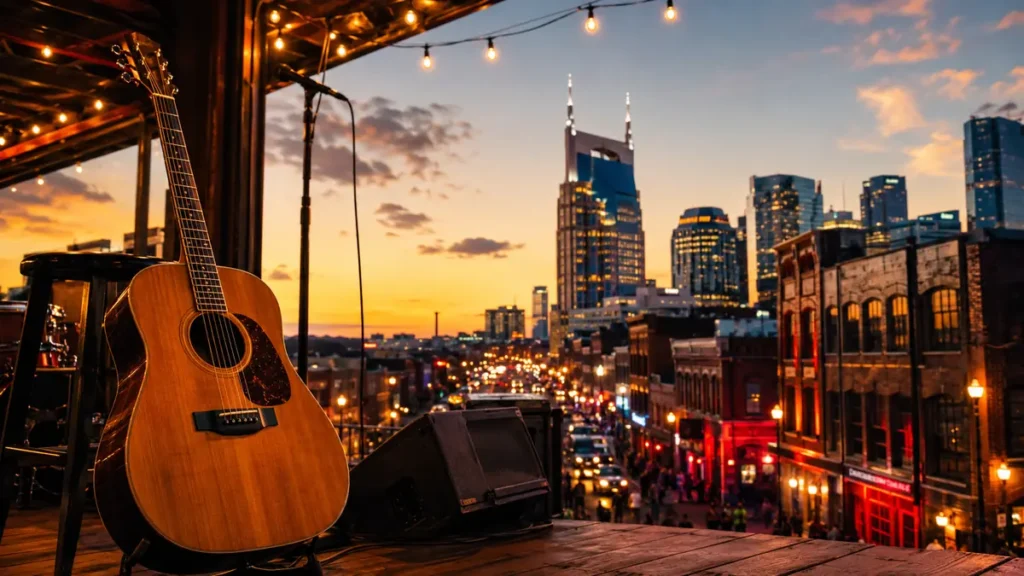
Nashville’s reputation begins with country music, but the city offers far more than neon-lit bars and cowboy boots. Historic recording studios, inventive restaurants, leafy parks, art museums, Civil War sites, and distinctive neighborhoods make Tennessee’s capital worth exploring beyond Broadway.
The best things to do in nashville include hearing live music on Lower Broadway, touring the Ryman Auditorium, visiting the Country Music Hall of Fame, seeing a Grand Ole Opry show, exploring Centennial Park, and trying Nashville hot chicken. Leave time for neighborhoods such as 12South, Germantown, and East Nashville.
Best Things to Do in Nashville for First-Time Visitors
If this is your first trip, start with the places that explain why Nashville became known as Music City. These attractions combine music history, live performances, local food, and recognizable landmarks.
1. Hear Live Music on Lower Broadway
Lower Broadway—often called Honky Tonk Highway—is the loud, colorful heart of downtown Nashville. Live bands perform throughout the day inside multi-level venues lined with neon signs.
Many honky-tonks do not charge a cover, although age restrictions and special-event policies vary. Robert’s Western World, Tootsie’s Orchid Lounge, Legends Corner, and The Stage are among the established names.
Broadway becomes busiest after sunset, particularly on Friday and Saturday nights. Visit during the afternoon if you want the music without the largest crowds. At night, keep valuables secure, stay with your group, and use a rideshare service rather than attempting to drive after drinking.
Broadway is entertaining, but it represents only one part of Nashville. A short visit followed by a show at a dedicated listening room usually provides a more complete picture of the city’s music culture.
2. Tour the Ryman Auditorium
The Ryman Auditorium began as the Union Gospel Tabernacle in the 1890s and later became closely associated with the Grand Ole Opry. Its wooden pews, stained-glass windows, and remarkable acoustics have earned it the nickname “Mother Church of Country Music.”
A daytime tour lets visitors explore exhibits, see memorabilia, and take a photograph on the stage when it is available. The guided backstage experience adds dressing rooms and stories about performers who appeared there. Official tour information indicates that typical experiences take approximately 45 to 60 minutes. Ryman Auditorium
Seeing a concert here is different from touring the building. If the schedule and budget allow, attend an evening performance; the intimate room and clear sound are a major part of the Ryman experience.
3. Explore the Country Music Hall of Fame and Museum
The Country Music Hall of Fame and Museum traces the development of country music through recordings, instruments, costumes, photographs, handwritten lyrics, and changing exhibitions.
Allow at least two hours for the galleries. Serious music fans can easily spend half a day inside. The museum recommends avoiding its peak period of roughly 11 a.m. to 2 p.m. when possible, so an early arrival can produce a calmer visit. Country Music Hall of Fame
The museum sits in SoBro, near Bridgestone Arena and several other downtown attractions. This makes it easy to combine with the Ryman, Walk of Fame Park, or a tour of Hatch Show Print.
4. Watch a Grand Ole Opry Performance
The Grand Ole Opry is a live radio show rather than a conventional concert by one headliner. A typical program features several established performers, emerging artists, and different styles of country music.
Shows generally last around two hours, including an intermission. The format makes the Opry especially useful for visitors who want to hear several artists in one evening. Grand Ole Opry
Most performances take place at the Grand Ole Opry House in the Opryland area, several miles from downtown. At selected times, the show returns to the Ryman Auditorium, so confirm the venue before arranging transportation.
Backstage tours offer access to themed dressing rooms, performance history, and the famous wooden circle on the Opry stage. If you must choose between a tour and a show, the live broadcast is the more distinctive experience.
5. Visit Historic RCA Studio B
Historic RCA Studio B is one of the most meaningful Nashville attractions for anyone interested in how records are made. Elvis Presley, Dolly Parton, Chet Atkins, the Everly Brothers, and many other performers recorded there.
Built in 1957, the studio helped develop the polished “Nashville Sound,” characterized partly by background vocals and orchestral elements. The room is still filled with the atmosphere of a working studio rather than a conventional museum. Historic RCA Studio B
Tours depart through the Country Music Hall of Fame and Museum, and advance booking is sensible. Arrive before the designated meeting time because late entry is not guaranteed.
6. See Letterpress Printing at Hatch Show Print
Founded in 1879, Hatch Show Print created bold posters for entertainers, circuses, fairs, and music performances. Its recognizable blocks of color and oversized type helped shape Nashville’s visual identity.
The working print shop is located inside the Country Music Hall of Fame and Museum complex. Visitors can browse the retail area without taking a full tour, while a guided experience explains traditional letterpress techniques and the shop’s collection of carved printing blocks. Hatch Show Print
It pairs naturally with the museum, but schedule each timed activity carefully rather than assuming you can walk directly into a tour.
Quick takeaway: For a music-focused day, combine the Country Music Hall of Fame, Hatch Show Print, and the Ryman. Reserve RCA Studio B for a timed tour and attend an Opry performance that evening.
Free Things to Do in Nashville
Nashville can become expensive once parking, admission, meals, and evening entertainment are added together. Fortunately, several of its most rewarding outdoor and historical experiences cost nothing.
7. Walk Through Centennial Park
Centennial Park is a 132-acre urban park west of downtown. Its features include Lake Watauga, gardens, monuments, a one-mile walking trail, a dog park, sports facilities, and the city’s most unusual landmark: a full-scale replica of the Parthenon. Metro Nashville Parks
Walking around the park and viewing the Parthenon’s exterior are free. The museum inside the building charges admission. Construction, festivals, and seasonal events can affect access to parts of the grounds, so check current park notices before visiting.
8. Step Inside the Parthenon
Nashville’s Parthenon was created for the Tennessee Centennial Exposition of 1897 and later rebuilt as a permanent structure. Inside stands a 42-foot re-creation of Athena, modeled after the ancient statue associated with the original Parthenon in Athens.
The lower level contains art galleries, while the upper hall provides the dramatic view of Athena. The Parthenon
The exterior is one of Nashville’s best free photo locations. Pay for the interior only if you are interested in classical architecture, the Athena installation, or the art collection.
9. Explore Bicentennial Capitol Mall State Park
Bicentennial Capitol Mall State Park presents Tennessee’s geography and history through an outdoor map, monuments, fountains, and a path beneath a carillon.
The park sits below the Tennessee State Capitol and next to the Nashville Farmers’ Market and Tennessee State Museum. Those three places form an efficient half-day route with minimal travel between stops.
Walk up toward the Capitol for a broader view of the park and downtown skyline. The area is quieter than Broadway and gives visitors useful context about Tennessee beyond its music industry.
10. Visit the Tennessee State Museum
The Tennessee State Museum covers Indigenous history, statehood, the Civil War and Reconstruction, natural history, art, and modern Tennessee. General admission is free, making it one of the best indoor options for travelers watching their budget.
The museum’s size surprises many first-time visitors. Allow roughly two hours for a selective visit or longer if state history is a major interest.
Because it is beside Bicentennial Capitol Mall and the Farmers’ Market, poor weather does not have to disrupt the entire day: begin indoors, eat nearby, and walk through the park when conditions improve.
11. Walk Across the John Seigenthaler Pedestrian Bridge
This pedestrian bridge crosses the Cumberland River between downtown and the East Bank. It provides one of the clearest panoramic views of Nashville’s skyline, particularly around sunset.
The downtown entrance is close to Broadway, while the opposite side leads toward Nissan Stadium and the riverfront. The bridge is exposed to sun and wind, so midday in summer can be uncomfortable.
Continue toward Wasioto Park if traveling with children. The 6.5-acre riverfront space includes play structures, water features, an amphitheater, and direct bridge access. Wasioto Park
12. Discover Fort Negley
Fort Negley preserves the remains of a large stone fortification built by Union forces during the Civil War. Interpretive signs explain the military occupation of Nashville and acknowledge the labor of Black workers, including formerly enslaved people and refugees, who constructed the fort.
The park is open from dawn to dusk for self-guided walks. The visitor center has more limited operating days and hours, so check the official schedule if you want indoor exhibits or restroom access. Fort Negley
The paths climb gradually and reveal views across the city. Wear stable shoes because the terrain is less polished than a downtown sidewalk.
Things to Do in Nashville Beyond Country Music
Music City’s name can make non-country fans wonder whether there is enough for them to do. There is. Nashville has visual art, African American history, gardens, architecture, sports, and a broad live-music scene.
13. Visit the National Museum of African American Music
The National Museum of African American Music examines the influence of Black musicians across gospel, blues, jazz, R&B, hip-hop, and other genres. Interactive exhibits connect those traditions to the development of American popular music.
Its location at Fifth + Broadway makes it convenient to reach from Lower Broadway. The museum also adds essential cultural context that can be missed when a Nashville itinerary focuses exclusively on country institutions.
Allow around two hours and leave enough time for the interactive stations rather than moving quickly from display to display.
14. See an Exhibition at the Frist Art Museum
The Frist Art Museum occupies Nashville’s former main post office, an Art Deco building completed in the 1930s. It does not maintain a permanent collection in the usual sense; instead, the galleries host rotating exhibitions.
That changing program means the experience depends heavily on the dates of your trip. Review the current exhibition calendar before visiting.
The Martin ArtQuest Gallery offers hands-on art activities and can be particularly helpful for families. Architecture enthusiasts should also look closely at the building’s preserved lobby and decorative details.
15. Tour Cheekwood Estate & Gardens
Cheekwood combines a historic mansion, art exhibitions, sculpture, and 55 acres of gardens. Seasonal displays—especially spring flowers and holiday lights—can turn it into a substantially different experience from one month to the next.
The estate is west of central Nashville, so it requires more travel time than downtown museums. Give it several hours rather than squeezing it between unrelated attractions.
Garden paths, outdoor art, and changing weather make comfortable footwear and season-appropriate clothing essential.
16. Explore the Adventure Science Center
The Adventure Science Center is one of the strongest things to do in Nashville with kids. Hands-on exhibits address the human body, physics, space, weather, and engineering, while the planetarium runs scheduled programs.
It sits near Fort Negley, allowing families to combine indoor science activities with a short historical walk. Check planetarium showtimes before arrival because admission arrangements may differ from access to the general exhibits.
17. Attend a Sporting Event
Nashville’s professional sports calendar provides alternatives to music venues:
- The Tennessee Titans play NFL games at Nissan Stadium.
- The Nashville Predators play NHL hockey at Bridgestone Arena.
- Nashville SC plays Major League Soccer at GEODIS Park.
- The Nashville Sounds play Minor League Baseball at First Horizon Park.
The Predators are especially convenient for downtown visitors because Bridgestone Arena sits beside Broadway. First Horizon Park pairs well with a meal in Germantown, while GEODIS Park can be combined with the Wedgewood-Houston neighborhood.
Experience Nashville’s Food and Neighborhoods
A common planning mistake is treating neighborhoods as brief photo stops. Nashville becomes more interesting when you select two or three districts and spend enough time to eat, browse local shops, and hear music away from downtown.
18. Try Nashville Hot Chicken
Nashville hot chicken is fried chicken coated with a cayenne-heavy spice mixture, traditionally served with white bread and pickles. Prince’s Hot Chicken is widely associated with the dish’s origin, while Bolton’s and Hattie B’s are also prominent names.
Heat labels are not standardized. “Hot” at one restaurant may be significantly more intense than “hot” somewhere else. First-time diners should order one level below what they normally choose and keep a mild side available.
The dish is worth trying for its balance of crisp texture, savory seasoning, and heat—not simply as a test of endurance. Confirm individual restaurant locations and operating hours because popular branches can attract long lines.
19. Eat a Meat-and-Three Lunch
A meat-and-three restaurant lets diners choose one main dish and three sides. Typical options include fried chicken, roast beef, meatloaf, macaroni and cheese, turnip greens, beans, cornbread, and banana pudding.
Arnold’s Country Kitchen helped make the format famous among visitors, but operating patterns can change and traditional cafeterias often keep limited lunch hours. Check the latest information rather than building an itinerary around an old recommendation.
A meat-and-three meal provides a broader introduction to Middle Tennessee cooking than hot chicken alone.
20. Spend Time in 12South
The 12South neighborhood is a walkable stretch of restaurants, coffee shops, boutiques, and residential streets. It is easy to explore casually without a detailed schedule.
The district is known for its murals, including the frequently photographed “I Believe in Nashville” design. Be considerate when taking pictures: murals and shops often sit beside homes, active sidewalks, and business entrances.
Sevier Park creates a pleasant southern endpoint. Visit earlier in the day for shopping and coffee; the area is livelier around meal times.
21. Explore East Nashville
East Nashville has an independent, creative character shaped by restaurants, vintage stores, cocktail bars, small music venues, and residential pockets.
Five Points is a useful starting point, but the neighborhood extends well beyond that intersection. Shelby Bottoms Greenway and Shelby Park offer trails, river scenery, birdwatching, playgrounds, fishing, and recreational facilities. Shelby Park alone covers roughly 300 acres. Shelby Park
Distances between individual East Nashville destinations can be larger than expected, so group stops geographically instead of attempting to walk everywhere.
22. Browse Germantown and the Nashville Farmers’ Market
Germantown is a historic neighborhood north of downtown with brick sidewalks, Victorian architecture, restaurants, and First Horizon Park.
The nearby Nashville Farmers’ Market includes merchant sheds and a food hall. Pair it with the Tennessee State Museum and Bicentennial Capitol Mall for one of the city’s easiest self-guided routes.
The market works well for groups because people can select different cuisines without splitting up. Vendor schedules vary, so not every stall operates at every hour.
23. Visit The Gulch and Wedgewood-Houston
The Gulch is a redeveloped district known for restaurants, hotels, boutiques, and murals. Its popular angel-wings mural often attracts a line, but the neighborhood’s main advantage is its proximity to downtown and convenient dining.
Wedgewood-Houston, usually shortened to WeHo, has a more arts-oriented identity, with galleries, studios, breweries, and creative businesses. It is also home to Third Man Records, founded by Jack White.
Choose The Gulch for polished urban convenience and Wedgewood-Houston for contemporary art and independent spaces. Neither requires an entire day.
Unique Things to Do in Nashville at Night
Nashville nightlife does not begin and end with Broadway. Smaller venues often deliver better sound, more attentive audiences, and a closer connection to the songwriting culture.
24. Listen to Songwriters Perform Their Own Work
A songwriter round features several writers taking turns performing songs and explaining how they were created. You may recognize hits usually associated with major recording artists.
The Bluebird Cafe is the best-known listening room, but its small size makes reservations difficult. Alternatives include The Listening Room Cafe and songwriter events hosted at other venues around town.
Conversation during performances is discouraged at serious listening rooms. Arrive on time, silence your phone, and treat the show more like a theater performance than background entertainment.
25. Hear Bluegrass at the Station Inn
The Station Inn is a compact venue in The Gulch with a long association with bluegrass and roots music. Its understated appearance is part of its charm.
Some performances operate differently from conventional reserved-seat concerts, so review the individual show details before going. Arrive early when seating is limited.
It is an excellent counterpoint to Broadway: less spectacle, fewer distractions, and greater emphasis on musicianship.
26. Catch a Show Outside Downtown
Nashville’s venue network covers far more than country music. Depending on the calendar, visitors can hear rock, jazz, Americana, classical music, pop, blues, or experimental work.
Consider venues such as:
- The Basement and The Basement East
- Exit/In
- Brooklyn Bowl Nashville
- Rudy’s Jazz Room
- Schermerhorn Symphony Center
- Marathon Music Works
- 3rd & Lindsley
Check the official event calendar for your travel dates. A carefully chosen evening performance will usually be more memorable than wandering into whichever downtown bar is loudest.
Things to Do in Nashville with Kids
Families can enjoy Nashville without keeping children inside adult-oriented entertainment districts.
The strongest choices include the Adventure Science Center, Nashville Zoo at Grassmere, Centennial Park, the Parthenon, Tennessee State Museum, Cheekwood, Shelby Park, and the Country Music Hall of Fame’s family programming.
Wasioto Park adds a modern riverfront play space, while the Gaylord Opryland Garden Conservatory offers elaborate indoor gardens and walkways. Access rules can change during conventions, holidays, and special events, so verify visitor policies before making a dedicated trip.
Lower Broadway is technically accessible to families during parts of the day, but it becomes louder and more crowded in the evening. An afternoon walk is usually the practical choice for parents who want children to see the neon signs and hear a band.
A balanced family day might look like this:
- Visit the Adventure Science Center in the morning.
- Eat lunch at the Nashville Farmers’ Market.
- Explore the Tennessee State Museum.
- Walk through Bicentennial Capitol Mall.
- Finish with an early, all-ages music performance.
How to Plan Things to Do in Nashville in One Day
With one day, focus on downtown rather than losing time crossing the city.
Begin at the Country Music Hall of Fame when it opens. Walk through Walk of Fame Park, tour the Ryman Auditorium, and have lunch near Fifth + Broadway. Spend the afternoon around the riverfront and John Seigenthaler Pedestrian Bridge, then hear live music on Lower Broadway.
If an Opry performance matters more than nightlife, leave downtown early enough to reach the Opry House. Traffic can make the trip longer than its distance suggests.
Do not attempt to combine downtown, Cheekwood, East Nashville, Opryland, and 12South in one day. The result will be more driving than sightseeing.
A Practical Two- or Three-Day Nashville Itinerary
Day One: Downtown Music History
Start with the Country Music Hall of Fame and add either Hatch Show Print or RCA Studio B. Tour the Ryman, walk Lower Broadway in the afternoon, cross the pedestrian bridge around sunset, and attend a ticketed show in the evening.
Day Two: Parks, History, and Local Food
Visit Centennial Park and the Parthenon in the morning. Eat a meat-and-three lunch or try hot chicken, then explore 12South. End with a songwriter round or a performance at the Station Inn.
Day Three: Choose Your Interests
Build the final day around one theme:
- Art and gardens: Frist Art Museum and Cheekwood.
- History: Tennessee State Museum, Bicentennial Capitol Mall, and Fort Negley.
- Families: Adventure Science Center, Nashville Zoo, and a park.
- Neighborhoods: Germantown, East Nashville, and Wedgewood-Houston.
- Country music: Grand Ole Opry tour, Opryland gardens, and an evening Opry show.
This approach provides structure without turning the visit into a race.
When Is the Best Time to Visit Nashville?
Spring and fall generally offer the most comfortable conditions for walking, parks, and outdoor performances. They are also popular seasons, so accommodation and event prices can rise.
Summer is hot and humid, with major festivals and active nightlife. Plan outdoor activities for the morning, carry water, and use museums during the hottest part of the afternoon.
Winter is quieter outside holiday periods. Some outdoor attractions lose seasonal color, but museums, music venues, restaurants, and indoor tours remain appealing.
Weather is only one factor. Concerts, professional sports, conventions, university events, and festivals can significantly affect room availability and downtown traffic. Check the citywide calendar before selecting dates.
Getting Around Nashville
Downtown Nashville is walkable, particularly around Broadway, SoBro, the Ryman, Fifth + Broadway, and the riverfront. However, the larger city is spread out.
Rideshare services are useful for 12South, East Nashville, Music Row, Cheekwood, and Opryland. A rental car can help if you plan several suburban attractions or regional day trips, but downtown hotel parking is often expensive.
Nashville’s WeGo public buses serve the city, although routes may not match every tourist itinerary. Review timetables in advance rather than assuming frequent service between all attractions.
When driving, group destinations by area:
| Area | Attractions that pair well |
|---|---|
| Downtown and SoBro | Broadway, Ryman, Country Music Hall of Fame, NMAAM |
| North of downtown | Germantown, Farmers’ Market, Tennessee State Museum, Bicentennial Mall |
| West End | Centennial Park, Parthenon, Vanderbilt area |
| Music Row | RCA Studio B, Demonbreun, Midtown |
| Opryland | Grand Ole Opry, Opryland gardens, Opry Mills |
| South Nashville | Fort Negley, Adventure Science Center, Wedgewood-Houston |
| East Nashville | Five Points, Shelby Park, Shelby Bottoms Greenway |
Mistakes to Avoid When Visiting Nashville
The biggest mistake is spending the entire trip on Broadway. The area is fun, but neighborhoods, museums, parks, and listening rooms reveal more of Nashville’s identity.
Other common problems include:
- Booking an Opry ticket without confirming whether the show is at the Opry House or Ryman Auditorium.
- Underestimating travel time between downtown and Opryland.
- Wearing uncomfortable shoes on hilly sidewalks.
- Arriving late for timed studio or museum tours.
- Ordering the hottest chicken level for novelty rather than enjoyment.
- Assuming every music venue admits guests under 21.
- Building an itinerary around outdated hours or closed restaurants.
- Paying for numerous attractions without leaving unstructured time to explore.
Reserve the experiences that can sell out—especially major concerts, Opry shows, RCA Studio B, and small listening rooms—but keep part of each day flexible.
Make the Most of Nashville
The most rewarding things to do in nashville combine its famous music institutions with places that reveal the wider city. Hear a songwriter explain a familiar hit, study Tennessee history, walk beneath the Parthenon, eat a regional meal, and spend an evening away from Broadway.
Choose one geographic area for each half-day, confirm current schedules directly with venues, and avoid packing every famous attraction into a single visit. Nashville is best experienced as a living music city, not a checklist of neon signs.