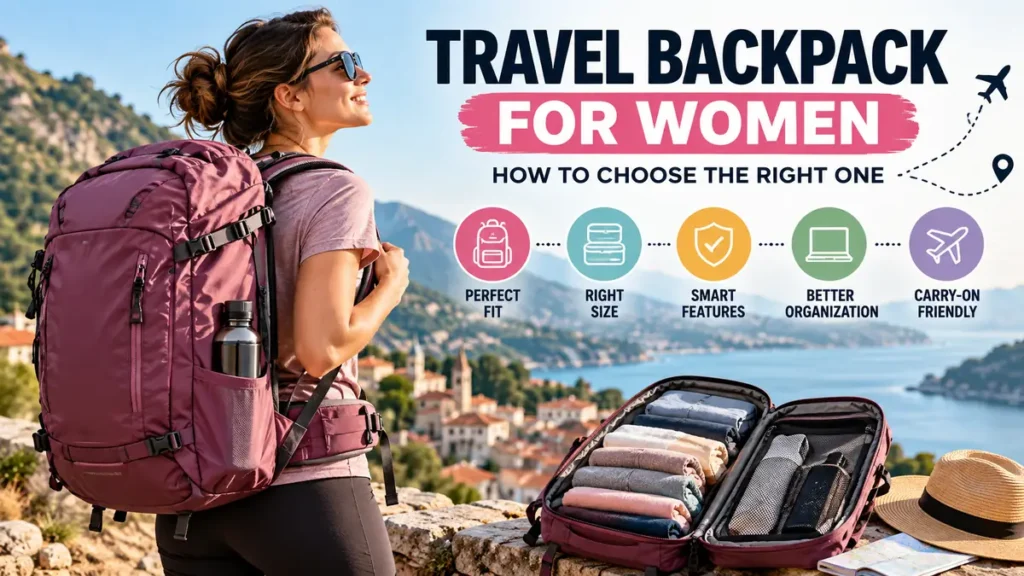
The right travel bags can make the difference between a smooth journey and one filled with awkward carrying, disorganized packing, and unnecessary baggage problems. A bag that works perfectly for a weekend road trip may be frustrating on a two-week international journey.
Travel bags include suitcases, backpacks, duffel bags, weekenders, totes, garment bags, and hybrid wheeled designs made to transport clothing and personal belongings. Choosing the right one depends mainly on trip length, transportation, packing volume, airline restrictions, terrain, and how comfortably you can carry or roll the bag. LuggageChoice
What Are Travel Bags?
Travel bags are bags or pieces of luggage specifically designed to carry clothing, toiletries, electronics, documents, and other belongings during a journey.
The term covers much more than traditional suitcases. A travel backpack designed for one-bag travel, a soft duffel used for a weekend away, and a wheeled suitcase checked onto a flight can all serve the same basic purpose.
What separates a useful travel bag from an ordinary everyday bag is its ability to handle the demands of travel. Good designs usually emphasize some combination of:
- Durable construction
- Practical packing capacity
- Comfortable carrying
- Secure closures
- Easy organization
- Convenient access
- Manageable weight
- Suitable dimensions
- Resistance to repeated handling
The importance of each feature changes according to the journey.
Someone walking between train stations needs different luggage from a traveler moving primarily between airports, taxis, and hotels.
Main Types of Travel Bags
There is no single type that works best in every situation. Wheeled luggage, travel packs, and duffel bags are three broad categories commonly used by travelers, with numerous variations within them. REI
| Type | Particularly Useful For | Main Advantage | Main Limitation |
|---|---|---|---|
| Carry-on suitcase | Flights and short trips | Easy airport transport | Limited capacity |
| Checked suitcase | Longer journeys | Large packing space | Must be checked on flights |
| Travel backpack | Mobile travel | Hands-free carrying | Can become uncomfortable when overloaded |
| Duffel bag | Weekends and road trips | Flexible storage | Less comfortable for long walks |
| Weekender | 1–3 night trips | Compact and accessible | Limited long-trip capacity |
| Rolling duffel | Gear-heavy journeys | Capacity plus wheels | Often bulky |
| Garment bag | Formal or business travel | Protects clothing | Less versatile |
| Travel tote | Personal-item use | Quick access | Limited support for heavy loads |
Carry-On Suitcases
Carry-on suitcases are designed to travel in an aircraft cabin rather than the checked baggage compartment, provided they comply with the airline’s requirements.
Their biggest advantage is convenience. You can keep your belongings with you, avoid baggage-claim waits, and reduce the possibility of checked luggage being delayed.
Wheeled carry-ons are particularly useful in airports, hotels, and cities with smooth surfaces.
Many modern versions include spinner wheels, telescoping handles, compression panels, internal dividers, and separate pockets.
The critical issue is size.
The FAA notes that most airlines use a maximum carry-on size around 45 linear inches when height, width, and depth are added together, but it specifically advises passengers to check their individual airline’s requirements. Federal Aviation Administration
That last point matters because there is no universal carry-on allowance covering every airline and ticket.
Checked Suitcases
A checked suitcase offers considerably more packing room and makes sense when you cannot reasonably fit everything into cabin luggage.
These bags are useful for:
- Longer vacations
- Family trips
- Cold-weather destinations
- Trips requiring several pairs of shoes
- Equipment-heavy travel
- Journeys involving formal clothing
The trade-off is mobility.
A large suitcase may feel effortless while rolling across an airport floor but become inconvenient when you encounter stairs, gravel, narrow train aisles, or uneven streets.
Checked luggage also experiences more handling than a bag kept with you, making wheel construction, handles, shell durability, and zipper quality especially important.
Travel Backpacks
Travel backpacks prioritize mobility.
Unlike ordinary school or day backpacks, dedicated travel models frequently have large openings, structured compartments, padded shoulder straps, laptop sleeves, compression straps, and sometimes hip belts.
Their biggest advantage is hands-free movement.
This is particularly valuable when navigating railway stations, public transportation, stairs, crowded streets, or destinations where rolling luggage becomes inconvenient.
Backpacks distribute weight across both shoulders rather than concentrating it on one side of the body. They are therefore generally more practical than shoulder-carried duffels when significant walking is involved. BagsMart.pk
The downside appears when people overpack them. A backpack that feels comfortable at home can feel completely different after 30 minutes of walking.
Duffel Bags
A duffel is usually a soft-sided bag built around a large central storage area.
Its flexible construction makes it particularly good for bulky items and irregular loads. Duffels can also squeeze into spaces where rigid suitcases cannot.
That makes them useful for:
- Weekend trips
- Road trips
- Sports travel
- Camping
- Short flights
- Gear-heavy journeys
Their simplicity is simultaneously their strength and weakness.
The large compartment provides excellent usable space but can quickly become disorganized without internal pockets or packing cubes.
Traditional duffels also put most of the load on your hand or one shoulder. That is manageable across a hotel lobby but less pleasant during a long airport connection.
Rolling Duffel Bags
A rolling duffel combines the flexible capacity of a duffel with the convenience of wheels.
These designs are particularly useful when carrying equipment or oddly shaped belongings. REI specifically highlights wheeled duffels as useful for adventure and multisport travelers carrying gear of different shapes and sizes. Opt Outside
The compromise is additional structure and weight.
Wheel assemblies and telescoping handles occupy space that an ordinary duffel can devote entirely to cargo.
Weekender Bags
A weekender sits somewhere between an everyday tote and a larger duffel.
As the name suggests, it is designed primarily for short trips.
A practical weekender should have enough space for a few outfits, basic toiletries, chargers, and perhaps an extra pair of shoes without becoming cumbersome.
Look for a wide opening. A stylish narrow opening can make an otherwise spacious bag surprisingly difficult to pack.
Garment Bags
Garment bags are designed primarily to transport clothing while reducing folds and wrinkles.
They are useful for:
- Business trips
- Weddings
- Formal events
- Suits
- Dresses
- Uniforms
Some modern designs fold into a duffel-like shape, giving travelers conventional storage alongside a dedicated garment section.
Travel Totes
A travel tote works particularly well as a secondary bag.
It can keep frequently needed items close at hand, including passports, headphones, chargers, snacks, reading material, and travel documents.
Some are designed to fit beneath an aircraft seat and may qualify as personal items depending on the airline’s rules.
For heavy packing, however, a backpack is generally more comfortable because the weight is distributed across two shoulders.
Travel Bags by Trip Length
Bag capacity should be determined by what you genuinely need rather than how much space you think you might fill.
A rough capacity framework can help:
| Trip | Approximate Capacity | Common Choice |
|---|---|---|
| Overnight | 20–30L | Backpack or small weekender |
| Weekend | 30–45L | Duffel, backpack, or carry-on |
| 3–5 days | 35–50L | Carry-on or travel backpack |
| About one week | 40–70L | Carry-on or medium luggage |
| Extended trip | 60–100L+ | Checked luggage |
These figures are guidelines rather than rules. Published travel-bag size guides commonly place carry-ons around 30–45 liters, medium bags around 50–70 liters, and larger luggage around 70–100 liters or more. Fosmore
Packing style makes an enormous difference.
A traveler taking lightweight clothing to a warm destination might spend a week with a 40-liter backpack. Someone carrying winter clothes, boots, and specialist equipment could need much more space for the same number of days.
How to Choose Travel Bags
The easiest mistake is choosing luggage according to appearance before thinking about the actual journey.
A better approach is to work backward from how you will travel.
1. Start With the Trip
Ask where the bag will spend most of its time.
For a conventional airport-to-hotel trip, wheeled luggage is difficult to beat. You can transport considerable weight without carrying it on your body.
For a multi-city journey involving trains, buses, stairs, and walking, a travel backpack can offer much greater mobility.
For road trips, the equation changes again. Soft travel bags and duffels are excellent because they can fit around other luggage inside a vehicle.
Rick Steves similarly recommends considering not only dimensions but also comfort, mobility, wheels, stairs, and uneven surfaces when selecting luggage. Rick Steves
2. Decide Whether You Will Carry On or Check the Bag
For air travel, establish this before buying.
A cabin bag must satisfy the restrictions of the airlines you intend to use. Do not assume that a bag advertised as “carry-on approved” will automatically meet every carrier’s requirements.
Check:
- Maximum dimensions
- Weight allowance
- Number of permitted cabin items
- Personal-item dimensions
- Ticket-specific baggage allowance
Measure the entire packed bag, including protruding handles, wheels, and pockets where applicable.
The FAA recommends checking directly with the airline regarding both the permitted number of carry-on items and maximum dimensions. Federal Aviation Administration
3. Consider How Far You Will Carry It
This factor is often underestimated.
Imagine your bag fully packed rather than empty in a store.
Will you need to carry it:
- Up several flights of stairs?
- Between railway platforms?
- Across cobblestones?
- Through a large airport?
- Onto crowded public transportation?
- Along an unpaved road?
A two-wheel or spinner suitcase performs beautifully on smooth flooring. A backpack usually performs better when the terrain becomes unpredictable.
A shoulder duffel is convenient for short distances but can become tiring during longer walks.
Hard-Shell vs. Soft-Shell Travel Bags
One of the most common luggage decisions is whether to choose hard-sided or soft-sided construction.
Neither is automatically superior.
Hard-Shell Luggage
Hard-shell suitcases typically use materials such as polycarbonate, polypropylene, ABS, or combinations of engineered plastics.
Their rigid exterior gives them a defined shape and provides useful protection around packed belongings.
Advantages include:
- Structured packing
- Good impact protection
- Easy-to-clean surfaces
- Less external bulging
- Modern appearance
Potential disadvantages include fewer exterior pockets and less flexibility when trying to squeeze the case into a confined space.
Soft-Shell Luggage
Soft-sided luggage commonly uses fabrics such as polyester, nylon, or other synthetic textiles.
Its flexibility is useful when packing into vehicles, storage spaces, and crowded luggage areas.
Advantages often include:
- Exterior pockets
- Flexible construction
- Easier access to small items
- Some ability to accommodate irregular loads
The trade-off is that soft construction offers less rigid protection around the contents.
The better option therefore depends on what you pack and how you travel.
Two Wheels vs. Spinner Wheels
Wheeled travel bags generally use either two wheels or four spinner wheels.
Two-Wheel Luggage
Two-wheel cases are pulled behind the traveler.
Because the wheels are often partly recessed, they may handle slightly rougher surfaces well and can sacrifice less internal space to the wheel assemblies.
However, the case’s weight pulls against your arm.
Four-Wheel Spinner Luggage
Spinner luggage can move in multiple directions while standing upright.
This makes maneuvering through airports, hotel lobbies, and queues particularly easy.
You can push the suitcase beside you instead of constantly pulling it behind you.
The exposed wheels are also important inspection points. A suitcase with an excellent shell but poorly constructed wheels can become frustrating quickly.
Before choosing one, test whether the wheels roll smoothly, remain stable when changing direction, and appear securely attached.
What Materials Are Good for Travel Bags?
Material affects weight, flexibility, durability, weather resistance, and how the bag handles abrasion.
Common soft-bag materials include:
Polyester
Polyester is widely used because it can provide a practical balance between cost, weight, and durability.
Quality varies significantly, however. Material type alone does not tell you how well a bag is constructed.
Nylon
Nylon is common in backpacks, duffels, and higher-performance soft luggage.
Ripstop construction may help limit the spread of small tears, while heavier fabrics can improve abrasion resistance.
Canvas
Canvas provides a classic appearance and substantial structure.
It can work well for weekenders and duffels but may be heavier than comparable synthetic fabrics.
Leather
Leather is frequently chosen for premium weekenders, briefcases, and duffels.
It can age attractively but generally requires more care and adds weight. For travelers prioritizing minimum luggage weight, synthetic alternatives are often more practical.
Polycarbonate
Polycarbonate is widely associated with hard-shell luggage because it combines rigidity with some flexibility.
Polypropylene
Polypropylene is another common hard-luggage material and can offer a useful balance of weight and durability.
ABS
ABS is frequently found in lower-priced hard-shell luggage.
Rather than choosing solely by the material name, examine the entire construction. Handles, wheels, stitching, seams, and zippers can fail before the main shell or fabric does.
Features Worth Looking for in Travel Bags
Features should solve actual travel problems rather than simply making the product specification longer.
Strong Zippers
Zippers experience significant stress, especially when a bag is packed tightly.
Look for smooth movement, solid zipper pulls, clean stitching, and tracks that do not snag easily.
Reliable Handles
Lift the bag using every handle before relying on it for travel.
The top and side handles should feel securely attached rather than loosely stitched onto the outer material.
For wheeled luggage, extend and retract the telescoping handle several times.
Excessive movement can become more noticeable once the suitcase is loaded.
Useful Compartments
More pockets are not automatically better.
A well-designed bag provides enough organization without dividing the interior into dozens of spaces that restrict what you can pack.
Useful compartments may include:
- Laptop sleeve
- Document pocket
- Shoe section
- Laundry compartment
- Small valuables pocket
- Water-bottle pocket
- Quick-access exterior pocket
For air travel, items needed during the flight are generally better kept in an accessible personal item rather than buried inside the overhead-bin bag. USA Today
Compression Straps
Compression straps keep clothing and other items from moving excessively inside the bag.
External compression straps can also reduce the profile of soft luggage when it is not completely full.
Water Resistance
Water resistance is useful when luggage may be exposed to rain, wet platforms, boats, or outdoor environments.
Remember that “water-resistant” does not necessarily mean waterproof.
Water can still enter through zippers and seams unless the entire bag has been designed and tested for substantial water exposure.
Lockable Zippers
Lockable zipper pulls can make it easier to secure the main compartment with an appropriate luggage lock.
They are useful for preventing casual access but should not be viewed as making a soft bag impossible to enter.
Backpack vs. Duffel vs. Suitcase
The choice becomes easier when you compare how each design behaves in real travel.
| Factor | Backpack | Duffel | Suitcase |
|---|---|---|---|
| Hands-free mobility | Excellent | Limited | Limited |
| Airport floors | Good | Good | Excellent |
| Stairs | Excellent | Fair | Poor |
| Flexible packing | Good | Excellent | Fair |
| Organization | Excellent | Fair | Excellent |
| Heavy loads | Fair | Fair | Excellent on smooth surfaces |
| Public transport | Excellent | Good | Fair |
| Road trips | Good | Excellent | Good |
| Business clothing | Fair | Fair | Excellent |
| Rough terrain | Excellent | Good | Poor |
Backpacks and duffels illustrate the trade-off particularly clearly: duffels provide an open, flexible packing space, while backpacks generally provide better weight distribution and hands-free movement. BagsMart.pk
Travel Bags for Air Travel
Air travel introduces restrictions that do not matter much during a road trip.
The first distinction is between a personal item, carry-on, and checked bag.
Personal Item
A personal item is generally the smaller piece that must fit beneath the seat in front of you.
Depending on airline rules, this might be a:
- Small backpack
- Laptop bag
- Tote
- Compact duffel
This is where you should normally keep things you may need during the flight, such as travel documents, medications, chargers, and electronics.
Carry-On
A carry-on normally goes into the overhead compartment.
It typically contains clothing, shoes, toiletries that meet applicable cabin rules, and items not needed constantly during the flight.
Checked Bag
Checked luggage travels in the aircraft’s cargo hold and is collected after arrival.
It provides considerably more capacity but should not contain essential items that you cannot afford to be without immediately after landing.
Always check current security and airline rules before packing because baggage policies and restrictions can change.
How to Pack Travel Bags More Efficiently
Buying a larger bag is not always the solution to packing problems.
Often, organization matters more.
Make a Packing List First
Do not begin by opening a suitcase and filling empty spaces.
Create your list first.
Separate it into categories such as:
- Clothing
- Footwear
- Toiletries
- Electronics
- Documents
- Medication
- Destination-specific equipment
Then remove unnecessary duplicates.
Pack Versatile Clothing
Clothing that works in several combinations reduces the total number of pieces required.
This becomes especially important during longer trips when travelers are tempted to pack a separate outfit for every possible situation.
Use Packing Cubes Strategically
Packing cubes help divide clothing into logical groups.
For example:
- Tops
- Bottoms
- Underwear
- Sleepwear
- Accessories
They primarily improve organization; they do not magically remove the physical volume of everything you pack.
Compression cubes can reduce the space occupied by compressible clothing, although the weight remains unchanged.
Put Heavy Items Near the Wheels
For upright rolling luggage, place heavier objects toward the wheel end.
This can improve stability and reduce the tendency of the suitcase to fall forward.
Keep Important Items Accessible
Do not bury your passport, medication, charger, or other frequently needed essentials underneath your clothing.
Use an accessible pocket or personal item instead.
Leave Some Space
Packing a bag until the zipper barely closes creates several problems.
It stresses the zipper and seams, eliminates room for anything acquired during the trip, and makes repacking harder.
A little unused capacity is often more valuable than squeezing in another unnecessary outfit.
Common Mistakes When Choosing Travel Bags
Buying the Largest Bag Available
Extra capacity encourages extra packing.
More belongings mean more weight, harder transportation, and potentially additional airline charges.
Choose the smallest bag that comfortably accommodates your realistic packing requirements.
Ignoring Empty Weight
A heavy suitcase consumes part of your baggage allowance before anything is packed inside.
Compare empty weights when evaluating similar luggage.
Trusting “Airline Approved” Without Checking
Marketing descriptions are not a substitute for an airline’s current baggage policy.
Check the dimensions and weight allowance yourself before flying. Federal Aviation Administration
Choosing Appearance Over Comfort
A beautiful duffel can become unpleasant after carrying it across three airport terminals.
Comfort should matter whenever the bag will spend significant time on your shoulder or back.
Ignoring the Wheels
For rolling luggage, wheels are one of the hardest-working components.
Check them as carefully as the shell.
Overlooking Repairability
Travel equipment gets damaged.
Replaceable wheels, accessible hardware, strong zipper systems, and warranties can extend the practical life of luggage.
How Many Travel Bags Do You Really Need?
You do not necessarily need a different bag for every kind of journey.
For many travelers, a small collection can cover most situations:
- A compact personal-item backpack for essentials and short trips.
- A carry-on suitcase or travel backpack for several-day journeys.
- A larger checked suitcase or duffel for trips requiring substantial capacity.
The exact combination depends on travel habits.
Someone who mostly takes weekend road trips may get much more use from a medium duffel than a hard-shell suitcase.
A frequent flyer may prioritize lightweight carry-on luggage and a personal-item backpack instead.
How to Make Travel Bags Last Longer
Good luggage should survive more than a handful of journeys.
After each trip, empty every compartment completely. Small food items, liquids, dirt, and moisture left inside can cause odors or damage.
Clean the exterior according to the manufacturer’s instructions and allow the bag to dry completely before storage.
For rolling luggage, periodically inspect:
- Wheels
- Axles
- Handles
- Zippers
- Seams
- Corner protection
Do not routinely overfill the bag. Constantly forcing a zipper closed puts unnecessary strain on the zipper track and seams.
Store luggage somewhere dry rather than in a damp environment.
Soft bags can often be stored inside larger suitcases, saving considerable space between trips.
Are Expensive Travel Bags Worth It?
Price alone does not determine whether luggage is good.
Premium luggage may offer better wheels, stronger hardware, lighter materials, better warranties, improved internal organization, or more refined construction.
Those advantages matter more to frequent travelers.
Someone flying several times per month subjects luggage to considerably more wear than someone taking one vacation per year.
Instead of focusing entirely on price or brand, evaluate:
- Construction quality
- Empty weight
- Wheel performance
- Handle strength
- Zipper quality
- Interior layout
- Warranty
- Repair options
- Suitability for your normal trips
A moderately priced bag that perfectly matches your travel habits can be more useful than an expensive bag designed for a completely different type of traveler.
Which Travel Bag Is Best for International Travel?
International travel does not automatically require large luggage.
The itinerary matters more.
For a trip involving multiple cities, trains, buses, stairs, and frequent accommodation changes, a carry-on-sized backpack or lightweight wheeled bag can reduce the burden of moving repeatedly.
For a single-destination holiday where you travel directly from the airport to a hotel, a larger wheeled suitcase may be perfectly practical.
Think beyond the flight itself.
Ask how you will transport the bag after landing.
That simple question often reveals whether wheels, backpack straps, flexible construction, or additional capacity will matter most.
Choosing Travel Bags for Different Travelers
Different travelers naturally prioritize different features.
Business travelers may value structured packing, laptop protection, quiet wheels, garment storage, and professional styling.
Adventure travelers often benefit from backpacks, durable fabrics, compression straps, weather resistance, and comfortable harness systems.
Families may prioritize large capacities, easy-clean materials, strong wheels, and clearly divided compartments.
Minimalist travelers generally benefit from lightweight carry-ons or travel backpacks that discourage unnecessary packing.
Road-trip travelers can make excellent use of soft duffels because flexible bags fit efficiently around other items inside a vehicle.
There is no universally correct configuration. The goal is to match the luggage system to the journey rather than forcing every journey to fit the same bag.
Final Thoughts on Travel Bags
Choosing travel bags becomes much easier once you stop looking for one universally “best” design.
Start with trip length, transportation, terrain, airline requirements, packing volume, and how far you expect to carry your belongings. Then compare suitcase, backpack, duffel, weekender, and hybrid designs according to those needs.
For air travel, always verify current baggage dimensions and allowances directly with your airline rather than relying solely on a manufacturer’s carry-on label. Federal Aviation Administration
The most practical travel bag is ultimately the one that carries what you genuinely need, remains comfortable to move, protects your belongings, and fits the realities of your journey.