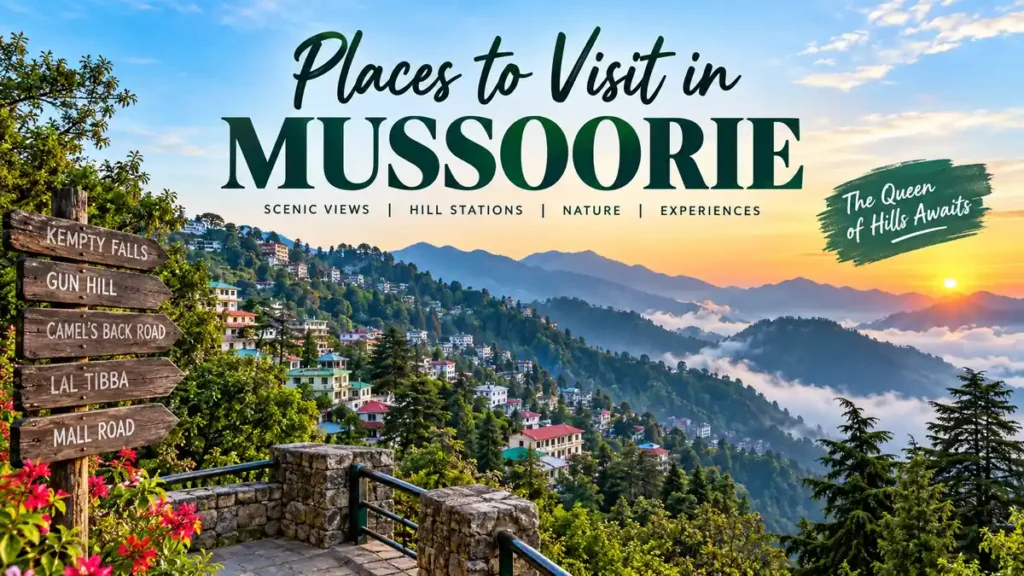
Mussoorie is much more than Mall Road and Kempty Falls. The hill station combines Himalayan viewpoints, waterfalls, colonial-era landmarks, forest walks, quiet Landour lanes, wildlife, gardens, temples, cafés, and sweeping views over the Doon Valley.
For first-time visitors, the best places to visit in mussoorie include Kempty Falls, Lal Tibba, Gun Hill, Mall Road, Camel’s Back Road, Landour, George Everest’s House, Company Garden, Cloud’s End, Benog Wildlife Sanctuary, Bhatta Falls, Jharipani Falls, Mussoorie Lake, and several quieter nature and heritage spots.
Mussoorie, often called the Queen of the Hills, sits in Uttarakhand above the Doon Valley. Its appeal comes from the contrast: you can spend one hour in a busy colonial-era market and the next walking beneath deodar and oak trees with Himalayan ridges stretching across the horizon.
Best places to visit in mussoorie at a glance
| Place | Best For | Approx. Time Needed |
|---|---|---|
| Kempty Falls | Waterfall, families | 2–3 hours |
| Lal Tibba | Himalayan views, sunrise | 1–2 hours |
| Gun Hill | Ropeway, viewpoints | 1–2 hours |
| Mall Road | Walking, food, shopping | 2–3 hours |
| Landour | Heritage walks, cafés | 2–4 hours |
| Camel’s Back Road | Sunset walks | 1–2 hours |
| George Everest’s House | History, viewpoints | 2–3 hours |
| Company Garden | Families, gardens | 1–2 hours |
| Cloud’s End | Forest scenery | 2–3 hours |
| Benog Wildlife Sanctuary | Birding, hiking | 2–4 hours |
| Bhatta Falls | Waterfall outing | 1–2 hours |
| Jharipani Falls | Light trekking | 1–2 hours |
| Mussoorie Lake | Views, short stop | 1–2 hours |
| Christ Church | Colonial heritage | 30–60 minutes |
| SOHAM Himalayan Centre | Himalayan culture | 1–2 hours |
| Lake Mist | Quiet waterside scenery | 1–2 hours |
| Surkanda Devi Temple | Temple, mountain views | Half day |
| Jwala Devi Temple | Spiritual stop, views | 2–3 hours |
The distances and travel times between attractions can vary considerably because Mussoorie’s mountain roads are narrow and traffic becomes heavy during peak weekends. Plan by area rather than trying to cover the entire list in one day.
1. Kempty Falls
Kempty Falls remains one of the most famous tourist places near Mussoorie. Water descends through a green valley into pools below, creating one of the area’s classic waterfall scenes.
The falls are roughly 15 km from central Mussoorie according to major travel listings, although the exact driving distance depends on where you start. India’s official tourism portal lists visitor hours of approximately 6:00 AM to 6:00 PM.
Kempty works particularly well for families and first-time visitors, but it can become crowded. Arriving earlier in the day makes a noticeable difference.
What to do at Kempty Falls
You can walk down toward the waterfall, enjoy the valley scenery, spend time near the pools, photograph the cascade, or simply stop for tea while looking over the surrounding hills.
Some adventure activities operate around the area as well, although their availability can change with weather and local conditions.
Quick takeaway: Visit Kempty Falls early if you want the scenery without the heaviest crowds.
2. Lal Tibba
If mountain views matter more to you than amusement-style attractions, Lal Tibba should be near the top of your itinerary.
Located around Landour, Lal Tibba is widely described as the highest point in Mussoorie. On clear days, the viewpoint provides broad Himalayan panoramas, while sunrise and sunset can transform the snow-covered ridges with warmer light.
The experience is simple: come for the landscape rather than a long list of activities.
Best time to visit Lal Tibba
Early morning generally offers the clearest atmosphere, while evening is attractive for sunset.
Visibility is never guaranteed in the mountains. Clouds, haze, rain, and winter weather can obscure distant peaks, so check local conditions before making a special trip solely for the panorama.
3. Gun Hill
Gun Hill is one of the easiest places to combine scenery with a classic Mussoorie tourist experience.
At roughly 2,122 metres, it is described by India’s tourism portal as Mussoorie’s second-highest peak. From the summit, visitors can look across the town, Himalayan ranges, and the Doon Valley.
The ropeway is part of the attraction itself. It runs from the Mall Road/Kulri side toward Gun Hill and offers elevated views during the ascent.
India’s tourism portal currently lists Gun Hill visiting hours as approximately 9:00 AM to 6:00 PM, although ropeway operating times and closures can change.
Why is it called Gun Hill?
The name is linked to the colonial-era practice of firing a cannon from the hill so residents could set their watches. The firing tradition ended long ago, but the name remained.
4. Mall Road
Mall Road is the social centre of Mussoorie.
Colonial-era buildings, cafés, restaurants, souvenir shops, woollen clothing stores and viewpoints line the promenade. It becomes particularly lively toward evening, when visitors return from day trips and start strolling through the centre of town.
You do not need to treat Mall Road as a separate sightseeing mission. It works best as the place you naturally return to between other attractions.
Try local snacks, browse small shops, stop for tea, and watch the lights appear across the hills after sunset.
How much time should you spend on Mall Road?
Two hours is enough for a relaxed walk, but you can easily spend an entire evening here if you include dinner and shopping.
5. Landour
Landour is one of the best places to visit in Mussoorie for travellers who prefer atmosphere over conventional sightseeing.
The old cantonment area has quiet roads, historic buildings, forested hills, churches, cafés and views over the surrounding mountains. India’s tourism portal highlights Landour as an especially rewarding destination for walking and slow travel.
Instead of rushing between landmarks, walk.
That is the point.
The quieter pace makes Landour feel very different from central Mussoorie.
What to see around Landour
Popular stops include Lal Tibba, St. Paul’s Church, the Landour Clock Tower area, heritage lanes and local cafés and bakeries.
Mussoorie also has a strong literary connection with author Ruskin Bond, who has lived in the area for decades and whose writing frequently draws from its landscapes and people.
6. Camel’s Back Road
Camel’s Back Road is one of the easiest scenic walks in town.
The roughly 4 km stretch runs between the Kulri and Library areas and takes its name from a natural rock formation whose profile resembles a camel’s back.
It is quieter than Mall Road and better suited to travellers who want to walk without constantly stopping at shops.
Best time for Camel’s Back Road
Go early in the morning for peaceful mountain air or in the late afternoon for sunset.
Comfortable walking shoes matter because the terrain is uneven in places.
7. Sir George Everest’s House
George Everest’s House combines one of Mussoorie’s strongest historical connections with excellent valley scenery.
The building, also known as Park Estate, was constructed in 1832 and served as the residence, observatory and laboratory of Sir George Everest, a former Surveyor General of India.
Mount Everest was later named after him.
From the surrounding area, you can look toward the Doon Valley, Himalayan ranges and the Aglar river valley. The setting is often as memorable as the building itself.
India’s tourism portal currently lists visiting hours of approximately 9:00 AM to 6:00 PM.
Who should visit?
George Everest is particularly worthwhile for photographers, walkers, history lovers and travellers who want a scenic picnic stop away from central Mussoorie.
8. Company Garden
Company Garden, also known as Municipal Garden, is one of the more family-oriented places to visit in Mussoorie.
Its landscaped flower beds and leisure facilities make it more structured than the town’s natural viewpoints and forest trails.
Travel listings commonly mention gardens, a small lake or boating area and family recreation facilities.
Visit if you are travelling with children or older family members who may prefer an accessible outing over a long hike.
If your priority is untouched mountain scenery, however, Lal Tibba, Cloud’s End or Benog Wildlife Sanctuary will probably be more rewarding.
9. Cloud’s End
Cloud’s End sits toward the quieter western side of Mussoorie and marks one of the edges of the main hill station area.
The surroundings are known for oak and deodar forest, walking routes and less urban scenery than central Mussoorie. Major Mussoorie travel listings place it around 6 km from the Library Road area.
This is a good place to slow the itinerary down.
Take a walk, listen for birds and enjoy the contrast with Mall Road’s crowds.
Is Cloud’s End worth visiting?
Yes, particularly if you enjoy forests and quiet viewpoints.
Travellers looking primarily for shopping, children’s rides or restaurant choices may find it less interesting.
10. Benog Wildlife Sanctuary
Benog Wildlife Sanctuary is one of the best places to visit in mussoorie for hikers, birdwatchers and nature lovers.
The protected landscape includes Himalayan forest and wildlife habitat, making it a better choice for people who want a genuine outdoor experience rather than a roadside viewpoint.
India’s official tourism portal currently lists sanctuary hours of approximately 7:00 AM to 5:00 PM and recommends proper walking shoes and binoculars.
Bird sightings depend on season, weather and patience, so do not approach it like a zoo where animals appear on demand.
What to carry
Bring:
- Water
- Comfortable hiking shoes
- Sun protection
- Binoculars
- A light rain layer during unstable weather
- Minimal plastic and reusable bottles where possible
Leave enough daylight for the return journey.
11. Bhatta Falls
Bhatta Falls offers an alternative to Kempty Falls for travellers who want another waterfall stop closer to the Mussoorie-Dehradun route.
The Dehradun district administration identifies Bhatta Falls as a scenic picnic attraction near Mussoorie, while recent travel listings also include it among the area’s popular waterfall experiences.
There is also a ropeway associated with the Bhatta Falls area.
The amount of water varies with season and rainfall, so expectations should change through the year.
12. Jharipani Falls
Jharipani Falls suits travellers who enjoy combining a short walk with a waterfall.
It lies outside the busiest centre and is generally approached as a nature outing rather than a highly developed tourist complex.
Both official tourism information and current Mussoorie guides list Jharipani among the waterfall attractions around town.
The path can become slippery after rain. Footwear with grip is far more useful here than fashion shoes.
When is Jharipani Falls best?
The landscape is particularly green during and after the monsoon, but heavier rainfall also increases the risk of slippery paths, landslides and disrupted road travel.
Visit only when local weather and access conditions are suitable.
13. Mussoorie Lake
Mussoorie Lake is a convenient short stop on the road connecting Mussoorie with Dehradun.
It offers waterside scenery, views over nearby hills and opportunities for a relaxed break. India’s tourism portal also highlights the surrounding landscape and recreational character of the lake area.
It is better viewed as a pleasant recreational stop than as Mussoorie’s most dramatic natural attraction.
If you have only one day in town, prioritize Lal Tibba, Landour, Gun Hill or Camel’s Back Road instead.
If you have two or three days, Mussoorie Lake fits comfortably into the itinerary.
14. Christ Church
Christ Church is one of the landmarks that reveals Mussoorie’s colonial history.
The church sits near the central part of town and works well as a brief heritage stop while exploring Mall Road and Library Chowk.
Its appeal lies less in the amount of time you spend there and more in the architectural and historical context it adds to a Mussoorie walk.
Combine it with nearby colonial buildings rather than making a separate journey.
15. SOHAM Himalayan Centre
Not every Mussoorie attraction needs to be a waterfall or viewpoint.
The SOHAM Himalayan Centre focuses on the culture and heritage of the Himalayan region through art, murals, sculptures, textiles, objects and other displays. Tripadvisor currently lists it among Mussoorie’s highly rated attractions.
It is particularly useful on a rainy or cloudy day when distant mountain views are limited.
Families travelling with older children may also find it a useful cultural counterpoint to outdoor sightseeing.
16. Lake Mist
Lake Mist lies along the Mussoorie-Kempty route and provides a quieter waterside stop.
The area is associated with the Kempty river system and small cascades, and traditional Mussoorie guides have long listed it among sightseeing stops between town and Kempty Falls.
It makes most sense when paired with Kempty Falls rather than visited as a standalone half-day excursion.
Allow enough time to stop, walk around and enjoy the setting instead of simply photographing it from the road.
17. Surkanda Devi Temple
Surkanda Devi Temple lies outside central Mussoorie but is an important spiritual excursion for visitors exploring the wider region.
The temple stands on an elevated ridge and is known both for religious significance and expansive Himalayan views. India’s tourism portal includes it among the prominent attractions accessible from Mussoorie.
This is better treated as a half-day or extended outing rather than squeezed between central Mussoorie attractions.
Mountain weather changes quickly, so carry an extra layer even when lower elevations feel warm.
18. Jwala Devi Temple
Jwala Devi Temple is another option for travellers interested in Mussoorie’s spiritual and mountain landscape.
Official tourism information groups Jwala Devi with the region’s prominent hill temples and highlights its elevated setting.
It fits especially well into itineraries that already include Benog Wildlife Sanctuary or the western side of Mussoorie.
Respect religious customs, keep noise low, and avoid treating temple spaces merely as photography locations.
Best places to visit in mussoorie for families
Families usually do best with attractions that offer easy access and enough variety to keep different age groups interested.
The strongest choices are:
- Kempty Falls
- Company Garden
- Gun Hill
- Mall Road
- Mussoorie Lake
- Lal Tibba
- Bhatta Falls
Kempty Falls and Company Garden provide more activity, while Lal Tibba and Gun Hill deliver the classic mountain views people usually expect from a Mussoorie trip.
For families with very young children or elderly travellers, avoid packing too many steep walks into the same day.
Best places to visit in mussoorie for couples
Mussoorie’s appeal for couples comes from scenic walks rather than any single attraction.
Landour, Camel’s Back Road, Lal Tibba, Cloud’s End and George Everest’s House all offer quieter settings than the busiest parts of town.
A particularly good combination is Landour in the morning, Lal Tibba later in the day and a slow walk around Mall Road after sunset.
The winterline can be an added attraction in the cooler months. India’s tourism portal describes the phenomenon as most visible roughly from October through February, when atmospheric conditions can create the appearance of a second horizon around sunset.
Best places in Mussoorie for nature lovers
For forests, wildlife and open landscapes, prioritize:
- Benog Wildlife Sanctuary
- Cloud’s End
- George Everest
- Lal Tibba
- Jharipani Falls
- Bhatta Falls
- Camel’s Back Road
These places make a more balanced trip than spending every day around Mall Road.
Benog is the most immersive nature experience, while Lal Tibba and George Everest offer better panoramic views with less demanding walking.
Best places to visit in Mussoorie in one day
If you only have one day, do not attempt every attraction.
A practical route is:
Morning: Landour and Lal Tibba
Start early in Landour when the lanes are quieter.
Walk around the heritage area and continue toward Lal Tibba for clear-day Himalayan views.
Late morning: Gun Hill
Return toward central Mussoorie and take the ropeway or walk toward Gun Hill.
Spend around an hour at the summit.
Afternoon: Mall Road
Have lunch around Mall Road and explore the central shopping and heritage area.
Evening: Camel’s Back Road
Finish with a sunset walk along Camel’s Back Road.
This itinerary minimizes long road journeys and gives you a good combination of views, history, food and walking.
Two-day Mussoorie itinerary
Two days allow you to include one major excursion outside the centre without turning the trip into a race.
Day 1
Start with Landour and Lal Tibba.
Move toward Gun Hill around midday, explore Mall Road afterward and finish the evening along Camel’s Back Road.
Day 2
Visit Kempty Falls early.
On the return journey, include George Everest’s House if time and road conditions allow.
Finish with Company Garden or a quieter evening in central Mussoorie.
Travellers who prefer forests over waterfalls can replace Kempty with Benog Wildlife Sanctuary and Cloud’s End.
Three-day Mussoorie itinerary
A third day gives you room to experience the quieter side of the hill station.
Day 1: Central Mussoorie
Explore Gun Hill, Mall Road, Christ Church and Camel’s Back Road.
Day 2: Landour and viewpoints
Spend the morning in Landour, visit Lal Tibba and slow down at local cafés and heritage lanes.
Day 3: Nature excursion
Choose one combination based on your interests:
- Kempty Falls + Lake Mist
- Benog Wildlife Sanctuary + Cloud’s End
- George Everest + Bhatta Falls
- Surkanda Devi Temple as a longer excursion
This works better than trying to visit 15 attractions in three days.
Best time to visit Mussoorie
Mussoorie changes considerably by season.
March to June
This is one of the busiest periods because visitors head to the hills to escape hotter temperatures in the plains.
The weather is generally suited to sightseeing and walking, but popular attractions and roads can become crowded.
July to September
The monsoon turns the hills intensely green and gives waterfalls greater volume.
The trade-off is rain.
Mountain roads can face landslides, fog, slippery surfaces and travel disruptions, so plans should remain flexible.
October to November
For many travellers, this is one of the strongest periods for scenery.
The monsoon has usually retreated, visibility can improve and temperatures are cooler.
It is also a good period to watch for Mussoorie’s winterline phenomenon.
December to February
Winter brings cold conditions and the possibility of snow during suitable weather systems.
The atmosphere can be beautiful, but road conditions, fog and cold temperatures require more preparation.
How to reach Mussoorie
Mussoorie is connected by road with Dehradun and other North Indian cities. The official Dehradun district website lists road connectivity with Dehradun, Delhi, Roorkee and Saharanpur.
By air
The nearest major airport is Dehradun Airport/Jolly Grant Airport (DED).
From there, travellers continue toward Mussoorie by road.
By train
Dehradun Railway Station (DDN) is the nearest major railway station listed by India’s official tourism portal.
From Dehradun, Mussoorie is reached by road.
By road
Buses, taxis and private vehicles connect Dehradun with Mussoorie.
The final climb is on mountain roads, so the actual journey time depends heavily on traffic, weather and the season.
How many days are enough for Mussoorie?
Two to three days is ideal for most first-time visitors.
One day is enough to see central attractions such as Mall Road, Gun Hill, Camel’s Back Road and perhaps Landour.
Two days let you add Kempty Falls or George Everest.
Three days allow you to slow down and include places such as Benog Wildlife Sanctuary, Cloud’s End, Bhatta Falls or a temple excursion.
Spending more days is worthwhile if you enjoy walking, cafés and relaxed mountain travel rather than checklist tourism.
Practical tips for visiting Mussoorie
Mussoorie looks compact on a map, but mountain geography changes how long travel takes.
A few practical habits make the trip easier:
- Start popular attractions early, especially Kempty Falls and Lal Tibba.
- Group nearby attractions together instead of repeatedly crossing town.
- Carry comfortable footwear because slopes are common.
- Keep a light jacket even in warmer months.
- Check weather before long drives or forest walks.
- Expect weekend congestion during peak travel periods.
- Avoid relying on exact mountain travel times.
- Carry some cash for small stalls and local services.
- Do not litter around waterfalls, forest trails or viewpoints.
- Never enter unsafe waterfall pools during strong flow.
- Confirm current attraction, ropeway and road status locally before travelling.
Current published hours exist for attractions such as Kempty Falls, Gun Hill, Benog Wildlife Sanctuary and George Everest’s House, but mountain weather, maintenance and local restrictions can change access without much notice.
Which places in Mussoorie are actually worth visiting?
For a first trip, prioritize quality over quantity.
The five places that give the clearest sense of Mussoorie are Landour, Lal Tibba, Camel’s Back Road, Gun Hill and Mall Road. Add Kempty Falls if waterfalls are important to you, and George Everest or Benog Wildlife Sanctuary if you prefer quieter outdoor scenery.
That combination covers nearly every side of the hill station: Himalayan landscapes, British-era heritage, local street life, forests, viewpoints and relaxed mountain walking.
Final thoughts on places to visit in mussoorie
The best places to visit in mussoorie are not all the busiest ones. Kempty Falls and Gun Hill deserve their popularity, but quieter experiences such as walking through Landour, watching the mountains from Lal Tibba, exploring George Everest’s House or following forest trails around Benog often become the most memorable parts of a trip.
Give Mussoorie at least two days if possible, organize attractions geographically, and leave room for unplanned walks. In a hill station built around views, forests and steep old roads, slowing down is often the best way to see more.