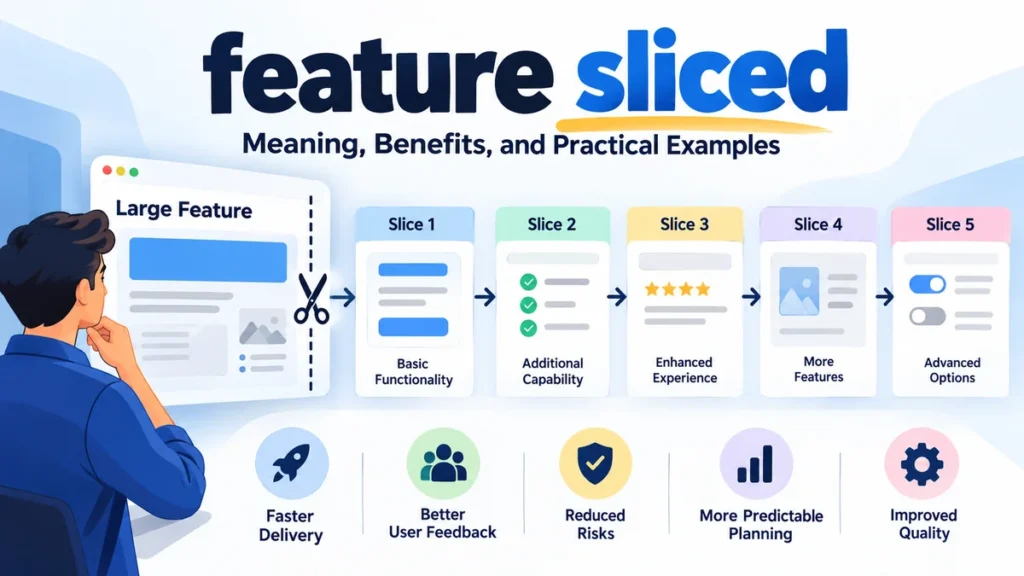
A software team can spend weeks developing a feature and still have nothing usable to show its customers. Often, the problem is not the team’s ability to write code. It is how the work has been divided.
The concept of feature sliced development addresses this challenge by breaking a large feature into smaller, independently valuable pieces that can be developed, tested, and delivered incrementally.
Feature slicing is an Agile software development technique that divides a large product feature into small, end-to-end pieces of functionality. Each slice ideally delivers observable user value, crossing the necessary interface, business logic, and data layers. This approach improves feedback, reduces delivery risk, and supports continuous delivery.
Understanding feature slicing is especially useful for software developers, product owners, Scrum teams, business analysts, and project managers who want to make complex projects easier to manage without sacrificing product quality.
What Does feature sliced Mean?
The phrase feature sliced generally describes a software feature that has been divided into smaller functional units.
Instead of treating a complex capability as one large development task, teams identify the smallest meaningful parts that can be implemented and validated separately.
For example, imagine an e-commerce application introducing a product review system.
A traditional plan might separate the work into database development, backend APIs, frontend interfaces, and testing. Although these tasks are technically distinct, none necessarily delivers a complete user-facing capability.
A feature-sliced approach could organize the work differently:
- Allow customers to submit a basic text review.
- Display approved reviews on product pages.
- Add star ratings.
- Introduce review editing.
- Add photo attachments.
- Implement moderation and reporting.
Each increment provides a recognizable capability while gradually building toward the complete product experience.
Feature slicing versus task decomposition
Feature slicing and task decomposition are related, but they solve different problems.
Task decomposition breaks work into manageable activities. Feature slicing breaks functionality into meaningful increments.
A task such as “create the review database table” might be necessary, but it does not independently provide customer value.
A slice such as “submit and display a basic product review” connects the technical components required for a useful outcome.
This distinction is central to effective Agile planning.
Why Is Feature Slicing Important in Agile Development?
Agile development emphasizes frequent feedback, adaptation, collaboration, and the delivery of working software.
Large features make these goals harder to achieve because they introduce uncertainty and delay opportunities for validation.
Feature slicing reduces that uncertainty.
Faster delivery of usable functionality
Small, complete increments can move through development and testing faster than large collections of tightly coupled requirements.
A team does not need to finish every planned enhancement before users can benefit from the first working version.
For example, a scheduling application might initially allow users to create appointments before introducing recurring bookings, calendar synchronization, and automated reminders.
Better feedback from users
Early releases reveal whether the team is solving the right problem.
Users may find that a simple capability satisfies most of their needs, making some originally planned enhancements unnecessary.
Conversely, feedback may reveal an unexpected requirement that deserves higher priority.
Reduced technical and delivery risks
Large features often contain hidden dependencies, unclear assumptions, and integration challenges.
Delivering smaller increments allows teams to identify these problems earlier.
A failed assumption becomes less expensive to correct when only a small part of the system depends on it.
More predictable sprint planning
Small user stories are generally easier to estimate, prioritize, and complete within a sprint.
This does not make estimates perfectly accurate. However, smaller work items usually expose uncertainty sooner and make progress easier to observe.
Improved quality assurance
Testing a narrow, complete behavior can be simpler than validating a large feature containing numerous interactions.
Teams can create acceptance criteria for each slice and automate relevant tests as the capability develops.
Horizontal Slicing vs. Vertical Slicing
One of the most important concepts in feature slicing is the difference between horizontal and vertical decomposition.
Horizontal slicing: dividing work by technical layer
Vertical slicing: delivering an end-to-end behaviorConceptual comparison: horizontal work focuses on layers, while vertical slices cross the layers needed to deliver a working capability.
Horizontal slicing
Horizontal slicing separates work according to technical components, such as:
- Frontend development
- Backend services
- Database implementation
- Infrastructure configuration
- Testing activities
This can be useful for assigning technical tasks, but it may delay the delivery of complete functionality.
Vertical slicing
Vertical slicing creates a narrow path through the system that delivers a usable outcome.
A vertical slice might involve a small interface change, one API endpoint, limited business logic, and a database operation.
The goal is not to implement every possible capability in each layer. It is to implement only what is necessary for that specific behavior.
| Aspect | Horizontal slicing | Vertical slicing |
|---|---|---|
| Primary focus | Technical components | User functionality |
| Delivery outcome | Individual system parts | Working increment |
| Feedback opportunity | Often later | Potentially earlier |
| Integration | May be delayed | Usually addressed within each slice |
| Common use | Engineering task planning | Agile story decomposition |
| Main risk | Incomplete end-to-end functionality | Poorly chosen slice boundaries |
Vertical slicing is usually preferable when the goal is to deliver user-visible value incrementally. Horizontal tasks can still exist within each vertical slice.
How to Split a Large Feature Into Smaller Slices
Effective feature slicing begins with understanding the user’s goal rather than immediately dividing development work among technical specialists.
Step 1: Identify the user outcome
Start by describing what the user needs to accomplish.
A common user story format is:
As a customer, I want to track my order so that I can understand when it will arrive.
This statement describes a meaningful outcome without prescribing its implementation.
Step 2: Identify the essential workflow
Map the actions required to complete the experience.
For order tracking, these might include viewing an order, checking its status, seeing shipping details, and receiving delivery notifications.
A user story map can help distinguish essential functionality from enhancements.
Step 3: Find the smallest valuable increment
Ask what the simplest useful version would look like.
For order tracking, the first slice could display a basic order status, such as processing, shipped, or delivered.
Real-time location tracking, carrier integration, and delivery predictions can follow later.
Step 4: Divide functionality using natural boundaries
Several established techniques can help teams split user stories. Applied Frameworks+1
| Splitting technique | Example |
|---|---|
| Workflow steps | Create order, confirm order, track order |
| Business rules | Standard shipping before international shipping |
| Data variations | Individual customer before business accounts |
| Operations | Create, view, update, delete |
| Complexity | Basic search before advanced filtering |
| User roles | Customer functionality before administrator tools |
| Interfaces | Web experience before a separate mobile experience |
| Scenarios | Successful payment before unusual recovery scenarios |
These techniques can be combined, but each resulting story should retain a meaningful outcome.
Step 5: Define acceptance criteria
Every slice needs clear conditions for completion.
For a basic order-status feature, acceptance criteria might include:
- An authenticated customer can view the status of their own order.
- The displayed status matches the application’s authoritative order record.
- An invalid order identifier produces an appropriate error.
- A customer cannot access another customer’s order.
- Automated tests verify the expected behavior.
Acceptance criteria make the scope understandable to developers, testers, and product owners.
Step 6: Implement, test, and gather feedback
Complete the necessary components across the system, validate the functionality, and demonstrate the result to stakeholders.
The slice should satisfy the team’s Definition of Done, including relevant security, accessibility, and quality requirements.
Release the functionality when appropriate, or keep it behind a feature flag until it is ready for users.
Feature-Sliced Design: An Architectural Approach
The term feature sliced is also closely associated with Feature-Sliced Design, commonly abbreviated FSD.
Feature-Sliced Design is a methodology for organizing frontend application code around business domains, responsibilities, and controlled dependencies. Its goal is to make applications easier to understand, maintain, and modify as requirements evolve. Feature-Sliced Design+1
Feature slicing in Agile planning and Feature-Sliced Design are related ideas, but they are not identical.
Agile feature slicing focuses on dividing deliverable work. Feature-Sliced Design focuses on organizing the source code itself.
Understanding the FSD architecture layers
The established FSD model identifies the following layers:
| Layer | Responsibility |
|---|---|
| App | Application initialization, routing, global providers |
| Pages | Complete screens and page-level composition |
| Widgets | Large, self-contained interface blocks |
| Features | User interactions that provide business value |
| Entities | Business concepts such as users and products |
| Shared | Reusable utilities, UI components, and infrastructure |
| Processes | Deprecated legacy layer |
Not every project needs every layer. The official methodology also distinguishes layers, slices, and segments as separate organizational concepts. Feature-Sliced Design+1
What are slices and segments?
A slice groups code around a particular business domain or functional responsibility.
For example, a social networking application could contain slices associated with users, posts, and comments.
A segment organizes code within a slice according to technical purpose.
Common segments include:
uifor interface components.apifor API interactions.modelfor application state, schemas, and business logic.libfor supporting utilities.configfor configuration and feature flags.
This structure keeps related code together without mixing every concern into one large module.
Example of a feature-sliced project structure
A simplified frontend application might use the following organization:
src/
├── app/
│   ├── providers/
│   └── routes/
├── pages/
│   ├── home/
│   └── product-details/
├── features/
│   ├── add-to-cart/
│   │   ├── ui/
│   │   ├── api/
│   │   ├── model/
│   │   └── index.ts
│   └── submit-review/
│       ├── ui/
│       ├── api/
│       └── index.ts
├── entities/
│   ├── product/
│   └── user/
└── shared/
    ├── ui/
    ├── api/
    └── lib/
This example illustrates how features can be separated from underlying business entities and shared infrastructure.
Dependency rules and public APIs
A central principle of Feature-Sliced Design is controlling dependencies.
Higher architectural layers can depend on lower layers, but lower layers should not depend on higher ones.
Slices on the same layer should generally remain independent. Public APIs provide controlled access to functionality exposed by a slice.
For example:
import { AddToCartButton } from "@/features/add-to-cart";This is preferable to importing an internal component through its private directory structure.
The result is lower coupling, stronger encapsulation, and more predictable refactoring. Feature-Sliced Design+1
Practical Examples of feature sliced Development
Feature slicing becomes easier to understand when applied to familiar applications.
Example 1: User authentication
A complete authentication system might include registration, login, password recovery, multifactor authentication, and account management.
Rather than delivering everything simultaneously, a team could define the following increments:
| Slice | Functionality | User value |
|---|---|---|
| 1 | Sign in with an existing account | Access protected functionality |
| 2 | Create a new account | Become a registered user |
| 3 | Reset a forgotten password | Recover account access |
| 4 | Enable multifactor authentication | Strengthen account protection |
| 5 | Manage active sessions | Control account access across devices |
Each slice requires appropriate security controls from the beginning. Password protection, authorization, and secure session handling should not be postponed simply to reduce story size.
Example 2: E-commerce checkout
A large checkout feature could be divided into increments supporting a single-item purchase, multiple-item purchases, discount codes, alternative payment methods, and saved addresses.
The first increment might support a complete, secure purchase using one payment method.
Later increments extend the capability without requiring the team to rebuild the entire checkout process.
This reflects the principle of vertical user-story slicing: delivering integrated customer outcomes rather than isolated technical layers. Bain & Company
Example 3: Search functionality
Consider a document management platform.
Its search feature could be introduced through these stages:
- Search documents by exact title.
- Support partial-title matches.
- Filter results by document type.
- Sort results by date.
- Add full-text search.
- Introduce advanced search operators.
The first version already helps users locate documents. More sophisticated functionality can be added according to observed needs.
Example 4: Reporting dashboards
A reporting dashboard might initially display one important metric, such as total completed orders.
Later slices could introduce daily trends, date filters, comparisons, export functionality, and role-specific dashboards.
The advantage is that stakeholders can validate the underlying metrics and presentation before the application becomes more complex.
Best Practices for Successful Feature Slicing
The quality of a slice depends on more than its size.
A small development task is not automatically a good feature slice.
Apply the INVEST principles
The INVEST framework provides useful criteria for evaluating user stories.
| Principle | Meaning |
|---|---|
| Independent | Minimizes unnecessary dependencies |
| Negotiable | Allows discussion about implementation |
| Valuable | Delivers a meaningful benefit |
| Estimable | Has enough clarity to assess effort |
| Small | Can be completed within a manageable period |
| Testable | Has verifiable acceptance criteria |
These principles help teams identify stories that are too broad, too vague, or overly dependent on other work.
Keep slices small but meaningful
A slice should be narrow enough to complete efficiently without becoming so fragmented that it loses functional value.
For example, “implement one database column” is small, but it does not describe a complete user outcome.
“Allow customers to save a preferred delivery address” is a more meaningful slice, even though it requires several technical changes.
Prioritize by value and uncertainty
Not every slice should be implemented in the order it appears in the original requirements.
Product owners can prioritize increments based on user benefit, business importance, dependencies, and technical risk.
High-risk assumptions may deserve early validation, particularly when they could significantly affect the architecture.
Maintain clear boundaries
When using Feature-Sliced Design, modules should have recognizable responsibilities.
Avoid creating generic directories that gradually accumulate unrelated business logic.
Keep reusable infrastructure in appropriate shared modules, while retaining feature-specific behavior close to the feature that owns it.
Use continuous integration
Continuous integration helps teams detect compatibility issues as each slice is developed.
Automated tests, code reviews, and deployment pipelines support incremental development by reducing the effort needed to validate each change.
Continuous delivery can further reduce release friction, although deployment frequency depends on operational and organizational requirements.
Measure outcomes rather than story counts
Completing many small stories does not necessarily mean a team is delivering meaningful progress.
Useful indicators include cycle time, lead time, escaped defects, user adoption, and the percentage of planned outcomes successfully delivered.
Story points and velocity can help a team with its own planning, but they should not be treated as universal productivity measurements.
Common Feature Slicing Mistakes and How to Avoid Them
Poor slicing can introduce unnecessary coordination, technical debt, and integration difficulties.
Creating slices around departments
Separating frontend, backend, and database work into unrelated backlog items can create handoffs and delay validation.
Where practical, organize delivery around complete behavior while allowing specialists to collaborate on the technical tasks inside each slice.
Making slices too small
Excessive fragmentation increases planning overhead and makes it harder to understand the intended outcome.
A useful slice should represent a recognizable improvement, not merely a few lines of code.
Ignoring technical dependencies
Some functionality genuinely depends on infrastructure, shared services, or external integrations.
These dependencies should be identified during planning rather than hidden behind an unrealistic promise of complete independence.
Delaying essential quality requirements
Security, accessibility, data integrity, and critical error handling are part of functional completeness.
They should not automatically be deferred to future slices.
For example, a basic login feature without adequate authentication safeguards is not a production-ready increment.
Confusing prototypes with releasable functionality
A prototype can be valuable for learning, but it is not necessarily a production-ready slice.
Teams should distinguish exploratory work from functionality that satisfies agreed acceptance criteria and operational standards.
Applying architectural rules mechanically
Feature-Sliced Design can introduce unnecessary complexity when teams create layers, abstractions, and directories that their applications do not need.
The official documentation supports incremental adoption and recommends considering whether an existing architecture actually needs replacement. Feature-Sliced Design
When Should You Use Feature Slicing?
Feature slicing is particularly useful when a product contains complex functionality, changing requirements, or opportunities for incremental feedback.
It works well for Scrum and Kanban teams, iterative product development, SaaS applications, enterprise software, and applications that evolve through frequent releases.
It can also help teams modernize legacy systems by replacing or improving capabilities incrementally rather than attempting a complete rewrite.
However, slicing does not eliminate all dependencies. Certain infrastructure migrations, regulatory requirements, and tightly coupled system changes may require coordinated delivery.
The practical goal is to create the smallest responsible increment, not to force every technical change into an artificially independent story.
Is feature slicing suitable for small projects?
Yes. Even a small application can benefit from dividing large capabilities into manageable, testable increments.
However, smaller projects may not need a formal Feature-Sliced Design architecture.
Simple organization and clear module boundaries may be sufficient.
Can feature slicing work with Scrum and Kanban?
Yes. Feature slicing is a work-decomposition technique rather than a competing project-management framework.
In Scrum, it helps teams create Product Backlog Items that can be completed within a Sprint.
In Kanban, smaller work items can improve flow, reveal bottlenecks, and reduce work in progress.
Does feature slicing improve software performance?
Not directly.
Feature slicing primarily improves the organization and delivery of functionality. It does not inherently make an application execute faster.
However, well-defined modules and smaller changes can make performance problems easier to isolate, investigate, and improve.
What is the difference between feature slicing and microservices?
Feature slicing describes how functionality or code is divided.
Microservices architecture describes a system organized into independently deployable services, typically communicating through defined interfaces.
A feature slice may involve one service, several services, or a monolithic application.
Likewise, a microservice can support several features.
The two approaches can complement each other, but they address different architectural and delivery concerns.
Final Thoughts on feature sliced Development
The central idea behind feature sliced development is straightforward: break complex functionality into smaller pieces that provide meaningful value and can be validated independently wherever practical.
Vertical feature slicing helps Agile teams deliver usable increments, gather feedback, and reduce uncertainty. Feature-Sliced Design applies a related domain-oriented approach to frontend code organization, emphasizing clear responsibilities and controlled dependencies.
Both approaches encourage developers to think in terms of functionality and maintainability rather than simply dividing work by technical components.
A useful starting point is to select one large feature, identify its smallest complete user outcome, define measurable acceptance criteria, and implement that outcome before expanding its capabilities.