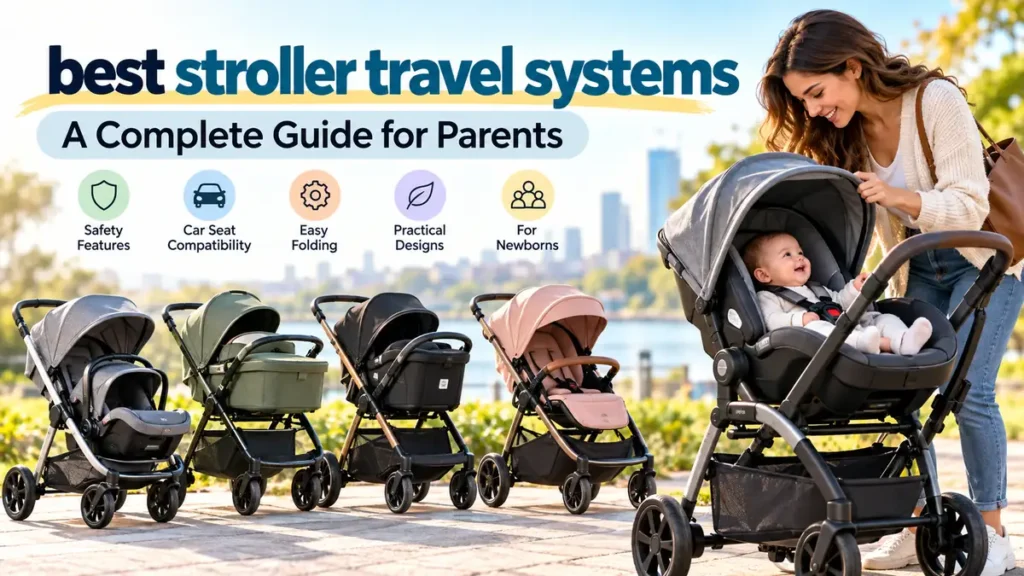
Choosing a stroller travel system can feel surprisingly complicated. A model that looks perfect in a showroom may be too heavy for your stairs, too bulky for your trunk, or inconvenient when you’re trying to move a sleeping baby from the car.
The best stroller travel systems combine a compatible infant car seat, a practical stroller, and a secure attachment system. The right choice depends on your baby’s age, vehicle, storage space, daily routine, and budget. Safety, ease of use, and proper car seat installation matter more than extra accessories.
A travel system can simplify everyday transportation, especially during the first year. However, not every combination works equally well for every family.
This guide explains how stroller travel systems work, compares popular designs, and helps parents understand the features that make the biggest difference.
What Is a Stroller Travel System?
A stroller travel system is a coordinated combination of an infant car seat and a stroller. The infant car seat can attach to the stroller frame, allowing parents to transfer their baby between the vehicle and stroller without moving the child out of the seat.
Most systems include three main components:
- Infant car seat: A rear-facing restraint designed for babies within its specified height and weight limits.
- Stroller: A wheeled frame with a seat for walks and everyday outings.
- Car seat base: A component that stays installed in the vehicle, when included and used according to the manufacturer’s instructions.
Some models also include a bassinet, reversible toddler seat, cup holder, storage organizer, or car seat adapters.
How does a travel system work?
The infant car seat locks into a compatible stroller using a manufacturer-approved connection. When returning to the vehicle, the car seat is removed from the stroller and secured to its installed base or directly with the vehicle seat belt, if that installation method is approved.
Parents should always verify that the seat has clicked securely into place.
A travel system is particularly useful for short transitions between driving and walking. It does not mean an infant car seat should replace a flat, firm sleep surface.
best stroller travel systems: Popular Models Explained
Several established manufacturers offer travel systems with different strengths. The following models illustrate common options for families with varying needs.
Model configurations, included accessories, and availability can vary by market and year. Confirm the exact product version and manufacturer specifications before relying on a feature.
1. Chicco Bravo Trio Travel System

The Chicco Bravo Trio is a recognizable example of a traditional travel system, pairing the Bravo stroller with a compatible KeyFit infant car seat.
Its design emphasizes straightforward transitions between car and stroller.
Notable features:
- Infant car seat compatibility within the supplied system
- One-hand stroller folding mechanism
- Adjustable stroller handle
- Storage basket for daily essentials
- Removable stroller seat on supported configurations
The Bravo Trio is particularly relevant to parents who primarily walk on sidewalks, visit shopping centers, and use their vehicle frequently.
The main consideration is its full-size stroller design, which may feel bulky in small apartments or compact car trunks.
2. UPPAbaby Vista V3 Travel System Configuration

The UPPAbaby Vista V3 is a premium modular stroller that can form part of a travel system with a compatible infant car seat.
Its defining feature is flexibility. The stroller can accommodate different seating configurations, making it relevant to families planning for more than one young child.
Notable features:
- Reversible toddler seat
- Modular seating options
- Large storage basket
- Adjustable handlebar
- Compatibility with specified infant car seats and accessories
Parents should understand that a Vista stroller and infant car seat may be sold separately rather than as one complete package.
Its larger footprint, additional components, and higher overall cost are important considerations.
3. Graco Modes Pramette Travel System

The Graco Modes Pramette is designed around multiple stroller configurations, including infant car seat use and a toddler seat that converts to a pramette-style position.
Its versatility can be useful during a child’s transition from infancy into toddlerhood.
Notable features:
- Multiple stroller seating configurations
- Reversible stroller seat
- Compatible Graco infant car seat in packaged systems
- Folding design for storage
- Storage basket and everyday convenience features
The pramette feature should not automatically be treated as an approved overnight sleeping space. Parents must follow the specific product’s instructions.
4. Evenflo Pivot Modular Travel System

The Evenflo Pivot Modular system is known for its adaptable seating arrangements.
Depending on the package, it typically includes an infant car seat and a stroller with multiple configurations.
Notable features:
- Parent-facing and forward-facing stroller positions
- Infant car seat attachment
- Convertible carriage-style stroller configuration
- Large storage basket
- Modular seat arrangement
This design is useful for parents who want flexibility without necessarily choosing a premium expandable stroller.
As with other modular systems, switching configurations requires following the instructions and checking that every connection is secure.
5. Doona Infant Car Seat & Stroller

The Doona takes a different approach. Rather than connecting a separate car seat to a conventional stroller, it integrates retractable stroller wheels into the infant car seat itself.
That makes it especially distinctive for short transfers and travel.
Notable features:
- Integrated wheels
- Conversion between approved car seat and stroller modes
- Compact transportation concept
- No separate full-size stroller frame required for its basic function
Its limitations are equally important. The Doona does not replace a full-size toddler stroller, and the car seat has specific height and weight limits.
Parents should also consider the weight they must lift when placing the entire unit into a vehicle.
6. Nuna MIXX Next With Compatible Infant Car Seat

The Nuna MIXX Next is a premium stroller that can be paired with compatible Nuna infant car seats.
It emphasizes suspension, maneuverability, and an adaptable stroller seat.
Notable features:
- Reversible stroller seating
- Adjustable recline positions
- Suspension designed for everyday comfort
- Folding mechanism
- Compatible infant car seat attachment using approved components
A complete travel system may require purchasing the stroller, car seat, and any necessary adapters separately.
The combined weight, folded size, and price should be considered alongside its comfort-oriented features.
Comparison of the Best Stroller Travel Systems
| Travel system | Design category | Main strength | Main consideration |
|---|---|---|---|
| Chicco Bravo Trio | Traditional full-size | Simple car-to-stroller transitions | Bulky for compact storage |
| UPPAbaby Vista V3 | Premium modular | Expandable seating configurations | Higher cost and larger footprint |
| Graco Modes Pramette | Convertible | Multiple infant and toddler modes | Configuration changes |
| Evenflo Pivot Modular | Modular | Flexible seating positions | More components to manage |
| Doona | Integrated car seat/stroller | Compact transitions | Limited long-term stroller use |
| Nuna MIXX Next | Premium full-size | Maneuverability and comfort | Separate components may be required |
No single model wins every category. The most practical choice depends on where the stroller will be used and how frequently it must be folded, lifted, and transported.
How to Choose the best stroller travel systems
The most useful way to evaluate a travel system is to examine the car seat and stroller separately before considering how well they work together.
1. Prioritize infant car seat safety
The infant car seat is the most safety-critical part of the system.
In the United States, applicable child restraints must comply with Federal Motor Vehicle Safety Standard (FMVSS) No. 213. Parents should also follow the vehicle manufacturer’s instructions and the car seat manufacturer’s installation requirements.
Look for these features:
- A five-point harness with straightforward adjustment
- Clear installation instructions and indicators
- Appropriate newborn fit
- A secure stroller attachment mechanism
- Easy-to-read height and weight limits
- A base or approved baseless installation method suitable for your vehicle
Features such as a load leg, anti-rebound bar, or additional side-impact protection may be available on particular models. Their presence does not automatically establish that one car seat is safer than another in every crash scenario.
The correct installation and fit are essential.
2. Check stroller weight and folded dimensions
Stroller weight affects daily convenience more than many parents initially expect.
A heavy stroller may feel manageable during a short demonstration but become inconvenient when lifting it into a car several times a day.
Before comparing models, consider three measurements:
| Measurement | Why it matters |
|---|---|
| Stroller weight | Affects lifting and carrying |
| Folded dimensions | Determines storage and trunk fit |
| Unfolded width | Influences movement through narrow spaces |
A lightweight stroller travel system may be especially helpful for apartment residents, frequent travelers, and parents who regularly use public transportation.
However, lighter designs sometimes offer smaller wheels, less storage, or fewer seating configurations.
3. Evaluate wheel design and suspension
Different environments demand different stroller characteristics.
Small wheels often work well on smooth indoor floors and paved walkways. Larger wheels and effective suspension may be more comfortable on cracked sidewalks, gravel paths, and uneven surfaces.
For city use, maneuverability and turning radius may matter more than large tires.
For suburban walks, suspension, wheel durability, and storage capacity may be more important.
An all-terrain stroller should not be confused with a jogging stroller. Running with a stroller requires a model specifically approved for jogging, and infants must meet the manufacturer’s age and developmental requirements.
4. Consider newborn seating options
Not every regular stroller seat is appropriate for a newborn.
Some systems support newborns through an attached infant car seat. Others offer a manufacturer-approved bassinet, carriage mode, or suitable newborn recline.
A bassinet-style stroller attachment may allow a baby to lie flatter during walks, but its approval for sleep depends on the exact product.
The American Academy of Pediatrics recommends that infants sleep on a firm, flat, noninclined surface designed for infant sleep. Car seats and other sitting devices are not recommended for routine sleep outside travel.
American Academy of Pediatrics
+1
5. Understand compatibility before mixing brands
A stroller and car seat should never be assumed compatible simply because their dimensions appear similar.
Some manufacturers offer adapters that allow selected infant car seats from other brands to connect to their strollers.
Compatibility depends on the exact models, production versions, and approved adapters.
An adapter that works with one model in a brand’s range may not work with another.
Only use combinations explicitly approved by the relevant manufacturers.
Travel System Types and Their Differences
Travel systems can be divided into several practical categories.
Traditional travel systems
Traditional systems usually combine a full-size stroller with a matching infant car seat.
They are designed for families who want a straightforward setup without managing numerous stroller configurations.
Their strengths include simplicity, familiar folding mechanisms, and coordinated components.
The main trade-off is reduced flexibility compared with some modular systems.
Modular travel systems
Modular systems allow parents to change the direction or arrangement of the stroller seat.
Depending on the model, the child may face the parent or face forward.
Some systems support additional seats or riding boards for older siblings.
This flexibility can extend the stroller’s usefulness, although it may increase overall weight and complexity.
Compact and lightweight systems
Compact travel systems emphasize portability and storage.
They can be useful for smaller vehicles, apartments, and frequent transportation changes.
For example, the Nuna TRVL lx paired with the PIPA urbn illustrates a compact travel-system approach that combines a folding stroller with an infant car seat designed for baseless installation.
Expert Guide
+1
However, compact designs still need to be evaluated for infant support, wheel performance, and stroller seat longevity.
Convertible and expandable systems
Expandable systems are designed to accommodate changing family needs.
The UPPAbaby Vista V3, for example, supports additional seating arrangements with appropriate accessories.
These systems can be practical for families expecting closely spaced children, but adding another seat may affect handling, storage access, and total weight.
best stroller travel systems for Different Family Needs
Instead of choosing based on a universal ranking, parents can identify the design that best fits their routine.
| Family situation | Useful characteristics | Example |
|---|---|---|
| First-time parents | Simple attachment, straightforward fold | Chicco Bravo Trio |
| Small apartments | Compact storage and portability | Doona |
| Growing families | Expandable seating | UPPAbaby Vista V3 |
| Everyday suburban use | Storage and flexible seating | Graco Modes Pramette |
| Flexible stroller positions | Reversible modular design | Evenflo Pivot Modular |
| Frequent rideshare use | Approved baseless installation | Nuna TRVL lx + PIPA urbn |
| Mixed sidewalk conditions | Suspension and maneuverability | Nuna TRIV lx + PIPA urbn |
Recent independent editorial evaluations also highlight the Joie Ginger DLX with Mint Latch for overall versatility and the Evenflo Pivot Modular for value. These are editorial assessments, not universal safety rankings.
Babylist
+1
What works best for city living?
City families often deal with narrow sidewalks, elevators, public transportation, and limited storage.
A compact fold, manageable weight, and easy steering are especially valuable.
A large stroller with generous storage may still be appropriate if parents walk frequently and rarely need to carry it upstairs.
What works best for frequent car travel?
Parents who drive several times a day may benefit from a system with an easy-to-remove infant car seat and an intuitive attachment mechanism.
The stroller should also fit inside the vehicle without complicated disassembly.
An easily installed car seat base can make repeated trips more convenient, while an approved baseless seat may be useful when changing vehicles.
What works best for twins or siblings?
Families with twins need a stroller configuration specifically approved for two infants and compatible infant car seats.
A single stroller that expands to accommodate a second child is not automatically suitable for twins from birth.
Check whether the stroller supports two infant car seats simultaneously, whether adapters are included, and how much storage remains with both seats installed.
Essential Travel System Safety Guidelines
Convenience should never compromise safe use.
Correctly install the infant car seat
Always follow both the car seat manual and the vehicle owner’s manual.
A correctly installed car seat should not move more than one inch side to side or front to back when checked at the belt path, according to commonly used U.S. child passenger safety guidance.
Important precautions include:
- Keep the child rear-facing within the seat’s permitted limits.
- Position the harness and chest clip according to the manufacturer.
- Avoid bulky clothing beneath the harness.
- Use the approved installation method.
- Check the seat’s installation before travel.
A certified Child Passenger Safety Technician (CPST) can help caregivers understand installation and fit.
Never use an infant car seat as a regular sleeping place
Babies frequently fall asleep during car journeys, but that does not make a car seat an appropriate replacement for a crib.
If a baby falls asleep in a car seat while traveling, keep the seat correctly installed and the harness properly fastened.
Once the journey ends, transfer the baby to an appropriate firm, flat sleep surface as soon as it is safe and practical.
The American Academy of Pediatrics specifically advises against routine sleep in car seats, strollers, swings, and similar sitting devices.
American Academy of Pediatrics
+1
Follow stroller safety precautions
Stroller safety involves more than attaching the car seat correctly.
Always engage the parking brake when stopped, especially when placing a baby into or removing a baby from the stroller.
Use the stroller harness as instructed, and avoid hanging heavy bags from the handlebar because they can affect stability.
Never use escalators while pushing an occupied stroller.
Parents should also inspect wheel locks, hinges, adapters, and attachment points for damage or unusual movement.
How Long Can a Baby Use a Travel System?
A travel system does not have one universal age limit because its components have different limits.
Infant car seat lifespan
Infant car seats are generally used from birth until the child reaches the manufacturer’s height or weight limit, or another stated fit limit.
Many children outgrow their infant car seats before their first birthday, while others use them longer.
A child’s head position, harness fit, and the specific seat instructions also determine when a transition is necessary.
Once the infant seat is outgrown, the child should move to another suitable rear-facing car seat.
Stroller lifespan
Many full-size strollers accommodate children well into toddlerhood.
Their maximum permitted weight and height vary significantly.
The stroller can often continue to be used after the infant car seat has been outgrown.
This is one reason parents should evaluate the quality and practicality of the stroller itself rather than focusing exclusively on the newborn phase.
Is a travel system worth using after infancy?
Yes, provided the stroller remains suitable for the child’s size and developmental needs.
The car seat component may have a relatively short period of use, but a well-chosen stroller can serve a family for several years.
That longer-term usability is an important part of assessing overall value.
Travel System vs. Separate Stroller and Car Seat
Parents do not necessarily need a packaged travel system.
A separately selected stroller and infant car seat can provide similar functionality when the manufacturer approves their use together.
| Factor | Packaged travel system | Separate components |
|---|---|---|
| Compatibility | Coordinated in the supplied package | Must be verified |
| Convenience | Often ready to use together | May require adapters |
| Flexibility | Limited to available configurations | More combinations possible |
| Overall cost | May offer bundle savings | Depends on chosen products |
| Replacement options | Depends on the system | Components can be selected individually |
A bundled travel system may simplify the decision-making process.
Separate components may be more suitable when a particular car seat fits the family’s vehicle especially well or when a specialized stroller is required.
Neither approach is inherently safer. Correct product selection, compatibility, and installation determine safe use.
Common Mistakes Parents Make When Choosing a Travel System
Choosing a stroller without checking trunk space
One of the most frustrating problems is discovering that the stroller barely fits inside the car.
Measure the trunk opening and usable cargo space, not just the manufacturer’s published folded dimensions.
Ignoring the weight of the infant car seat
A car seat that feels light when empty can become difficult to carry as the baby grows.
Consider how frequently the seat must be lifted and how far it will be carried.
Assuming expensive means safer
A higher price may reflect premium materials, suspension, design, or additional accessories.
It does not automatically mean the car seat provides better protection than a correctly used, compliant, lower-priced alternative.
Overlooking car seat expiration and recalls
Child restraints have manufacturer-defined service lives and may be subject to safety recalls.
Before using a secondhand infant car seat, verify its history, model identification, expiration information, and recall status.
Avoid seats with an unknown crash history.
Focusing on accessories rather than daily usability
Cup holders, organizers, and stylish finishes can be appealing.
However, parents often benefit more from a reliable folding mechanism, comfortable handle height, accessible storage, and simple car seat attachment.
A Practical Checklist Before Choosing a Travel System
Use this checklist to compare systems based on your family’s actual requirements.
Travel System Evaluation
0 of 9 checkedThe infant car seat fits the baby and can be installed correctly in the vehicle.The car seat and stroller combination is manufacturer-approved.The folded stroller fits the intended storage space.The stroller is manageable to lift and carry.The wheels and suspension suit everyday walking conditions.The stroller seat supports the child’s current developmental stage.The harnesses, brakes, and attachment mechanisms are easy to operate.Replacement parts, manuals, and recall information are accessible.The stroller remains useful after the infant car seat is outgrown.
Reset checklist
Completing this checklist provides a more meaningful comparison than relying solely on promotional descriptions or popularity rankings.
Final Thoughts on the best stroller travel systems
The best stroller travel systems make everyday transportation easier without compromising proper car seat installation, stroller stability, or infant comfort.
Traditional combinations such as the Chicco Bravo Trio emphasize simplicity. Modular options such as the Evenflo Pivot and UPPAbaby Vista provide more seating flexibility, while compact designs such as the Doona address different transportation needs.
No system is ideal for every family. A practical evaluation should begin with the infant car seat’s fit and installation, followed by stroller weight, folding dimensions, maneuverability, and long-term usefulness.
Before settling on a system, consult the manufacturer’s latest instructions, verify compatibility, and check relevant safety recalls. Those steps matter far more than choosing the most expensive or most heavily advertised model.