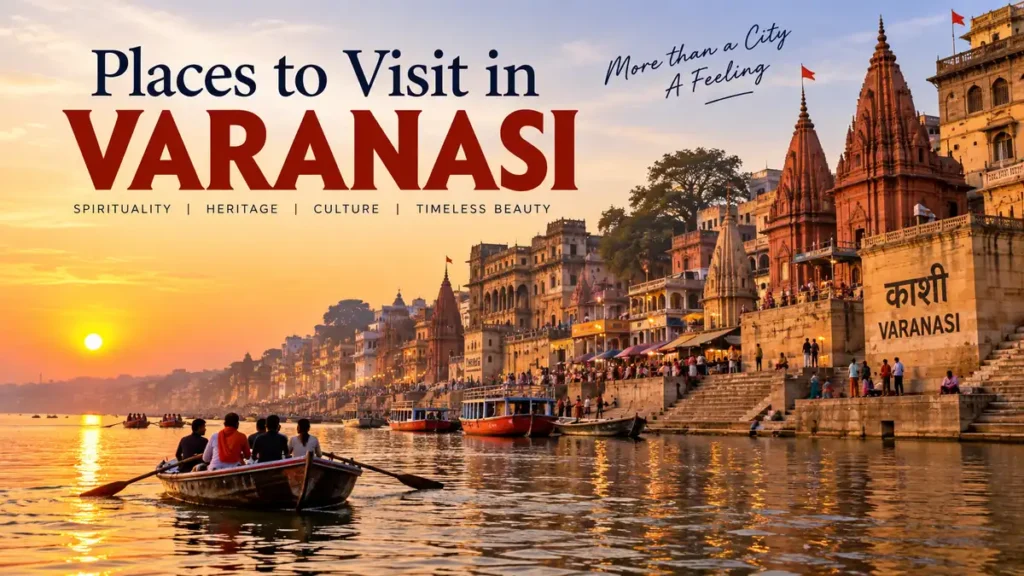
Varanasi is not a city you simply see. You experience it through temple bells before sunrise, wooden boats moving quietly across the Ganga, narrow lanes scented with incense and food, centuries-old rituals, and ghats where everyday life unfolds beside one of India’s most sacred rivers.
For travelers searching for places to visit in varanasi, the essential experiences include Kashi Vishwanath Temple, Dashashwamedh Ghat, Assi Ghat, Manikarnika Ghat, Sarnath, Ramnagar Fort, Banaras Hindu University, Bharat Kala Bhavan, Sankat Mochan Temple, Durga Temple, Tulsi Manas Mandir, Bharat Mata Temple, and a sunrise boat ride on the Ganga.
Varanasi—also widely called Banaras or Kashi—is one of India’s most distinctive cultural and spiritual destinations. Hindu traditions closely associate Kashi with Lord Shiva, while nearby Sarnath is one of Buddhism’s most significant pilgrimage sites. That combination makes the city far more than a collection of temples.
This guide covers the famous landmarks as well as the experiences that help you understand why Varanasi feels unlike almost anywhere else in India.
Best places to visit in varanasi at a glance
| Place | Best for | Ideal time |
|---|---|---|
| Kashi Vishwanath Temple | Hindu pilgrimage and spirituality | Early morning |
| Dashashwamedh Ghat | Ganga Aarti and riverfront atmosphere | Evening |
| Assi Ghat | Sunrise and Subah-e-Banaras | Early morning |
| Manikarnika Ghat | Understanding Varanasi’s spiritual traditions | Daytime |
| Sarnath | Buddhist history and archaeology | Morning |
| Dhamek Stupa | Buddhist heritage | Morning |
| Ramnagar Fort | History and architecture | Late morning |
| Banaras Hindu University | Campus, culture and architecture | Morning |
| Bharat Kala Bhavan | Art and cultural history | Daytime |
| Sankat Mochan Temple | Hanuman worship | Morning |
| Durga Temple | Temple architecture and devotion | Morning |
| Tulsi Manas Mandir | Ramcharitmanas heritage | Daytime |
| Bharat Mata Temple | Unusual cultural landmark | Daytime |
| Ganga boat ride | Views of the ghats | Sunrise |
| Old Varanasi lanes | Food, markets and local life | Morning/evening |
1. Kashi Vishwanath Temple
Kashi Vishwanath Temple is the spiritual centerpiece of Varanasi and one of the city’s most significant places of worship. Dedicated to Lord Shiva, it attracts pilgrims from across India and abroad.
The temple sits within the historic heart of Kashi, close to the Ganga and Dashashwamedh Ghat. Visiting the temple and then walking toward the river gives you an immediate sense of how closely Varanasi’s religious life is connected to its waterfront.
Expect security procedures and crowds, particularly on important Hindu festival days. Carry as little as possible and check current official visitor rules before going because restrictions on phones, bags and other belongings can change.
The surrounding lanes are an experience themselves. They contain shrines, flower sellers, religious shops, food stalls and streams of pilgrims navigating streets that can feel impossibly narrow for the amount of life packed into them.
Quick takeaway: If you have time for only one major Hindu temple in Varanasi, Kashi Vishwanath should generally be your priority.
2. Dashashwamedh Ghat
Dashashwamedh Ghat is one of the busiest and most recognizable riverfront locations in Varanasi. It lies near Kashi Vishwanath Temple and is closely associated with the city’s famous evening Ganga Aarti.
The atmosphere changes throughout the day.
Come around sunrise and you will see bathing rituals, prayers, boats and the river in softer light. Return around sunset and the same ghat becomes a large gathering place for the Ganga Aarti.
During the ceremony, priests perform coordinated rituals using lamps, incense and other traditional offerings while devotional chants, bells and conch sounds fill the riverfront.
You can watch from the ghat or from a boat on the Ganga. A riverside position offers a different perspective because you can see the lamps, crowd and historic buildings together.
Arrive well before the ceremony if you want a comfortable viewing position. Exact schedules can vary with season and sunset, so verify the day’s timing locally rather than relying on an old online timetable.
3. Assi Ghat
Assi Ghat offers a different side of the Varanasi riverfront.
Located around the meeting point of the Assi and Ganga, it is known for Subah-e-Banaras, an early-morning program involving Vedic chanting, music, prayer and yoga.
If Dashashwamedh represents Varanasi at its most intense, Assi often feels more spacious and relaxed.
Arrive before sunrise. Watch the morning ceremony, walk beside the river and then take a boat ride as daylight begins illuminating the ghats.
Assi is also popular with students and travelers because of its proximity to Banaras Hindu University and the cafés and restaurants in the surrounding neighborhood.
For photographers, the combination of morning light, boats, worshippers and the broad river makes this one of the best places to start a day in Varanasi.
4. Take a sunrise boat ride on the Ganga
A sunrise boat ride is technically an experience rather than a single attraction, but it belongs near the top of any list of the best things to do in Varanasi.
From the river, the geography of the old city finally makes sense.
You can see long sequences of ghats, temples, palaces, steps and buildings stacked above the water. Priests conduct rituals while residents bathe, pilgrims pray and boats cross the river.
The hour around sunrise usually provides a calmer experience than the busy evening riverfront.
Popular routes connect areas around Assi Ghat, Dashashwamedh Ghat and the historic ghats farther north. The exact route depends on where you board, water conditions and the type of boat.
For a first visit, prioritize the experience rather than trying to cover the maximum possible distance. A slower ride through the central riverfront often reveals more than rushing past dozens of ghats.
5. Manikarnika Ghat
Manikarnika Ghat is one of Varanasi’s most sacred cremation grounds and one of the most culturally sensitive places a visitor can encounter.
Hindu traditions connect cremation in Kashi with moksha—liberation from the cycle of birth and death. Cremation rituals take place at Manikarnika as part of this living religious tradition.
This is not a tourist spectacle.
Visitors should remain quiet, keep an appropriate distance from ceremonies and avoid intrusive photography. Families are performing funeral rites, and their privacy matters more than getting a photograph.
Approached respectfully, Manikarnika can help travelers understand an essential aspect of Varanasi: here, death is not hidden from public life. Rituals surrounding life, death, devotion and liberation exist alongside ordinary daily activity.
Nearby Manikarnika Kund is also associated with the mythology of the site.
What actually works: Visit with a knowledgeable local heritage guide if you want to understand the traditions rather than merely observe them.
6. Sarnath
For anyone interested in history, archaeology or Buddhism, Sarnath deserves at least half a day.
Located outside central Varanasi, Sarnath is revered as the place associated with Gautama Buddha’s first sermon after enlightenment. The area consequently became an important Buddhist center.
The experience contrasts sharply with central Varanasi. Instead of crowded riverfront lanes, Sarnath presents stupas, archaeological remains, monasteries and spaces associated with Buddhist history.
Important sights include Dhamek Stupa, Chaukhandi Stupa and the archaeological area.
Travelers often make the mistake of squeezing Sarnath between several city attractions. Give it enough time to walk slowly through the historic complex and understand why it became one of India’s major Buddhist pilgrimage destinations.
7. Dhamek Stupa
Dhamek Stupa is among Sarnath’s defining monuments and one of the most significant Buddhist landmarks around Varanasi.
Its massive cylindrical form immediately dominates the archaeological landscape. Rather than treating it simply as a photo stop, spend some time walking around the monument and observing pilgrims and visitors from different Buddhist traditions.
The wider Sarnath area helps connect several chapters of Indian history: the life and teachings of Gautama Buddha, the growth of Buddhism, archaeological remains and later Buddhist communities.
If your Varanasi itinerary is primarily focused on Hindu temples and ghats, Sarnath and Dhamek Stupa provide valuable historical balance.
8. Ramnagar Fort
Across the Ganga from the main city lies Ramnagar Fort, historically associated with the Kashi Naresh.
The fort features sandstone architecture, gateways and collections of historic objects and weapons. Official tourism information currently lists visiting hours from 10:00 AM to 5:00 PM, though checking locally before departure is sensible.
Do not expect a perfectly restored palace museum. Part of the appeal is the atmosphere of an aging royal complex and its relationship with Varanasi’s history.
The journey is also worthwhile because it takes you away from the dense old-city core and provides a different perspective on the Ganga.
Travelers particularly interested in heritage architecture can combine Ramnagar Fort with a slower exploration of the eastern side of the river.
9. Banaras Hindu University
Banaras Hindu University, commonly called BHU, adds another dimension to a Varanasi itinerary.
The university is one of the city’s major educational institutions, and its expansive campus feels dramatically different from the narrow lanes near the ghats.
One of its best-known landmarks is the New Vishwanath Temple, also called Birla Temple. The Varanasi district administration describes it as a modern place of worship planned by Pandit Madan Mohan Malaviya and built by the Birlas, with access irrespective of caste or creed.
BHU is particularly easy to combine with Assi Ghat, Sankat Mochan Temple and Durga Temple because they are in the same broader part of the city.
10. Bharat Kala Bhavan
Located within Banaras Hindu University, Bharat Kala Bhavan is worth adding if you want to understand Varanasi beyond its religious landmarks.
The museum is associated with Indian art, cultural heritage and historical collections. It also appears among the cultural attractions highlighted in official Varanasi tourism material.
After several days of temples and ghats, a museum visit provides useful context for the visual culture, artistic traditions and historical depth of the region.
Check current opening days and visitor hours before planning your trip, particularly around public holidays and university events.
11. Sankat Mochan Hanuman Temple
Sankat Mochan Temple is an important Varanasi shrine dedicated to Lord Hanuman.
Local government tourism information associates its foundation with Goswami Tulsidas and places it near the Assi area on the route toward BHU.
The temple remains an active place of worship, so it is better approached as a religious site rather than simply another sightseeing stop.
Go early if possible, dress modestly and follow security instructions. Monkeys may be present around temple areas, so avoid carrying exposed food and keep loose belongings secure.
A practical southern Varanasi route can combine Sankat Mochan Temple, Durga Temple, Tulsi Manas Mandir, BHU and Assi Ghat.
12. Durga Temple and Durga Kund
The red-colored Durga Temple is one of Varanasi’s recognizable Hindu temples.
The temple dates to the 18th century, and the adjacent water body is known as Durga Kund.
Its architecture and devotional atmosphere make it worth visiting even if Kashi Vishwanath is your main temple destination.
Because Tulsi Manas Mandir is nearby, visiting both together is much more efficient than making separate journeys across the city.
This part of Varanasi also demonstrates why planning by neighborhood matters. Traffic can make apparently short distances take longer than expected, whereas several nearby attractions can often be covered comfortably on foot or with a short local ride.
13. Tulsi Manas Mandir
Tulsi Manas Mandir is dedicated to Lord Rama and closely associated with Goswami Tulsidas and the Ramcharitmanas.
The district administration notes the tradition that Tulsidas lived and wrote the Ramcharitmanas at this location, and verses from the work are inscribed on the temple walls.
That literary connection distinguishes it from Varanasi’s many other temples.
It is especially worthwhile for visitors interested in Hindu literature, the Ramayana tradition and the cultural influence of Tulsidas.
Pair it with Durga Temple, which is nearby.
14. Bharat Mata Temple
Bharat Mata Temple is unusual because its focus is Mother India rather than a conventional deity.
According to the Varanasi district administration, Mahatma Gandhi inaugurated the temple in 1936, and it contains a relief map of India carved from marble.
That makes it an interesting stop for travelers exploring India’s nationalist and cultural history.
It does not require as much time as Kashi Vishwanath, Sarnath or the major ghats, so it works particularly well as an additional stop when moving between larger attractions.
15. Explore the old lanes, markets and food of Banaras
Some of the most memorable places to visit in Varanasi do not have admission gates or famous monuments.
Walk through the lanes around the old city and you encounter tiny shrines, flower sellers, cows, tea stalls, religious processions, workshops and generations-old businesses within a remarkably compact area.
Food should be part of that exploration.
Common Banarasi experiences include kachori-sabzi in the morning, jalebi, chaat, lassi and seasonal sweets. Banarasi paan is another deeply rooted part of the city’s food culture.
Varanasi is also famous for Banarasi silk and weaving traditions. Markets around the old city sell sarees, textiles, religious objects and handicrafts. When buying expensive silk, compare several sellers and ask clearly about fabric composition, weaving technique and provenance rather than relying solely on a sales pitch.
The best way to explore these neighborhoods is slowly. Varanasi rewards curiosity far more than a rigid checklist.
Which ghats should you visit in Varanasi?
Visitors often ask which Varanasi ghat is best because there are far too many to explore properly in a short trip.
For a first visit, focus on three:
Dashashwamedh Ghat for the large evening Ganga Aarti.
Assi Ghat for sunrise, Subah-e-Banaras and a comparatively relaxed riverfront atmosphere.
Manikarnika Ghat for understanding the city’s traditions surrounding cremation, death and moksha—provided you visit with complete respect for grieving families.
Dashashwamedh and Assi are both officially listed as open around the clock, although specific ceremonies and activities follow their own schedules.
Once you have experienced these, walking or boating past smaller ghats gives you a broader picture of riverfront life.
Best places to visit in varanasi in one day
One day is enough for the highlights, but not enough to understand the city deeply.
Start before sunrise at Assi Ghat and watch Subah-e-Banaras. Take a morning boat ride along the Ganga, then head toward the old city.
Visit Kashi Vishwanath Temple and spend time walking through the surrounding lanes. Continue toward Dashashwamedh Ghat and explore the riverfront.
After lunch, choose between the temples around BHU or a short cultural stop depending on your interests.
Return to Dashashwamedh before sunset for the evening Ganga Aarti.
This itinerary is intentionally compact. Trying to add Sarnath and Ramnagar Fort to the same day usually turns the trip into a race between attractions.
Best places to visit in varanasi in two days
Two days gives you a much better introduction.
Day 1: Ghats and old Varanasi
Begin with Assi Ghat at sunrise, followed by a boat ride. Visit Kashi Vishwanath Temple, explore the old lanes, see Dashashwamedh Ghat and respectfully pass Manikarnika Ghat.
Spend the evening watching the Ganga Aarti.
Day 2: Sarnath and southern Varanasi
Visit Sarnath in the morning and spend time around Dhamek Stupa and the archaeological area.
After returning to Varanasi, explore BHU, New Vishwanath Temple, Bharat Kala Bhavan, Sankat Mochan Temple, Tulsi Manas Mandir and Durga Temple according to available time.
Finish your second evening at Assi Ghat if you want a quieter contrast with Dashashwamedh.
What is the best time to visit Varanasi?
For most sightseeing, the cooler months are generally the easiest time to explore Varanasi because much of the experience involves walking outdoors.
Winter mornings can be chilly and sometimes misty, but they can also create an atmospheric riverfront experience. Summer heat makes midday exploration considerably harder, so early mornings and evenings become especially valuable.
The monsoon changes river conditions and may affect boating or access to sections of the ghats. Always follow local safety instructions when water levels are high.
Festival periods can be extraordinary but crowded.
Dev Deepawali is particularly associated with spectacular illumination along the ghats, while Maha Shivratri has enormous religious significance in the city of Shiva. Official tourism material highlights Dev Deepawali as an especially striking period around the Ganga riverfront.
If you travel during a major festival, expect heavier crowds, higher accommodation demand and longer travel times.
How many days are enough for Varanasi?
Two full days are enough to experience the essential sights, while three days provide a much better pace.
With three days, you can devote one day to the ghats and old city, another to Sarnath and southern Varanasi, and a third to Ramnagar Fort, museums, markets, food and places you discovered along the way.
Varanasi is one destination where extra time genuinely improves the experience.
A traveler rushing between ten landmarks may technically see more but understand less. Sitting beside the Ganga for an hour, walking through an old neighborhood without a strict destination or watching the city wake before sunrise can be as memorable as visiting a famous monument.
Practical tips for visiting Varanasi
The old city is easier to explore when you accept that walking is part of the experience. Vehicles cannot conveniently reach every lane or riverfront location, and traffic can slow down even short journeys.
Keep these practical points in mind:
- Wear footwear that is comfortable for uneven lanes and long walks.
- Dress respectfully when visiting temples and active religious sites.
- Check current temple security and entry requirements before leaving your hotel.
- Carry minimal belongings when visiting heavily secured temples.
- Agree on boat fares and the approximate route before boarding.
- Keep enough buffer time between attractions because road traffic can be unpredictable.
- Avoid drinking untreated tap water.
- Be cautious with monkeys around some temple areas.
- Ask permission before photographing individual people or religious rituals.
- Never treat cremation ceremonies as photo opportunities.
- Check current opening hours for museums, forts and archaeological sites.
- During high river levels, follow official instructions concerning boats and ghat access.
One particularly common mistake is trying to explore the old city by car. A better approach is to get as close as practical by vehicle and continue on foot.
Is Varanasi worth visiting if you are not religious?
Yes.
Religion is central to Varanasi’s identity, but you do not need to be Hindu or Buddhist to appreciate the city.
Architecture, history, photography, music, food, textiles, archaeology and everyday street life provide plenty to explore. Sarnath adds Buddhist history, Ramnagar Fort provides a royal heritage dimension, Bharat Kala Bhavan introduces art and culture, and BHU shows a more modern institutional side of the city.
What matters is approaching sacred spaces with respect.
You may not personally participate in the beliefs behind a ritual at the Ganga or a temple, but understanding what that ritual means to the people performing it makes the experience far richer.
What should you not miss in Varanasi?
If your schedule is extremely limited, prioritize five experiences:
- Watch sunrise from the Ganga.
- Visit Kashi Vishwanath Temple.
- Explore the old city and its ghats on foot.
- Experience the Ganga Aarti at Dashashwamedh Ghat.
- Spend half a day at Sarnath.
Add Assi Ghat, Manikarnika Ghat, BHU and Ramnagar Fort when you have more time.
This combination covers the major dimensions of Varanasi: Hindu spirituality, the Ganga, Buddhist heritage, living traditions, architecture and local culture.
A thoughtful way to experience Varanasi
The best places to visit in varanasi are connected by something deeper than geography.
Kashi Vishwanath Temple represents the city’s devotion to Lord Shiva. Dashashwamedh and Assi reveal its relationship with the Ganga. Manikarnika confronts visitors with traditions surrounding mortality and moksha. Sarnath connects the region to Gautama Buddha and Buddhist history. BHU, Bharat Kala Bhavan and Ramnagar Fort reveal educational, artistic and royal layers that are easy to miss on a quick pilgrimage.
Do not try to turn Varanasi into a race through tourist attractions.
Start before sunrise. Walk when you can. Take a boat on the Ganga. Spend time observing the ghats without needing to photograph everything. Explore the old lanes, taste Banarasi food, visit Sarnath and leave enough room in your itinerary for discoveries you did not plan.
That slower approach is often when Varanasi becomes most memorable.