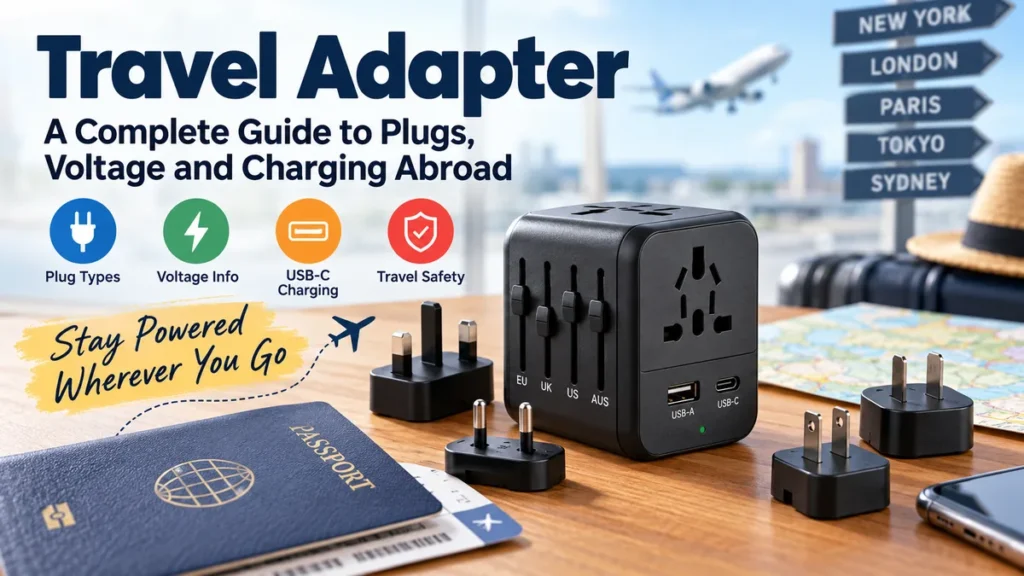
You arrive at your hotel after a long flight, your phone battery is nearly empty, and then you discover that your charger does not fit the wall socket. Different countries use different plug shapes, voltages, and electrical systems, which makes this a surprisingly common travel problem.
A travel adapter lets a plug designed for one type of electrical outlet physically connect to another. It changes the plug configuration, but it normally does not convert voltage. Before traveling, check your destination’s plug type and voltage, then confirm that your phone, laptop, camera, or other device supports that voltage.
Understanding that distinction prevents most charging problems abroad. For many modern electronics, the process is simple: check the charger label, pack the correct plug adapter, and charge normally.
What Is a Travel Adapter and How Does It Work?
A travel adapter is a small electrical accessory that creates physical compatibility between your device’s plug and a differently shaped wall outlet.
Imagine you normally use a charger with two flat pins, but your destination has sockets designed for two round pins. Your charger cannot physically enter that socket. The adapter provides the appropriate pins on one side while accepting your charger on the other.
The electricity still comes from the destination’s electrical grid.
That last point matters because an adapter normally does not transform the electricity itself. International electrical guidance distinguishes plug adaptation from voltage conversion, and travel-adaptor requirements are addressed by standards such as IEC 60884-2-5.
Travel adapter vs. power adapter
These terms can become confusing because “power adapter” is used for several different products.
A laptop’s AC power supply, for example, may be called a power adapter. It takes electricity from the wall and provides the electrical output required by the laptop.
A travel plug adapter has a narrower job: making one plug configuration fit another socket configuration.
Does a travel adapter convert voltage?
Usually, no.
This is the single most important fact to understand before plugging an appliance into electricity overseas.
If a wall outlet supplies 230 volts, putting a basic plug adapter between the socket and your appliance does not magically turn that electricity into 120 volts.
A separate voltage converter or transformer may be necessary when the appliance cannot accept the destination’s supply voltage.
Quick Takeaway: A plug adapter changes shape. A voltage converter changes voltage. Never assume that an international adapter performs both jobs.
Travel Adapter vs. Voltage Converter: What’s the Difference?
Travelers frequently use “adapter” and “converter” interchangeably, but they solve different problems.
| Device | What it does | When you may need it |
|---|---|---|
| Travel adapter | Changes physical plug compatibility | Destination uses a different socket |
| Voltage converter | Steps electrical voltage up or down | Device cannot accept destination voltage |
| Transformer | Converts voltage, often for particular electrical loads | Certain incompatible appliances |
| USB charger | Converts mains electricity into suitable charging output | Phones, tablets and other USB devices |
| Universal adapter | Supports several international plug configurations | Traveling across multiple regions |
Suppose you are traveling from a country with approximately 120V electricity to one using approximately 230V.
Your plug shape might be different, creating the first problem.
Your appliance’s voltage rating might also be incompatible, creating a second, completely separate problem.
The adapter solves the first problem. A suitable converter may be required for the second.
How to know whether you need a voltage converter
Look closely at the charger, power brick, appliance label, or manufacturer’s electrical specifications.
You may see something similar to:
INPUT: 100–240V ~ 50/60Hz
That indicates the power supply can operate across a broad range of mains voltages and frequencies. In that situation, you generally need only physical plug compatibility when traveling between countries within that range.
If the label specifies only one voltage, such as 120V, do not connect it directly to a 230V supply simply because you have an adapter.
Understanding International Plug Types
There isn’t one worldwide electrical outlet.
Plug-and-socket systems developed differently between countries, and multiple configurations remain in use. International references identify plug systems using letters, with Types A through N found around the world.
Some of the types travelers encounter most frequently include:
| Plug type | Basic design | Common examples |
|---|---|---|
| Type A | Two flat parallel pins | United States, Canada, Japan |
| Type B | Two flat pins plus grounding pin | United States, Canada |
| Type C | Two round pins | Many European and other countries |
| Type D | Three round pins | India and neighboring countries |
| Type E | Two round pins with grounding arrangement | France and some European countries |
| Type F | Two round pins with side grounding | Germany and much of continental Europe |
| Type G | Three rectangular pins | UK, Ireland, Singapore |
| Type I | Two angled flat pins, sometimes with earth | Australia, New Zealand |
| Type J | Three round pins | Switzerland |
| Type K | Danish three-pin system | Denmark |
| Type L | Three inline round pins | Italy |
| Type M | Three larger round pins | South Africa and some other locations |
| Type N | Three-pin configuration | Brazil and some other locations |
Country coverage isn’t always as simple as assigning one letter to one nation. Some destinations use multiple socket types, while universal or multi-standard receptacles can also appear in hotels and other buildings.
Check the specific destination rather than relying solely on a regional assumption.
Europe
Much of continental Europe uses Type C and related Type E/F systems, typically with mains electricity around 220–240V. The United Kingdom and Ireland are notable exceptions because Type G sockets are used there.
This means an adapter that works in France or Germany should not automatically be assumed to work in Britain.
Italy and Switzerland also have their own socket systems, although some two-pin European plugs can be physically compatible with certain sockets. Recessed outlets can create another practical issue: a bulky adapter may not seat securely.
United States and Canada
The United States and Canada primarily use Type A and Type B plugs and approximately 120V electricity.
Travelers arriving with European, British, or Australian plugs will therefore generally require an appropriate plug adapter.
Voltage compatibility needs to be checked separately.
United Kingdom and Ireland
The Type G system uses three rectangular pins.
Travelers arriving from continental Europe, North America, Australia, and many Asian countries generally need a Type G-compatible adapter unless their charger already has the appropriate plug.
Australia and New Zealand
Australia and New Zealand use Type I sockets and operate around 230V. Travelers carrying Type A, C, or G plugs normally need physical adaptation.
Asia
Asia cannot be treated as one plug region.
Japan commonly uses Type A/B and has a 100V supply. Singapore uses Type G at 230V, while India prominently uses Type C and D configurations alongside other sockets. Other Asian destinations have still different combinations.
Check each country separately when planning a multi-country Asian trip.
How to Choose the Right Travel Adapter
The right adapter is determined by three things: where you are coming from, where you are going, and what you intend to plug in.
Follow this sequence.
- Identify the plug fitted to your device or charger.
- Find the socket type used at your destination.
- Check the destination’s mains voltage and frequency.
- Read the voltage input specification on your device or charger.
- Determine whether the device is single-voltage or multi-voltage.
- Check its wattage and grounding requirements.
- Choose an adapter designed for the destination socket and appropriate electrical load.
A country-by-country reference is much safer than assuming neighboring countries use identical systems. Worldwide plug tables show substantial variation even within the same geographic region.
Check the voltage rating first
Voltage deserves attention before convenience features such as USB ports.
Look for an input range on the charger.
For example:
100–240V, 50/60Hz
This broad range is common on modern electronic power supplies. Such a charger can normally handle both common international voltage ranges without a separate converter, provided the physical connection is correct.
Check maximum current and power
An adapter also has electrical limits.
Do not assume that because a plug physically fits, any appliance can safely be connected through it. Check the adapter’s rated voltage, current, and maximum load against the equipment you plan to use.
IEC 60884-2-5, for example, covers travel adaptors within defined voltage and current limits and includes construction and safety requirements.
Consider grounding
Two-pin and three-pin plugs aren’t interchangeable from a safety perspective.
A grounding or earthing connection exists for a reason. If an appliance requires earth protection, choose an adapter that properly maintains the grounding path rather than defeating it merely to make the plug fit.
This matters particularly for equipment with grounded three-pin plugs.
What Is a Universal Travel Adapter?
A universal travel adapter combines several international plug configurations into one device.
Rather than carrying separate adapters for the United States, Europe, Britain, and Australia, a traveler can select or extend the appropriate pins from one compact unit.
Many designs primarily accommodate combinations based around:
- Type A/B-style destinations
- Type C-style European outlets
- Type G outlets
- Type I outlets
This can be convenient for international trips involving several countries.
But the word universal deserves skepticism.
No adapter should automatically be assumed to work with every socket in every country. Some universal models do not adequately cover less-common systems such as Type D or Type M.
Universal adapter vs. country-specific adapter
A universal model makes sense when your itinerary crosses several plug regions.
A simple country-specific adapter can be preferable when visiting one destination. It may be smaller, lighter, cheaper, and less likely to sag from a loose wall outlet.
Rick Steves, for example, notes that bulky universal designs can be less convenient than small individual adapters, particularly around recessed European outlets.
Quick Takeaway: Frequent multi-country traveler? A universal model can reduce clutter. One-country trip? A compact dedicated plug adapter may be all you need.
USB, USB-C and Modern Travel Charging
Travel charging has become easier because many devices no longer need their original wall charger connected directly to an outlet.
Phones, tablets, headphones, cameras, smartwatches, power banks, and some laptops can charge over USB.
Modern travel adapters therefore often include:
USB-A ports for traditional USB cables and USB-C ports for newer electronics.
USB-C is particularly useful because compatible implementations can provide substantially more charging power than older basic USB connections.
Does USB-C eliminate the need for a travel adapter?
Not necessarily.
USB-C standardizes the device-side charging connection, but electricity still has to reach the charger from the wall.
If your USB-C charger has a plug that does not fit the destination’s socket, you still need the appropriate wall adapter or a charger fitted with the destination’s plug.
What about USB-C Power Delivery?
USB Power Delivery, commonly called USB PD, allows compatible USB-C equipment to negotiate charging power.
That makes USB-C particularly useful for travelers carrying several compatible devices. One appropriately rated multi-port charger may be able to replace multiple individual charging bricks.
However, check the output specifications rather than counting ports alone.
A travel adapter advertised with several USB-C ports might divide its available power when multiple devices are connected. A laptop may also require substantially more charging power than a phone or wireless earbuds.
Do Phones Need a Voltage Converter?
Usually, the charger determines the answer rather than the phone itself.
Many modern phone chargers are designed for wide input ranges such as 100–240V at 50/60Hz. When the charger has that specification, it can normally accept common international mains voltages without a separate converter.
You may still need a plug adapter.
For example, a North American charger could electrically support 230V but still have Type A pins that cannot physically fit a Type G socket in the United Kingdom.
The voltage is compatible.
The plug isn’t.
That’s exactly the situation a travel adapter is designed to solve.
Do Laptops Need a Travel Adapter or Converter?
Modern laptop power supplies commonly accept broad international input ranges, but never assume yours does.
Check the power brick.
If it states something similar to:
INPUT 100–240V ~ 50–60Hz
then a voltage converter is generally unnecessary within that range. You simply need a suitable physical connection to the destination outlet.
The laptop’s charging wattage still matters if you plan to use USB-C ports built into a universal adapter.
A low-output USB-C port might charge a phone perfectly while charging a laptop very slowly—or not providing sufficient power during active use.
For laptops, compare the charger’s required wattage with the USB-C output available from the charging device.
Hair Dryers, Straighteners and Other High-Power Appliances
This is where travelers need to be more careful.
Phones, cameras, tablets, and laptops commonly use electronic power supplies capable of accepting broad voltage ranges.
Heating appliances can be different.
Hair dryers, curling irons, straighteners, travel irons, kettles, and similar equipment may consume substantial power and may be designed for only one voltage range. Travel guidance therefore recommends checking these devices particularly carefully before connecting them abroad.
Imagine a hair dryer marked:
120V only
Taking it to a country supplying around 230V and attaching a simple plug adapter does not make it compatible.
Do not plug it in unless the appliance and any conversion equipment are specifically suitable for that electrical system and load.
Often the simpler solution is using a dual-voltage travel appliance or equipment supplied by the hotel.
Why wattage matters with converters
A converter must handle the appliance’s power demand.
A small converter intended for low-power electronics should not be assumed capable of operating a high-wattage heating appliance.
Always check both voltage and wattage ratings.
Travel Adapter Safety: Mistakes to Avoid
A small plastic adapter can look harmless, but it sits directly between your electronics and mains electricity.
Treat it as electrical equipment, not just another travel accessory.
1. Assuming an adapter converts voltage
This remains the most common mistake.
It doesn’t unless the product explicitly includes voltage-conversion functionality.
2. Plugging adapters into adapters
Avoid daisy-chaining travel adapters.
IEC requirements for travel adaptors specifically address warnings against inserting one adaptor into another.
Use one correctly designed solution whenever possible.
3. Ignoring grounding
Don’t remove a safety earth connection simply to make a three-pin appliance fit a two-pin system.
Use appropriate grounded equipment where the device requires it.
4. Overloading the adapter
Multiple outlets and USB ports do not mean unlimited electrical capacity.
Check the manufacturer’s maximum current and power rating, particularly when connecting several devices simultaneously.
5. Using damaged or loose equipment
Stop using an adapter if its pins are bent, casing is cracked, contacts are loose, or it becomes unusually hot.
A heavy universal adapter hanging from a worn socket can also make poor contact.
6. Buying solely by the number of countries advertised
Claims such as “works in 150+ countries” are useful only when the adapter actually supports the plug systems on your itinerary.
Check the specific countries.
7. Assuming hotel universal sockets solve everything
Some hotels provide multi-standard sockets or USB charging points. They can be convenient, but they should not replace checking voltage compatibility.
A physically compatible socket tells you very little about whether a single-voltage appliance can safely use the local supply.
How Many Travel Adapters Should You Bring?
For a solo traveler carrying only a phone and laptop, one suitable adapter may be enough.
The answer changes when several devices need overnight charging.
Consider what you regularly charge:
- Smartphone
- Laptop
- Tablet
- Camera batteries
- Smartwatch
- Wireless earbuds
- Power bank
- Portable gaming device
One adapter paired with a suitable multi-port USB charger can often reduce the number of wall connections required.
A second small adapter can still be useful as backup. Adapters are easy to leave behind in hotel outlets—a practical problem experienced travelers regularly encounter.
Can You Take a Travel Adapter on a Plane?
An ordinary travel plug adapter is generally just passive electrical hardware rather than a battery.
The more important distinction arises when your charging setup includes a power bank or another device containing lithium batteries. Battery-powered equipment is subject to separate airline and aviation safety requirements.
Do not assume the rules for a passive wall adapter automatically apply to every item in your charging kit. Check your airline’s current baggage requirements before departure, particularly for power banks and spare lithium batteries.
How to Build a Simple International Charging Kit
You don’t need a bag full of electrical accessories for most trips.
A practical setup can be built in a few steps.
Step 1: List your devices
Write down everything you’ll actually charge.
Ignore gadgets you’re unlikely to use.
Step 2: Check each input specification
Look at every charger and power supply.
Find the voltage range, frequency, wattage, and other input information.
Step 3: Check destination electricity
Confirm:
plug type + voltage + frequency
Do this separately for each country on a multi-country itinerary.
Step 4: Match the physical plugs
Determine whether you need Type A, C, D, G, I, or another configuration.
Step 5: Identify incompatible appliances
Pay particular attention to heating and motor-driven devices such as hair dryers and styling tools.
Step 6: Consolidate charging
If several devices support USB-C, an appropriately rated multi-port charger can reduce the number of power bricks you carry.
Step 7: Test before departure
Connect your normal cables and chargers to the adapter before packing.
It is much better to discover that a large laptop plug blocks an adjacent USB port at home than after checking into a hotel overseas.
What Features Matter in a Travel Adapter?
More features aren’t automatically better.
Focus first on electrical compatibility and safety, then convenience.
| Feature | Why it matters |
|---|---|
| Correct destination plug | Ensures physical compatibility |
| Appropriate voltage/current rating | Helps keep use within design limits |
| Grounding support | Important for grounded appliances |
| USB-C | Convenient for modern electronics |
| USB Power Delivery | Useful for faster compatible charging |
| Multiple USB ports | Reduces charger clutter |
| Replaceable or built-in fuse | Can provide overcurrent protection depending on design |
| Compact body | Easier to pack and use in tight sockets |
| Secure pins | Helps maintain reliable wall contact |
| Safety shutters | Reduce accidental access to live contacts |
| Clear electrical labeling | Makes compatibility easier to verify |
Don’t judge a travel adapter purely by size or the number of USB ports.
Its first job is to provide a safe, appropriate connection.
Travel Adapter Questions Worth Answering Before Every Trip
Instead of asking only, “Which adapter do I need?”, work through four questions.
What plug does my destination use?
Countries may use one or several plug systems. Consult a current country-specific reference.
What voltage does the destination supply?
Common systems fall around 100–127V or 220–240V, although exact standards differ by country. Most countries listed in global references operate within the higher 220–240V range.
What voltage can my device accept?
Read the manufacturer’s input label rather than guessing.
How much power does the device require?
This becomes especially important for laptops and high-wattage appliances.
Answer those four questions and most international power problems become straightforward.
Final Thoughts on Choosing a Travel Adapter
A travel adapter solves one simple but essential problem: it allows your plug to connect to a differently shaped electrical outlet abroad. It should never be assumed to convert voltage.
Before every international trip, check the destination’s plug type, mains voltage, and frequency, then compare those specifications with the input rating on each device. Multi-voltage electronics marked around 100–240V, 50/60Hz will often need only physical plug adaptation, while single-voltage and high-power appliances require more careful planning.
For one-country trips, a compact destination-specific adapter can be the simplest option. For multi-country travel, a well-designed universal adapter with appropriate USB-C charging can reduce what you carry—but “universal” should never replace checking actual compatibility.
The best next step is simple: check the plug, voltage, frequency, and device label before you pack.