Manchester is one of those cities that becomes more interesting the deeper you explore it. Football may have made the city globally famous, but its industrial heritage, music, museums, Victorian architecture, independent shops, galleries, canals and neighbourhoods give visitors far more reasons to stay.
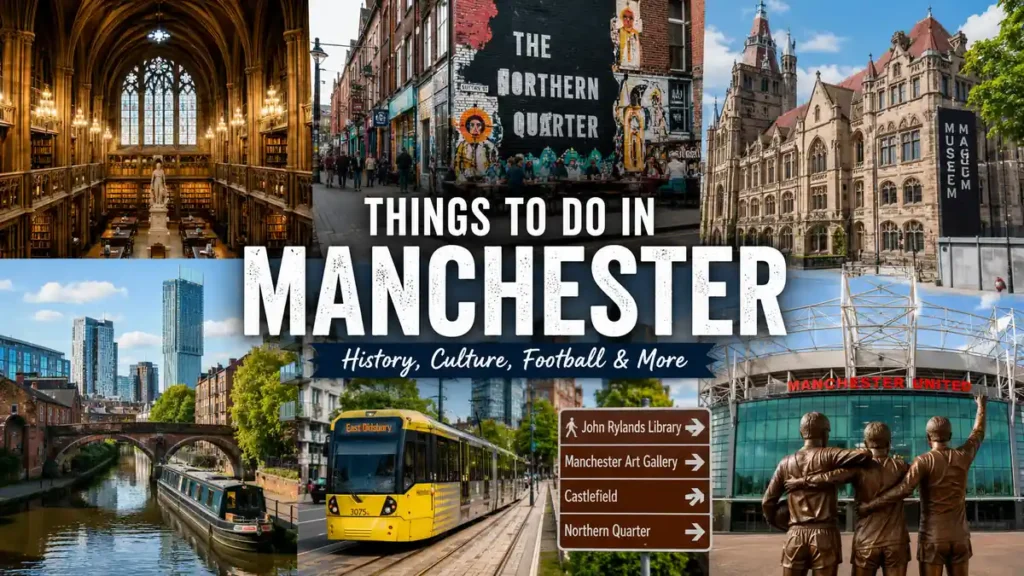
If you are looking for things to do in manchester, start with the John Rylands Library, Northern Quarter, Manchester Museum, Manchester Art Gallery and the city’s football attractions. Add Castlefield, Ancoats, live music, food markets and a few lesser-known historic sites, and you have enough variety for a rewarding two- or three-day city break.
Manchester is compact enough to explore much of the centre on foot, while the Metrolink tram network makes places such as Old Trafford and Salford Quays straightforward to reach. The key is not trying to tick off every attraction. Pick a mixture of history, culture, neighbourhoods and experiences that reveal why Manchester feels different from other British cities.
Best things to do in manchester for first-time visitors
For a first trip, concentrate on attractions that tell Manchester’s story. The city played an enormous role in industrialisation, political reform, popular music and English football, and you can encounter all four within a relatively small area.
Here are the places worth putting near the top of your itinerary.
1. Step inside the John Rylands Library
The John Rylands Research Institute and Library looks more like a Gothic cathedral than a conventional library.
Opened in 1900, it is one of Europe’s notable examples of neo-Gothic architecture and houses rare books, manuscripts and archives as part of the University of Manchester Library. Admission is free.
The Historic Reading Room is the visual highlight, with soaring stonework, stained glass and intricate architectural details.
Don’t treat it merely as a photo stop. Slow down and look at the exhibitions and collections as well; they provide a better understanding of why the building exists.
Practical tip: As of September 2026, general visitor opening is Wednesday to Saturday, 10am–5pm, with last entry at 4:40pm.
2. Explore the Northern Quarter
The Northern Quarter provides a completely different version of Manchester.
Independent record stores, vintage shops, cafés, murals, bars and small creative businesses fill the streets around Oldham Street, Thomas Street and Stevenson Square. It is repeatedly highlighted in current Manchester guides as one of the city’s essential neighbourhoods.
Part of the appeal is that there isn’t one attraction you need to see. The neighbourhood itself is the experience.
Spend an hour wandering without a strict route. Look for street art, browse independent shops and stop somewhere that catches your attention.
It works particularly well in the late afternoon because you can easily continue into dinner, drinks or live music.
3. Visit Manchester Museum
Manchester Museum is an excellent choice for families, history enthusiasts and anyone needing a substantial indoor attraction when Manchester’s weather turns wet.
The museum has been part of the city’s cultural landscape for more than 130 years and forms part of the University of Manchester.
Its collections span archaeology, natural history and cultures from around the world.
Allow roughly two hours rather than attempting to race through every gallery.
4. Discover Manchester Art Gallery
Right in the city centre, Manchester Art Gallery combines historic collections with contemporary exhibitions.
It is particularly convenient if you only have a weekend because you can fit it between other central sights rather than devoting half a day to travelling.
Entry is free, and current opening hours are Tuesday to Sunday, 10am–5pm. The gallery is undergoing building improvements, so occasional temporary gallery closures can occur.
Free volunteer-led tours are also offered on selected days, providing extra context without requiring a private guide.
5. Walk through Castlefield
For industrial heritage, canals and a slower pace, head towards Castlefield.
This historic district gives you a glimpse of the infrastructure that helped transform Manchester during the Industrial Revolution. Brick warehouses, railway viaducts, canals and waterside paths make it one of the most atmospheric parts of the city.
It is best experienced on foot.
Follow the canals, explore the old industrial architecture and continue towards Deansgate or the River Irwell.
Castlefield is also particularly photogenic around sunset when the old brickwork and modern towers create one of Manchester’s most distinctive urban scenes.
Football experiences and stadium tours
You don’t have to follow the Premier League to understand that football is inseparable from Manchester’s identity.
The city is home to Manchester United and Manchester City, while the National Football Museum examines the wider history and cultural importance of the sport. Official tourism information understandably treats football as one of Manchester’s defining visitor experiences.
6. Tour Old Trafford
Old Trafford is one of world football’s most recognisable stadiums.
The Manchester United museum and stadium tour takes visitors behind the scenes into areas such as the players’ dressing room, tunnel, pitchside dugouts and press/media spaces. The standard stadium-tour portion lasts about 70 minutes, with additional time recommended for the three-level museum.
For supporters, allow at least two hours.
There is one important planning detail: stadium tours are closed on Manchester United home match days and can be altered because Old Trafford remains a working stadium.
Check the fixture calendar before building your day around a tour.
7. Experience the Etihad Stadium
Manchester City supporters can instead head east to the Etihad Stadium.
Stadium experiences provide access to areas usually hidden from spectators and offer an interesting look at the infrastructure behind a modern Premier League club.
Even if you aren’t strongly attached to either Manchester team, comparing Old Trafford’s long history with the modern Etihad Campus illustrates how football has shaped different parts of the city.
8. Visit the National Football Museum
If you want football history without committing to a stadium tour, visit the National Football Museum.
Located inside the distinctive Urbis building near Manchester Victoria, it examines football through trophies, historic objects, exhibitions and interactive experiences.
The museum is currently open daily from 10am–5pm, with last admission at 4pm. Manchester residents qualify for free admission, while other visitors generally need a ticket.
Among its exhibits are important pieces of football memorabilia and replicas of major trophies, including the Premier League and Women’s Super League trophies.
It’s a particularly good family option because there is enough interactive material to engage children who may not want to spend hours reading museum labels.
Quick Takeaway: Football fan? Choose one stadium tour plus the National Football Museum rather than attempting both stadiums in a single day.
Free things to do in manchester
Manchester can be surprisingly affordable if you build your itinerary around museums, galleries, architecture and neighbourhood walks.
Several major cultural attractions offer free entry, including Manchester Museum, the Whitworth and Manchester Art Gallery, while the John Rylands Library is also free to visit.
9. See contemporary and historic art at the Whitworth
The Whitworth sits within Whitworth Park and is part of the University of Manchester.
Its location makes it easy to combine with Manchester Museum and other Oxford Road attractions.
This is one of the smartest ways to structure a rainy day: move between the museums and cultural venues along the Oxford Road corridor rather than crossing the entire city.
10. Visit Manchester Cathedral
Manchester Cathedral introduces visitors to a much older side of the city.
The cathedral sits close to the National Football Museum and Chetham’s Library, so these attractions naturally form a compact historical walking route.
Look beyond the scale of the building and spend time examining the woodwork, stonework and architectural details.
11. Walk around Chinatown
Manchester’s Chinatown is easy to reach from the central shopping and cultural districts.
Its ornate Chinese arch makes an obvious starting point, but the area is better experienced through its restaurants, bakeries and supermarkets.
Rather than visiting only for a photograph, incorporate Chinatown into lunch or dinner. That turns a five-minute landmark stop into part of your experience of Manchester’s multicultural identity.
12. Explore the city’s canals
Manchester’s canals provide some of the best free walks in the centre.
Castlefield is the obvious starting point, but the network extends towards neighbourhoods such as Ancoats and beyond.
Canal walking also reveals something visitors sometimes miss: Manchester makes much more sense when viewed as an industrial city shaped by transport, warehouses, waterways and trade.
Bring comfortable shoes because cobbles and towpaths can become slippery after rain.
History, architecture and culture
Manchester’s story stretches far beyond mills and football.
Political reform, workers’ movements, literature, science and radical ideas all have strong connections to the city.
13. Visit the Science and Industry Museum
The Science and Industry Museum occupies a historically appropriate part of Castlefield and explores Manchester’s contributions to science, technology and industrial development.
It is especially valuable if you’re travelling with children because the subject matter goes beyond static historical displays.
The museum also gives context to what you’ll see outside in Castlefield: railway infrastructure, warehouses, canals and industrial buildings stop looking like random remnants and start becoming pieces of the same story.
Check current galleries and temporary closures before visiting, as the museum has been undergoing a major programme of restoration and redevelopment.
14. Discover the People’s History Museum
The People’s History Museum explores democracy, protest, workers’ rights and social change.
It adds an important dimension to a Manchester itinerary because the city’s significance wasn’t purely technological or economic.
Industrialisation transformed how people worked and lived, and Manchester became a major centre for political organising and campaigns for representation and rights.
Pairing this museum with the Science and Industry Museum gives you a much fuller picture of the city’s past.
15. Tour Chetham’s Library
Chetham’s Library is one of Manchester’s most atmospheric historic interiors.
It describes itself as the oldest public library in the English-speaking world, and the medieval building feels remarkably removed from the busy streets outside.
Unlike the John Rylands Library, however, you cannot simply walk inside whenever it is open.
Public access is through pre-booked guided tours and events because the library shares its site with Chetham’s School of Music. Tours are generally offered Monday to Saturday, subject to school activities and other events.
This is precisely the kind of planning detail worth knowing before arriving.
16. Explore Aviva Studios
Manchester isn’t simply preserving its cultural history; it continues to invest heavily in new creative spaces.
Aviva Studios, home of Factory International, represents the contemporary side of that story.
The venue hosts ambitious programmes spanning music, visual art, theatre, performance and cross-disciplinary work.
Check the programme rather than assuming you can experience the venue in the same way as a museum. What makes Aviva Studios interesting is the event or production happening during your visit.
Cool neighbourhoods and unusual things to do in Manchester
Some of Manchester’s best experiences aren’t conventional attractions.
Neighbourhoods such as Ancoats and the Northern Quarter regularly feature in current travel guides because they reveal how the city actually lives rather than simply presenting its history.
17. Spend an afternoon in Ancoats
Once one of Manchester’s great industrial districts, Ancoats has evolved into an area of converted mills, apartments, cafés, restaurants and public spaces.
Walk around Cutting Room Square before exploring the surrounding streets and canals.
Ancoats works particularly well after the Northern Quarter because the two neighbourhoods are close enough to combine on foot.
A simple route is:
- Start around Stevenson Square.
- Explore Northern Quarter shops and street art.
- Walk towards Ancoats.
- Stop around Cutting Room Square.
- Continue along the canal.
- Stay for dinner or drinks.
That creates an enjoyable half-day without relying on a long checklist of attractions.
18. Discover Manchester’s street art
The Northern Quarter is the obvious area for street-art hunting, but murals and temporary works appear throughout central Manchester.
Street art changes more frequently than monuments or museums, which is part of its appeal. Don’t rely too heavily on an old map showing specific pieces; treat the search itself as part of your walk.
This is also an easy activity to combine with independent shopping, coffee or photography.
19. Explore the Gay Village and Canal Street
Canal Street and the surrounding Gay Village form one of Manchester’s best-known nightlife districts.
During the daytime, the canalside setting makes it pleasant to walk through while exploring the southern edge of the centre. At night, bars and venues give the district a very different energy.
Manchester’s LGBTQ+ history is an important part of the area’s identity, so visitors interested in social and cultural history may want to explore beyond the nightlife.
20. Browse independent shops and record stores
Manchester’s relationship with music isn’t confined to museums or concert venues.
Browsing record stores in and around the Northern Quarter is one of the easiest ways to experience that culture casually.
The city is associated with acts including Joy Division, New Order, The Smiths, The Stone Roses and Oasis, and its musical influence continues through venues, club culture and independent record shops.
Vinyl collector or not, these shops often reveal more personality than another hour in a mainstream shopping centre.
Music and nightlife in Manchester
Music deserves its own place on any serious list of things to do in manchester.
Manchester’s musical reputation extends from post-punk and indie rock to dance music, electronic culture and contemporary arena tours.
21. See a live concert
Large concerts now take place at venues including Co-op Live and the AO Arena, while smaller venues provide a completely different experience.
Lonely Planet specifically highlights Manchester’s live-music culture and Co-op Live among the city’s modern attractions.
Don’t automatically choose the biggest concert available.
A smaller club show can feel more connected to Manchester’s musical heritage than an international arena tour.
Check what’s playing during your dates and work backwards from there.
22. Experience Manchester’s pubs
Traditional pubs provide another window into the city.
Rather than searching only for fashionable cocktail bars, include at least one historic Manchester pub.
Look for original interiors, snug rooms, tiled details and locally brewed beer. Some pubs feel almost unchanged compared with the glass towers appearing around them.
If nightlife isn’t your thing, go in the afternoon when the atmosphere is usually quieter.
Food and markets worth experiencing
Manchester’s food scene reflects its diverse population and constantly changing neighbourhoods.
You’ll find everything from historic curry houses and Chinese restaurants to bakeries, food halls, modern British cooking and independent cafés.
23. Eat your way through the city
Avoid trying to identify one definitive “Manchester food.”
Instead, explore different districts.
The Northern Quarter works well for casual independent restaurants and cafés. Chinatown is the obvious destination for East Asian food, while Ancoats has become one of the city’s strongest restaurant districts.
Manchester’s broader restaurant scene is now significant enough to feature prominently alongside culture and nightlife in major city guides.
For a weekend visit, choosing restaurants by neighbourhood also reduces unnecessary travel.
24. Visit Mackie Mayor
Mackie Mayor occupies a restored historic market building close to the Northern Quarter.
Inside, communal seating is surrounded by independent food and drink traders.
It’s particularly useful for groups because everyone can choose something different without splitting up.
Visit outside peak meal times if you want a quieter look at the building itself.
Outdoor and family-friendly things to do in Manchester
Manchester’s reputation for rain sometimes causes visitors to plan entirely indoor itineraries.
That’s a mistake.
Parks, canals, gardens and green spaces provide a useful contrast to the city’s dense urban core.
25. Escape to RHS Garden Bridgewater
If you have more than a weekend, RHS Garden Bridgewater is one of the strongest Greater Manchester day-trip options.
The 154-acre garden occupies the historic grounds of Worsley New Hall and includes areas such as the Paradise Garden, Kitchen Garden and Chinese Streamside Garden.
It sits roughly nine miles from Manchester city centre in Worsley, Salford.
This is not something to squeeze between city-centre attractions. Give it at least half a day.
What are the best things to do in Manchester with kids?
Families have plenty of choices that don’t revolve around shopping or expensive entertainment.
Manchester Museum and the Science and Industry Museum provide educational indoor options, while the National Football Museum combines sporting history with interactive exhibits. Visit Manchester specifically recommends these attractions among its family-friendly activities.
For outdoor time, consider parks, canal walks or RHS Garden Bridgewater.
A family day could look like this:
| Time | Activity |
|---|---|
| Morning | Manchester Museum |
| Lunch | Oxford Road/city centre |
| Afternoon | National Football Museum |
| Late afternoon | Cathedral Gardens |
| Evening | Casual dinner in Northern Quarter |
For football-loving children, replace one museum with an Old Trafford or Etihad Stadium tour.
What can you do in Manchester when it rains?
Rain doesn’t need to ruin a Manchester visit because many of its strongest attractions are indoors.
Head for:
- John Rylands Library
- Manchester Museum
- Manchester Art Gallery
- The Whitworth
- National Football Museum
- Science and Industry Museum
- People’s History Museum
- indoor markets and food halls
A useful strategy is to keep one outdoor neighbourhood walk flexible.
If the morning is dry, explore Castlefield or the Northern Quarter first. Save museums for the afternoon. If heavy rain arrives early, reverse the plan.
Manchester weather rewards flexible itineraries more than rigid hour-by-hour schedules.
What are the best things to do in Manchester at night?
Manchester changes character after dark.
Live music is an obvious choice, but it’s not the only one. Theatre, comedy, football, pubs, restaurants and neighbourhood bars provide plenty of alternatives.
The Northern Quarter is ideal for bar-hopping and casual nightlife, while Canal Street is the centre of the Gay Village. Ancoats suits visitors who prefer dinner and cocktails over clubs.
Check event calendars for Aviva Studios, Co-op Live, AO Arena and smaller independent venues before your trip.
A scheduled performance can become the anchor around which you organise the rest of the day.
Best hidden gems and unusual Manchester experiences
If you’ve already visited the major attractions, Manchester still has plenty left.
Chetham’s Library is one of the strongest examples because access requires more planning than better-known sights. Canal walks beyond the busiest sections of Castlefield also reveal quieter parts of the city’s industrial landscape.
Look for:
- lesser-known Northern Quarter street art
- historic pubs
- independent record stores
- architectural details around the old commercial district
- canal routes through Ancoats
- temporary exhibitions
- small live-music venues
- walking tours focusing on industrial or political history
Current specialist guides increasingly emphasise Manchester’s hidden historic buildings, unusual tours, immersive experiences and street-art locations alongside its major museums and stadiums.
The advantage is simple: these experiences make a second visit feel completely different from the first.
How many days do you need in Manchester?
Two full days are enough to see the main highlights. Three days provide a much better experience because you can explore neighbourhoods without constantly checking the clock.
One day in Manchester
If you only have one day:
Morning: John Rylands Library → Deansgate → Castlefield
Lunch: Northern Quarter
Afternoon: Manchester Museum or National Football Museum
Evening: Northern Quarter, Ancoats or a live show
Don’t attempt both major football stadiums on a one-day visit.
Two days in Manchester
Use your first day for the historic centre, museums and Northern Quarter.
Make day two more specialised:
Football fans: Old Trafford or Etihad Stadium + National Football Museum.
Culture lovers: Whitworth + Manchester Museum + Aviva Studios.
Food-focused visitors: Ancoats + Northern Quarter + Chinatown.
This gives each day a clear theme.
Three days in Manchester
Three days allow you to slow down.
Use the third day to explore Salford Quays, RHS Garden Bridgewater or another part of Greater Manchester.
Official Manchester tourism itineraries now provide plans ranging from 24 and 48 hours to 72 hours, five days and seven days, reflecting how much there is to explore beyond the central attractions.
Quick Takeaway: Two days works for the highlights. Three days is better if you want football, museums, neighbourhoods and nightlife without rushing.
How to get around Manchester
Walking is usually the best way to explore central Manchester.
Many major attractions sit surprisingly close together. Deansgate, the John Rylands Library, Castlefield, Chinatown, Northern Quarter and Manchester Cathedral can all fit into a walking-heavy itinerary.
For longer journeys, use Metrolink.
The tram network is particularly useful for destinations outside the immediate centre, including Old Trafford and the Etihad Campus.
Manchester Piccadilly, Manchester Victoria and Manchester Oxford Road are the principal city-centre railway stations you’ll encounter as a visitor.
A practical rule is simple:
Walk within the centre; use trams for the outer districts.
That is generally faster and less stressful than trying to drive between central attractions and repeatedly finding parking.
How to plan a Manchester trip without wasting time
The biggest mistake is organising attractions by popularity instead of geography.
Manchester works better when you group nearby places.
| Area | Good attractions to combine |
|---|---|
| Deansgate/Castlefield | John Rylands Library, canals, Castlefield |
| Medieval Quarter | Manchester Cathedral, National Football Museum, Chetham’s Library |
| Northern Quarter/Ancoats | Street art, independent shops, cafés, Mackie Mayor, canals |
| Oxford Road | Manchester Museum, Whitworth |
| Central Manchester | Manchester Art Gallery, Chinatown |
| Old Trafford | Stadium tour, nearby Trafford attractions |
| Etihad Campus | Etihad Stadium, Co-op Live |
| Salford/Worsley | RHS Garden Bridgewater |
This approach cuts unnecessary transport time and leaves more room for spontaneous discoveries.
Pre-book anything with limited capacity, particularly stadium tours, Chetham’s Library tours and major performances.
Museums and neighbourhoods can then fill the flexible parts of your schedule.
Opening hours, exhibitions and events can change, so check official venue information shortly before travelling—especially for working stadiums and attractions undergoing restoration.
Are there enough things to do in Manchester for a weekend?
Absolutely.
Manchester’s strength isn’t one blockbuster landmark. It is the concentration of different experiences.
You can stand inside a neo-Gothic library in the morning, explore industrial canals before lunch, see football history in the afternoon, eat in Ancoats and finish with live music—all without leaving Greater Manchester.
For first-time visitors choosing among the many things to do in manchester, prioritise the John Rylands Library, Northern Quarter, Castlefield, one major museum and whichever part of Manchester’s football or music culture interests you most. Then leave some empty space in the itinerary.
That unplanned hour wandering through a side street, record shop, canal path or old pub is often where Manchester makes its strongest impression.