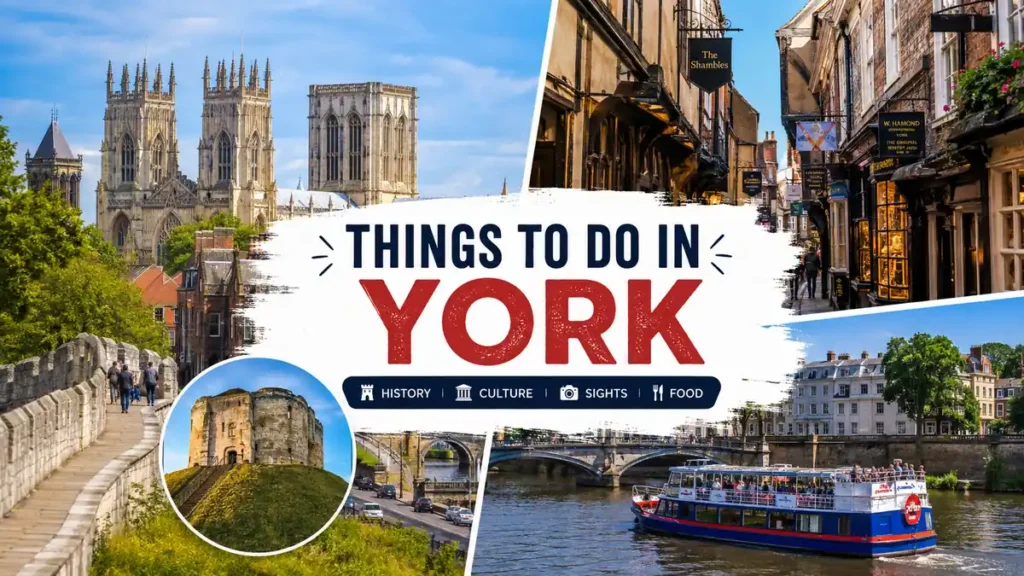
York is the sort of city where a short walk can take you from Roman remains to Viking archaeology, medieval streets, Georgian buildings and a Victorian railway collection. The challenge is not finding things to do in york; it is deciding which experiences deserve your limited time.
For a first visit, the best things to do in York are exploring York Minster, walking the medieval City Walls, wandering through the Shambles, discovering Viking York at JORVIK Viking Centre, visiting the National Railway Museum and seeing Clifford’s Tower. Add Museum Gardens, a ghost walk and York’s chocolate heritage if you have more time.
This guide focuses on York, England, and combines the essential landmarks with free attractions, family activities, historical experiences and quieter places that are easy to overlook.
Best things to do in york for first-time visitors
York has more than 2,000 years of history packed into a remarkably walkable centre. Roman Eboracum, Viking Jorvik and medieval York overlap so closely that you rarely need transport between the major sights. Visit York describes the city as having around 30 museums as well as a strong cultural scene.
If you only have a day, prioritise four experiences:
- York Minster
- York City Walls
- The Shambles and Shambles Market
- One major museum or historical attraction, such as JORVIK Viking Centre or the National Railway Museum
With two or three days, you can slow down and add Clifford’s Tower, Museum Gardens, a river trip, York’s Chocolate Story and some of the city’s smaller medieval buildings.
1. Explore York Minster


5
York Minster dominates York’s skyline and is the natural starting point for anyone interested in the city’s architecture and religious history.
Construction of the present Gothic cathedral took place over several centuries, and today visitors can see soaring vaulted interiors, medieval stonework and an exceptional collection of stained glass. The building also sits over layers of earlier history, including Roman remains.
York Minster remains an active place of worship rather than simply a visitor attraction, so sightseeing access can change around services and special events. The Minster recommends checking its current calendar before visiting.
One of the most memorable experiences is climbing the Central Tower. The climb involves narrow medieval stairs, so it will not suit everyone, but the reward is a panoramic view across York’s rooftops.
Best for: architecture, history, photography and first-time visitors.
Practical tip: Visit early in your day. You will appreciate the interior much more before you have spent several hours walking around the city.
2. Walk York’s medieval City Walls
If you are searching for free things to do in York, start with the walls.
York’s City Walls extend for about 3.4 kilometres and form the longest medieval town-wall circuit in England. Walking the full route generally takes around two hours if you allow time to stop at the gateways and viewpoints.
The route gives you a completely different perspective on the city. Instead of looking up at York Minster from narrow streets, you suddenly see its towers rising above the rooftops.
Look out for the historic gateways known locally as bars, including:
- Bootham Bar
- Monk Bar
- Walmgate Bar
- Micklegate Bar
The elevated walkway is free. Gates normally open from 8am and close around dusk, although severe weather, ice, conservation work or high winds can cause closures.
You do not have to complete the entire circuit. A shorter section can still provide excellent views.
Quick Takeaway: For one of the best combinations of history, scenery and value in York, walk at least part of the City Walls.
Historic things to do in york
York rewards people who like understanding why a place looks the way it does. Its streets preserve layers left by Romans, Anglo-Saxons, Vikings, Normans and later generations.
3. Wander through the Shambles


5
The Shambles is York’s most recognisable medieval street.
Its timber-framed buildings lean toward each other above a narrow lane, creating the enclosed appearance that makes the street so photogenic. Historically, this was associated with butchers and meat trading rather than the boutiques and speciality shops visitors see today.
The biggest mistake is visiting only in the busiest part of the afternoon.
Come early in the morning if photography matters to you. Then return later when the shops and nearby Shambles Market are fully active.
Explore the lanes branching away from the main street too. York’s network of narrow passages—sometimes called snickelways—is part of what makes walking around the historic centre so enjoyable.
4. Travel back to Viking York at JORVIK Viking Centre
Modern York sits directly above its Viking predecessor, and JORVIK Viking Centre makes that buried history tangible.
Between 1976 and 1981, archaeologists excavating Coppergate discovered houses, workshops and backyards belonging to Viking-age Jorvik. The attraction was subsequently created over the archaeological site.
The experience has three main parts. You learn about the Coppergate excavation, ride through a reconstruction of 10th-century York and then examine genuine archaeological finds.
The reconstructed settlement uses sights, sounds and even smells to evoke everyday Viking life. Displays include metalwork, carved bone, tools, skeletons and the famous Lloyds Bank Coprolite.
The scale of the original excavation is remarkable: work at Coppergate produced tens of thousands of archaeological contexts and huge quantities of pottery, animal bone and other objects.
Pre-booking is strongly recommended and the attraction states that booking ahead is essential.
Best for: families, archaeology enthusiasts and anyone wanting to understand why York’s Viking identity is more than a tourism theme.
5. Climb Clifford’s Tower
Clifford’s Tower is the most prominent surviving part of York Castle.
William the Conqueror established a castle here following the Norman conquest. The present stone tower largely dates from the 13th century and later served various administrative purposes, including as a treasury and prison.
The site also carries a much darker history.
In 1190, members of York’s Jewish community were besieged at the castle in one of the most notorious episodes of antisemitic violence in medieval England. That history deserves time and attention rather than treating the tower solely as a viewpoint.
Today, internal walkways and a roof deck allow visitors to explore the structure and look over the surrounding city.
6. Discover York Castle Museum
Close to Clifford’s Tower, York Castle Museum explores social history rather than focusing on one archaeological period.
Its collections have traditionally included recreated historical environments, prison history, everyday objects and exhibitions dealing with different periods of British life.
However, this is one attraction where checking current access before visiting is particularly important. Parts of the museum have experienced closures related to building and roof issues, while other areas—including historic prison cells and selected galleries—have remained accessible.
Do not build a tightly timed itinerary around a specific gallery without checking its current status.
Best museums and cultural attractions in York
York’s museums are useful when the weather turns wet, but they are not merely rainy-day substitutes. Several are among the city’s strongest attractions in their own right.
7. Visit the National Railway Museum


6
National Railway Museum is one of the best free things to do in York.
You do not need to be a railway enthusiast to enjoy it. The museum uses locomotives, carriages and engineering exhibits to tell a broader story about how rail transformed travel, technology and British society.
Highlights include Mallard, the steam locomotive that set the world steam speed record in 1938, alongside high-speed railway exhibits such as a Japanese Shinkansen.
Station Hall reopened following a major redevelopment and now presents historic railway vehicles, royal carriages and objects connected with the experience of railway stations and travel.
Families can also investigate engineering through Wonderlab: The Bramall Gallery, which features interactive challenges and demonstrations.
General museum entry is free, although certain experiences may carry separate charges.
Allow: roughly two to three hours if trains, engineering or industrial history interest you.
8. Explore the Yorkshire Museum
Located within Museum Gardens, the Yorkshire Museum provides useful context for the archaeology you encounter elsewhere in York.
The institution opened in 1830 to house collections belonging to the Yorkshire Philosophical Society. Its collections cover archaeology, geology, palaeontology and natural history.
It makes particular sense for travellers fascinated by Roman and medieval York because objects provide evidence for periods that can otherwise feel abstract when you are simply walking past ruins.
9. Look beyond York’s blockbuster museums
One of the weaknesses of rushing through York is that visitors often move from one famous attraction to another without seeing its smaller historic buildings.
For a deeper trip, investigate places such as Barley Hall, a restored medieval townhouse, and the city’s other specialist collections. York Archaeology operates Barley Hall alongside JORVIK and DIG, providing another way to explore the city’s past.
These smaller attractions can feel more intimate than the major museums and are particularly worthwhile on a second visit.
Free things to do in York
York can become expensive if you buy admission to several major attractions in one day. Fortunately, some of the most atmospheric parts of the city cost nothing.
10. Relax in York Museum Gardens
York Museum Gardens covers more than ten acres close to the railway station and historic centre.
The gardens contain mature planting, wildlife habitats and archaeological remains, making them much more than an ordinary city park. Entry to the gardens is free.
They are particularly useful when you want a break between museums.
Pick up something to eat, find a bench and spend half an hour away from the busiest shopping streets.
11. See the ruins of St Mary’s Abbey
The dramatic ruins of St Mary’s Abbey stand inside Museum Gardens.
The abbey was founded in 1088 and developed into one of medieval England’s wealthiest and most powerful Benedictine monasteries. Its fortunes ended during Henry VIII’s Dissolution of the Monasteries, and the buildings gradually became ruins.
Today you can walk beside surviving sections of the church and imagine the enormous religious complex that once competed visually and politically with York Minster.
Because the ruins sit within the free gardens, this is one of York’s easiest historical stops.
12. Hunt for Roman remains
York began as the Roman fortress of Eboracum, established in AD 71.
Roman York is less visually obvious than medieval York, but traces survive throughout the centre. The Multangular Tower in Museum Gardens is an easy place to start, while York Minster’s underground story also connects visitors with earlier Roman layers.
The fun comes from recognising that the modern street plan is sitting on almost two millennia of continuous urban history.
13. Explore York’s snickelways
Some of the best York sightseeing happens when you stop following the obvious route.
Narrow alleys, passages and lanes thread between the city’s larger streets. Walking them reveals hidden courtyards, old brickwork, unexpected views of church towers and tiny independent businesses.
You do not need a formal itinerary. Start around the Shambles, Stonegate and Petergate and follow whichever passage looks interesting.
It is a simple way to experience the medieval character that survives beyond York’s headline landmarks.
Fun things to do in York for families
York works unusually well for families because so many attractions turn history into an experience rather than simply presenting objects behind glass.
14. Discover York’s chocolate history
York’s Chocolate Story explains why chocolate is such an important part of the city’s industrial identity.
York was home to famous confectionery families and companies including Rowntree’s and Terry’s. The guided experience follows chocolate from its ancient origins through production and York’s confectionery history, combining storytelling with demonstrations and tastings.
Visitors can learn about products associated with York, including Terry’s Chocolate Orange and KitKat, while seeing chocolate-making techniques.
There is a useful 2026 planning detail: York’s Chocolate Story says refurbishment work is scheduled from 21 September to 21 October 2026. Guided tours are expected to continue with temporary changes, but anyone visiting during that period should check arrangements beforehand.
15. Try DIG with younger children
For children who prefer doing something rather than reading display panels, DIG takes an archaeological approach to York’s history.
The concept is simple: children discover how archaeology helps reconstruct the past.
It pairs particularly well with JORVIK because children first encounter reconstructed Viking life and then learn more about how archaeologists actually uncover evidence.
16. Spend time in Wonderlab
Families visiting the National Railway Museum should consider Wonderlab: The Bramall Gallery.
Rather than focusing exclusively on historic trains, the gallery explores engineering principles through hands-on activities. Visitors can experiment with forces, construction, air movement and mechanical ideas.
It is especially useful if your children have reached their limit for traditional historical sightseeing.
Quick Takeaway: For a family day, combine one immersive historical attraction such as JORVIK with a more active experience such as Wonderlab or DIG.
Unique things to do in York
York’s popularity means its central streets can become crowded. Fortunately, some of the city’s most memorable experiences happen after the daytime crowds begin to disappear.
17. Join a York ghost walk
Ghost walks have become part of York’s visitor culture, and the historic centre provides a convincing stage for them.
Even if you are sceptical about ghosts, a good walking tour can be worthwhile because the storytelling introduces old streets, local legends and darker episodes of the city’s history.
Tripadvisor currently lists ghost tours and historical walking tours among York’s prominent visitor experiences.
Choose the style carefully. Some tours emphasise theatrical entertainment and jump scares, while others lean toward folklore and documented history.
For adults or families with older children, an evening walk is an excellent way to experience the city after many museums have closed.
18. See York from the River Ouse
The River Ouse gives York another perspective.
A sightseeing cruise lets you see bridges, riverfront buildings and sections of the city that are easy to miss when walking through the medieval centre. Visit York includes City Cruises among experiences covered by its visitor-pass offering.
A river trip also gives tired feet a break, which matters more than you might expect after a day on cobbled streets and city walls.
Weather affects the experience, so save this for a clear afternoon when possible.
19. Explore York after dark
Do not assume York shuts down when the attractions close.
The city centre becomes particularly atmospheric in the evening. York Minster is illuminated, narrow streets become quieter and centuries-old buildings feel very different without daytime crowds.
Stonegate, Petergate and the lanes surrounding the Shambles are worth revisiting after dinner.
Traditional pubs are another part of York’s identity. Rather than trying to visit as many as possible, choose one historic pub and slow down.
20. Browse independent shops and Shambles Market
York’s centre has retained a strong independent-shopping character.
Shambles Market operates seven days a week and brings together local traders close to the city’s most famous medieval street.
Beyond the market, explore Stonegate, Fossgate and surrounding streets for independent bookshops, food shops, gifts and speciality retailers.
Shopping here works best when treated as part of exploring the city rather than as a separate activity.
What to do in York when it rains
Rain does not need to ruin a York itinerary.
The compact centre means you can move quickly between indoor attractions. A wet-weather day could include:
- York Minster
- JORVIK Viking Centre
- National Railway Museum
- Yorkshire Museum
- York’s Chocolate Story
- York Castle Museum, subject to current gallery access
Keep the City Walls and Museum Gardens flexible. If the weather clears, move them back into your schedule.
Remember that City Wall access can be restricted when conditions become icy, slippery or otherwise unsafe.
York’s narrow historic streets also mean an umbrella can become awkward in busy periods. A waterproof jacket is often more practical.
How to spend one day in York
If you have only one day, resist the temptation to squeeze in every museum.
A realistic itinerary works better.
Morning: Minster, walls and medieval streets
Start at York Minster soon after sightseeing admission begins.
After exploring the cathedral, walk a nearby section of the City Walls. Continue toward Stonegate and the Shambles before the afternoon crowds become heavier.
Lunch: Shambles Market or the historic centre
Stop around Shambles Market, Fossgate or another central area.
York’s compact layout means there is little reason to travel far for lunch when you only have one day.
Afternoon: Choose one major attraction
Pick according to your interests:
| If you like… | Choose… |
|---|---|
| Viking history | JORVIK Viking Centre |
| Trains and engineering | National Railway Museum |
| Social history | York Castle Museum |
| Archaeology | Yorkshire Museum |
| Medieval castles | Clifford’s Tower |
| Food history | York’s Chocolate Story |
Do not try to do all six.
Evening: Ghost walk or riverside stroll
Finish with an evening ghost walk, traditional pub or relaxed walk around the illuminated historic centre.
That combination provides a much richer impression of York than spending the entire day racing between ticketed attractions.
How to spend two days in York
Two days is a better amount of time for a first visit.
Use Day One for York Minster, the City Walls, the Shambles, JORVIK Viking Centre and an evening walk.
On Day Two, visit the National Railway Museum, Museum Gardens and St Mary’s Abbey before heading toward Clifford’s Tower. Add York Castle Museum, York’s Chocolate Story or a river cruise according to your interests.
The advantage is not merely seeing more attractions. You also gain time to explore York’s lanes, cafés, markets and historic streets without constantly checking the clock.
Are there enough things to do in York for three days?
Yes, especially if you enjoy history.
On a third day, concentrate on attractions you skipped, smaller historical sites and experiences beyond the obvious landmarks.
York also makes a convenient base for exploring wider Yorkshire. The North York Moors National Park, Yorkshire Dales and other countryside destinations are within reach, while Visit York specifically promotes the city as a base for exploring Yorkshire’s landscapes and coastline.
Another notable excursion is Castle Howard, a grand country house outside York that has appeared in productions including Bridgerton and Brideshead Revisited.
If your priority is York itself, however, spend at least your first two days within the city.
Best things to do in York by interest
Different visitors will come away with completely different favourite experiences.
| Traveller | Best choices |
|---|---|
| First-time visitor | York Minster, City Walls, Shambles |
| History enthusiast | JORVIK, Clifford’s Tower, Yorkshire Museum |
| Family with children | JORVIK, DIG, Wonderlab, Chocolate Story |
| Budget traveller | City Walls, Museum Gardens, St Mary’s Abbey, National Railway Museum |
| Architecture lover | York Minster, medieval streets, historic bars |
| Railway enthusiast | National Railway Museum |
| Couple | River Ouse, evening streets, ghost walk |
| Photographer | Shambles early morning, City Walls, Minster |
| Rainy-day visitor | Museums, Minster, JORVIK, Chocolate Story |
Practical tips for visiting York
York looks straightforward on a map, but a few decisions can dramatically improve your visit.
Walk rather than drive around the centre
Most major attractions are within walking distance of each other. The historic centre is best understood on foot, and driving between individual sights is rarely useful.
Comfortable shoes matter. You will encounter cobbles, stairs and uneven historic surfaces.
Book the most popular timed attractions first
JORVIK explicitly advises pre-booking.
Once you have fixed your timed attraction, build the flexible parts of your itinerary—walls, streets, gardens and markets—around it.
Check live opening information
Historic attractions sometimes close for worship, weather, conservation or maintenance.
York Minster can alter sightseeing access around services, while the City Walls can close in dangerous weather conditions.
Always check official information shortly before visiting rather than relying on an old itinerary.
Do not underestimate walking time
York is compact, but that encourages people to pack too much into one day.
The full City Walls circuit alone can take around two hours.
A museum that appears to require 60 minutes can easily absorb two or three hours once you start reading displays.
Consider whether an attraction pass makes sense
The Visit York Pass covers dozens of participating attractions, including several major sights.
It is not automatically cheaper for everyone. Work out which paid attractions you genuinely plan to enter, compare their individual admission prices with the current pass price and then decide.
Buying a pass and rushing through attractions purely to “get your money’s worth” usually produces a worse trip.
When is the best time to visit York?
York is a year-round destination, but each season changes the experience.
Spring brings longer days and flowers along the City Walls and Museum Gardens. Summer provides the longest sightseeing hours but also tends to produce busier streets.
Autumn works particularly well for atmospheric walks and historical attractions.
Winter gives York a completely different character, particularly around the festive period and Christmas markets. Time Out highlights spring and summer for warmer weather and December for York’s Christmas atmosphere.
Weekends and school holidays can be crowded around the Shambles and other major attractions.
If you have flexibility, staying overnight gives you an underrated advantage: you can explore early in the morning and again in the evening after day visitors have left.
Which York attractions should you prioritise?
For a first visit, York Minster deserves the highest priority because it combines architecture, history and the city’s strongest visual landmark.
The City Walls should come next because they are free and help you understand York’s geography.
Then choose according to interest.
Pick JORVIK if Viking history fascinates you. Choose the National Railway Museum if you enjoy engineering, transport or family-friendly museums. Visit Clifford’s Tower for Norman and medieval history, or York’s Chocolate Story for something lighter and more interactive.
And leave unplanned time.
Some of York’s best moments happen between attractions: finding an unexpected medieval passage, seeing the Minster appear at the end of a narrow lane, sitting beside St Mary’s Abbey or walking through the Shambles after the crowds disappear.
Final thoughts on things to do in york
The best things to do in york reveal the city one historical layer at a time. Start with York Minster and the City Walls, wander the Shambles, then choose between Viking archaeology at JORVIK, railway history at the National Railway Museum, Clifford’s Tower and York’s excellent museums.
But do not turn York into a checklist.
Walk the snickelways, spend time in Museum Gardens, look at the ruins of St Mary’s Abbey, explore the market and return to the medieval centre after dark. With one day you can see the essentials; with two or three, York begins to feel less like a collection of attractions and more like the remarkably well-preserved historic city it is.