Packing a suitcase is easy until you reach the bathroom cabinet. Shampoo, sunscreen, toothpaste, cleanser, moisturizer, deodorant, shaving products, and contact lens solution can quickly turn a light carry-on into an overstuffed bag.
That is where travel size toiletries help. They let you maintain your normal hygiene and personal-care routine while using less luggage space and, when flying, make it easier to comply with airport security rules.
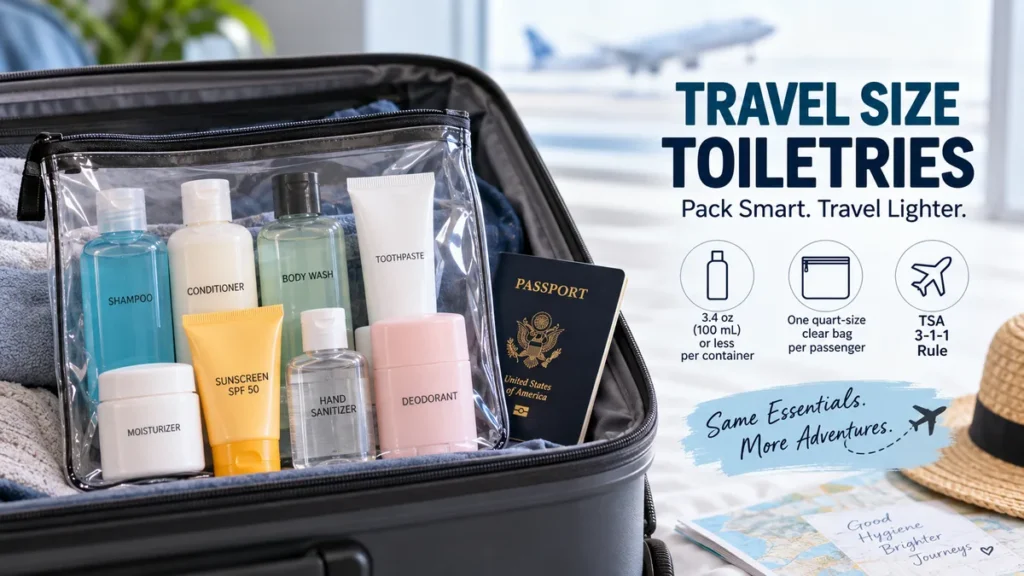
Travel size toiletries are compact versions of everyday hygiene, skincare, haircare, and grooming products. For U.S. carry-on travel, liquids, gels, aerosols, creams, and pastes generally need to be in containers of 3.4 ounces (100 mL) or less and fit within one quart-size clear bag per passenger under the TSA 3-1-1 rule.
The trick, however, is not simply buying miniature versions of everything you own. Good toiletry packing means understanding what counts as a liquid, choosing quantities based on trip length, replacing liquids with solids where practical, and preventing the dreaded shampoo explosion inside your suitcase.
What Are Travel Size Toiletries?
Travel size toiletries are smaller versions or portions of personal-care products designed to be easier to transport.
Common examples include:
- Shampoo and conditioner
- Body wash
- Toothpaste
- Mouthwash
- Deodorant
- Facial cleanser
- Moisturizer
- Sunscreen
- Hand sanitizer
- Shaving cream
- Hair styling products
- Contact lens solution
- Makeup and makeup remover
- Perfume or cologne
Travel-size does not automatically mean “approved for every airplane cabin.” That distinction matters.
For U.S. airport security, the relevant measurement for liquids in carry-on luggage is normally 3.4 fluid ounces (100 mL) or less per container. TSA’s rule applies to liquids, gels, aerosols, creams, and pastes.
So a bottle marketed as a “mini” could still be too large if its container capacity exceeds the applicable security limit.
Travel Size vs. TSA Size
These terms are frequently treated as interchangeable, but they describe different things.
| Term | What It Means |
|---|---|
| Travel size | A smaller version of a regular product |
| TSA-compliant liquid size | Generally 3.4 oz/100 mL or less per container for U.S. carry-ons |
| Sample size | A very small amount intended primarily for sampling |
| Refillable container | An empty travel bottle or jar filled from a larger product |
| Solid toiletry | A non-liquid alternative such as bar soap or some deodorant sticks |
This distinction becomes especially useful when shopping or decanting products before a flight.
Travel Size Toiletries and the TSA 3-1-1 Rule
For travelers departing through U.S. security checkpoints, TSA uses its well-known 3-1-1 liquids rule.
The basic formula is:
3 — 3.4 ounces (100 mL) or less per container
1 — one quart-size clear plastic zip-top bag
1 — one liquids bag per passenger
TSA states that liquids, gels, aerosols, creams, and pastes packed in carry-on luggage must follow this system.
This means products such as liquid shampoo, conditioner, lotion, sunscreen, toothpaste, liquid foundation, shaving gel, and hand sanitizer normally count toward your liquids allowance.
The Container Size Matters
One of the easiest airport-security mistakes is putting a small quantity of product inside a large bottle.
Imagine you have only 50 mL of shampoo remaining inside a 200 mL bottle.
The product amount may be below 100 mL, but the container itself has a capacity greater than 100 mL. At airports operating the standard 100 mL restriction, that can make it unsuitable for hand luggage.
UK guidance explicitly states that, at most airports, containers larger than 100 mL cannot pass through security even when they are only partially full.
Decanting the shampoo into a properly sized container solves the problem.
What Counts as a Liquid?
The definition is broader than plain liquids.
Depending on the airport’s rules, it can include:
| Product | Usually Treated as Liquid/Gel/Paste? |
|---|---|
| Shampoo | Yes |
| Liquid conditioner | Yes |
| Toothpaste | Yes |
| Lotion | Yes |
| Facial cleanser gel | Yes |
| Liquid sunscreen | Yes |
| Perfume | Yes |
| Shaving foam | Yes |
| Hair gel | Yes |
| Spray deodorant | Yes |
| Contact lens solution | Yes |
| Mascara | Yes |
| Lip gloss | Yes |
| Bar soap | Generally no |
| Solid deodorant | Generally no |
UK security guidance specifically includes creams, lotions, oils, perfumes, mascara, lip gloss, sprays, toothpaste, gels, and contact lens solution within its liquids restrictions.
This broader definition explains why a liquids bag fills much faster than many first-time carry-on travelers expect.
Travel Size Toiletries Rules Outside the United States
The 100 mL principle is common internationally, but travelers should not assume airport rules are identical everywhere.
Within the European Union, liquids, aerosols, and gels are generally permitted through security in individual containers with a capacity no greater than 100 mL, packed in one transparent, resealable bag with a maximum capacity of one liter.
The UK is more complicated because security arrangements can vary by airport. Current government guidance says that at most UK airports, liquid containers cannot exceed 100 mL, while some airports may permit containers holding up to two liters. Travelers are therefore advised to check the rules at their departure and connecting airports.
Quick Takeaway
Never rely only on what happened during your previous flight.
Before an international journey, check the current requirements for your:
- Departure airport
- Connecting airport or airports
- Return airport
New security scanners do not necessarily mean identical rules at every checkpoint.
Essential Travel Size Toiletries Packing List
There is no universal toiletry checklist because routines differ. Someone who shaves daily has different needs from someone who wears contact lenses or follows a multi-step skincare routine.
A practical approach is to begin with daily hygiene and add only products you genuinely expect to use.
Oral Care
The basics are:
- Toothbrush
- Travel toothpaste
- Dental floss or floss picks
- Small mouthwash, if needed
Toothpaste is particularly easy to overlook when preparing your liquids bag because it is a paste rather than an obvious liquid.
Under both U.S. and European aviation security rules, pastes fall within liquid-related restrictions.
Hair Care
Depending on your routine, consider:
- Shampoo
- Conditioner
- Dry shampoo
- Comb or compact hairbrush
- Hair ties or clips
- Styling cream, gel, or mousse
Do not automatically pack 100 mL of shampoo simply because that is the maximum commonly allowed container size.
If you wash your hair twice during a four-day trip, you probably need far less.
Testing your consumption at home before traveling is one of the simplest ways to discover how much product you actually use. Travel packing guides increasingly recommend downsizing and decanting based on genuine usage rather than automatically packing the largest permissible travel container.
Body and Hygiene Products
Your core kit might include:
- Deodorant
- Soap or body wash
- Hand sanitizer
- Razor
- Shaving product
- Body lotion
- Tissues
- Wet wipes
- Menstrual products, if required
Hotel toiletries can reduce what you need to bring, but only rely on them when you know what your accommodation provides.
Skincare
A simple travel skincare kit might contain:
- Facial cleanser
- Moisturizer
- Sunscreen
- Lip balm
- Treatment or serum, if essential
Travel is rarely the ideal time to transport every product from a ten-step skincare routine.
Think in terms of maintaining the routine rather than reproducing the entire bathroom shelf.
For many people, cleanser, moisturizer, and sunscreen cover the essentials for a short trip.
Grooming
Depending on your normal routine:
- Razor
- Shaving cream or gel
- Comb
- Tweezers
- Nail clippers
- Nail file
- Cotton swabs or pads
Rules for sharp items deserve separate attention. For example, UK guidance permits fixed-cartridge disposable razors, nail clippers, and tweezers in hand luggage, while restrictions apply to certain blades and other sharp objects.
Always check the relevant airport security authority when you are unsure about a specific grooming tool.
Contact Lens and Eye Care
Travelers who wear contacts may need:
- Contact lenses
- Lens case
- Contact lens solution
- Eye drops
- Backup glasses
- Cleaning cloth
Contact lens solution counts as a liquid under standard airport security rules. UK guidance, for example, lists it explicitly and permits containers up to 100 mL under the standard hand-luggage restriction.
How Much Toiletry Product Do You Actually Need?
This is where efficient packing differs from simply buying mini bottles.
A 100 mL bottle is the maximum commonly permitted size for a carry-on liquid container under many security systems. It is not a recommended quantity for every product.
Think about usage frequency.
| Trip Length | Practical Packing Approach |
|---|---|
| 1–2 nights | Samples, tiny containers, solids |
| 3–4 nights | Small refillable bottles |
| 5–7 nights | Moderate travel containers |
| 1–2 weeks | Larger travel sizes for frequently used products |
| Extended travel | Solids, refills, or purchasing replacements locally |
Products also disappear at very different rates.
You might use a substantial amount of sunscreen every day but only a tiny amount of facial serum. Putting both into identical 100 mL bottles wastes space.
Try the Home Test
Several days before traveling, estimate how much of each product you use.
Better still, transfer a measured amount into your travel container and use only that bottle at home for the same number of days as your planned trip.
You will quickly learn whether you are packing too much or too little.
This is far more reliable than guessing.
Refillable Bottles vs. Pre-Packaged Travel Size Toiletries
You generally have two options: buy miniature versions or transfer products from full-size containers.
Neither method is always superior.
Pre-Packaged Minis
These are convenient because the product arrives in compact packaging with its original label.
They work particularly well when:
- You travel occasionally
- Your preferred brand offers minis
- You want clearly labeled products
- You do not want to clean reusable bottles afterward
The downside is waste.
Repeatedly buying tiny versions can create more packaging, and the cost per milliliter may be substantially higher than buying a regular-size product.
Refillable Travel Containers
Refillable bottles and jars let you decant products you already own.
Common capacities include:
- 15 mL
- 30 mL
- 50 mL
- 75 mL
- 100 mL
Smaller sizes are often better for concentrated products such as serum, face cream, hair oil, and styling products.
Refillables are especially useful when your preferred shampoo, cleanser, or moisturizer is not sold in miniature packaging.
Label Everything
After filling several identical containers, clear shampoo and facial cleanser can become surprisingly difficult to distinguish.
Label bottles before packing.
Include at least the product name. If multiple travelers share one toiletry bag, adding initials can also prevent confusion.
Solid Toiletries Can Save Valuable Liquid-Bag Space
One of the smartest ways to simplify carry-on packing is to replace suitable liquid products with solid versions.
Possible swaps include:
| Instead of | Consider |
|---|---|
| Liquid shampoo | Shampoo bar |
| Liquid conditioner | Conditioner bar |
| Body wash | Bar soap |
| Liquid deodorant | Solid deodorant |
| Liquid cleanser | Solid cleansing bar |
| Liquid perfume | Solid fragrance |
| Shaving cream | Shaving bar |
Solid toiletries are particularly helpful when your clear liquids bag is already crowded with products that have no practical solid substitute.
Travel guides focused on minimalist packing commonly use shampoo bars, conditioner bars, soap, and other solids specifically to reduce reliance on liquid containers.
There is another benefit: a shampoo bar cannot leak across your clothes.
Solids Still Need Sensible Storage
A wet soap or shampoo bar should not simply be dropped into a sealed toiletry bag.
Allow it to dry when possible and use a draining soap case, breathable container, or suitable travel pouch. Otherwise, the bar can become soft and messy.
How to Pack Travel Size Toiletries Without Leaks
Airport compliance solves only half the problem.
The other half is ensuring your suitcase does not smell like conditioner when you arrive.
Air pressure changes, loose caps, weak packaging, and rough baggage handling can all contribute to leaks.
1. Choose Reliable Containers
Inspect refillable bottles before traveling.
Look for:
- Secure screw or locking caps
- Tight seals
- Durable construction
- Wide openings when easier refilling matters
- Bottles suited to the consistency of the product
Thin lotions work well in squeeze bottles. Thick creams may be easier to use from small jars.
2. Do Not Fill Containers Completely
Leaving a little room inside refillable bottles can reduce mess and makes flexible containers easier to use.
There is rarely a reason to fill every container to its maximum capacity anyway.
3. Check Every Cap
Do a final cap check immediately before placing toiletries in your luggage.
Pay particular attention to flip-top shampoo bottles and pumps that can accidentally open.
4. Separate High-Risk Liquids
Anything oily, strongly colored, or difficult to wash out deserves extra protection.
Hair oils, liquid makeup, and similar products can create more damage than ordinary shampoo.
5. Keep Liquids Away From Electronics
Even when containers appear secure, avoid placing them directly against:
- Laptops
- Cameras
- Chargers
- Passports
- Paper documents
A secondary waterproof pouch adds useful protection.
How to Organize a Travel Toiletry Bag
Organization matters most when you are moving frequently.
Instead of throwing everything into one large compartment, divide your kit by purpose.
A practical system might look like this:
Clear liquids bag: shampoo, toothpaste, cleanser, sunscreen, moisturizer and other regulated liquids.
Dry toiletries pouch: toothbrush, floss, solid deodorant, comb, bar soap and similar items.
Grooming section: razor, nail clippers and tweezers.
Medication section: medicines and relevant documentation.
This system makes airport screening easier while keeping bathroom items accessible after arrival.
Hanging Toiletry Bags
A hanging organizer can be useful in hotel bathrooms with limited counter space.
It also keeps bottles upright and allows you to see several products at once instead of digging through one deep pouch.
For minimalist carry-on travel, however, a large hanging bag can become unnecessary weight. A compact pouch may be enough.
Choose the organizer based on how you travel rather than how many compartments it has.
Travel Size Toiletries for Carry-On vs. Checked Luggage
Your packing strategy changes significantly depending on where the toiletries travel.
Carry-On Toiletries
Prioritize:
- Small quantities
- Security-compliant containers
- Solid alternatives
- Essential products
- Leak-resistant packaging
- Easy access at security
Under the U.S. TSA 3-1-1 system, regulated liquids need to fit inside the passenger’s quart-size liquids bag.
Checked-Bag Toiletries
Checked luggage generally provides greater flexibility for normal toiletries, but that does not mean there are no restrictions.
For example, TSA notes that FAA rules limit the total quantity of certain restricted medicinal and toiletry articles, including aerosols, in checked baggage. Individual containers and total quantities are subject to limits.
Even when a full-size product is permitted, consider whether you really need it.
Carrying a 500 mL shampoo bottle for a three-night trip adds unnecessary weight and creates a larger potential leak.
What About Medication?
Medication should not simply be treated as ordinary travel toiletries.
Rules can include exemptions for medically necessary liquids.
In the United States, TSA permits medically necessary liquids, medications, and creams above the normal 3.4-ounce/100 mL limit in carry-on luggage, although they should be presented for separate screening.
The EU similarly provides exemptions for liquids needed during travel for medical purposes and certain special dietary requirements.
Requirements for documentation vary.
For example, UK guidance states that travelers carrying essential liquid medicines in containers larger than 100 mL need proof that the medication is prescribed to them, such as a prescription copy or doctor’s letter.
For international travel, also investigate whether the medication itself is restricted at your destination. A medicine legally prescribed in one country is not automatically unrestricted everywhere else.
Common Travel Size Toiletries Packing Mistakes
A good packing system is often more about what you leave behind than what you bring.
Packing the Maximum Allowed Amount of Everything
A 100 mL allowance does not mean every liquid needs 100 mL.
Packing ten large travel bottles when you need only a fraction of each defeats the purpose of traveling light.
Confusing Product Amount With Container Capacity
Putting 30 mL of lotion inside a 200 mL bottle does not turn it into a 30 mL container.
At airports enforcing the standard rule, the container’s capacity matters.
Forgetting That Pastes and Gels Count
Toothpaste, hair gel, shaving foam, and similar products may belong with your liquids.
The European Commission specifically defines liquids broadly to include gels, aerosols, pastes, lotions, and liquid-solid mixtures.
Packing “Just in Case” Products
Most toiletries are easily replaceable.
Unless a product is medically necessary, unusually expensive, prescription-only, or difficult to find at your destination, ask whether you genuinely need to carry an emergency backup.
Using Unlabeled Bottles
Mystery liquids become annoying surprisingly quickly.
Label refillable containers before departure.
Ignoring Your Return Airport
A departure airport’s procedures do not automatically apply to the airport you will use on the way home.
This becomes especially relevant when traveling internationally or connecting through multiple countries.
How to Build a Minimalist Travel Toiletries Kit
If you want to reduce your toiletry bag substantially, start with your actual routine.
Step 1: Write Down Your Routine
Think through one normal day from waking up until bedtime.
What do you genuinely use?
That creates your initial list.
Step 2: Remove Accommodation-Provided Items
If your hotel reliably provides shampoo, conditioner, body wash, or soap and you are comfortable using them, remove those products.
Do not make assumptions when a particular product is essential.
Step 3: Replace Liquids With Solids
Look for practical solid alternatives.
Even replacing two or three products can free substantial room in your liquids bag.
Step 4: Calculate Quantity by Trip Length
Do not default to the biggest travel bottle.
A 30 mL container may be more than enough for something you use sparingly.
Step 5: Remove Duplicates
You probably do not need three moisturizers, multiple fragrances, or several styling products on a short trip.
Choose the product that covers the most likely situation.
Step 6: Test the Kit Before Departure
Use only your packed toiletries for a day or two at home.
Anything essential you forgot becomes obvious while you still have time to fix it.
A Practical Travel Size Toiletries Checklist
For a typical short trip, a streamlined kit could look like this:
Daily Essentials
- Toothbrush
- Toothpaste
- Floss
- Deodorant
- Shampoo
- Conditioner, if needed
- Soap or body wash
- Facial cleanser
- Moisturizer
- Sunscreen
- Comb or hairbrush
Personal Additions
Add only where relevant:
- Razor
- Shaving product
- Makeup
- Makeup remover
- Hair styling product
- Contact lenses
- Contact lens solution
- Menstrual products
- Lip balm
- Hand sanitizer
- Prescription medication
Useful Packing Equipment
- Clear resealable liquids bag
- Refillable bottles
- Small jars
- Waterproof toiletry pouch
- Labels
- Soap or shampoo-bar container
This list is deliberately adaptable. Someone taking a two-day business trip should not pack the same toiletry kit as someone spending three weeks moving between hostels.
Are Travel Size Toiletries Worth It?
They are useful, but miniature products are not automatically the smartest choice.
Pre-packaged minis offer convenience and recognizable labels. Refillable containers allow you to use products you already own and pack precisely the quantity required. Solid toiletries can reduce liquids altogether.
For frequent travelers, a combination usually works best.
Keep reusable containers for products you regularly use, retain genuinely useful miniature packaging, and use solid alternatives where they fit your routine.
The result is a toiletry kit built around your consumption, rather than around whatever manufacturers happen to sell in miniature bottles.
Final Thoughts on Travel Size Toiletries
The best travel size toiletries kit is not the one containing the most miniature products. It is the smallest collection that reliably covers your hygiene, grooming, skincare, and personal needs for the duration of the trip.
For carry-on travel, start by checking the current security rules at every relevant airport. U.S. TSA guidance continues to use the 3-1-1 framework for ordinary liquids, gels, aerosols, creams, and pastes, while EU rules generally use the 100 mL-per-container and one-liter-bag system. UK requirements can vary by airport, making a pre-trip check particularly worthwhile.
Then simplify: measure what you actually use, decant intelligently, replace suitable liquids with solids, label reusable containers, and protect anything that could leak.
A few minutes spent organizing travel size toiletries before departure can mean a lighter bag, faster security preparation, fewer spills, and one less thing to worry about once the trip begins.