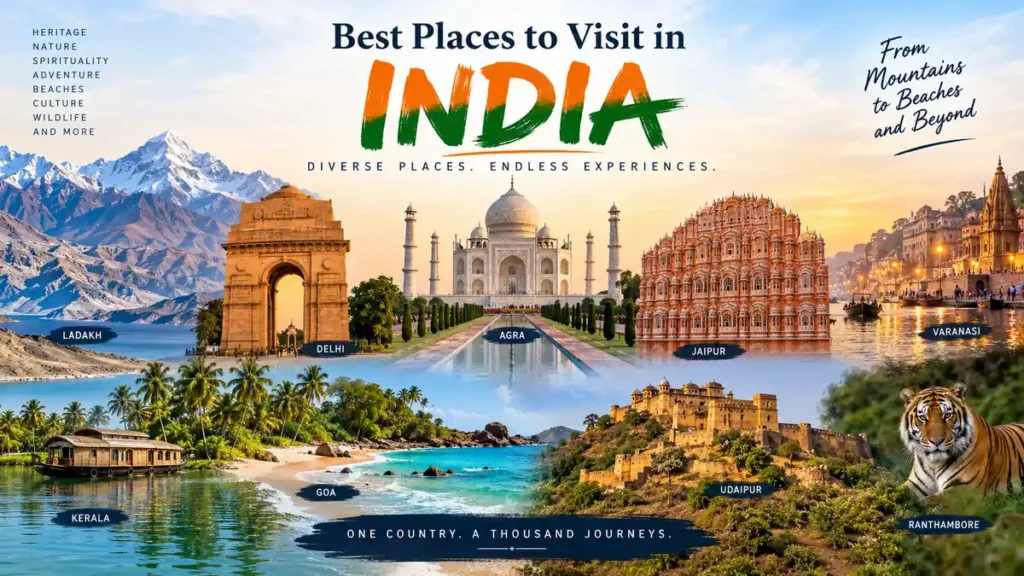
India can feel like several countries packed into one. Snow-covered Himalayan valleys, tropical beaches, royal forts, ancient temples, wildlife reserves, busy megacities, deserts, tea estates, and quiet backwaters can all be part of the same journey.
For travelers researching places to visit in india, the real challenge is not finding somewhere interesting. It is deciding which experiences deserve limited vacation time.
Quick answer: The best places to visit in India include Delhi, Agra, Jaipur, Udaipur, Varanasi, Goa, Kerala, Mumbai, Ladakh, Kashmir, Rishikesh, Amritsar, Hampi, Darjeeling, Meghalaya, the Andaman Islands, Jaisalmer, Ranthambore, Khajuraho, and the Rann of Kutch. The right choices depend mainly on season, interests, and trip length.
Best places to visit in india at a glance
India’s official tourism portal groups experiences around heritage, spirituality, wildlife, adventure, gastronomy, wellness, arts, rural tourism, and nature. That variety is a useful way to plan a trip rather than simply trying to collect famous cities.
| Destination | Best for | Good time to visit | Suggested stay |
|---|---|---|---|
| Delhi | History, food, architecture | October–March | 2–3 days |
| Agra | Taj Mahal, Mughal heritage | October–March | 1–2 days |
| Jaipur | Forts, palaces, culture | October–March | 2–3 days |
| Udaipur | Lakes, palaces, couples | October–March | 2–3 days |
| Varanasi | Spirituality, culture | October–March | 2–3 days |
| Goa | Beaches, food, nightlife | November–February | 3–5 days |
| Kerala | Backwaters, nature, wellness | September–March | 5–8 days |
| Mumbai | Urban culture, food | November–February | 2–3 days |
| Ladakh | Mountains, road trips | May–September | 5–8 days |
| Kashmir | Lakes, valleys, mountains | April–October | 5–7 days |
| Rishikesh | Yoga, rafting, Himalayas | February–May, September–November | 2–4 days |
| Amritsar | Sikh heritage, food | October–March | 2 days |
| Hampi | Ruins, history, landscapes | October–February | 2–3 days |
| Darjeeling | Tea, Himalayan views | March–May, October–December | 3 days |
| Meghalaya | Waterfalls, caves, nature | October–April | 4–6 days |
| Andaman Islands | Beaches, diving | October–May | 4–6 days |
| Jaisalmer | Thar Desert, fort | October–March | 2–3 days |
| Ranthambore | Tigers, wildlife | October–June | 2–3 days |
| Khajuraho | Temple architecture | October–March | 1–2 days |
| Rann of Kutch | Salt desert, landscapes | November–February | 2–3 days |
These seasons are broad planning windows rather than guarantees. India’s weather varies considerably by region, elevation, monsoon timing, and year.
1. Delhi: the ideal introduction to India’s history
For many international visitors, Delhi makes the most practical starting point.
The city layers different periods of Indian history on top of one another. Old Delhi preserves the atmosphere of the Mughal era, while New Delhi has broad avenues and monumental government architecture.
Major historical sites include the Red Fort, Jama Masjid, Humayun’s Tomb and Qutub Minar. Humayun’s Tomb and the Qutb Minar complex are UNESCO World Heritage sites, and both help explain architectural traditions that later influenced other major monuments in northern India.
Chandni Chowk provides an entirely different experience. Its narrow lanes, shops, religious buildings and food stalls show the living side of Old Delhi rather than presenting history as a museum exhibit.
What actually works in Delhi
Do not attempt to see the entire city in a single day.
A better approach is to devote one day to Old Delhi and another to New Delhi and South Delhi. The distances and traffic can make an ambitious itinerary exhausting.
Delhi is also one point of the famous Golden Triangle, the travel circuit connecting Delhi, Agra and Jaipur.
Quick Takeaway: Choose Delhi for Mughal history, monuments, street food and a convenient introduction to northern India.
2. Agra: home of the Taj Mahal
Few landmarks are as closely associated with a country as the Taj Mahal is with India.
Built in Agra during the Mughal period, the white-marble mausoleum attracts visitors for its architecture, symmetry, craftsmanship and history. It remains one of India’s most recognizable UNESCO World Heritage sites.
Agra should not be treated only as a quick photo stop, however.
Agra Fort adds another layer to the city’s Mughal story, while other historical structures around the region make an overnight stay worthwhile.
For many first-time visitors, Agra fits naturally between Delhi and Jaipur as part of the Golden Triangle.
How long do you need in Agra?
One full day can cover the principal monuments, but staying overnight gives you more flexibility and avoids turning the visit into a rushed day trip.
Early morning is particularly attractive for experiencing the Taj Mahal before the busiest part of the day.
Best for: Mughal architecture, history and first-time visitors.
3. Jaipur: forts, palaces and Rajasthan culture
Jaipur combines royal history with one of India’s most recognizable urban landscapes.
Known as the Pink City, Jaipur is Rajasthan’s capital and an essential stop for travelers interested in palaces, forts, markets, crafts and architecture.
Amber Fort, also known as Amber Palace, is among India’s most visited historic attractions. Tripadvisor’s current India attractions listings place both the Taj Mahal and Amber Palace among the country’s prominent visitor sights.
Within the city, the Hawa Mahal’s distinctive façade has become a symbol of Jaipur. The City Palace and Jantar Mantar add royal and scientific history, while bazaars introduce visitors to textiles, jewelry and traditional crafts.
Jaipur works especially well for first-time travelers because it delivers a strong Rajasthan experience without requiring a long desert journey.
4. Udaipur: lakes and royal palaces
Udaipur offers a gentler side of Rajasthan.
Rather than desert landscapes, the city is defined by lakes, hills, ghats and palaces. Lake Pichola forms its visual center, with the City Palace rising above the waterfront.
Other worthwhile stops include Fateh Sagar Lake, Jagmandir and the Monsoon Palace, also known as Sajjangarh Palace.
Evenings are particularly pleasant around the lakefront and old city.
Udaipur is a good choice for couples, photographers and travelers who enjoy architecture but want a slower pace than Delhi or Jaipur.
Quick Takeaway: If Jaipur represents Rajasthan’s forts and bustling bazaars, Udaipur represents its lakes, palaces and romantic landscapes.
5. Varanasi: India’s spiritual heart
Varanasi is not simply another sightseeing destination.
Situated along the Ganges, or Ganga, it is one of the world’s most significant spiritual cities and an important center of Hindu religious life.
The ghats along the river are central to the experience. Boats move across the water around sunrise, worshippers perform rituals, and ceremonies take place throughout the day.
The evening Ganga Aarti is one of the city’s best-known experiences. Lonely Planet also highlights witnessing the Ganga Aarti and exploring Varanasi’s ghats among notable experiences in India.
Varanasi can feel intense, especially for travelers unfamiliar with Indian religious traditions. Approach the ghats respectfully, remember that many are active religious and ceremonial spaces, and ask before photographing people at close range.
6. Goa: beaches with a cultural side
Goa is usually associated with beaches, but treating it only as a beach destination misses much of its character.
North Goa generally offers busier coastal areas, markets and nightlife, while South Goa is known for comparatively quieter beaches.
Palolem, Agonda, Anjuna and Vagator are among the names travelers frequently encounter when planning a coastal trip.
Goa’s inland and historic areas are equally important. Portuguese influence remains visible in churches, architecture and food, particularly around Old Goa. The region therefore works for travelers who want relaxation without abandoning cultural sightseeing entirely.
Plan at least three days; five days gives you much more room to combine beaches, historic areas and local food.
7. Kerala: backwaters, hills and tropical landscapes
Kerala is one of the easiest recommendations for travelers who prioritize nature.
Its appeal comes from variety rather than one landmark.
The Kerala backwaters, particularly around Alappuzha (Alleppey), are famous for houseboat journeys through canals and lagoons. Kochi brings together maritime history and urban culture, while Munnar replaces the tropical coast with rolling tea-covered hills.
Farther inland, areas around Periyar offer forest and wildlife experiences.
Kerala is also closely associated with Ayurveda and wellness tourism, both of which feature within India’s broader tourism offering.
How many days should you spend in Kerala?
Five to eight days is much more useful than trying to squeeze Kerala into a weekend.
A first trip might combine Kochi, Munnar and the backwaters around Alappuzha. Adding beaches or wildlife requires extra time.
8. Mumbai: India’s high-energy coastal metropolis
Mumbai is one of the best places to visit in india for understanding contemporary urban life.
The city combines colonial-era architecture, finance, cinema, street food, historic neighborhoods and the Arabian Sea.
The Gateway of India is the classic starting point. Nearby South Mumbai contains some of the city’s most recognizable architecture, while Marine Drive offers an easy waterfront walk.
Food is part of the experience. Local favorites range from vada pav and pav bhaji to seafood and regional Maharashtrian dishes.
Mumbai can be overwhelming if you schedule attractions on opposite sides of the city back-to-back. Group your sightseeing geographically and allow generous travel time.
9. Ladakh: high-altitude landscapes and Buddhist culture
Ladakh looks dramatically different from tropical and urban India.
Its high-altitude desert landscape contains barren mountains, deep valleys, Buddhist monasteries and extraordinarily clear skies.
Leh serves as the main base for many visitors. From there, routes extend toward Nubra Valley, monasteries and high mountain areas.
Ladakh is particularly popular with road-trippers, trekkers and photographers, and current India travel guides consistently highlight it among the country’s major mountain destinations.
Do not rush your first day in Ladakh
Altitude matters.
Leh sits high above sea level, so arriving travelers should allow time for acclimatization rather than immediately attempting strenuous hikes or rapid ascents to even higher elevations.
Anyone with health concerns related to altitude should seek appropriate medical guidance before a high-altitude itinerary.
10. Kashmir: lakes, valleys and Himalayan scenery
Kashmir’s alpine landscapes offer another version of the Himalayas.
Srinagar is the usual gateway. Dal Lake, Mughal gardens and traditional houseboats make the city itself worth exploring before continuing toward mountain destinations.
Gulmarg is associated with mountain scenery and winter activities, while Pahalgam provides access to valleys, rivers and hiking landscapes.
Sonamarg is another scenic Himalayan destination and is also highlighted among India’s striking camping regions.
Weather and local travel conditions can affect access to mountain areas, so check current official information before traveling.
11. Rishikesh: yoga and Himalayan adventure
Rishikesh occupies a distinctive position where spirituality and adventure tourism overlap.
Located along the Ganges in Uttarakhand, the city is internationally associated with yoga, meditation and ashrams.
At the same time, the surrounding Himalayan foothills support rafting, hiking and camping. India’s tourism portal specifically recognizes yoga, meditation, rafting and hiking among the country’s major wellness and adventure experiences.
Rishikesh works well for travelers who want nature without committing to a remote Himalayan expedition.
Nearby Haridwar can also be incorporated into a spiritual itinerary.
12. Amritsar: the Golden Temple and Punjabi culture
The Golden Temple, or Harmandir Sahib, makes Amritsar one of India’s most significant spiritual destinations.
It is Sikhism’s most revered shrine and welcomes visitors from different backgrounds.
The community kitchen, or langar, is integral to the complex and reflects Sikh principles of service and equality.
Amritsar also offers exceptional Punjabi food and important historical sites.
As with Varanasi, remember that the Golden Temple is first and foremost an active sacred place. Dress and behave respectfully and follow local instructions within the complex.
13. Hampi: an extraordinary landscape of ruins
Hampi in Karnataka combines archaeology with an unusual boulder-strewn landscape.
The surviving monuments of the former Vijayanagara capital include temple complexes, stone structures, market areas and royal remains spread over a large area.
It is a destination where allocating enough time matters.
Rather than trying to race through the ruins in a few hours, spend two or three days exploring different clusters. Walking and cycling can reveal details easily missed when moving rapidly between major monuments.
Hampi appears repeatedly in broad India destination guides because it combines historical importance with a landscape unlike the country’s better-known Mughal and Rajput sites.
14. Darjeeling: tea estates and Himalayan views
Darjeeling is one of India’s classic hill destinations.
Its tea estates, cool mountain climate and Himalayan setting distinguish it sharply from the plains below.
The historic Darjeeling Himalayan Railway, popularly called the toy train, remains one of the area’s signature experiences. Current destination guides also highlight Darjeeling for its mountain railway and scenery.
On clear days, viewpoints around Darjeeling can offer spectacular Himalayan panoramas.
The region is particularly appealing to travelers interested in tea culture, photography, rail heritage and slower mountain journeys.
15. Meghalaya: waterfalls, caves and living root bridges
Travelers who want greener landscapes should look toward Northeast India.
Meghalaya is famous for extraordinary rainfall, forested hills, waterfalls, caves and living root bridges created from the roots of rubber fig trees.
Shillong is a practical gateway, while areas around Cherrapunji (Sohra) and Nongriat attract hikers and nature travelers.
Dawki and the Umngot River have also become popular for their strikingly clear water during favorable conditions.
Meghalaya is a useful alternative for travelers who have already explored India’s more established Delhi–Rajasthan–Agra circuit and want a completely different regional experience.
16. Andaman and Nicobar Islands: tropical India
For beaches and marine scenery, the Andaman Islands provide a dramatically different Indian landscape.
Clear water, tropical forests and coral ecosystems support snorkeling and scuba-diving experiences.
Port Blair is the main entry point for most visitors, while popular island areas provide access to beaches and marine activities.
The islands can be an excellent choice for couples and nature-focused travelers, but distances and ferry schedules mean that itineraries need more planning than a typical mainland beach holiday.
India’s official tourism categories include marine life, scuba diving, snorkeling, beaches and island experiences, reflecting the country’s broader coastal diversity.
17. Jaisalmer: the Thar Desert experience
Jaisalmer rises from the desert in western Rajasthan.
The city’s golden sandstone architecture gives it a visual identity unlike Jaipur or Udaipur. Jaisalmer Fort dominates the old city, while the surrounding Thar Desert provides the classic Rajasthan desert experience.
Desert excursions often include dunes, camel rides and overnight camps.
Jaisalmer and other Rajasthan destinations continue to feature prominently in current travel coverage for camping and desert landscapes.
A common mistake is treating Jaisalmer as an easy extension of Jaipur. Rajasthan is large, and overland travel takes time. Check actual journey durations before building an itinerary.
18. Ranthambore National Park: wildlife and tiger country
India is not only about cities and monuments.
Ranthambore National Park in Rajasthan is among the country’s well-known destinations for wildlife safaris and tiger habitat.
The landscape combines forest, open terrain and historic ruins, producing a distinctive setting for wildlife viewing.
A safari does not guarantee a tiger sighting. Wildlife experiences are unpredictable, and that uncertainty is part of responsible nature tourism.
If seeing Indian wildlife is a major priority, other important regions include Madhya Pradesh and the Sundarbans. Current travel guides highlight tiger experiences in central India and the Sundarbans among India’s major wildlife attractions.
19. Khajuraho: remarkable temple architecture
Khajuraho in Madhya Pradesh is best known for its historic temple complexes and intricate stone carvings.
The temples display sophisticated medieval Indian architecture and sculpture. Although Khajuraho is sometimes reduced to discussions of its erotic carvings, those represent only part of a much broader artistic and religious program.
For travelers interested in archaeology, temple architecture and Indian art history, Khajuraho deserves more attention than its relatively remote location sometimes receives.
It can also be paired with a broader central India itinerary incorporating wildlife destinations.
20. Rann of Kutch: India’s surreal salt landscape
The Great Rann of Kutch in Gujarat presents one of India’s most unusual natural landscapes.
Its vast salt flats create an almost otherworldly horizon, particularly during the dry season.
Kutch is also associated with handicrafts, textile traditions and communities whose cultural heritage adds depth beyond the landscape itself.
Recent India travel coverage continues to identify the Rann of Kutch as one of the country’s distinctive destinations, especially for travelers looking beyond conventional city itineraries.
Best places to visit in india for first-time travelers
If this is your first trip, resist the temptation to cross the entire country.
India is vast, and repeatedly flying or taking long overnight journeys can consume a surprising amount of your holiday. Lonely Planet similarly recommends focusing on a region or state rather than trying to absorb the country’s full geographical and cultural range in one trip.
For a first visit, these combinations are particularly practical:
- Classic North India: Delhi → Agra → Jaipur
- Rajasthan: Jaipur → Jodhpur → Udaipur → Jaisalmer
- Kerala: Kochi → Munnar → Alappuzha → beach
- Himalayan journey: Delhi → Leh → Nubra Valley and surrounding Ladakh
- Culture and spirituality: Delhi → Agra → Varanasi
- West coast: Mumbai → Goa
- South India heritage: Bengaluru → Mysuru → Hampi
The Golden Triangle of Delhi, Agra and Jaipur remains especially practical for first-time visitors because it connects several of northern India’s best-known historical destinations in one route.
Most beautiful places in India for nature
Travelers interested primarily in landscapes have plenty of options beyond famous monuments.
For mountains, consider Kashmir, Ladakh, Himachal Pradesh, Uttarakhand, Sikkim and Darjeeling.
For tropical greenery and water, Kerala, Meghalaya and the Andaman Islands stand out.
For unusual landscapes, the Rann of Kutch provides salt flats, Jaisalmer provides desert scenery, and Ladakh provides a high-altitude cold desert.
India’s official tourism platform reflects this geographical range through dedicated categories for deserts, beaches, hills and mountains, forests, rivers, lakes and national parks.
Best places for history and architecture
India’s architectural heritage spans many centuries and religious traditions.
For Mughal architecture, prioritize Delhi and Agra.
For Rajput forts and palaces, travel through Jaipur, Jodhpur, Udaipur and Jaisalmer.
For temple architecture and archaeology, consider Hampi, Khajuraho, Madurai, Ajanta and Ellora. The Ellora Caves, for example, contain rock-cut monuments associated with Buddhist, Hindu and Jain traditions.
For colonial-era architecture, Mumbai, Kolkata, Chennai, Goa and parts of Kochi offer very different regional examples.
This variety is one reason a single “heritage trip to India” can mean several completely different itineraries.
When is the best time to visit India?
There is no single best month for the entire country.
For much of northern and central India, October through March generally provides more comfortable sightseeing conditions than the hottest months.
The Himalayas follow different patterns. High-altitude Ladakh is most accessible during the warmer part of the year, while some Himalayan destinations attract winter visitors specifically for snow.
Goa and many west-coast beach areas are particularly popular during the drier winter season.
Monsoon travel can also be rewarding in lush regions, but heavy rain may disrupt road journeys, outdoor activities and sightseeing.
Plan by region, not by country
This is one of the most useful practical rules for an India trip.
Before choosing dates, check the expected conditions for each specific destination. A good month for Rajasthan may not be the ideal month for a Himalayan road trip.
North India vs South India: which should you choose?
Neither is a substitute for the other.
North India is particularly strong for Mughal monuments, Rajasthan’s forts and palaces, Himalayan landscapes, Sikh heritage and sacred cities such as Varanasi and Rishikesh.
South India offers Kerala’s backwaters, Karnataka’s historic sites, Tamil Nadu’s Dravidian temples, tropical coastlines and distinctive regional cuisines.
If your priority is the Taj Mahal, Rajasthan and the Golden Triangle, start in the north.
If you want tropical landscapes, backwaters, temple culture and a generally slower itinerary, southern India may fit better.
Travelers with enough time can combine both, but it is usually better to explore fewer destinations properly than spend most of a trip in transit.
How many days do you need to visit India?
A week is enough for one compact route, not for “seeing India.”
With 7 days, concentrate on the Golden Triangle, Goa, Kerala, or one other defined region.
With 10–14 days, you can explore a region in greater depth or combine two geographically sensible areas.
With three weeks, a north-and-south itinerary becomes more realistic, although you still need to be selective.
One travel-planning source estimates 34 visiting days merely to cover its own selection of major Indian destinations, illustrating why trying to see everything quickly is unrealistic.
The best itinerary is not the one with the largest number of pins on a map. It is the one that leaves enough time to experience each place.
Practical tips for choosing where to go
Before finalizing your route, consider five things: season, distance, interests, altitude and pace.
India’s map can make neighboring states look deceptively manageable, yet road and rail journeys may take much longer than expected. Check actual travel times rather than distances alone.
For mountain destinations, account for weather and altitude. For wildlife reserves, book around park access and remember that sightings are never guaranteed.
At religious sites, modest clothing and respectful behavior are generally appropriate. Shoes may need to be removed, and photography can be restricted in specific areas.
Most importantly, leave breathing room in your schedule. A free afternoon in Jaipur, Varanasi or Kochi can become more memorable than another hurried monument.
Choosing the right places to visit in india
The best places to visit in india depend less on somebody else’s ranking and more on the experience you want.
Choose Delhi, Agra and Jaipur for a first encounter with monumental history. Add Udaipur and Jaisalmer for a deeper Rajasthan journey. Head to Varanasi, Amritsar or Rishikesh for spiritual and cultural experiences.
Choose Kerala, Goa or the Andaman Islands for water and tropical scenery; Ladakh, Kashmir, Darjeeling or Meghalaya for dramatic landscapes; Ranthambore for wildlife; and Hampi, Khajuraho or Kutch when you want to move beyond India’s most conventional tourist circuit.
India rewards slower travel. Pick a region, match it to the season, allow realistic travel time, and experience a handful of destinations properly rather than trying to cover the whole country in one journey.