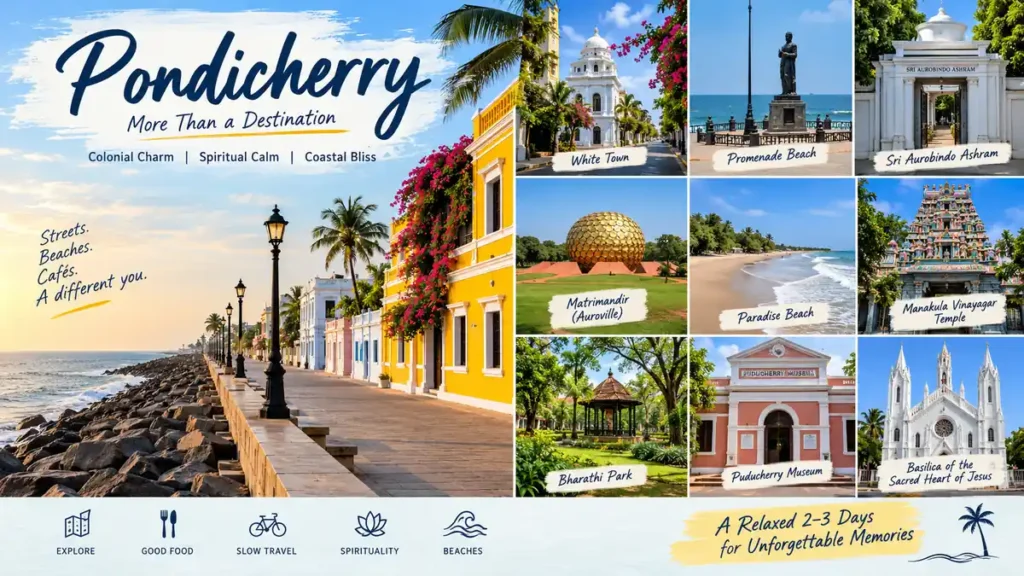
Pondicherry is the kind of destination where the streets between attractions can be as memorable as the attractions themselves. Pastel colonial houses, Tamil temples, quiet courtyards, sea-facing promenades, cafés, churches, and beaches give this compact coastal city several distinct personalities.
The best pondicherry places to visit include White Town, Promenade Beach, Sri Aurobindo Ashram, Auroville and Matrimandir, Paradise Beach, Serenity Beach, Manakula Vinayagar Temple, Bharathi Park, Puducherry Museum, and the Basilica of the Sacred Heart of Jesus. A relaxed two- or three-day trip is enough to experience most major highlights without rushing.
Officially known as Puducherry, the city preserves visible traces of its French colonial period alongside a much older and equally important Tamil identity. The result is not simply a collection of tourist attractions but a destination best experienced through neighborhoods, architecture, food, spirituality, and the Bay of Bengal.
Best pondicherry places to visit at a glance
If this is your first visit, these attractions provide the strongest introduction to the city.
| Place | Best for | Suggested time |
|---|---|---|
| White Town | Heritage and photography | 2–3 hours |
| Promenade Beach | Sunrise and evening walks | 1–2 hours |
| Sri Aurobindo Ashram | Spiritual experience | 30–60 minutes |
| Auroville | Culture and sustainable living | Half day |
| Matrimandir | Architecture and contemplation | 1–2 hours |
| Paradise Beach | Sand and coastal scenery | 2–4 hours |
| Serenity Beach | Sunrise and surfing | 1–2 hours |
| Manakula Vinayagar Temple | Religion and local culture | 30–60 minutes |
| Bharathi Park | Relaxation | 30–60 minutes |
| Puducherry Museum | History | 1–2 hours |
| Sacred Heart Basilica | Architecture | 30–60 minutes |
| Chunnambar Boat House | Boating and Paradise Beach access | 1–2 hours |
| Botanical Garden | Families and greenery | 1–2 hours |
| Arikamedu | Archaeology and history | 1–2 hours |
The historic core is particularly compact, so walking and cycling often make more sense than repeatedly taking a vehicle between nearby landmarks. India’s official tourism portal specifically recommends walking or bicycling through the heritage quarters to experience both French-era architecture and restored Tamil houses.
1. White Town and the French Quarter
White Town is one of the most recognizable places in Pondicherry. Its tree-lined streets contain colonial-era villas, pastel façades, high compound walls, shaded courtyards, churches, cafés, and buildings displaying French architectural influences.
This is where slowing down pays off. Rather than treating White Town as one attraction, allow a couple of hours to explore its streets on foot.
The neighborhood is especially pleasant early in the morning, when temperatures are lower and the streets tend to be quieter.
Look beyond the famous yellow façades too. Pondicherry’s heritage is not exclusively French. Cross toward the Tamil Quarter and the streetscape changes, revealing traditional Tamil houses, temples, shops, and everyday neighborhood life. This contrast provides a much fuller picture of Puducherry than White Town alone.
What to notice in White Town
Watch for:
- Pastel and mustard-yellow heritage buildings
- Bougainvillea-covered walls
- French street names
- Colonial-style doors and windows
- Shaded courtyards
- Heritage hotels and cafés
- Churches and administrative buildings
- Quiet residential lanes
Quick Takeaway: Explore White Town on foot rather than rushing between individual landmarks. The neighborhood itself is the attraction.
2. Promenade Beach and Goubert Avenue
Promenade Beach, sometimes associated with Rock Beach because of its rocky shoreline, forms one of Pondicherry’s most popular public spaces.
The promenade stretches for roughly 1.5 km beside Goubert Avenue and passes several recognizable landmarks, including the Mahatma Gandhi statue, French War Memorial and Dupleix-related monuments.
Unlike a broad sandy beach designed mainly for swimming, the promenade is best for walking, sitting by the sea, watching the waves, and enjoying the coastal atmosphere.
When should you visit Promenade Beach?
Sunrise is ideal if you want softer light, cooler weather, and fewer people. Evening is livelier and works well for a leisurely walk after exploring White Town.
Weekends can be significantly busier, particularly when visitors arrive from nearby cities.
If photography matters to you, visit once around sunrise rather than relying only on an evening stop.
3. Sri Aurobindo Ashram
Sri Aurobindo Ashram offers a completely different experience from Pondicherry’s beaches and heritage streets.
Founded in 1926 by Sri Aurobindo and Mirra Alfassa, widely known as The Mother, the ashram became one of the city’s most significant spiritual institutions. The Samadhi of Sri Aurobindo and The Mother is located here.
Visitors come for meditation, silence, spiritual study, and reflection rather than conventional sightseeing.
Keep conversations quiet, follow posted rules, and avoid treating the premises as a casual photo stop. The experience works best when you allow yourself time to sit quietly rather than simply entering and leaving.
Because the ashram is close to White Town and the seafront, it fits naturally into a walking itinerary.
4. Auroville
About a half-hour drive from central Puducherry, Auroville is among the region’s most unusual attractions.
Founded in 1968 and closely associated with The Mother, Auroville was conceived as an international township bringing together people from different backgrounds. Today, it is known for experiments in community living, ecological restoration, architecture, education, crafts, and sustainable practices.
Auroville deserves more time than a quick photo stop.
Start at the Visitors’ Centre, where you can understand the township’s philosophy and development before exploring the surrounding area.
What makes Auroville different?
The township contains experimental architecture, learning spaces, workshops, community facilities, cafés, forested areas, and projects involving ecological design.
Its architecture is particularly interesting because many buildings combine natural materials, climate-conscious design, traditional techniques, and experimental construction methods.
Plan at least half a day if you want more than a superficial visit.
5. Matrimandir
At the geographical and symbolic center of Auroville stands Matrimandir, a large golden spherical structure surrounded by landscaped gardens.
It is one of the most photographed landmarks near Pondicherry, but Matrimandir is intended primarily as a place for quiet concentration rather than a conventional religious monument.
First-time visitors commonly see it from the designated viewing area. Access arrangements for deeper visits can differ from simply visiting the viewpoint, so checking Auroville’s current visitor procedures before traveling is sensible.
The surrounding landscape is part of the experience. Give yourself enough time to walk rather than treating the structure as a five-minute photo stop.
6. Paradise Beach
For travelers primarily interested in sandy beaches, Paradise Beach is one of the standout pondicherry places to visit.
Also known as Plage Paradiso, the beach lies near Chunnambar and is commonly reached by boat from the Chunnambar Boat House. It is known for its sandy shoreline and separation from the denser city center.
The boat journey adds to the experience, especially for families.
Spend time walking along the sand, relaxing near the shore, or simply enjoying the coastal scenery. Conditions and permitted water activities can change, so follow local safety instructions rather than assuming the sea is suitable for swimming.
Paradise Beach or Promenade Beach?
They offer very different experiences.
| Paradise Beach | Promenade Beach |
|---|---|
| Sandy shoreline | Primarily rocky seafront |
| Reached via Chunnambar area | In central Pondicherry |
| Better for a beach outing | Better for walking |
| Requires more time | Easy short visit |
| Feels removed from the city | Surrounded by major landmarks |
Choose Paradise Beach when you want dedicated beach time. Choose the promenade when you want an easy coastal walk combined with heritage sightseeing.
7. Serenity Beach
Serenity Beach lies roughly 10 km from central Puducherry around the Kottakuppam area and is known for its sandy coastline, fishing activity, rocky sections, and surfing scene.
Early morning is particularly rewarding.
Fishing boats along the coast add local character, while the rising sun over the Bay of Bengal makes this a good location for photography.
Surfing is another reason people visit the area, with surf schools operating around the coast. Sea conditions can be rough, however, so swimming decisions should always follow current local warnings and lifeguard guidance.
8. Manakula Vinayagar Temple
Sri Manakula Vinayagar Temple provides an important counterpoint to Pondicherry’s French colonial image.
Dedicated to Lord Ganesha, the temple predates French rule and remains an active place of worship. Its interior includes elaborate paintings, sculptures, and religious decoration, while an important feature associated with the temple is its gold-plated chariot.
Dress respectfully and remember that you are entering an active religious site rather than a museum.
Combining the temple with Sri Aurobindo Ashram and White Town is straightforward because all three are relatively close to one another.
9. Bharathi Park
After several hours of walking through central Pondicherry, Bharathi Park offers an easy place to slow down.
The green space sits within the historic part of the city and is surrounded by notable buildings. Its central landmark, Aayi Mandapam, gives the park a distinctive architectural focus.
The park is particularly useful for families or travelers who need a quiet break between heritage attractions.
Rather than setting aside half a day, incorporate Bharathi Park into a walking route through White Town.
10. Puducherry Museum
Anyone interested in understanding what existed before the French colonial period should make time for the Puducherry Museum.
Its collections help connect several layers of regional history, including archaeology, sculpture, material culture, and Pondicherry’s colonial past.
This is particularly useful before or after visiting Arikamedu because archaeological objects provide context for the ancient trade networks associated with the region.
Allow roughly an hour, or longer if history is one of your main interests.
11. Basilica of the Sacred Heart of Jesus
The Basilica of the Sacred Heart of Jesus is one of Pondicherry’s prominent Christian landmarks and is noted for its Gothic architectural character and stained-glass panels depicting scenes connected with the life of Christ.
Its pointed arches, decorative details, and stained glass make it especially appealing to architecture enthusiasts.
It is also an active place of worship, so sightseeing should remain respectful during services.
The basilica is conveniently located for travelers arriving around Puducherry railway station and can be incorporated into a central-city sightseeing route.
12. Immaculate Conception Cathedral
Pondicherry’s Christian heritage extends beyond the Sacred Heart Basilica.
The Immaculate Conception Cathedral is another important church in the city and reflects the long presence of Catholic institutions during the colonial period.
Its bright exterior, religious artwork, and central location make it an easy addition to a heritage walk.
Visiting both churches also demonstrates how Pondicherry’s religious landscape includes Hindu temples, Christian churches, ashrams, and contemporary spiritual communities rather than belonging to a single tradition.
13. Chunnambar Boat House
Chunnambar Boat House is both an attraction and the usual gateway toward Paradise Beach.
Located south of central Pondicherry, the area provides boating experiences along the Chunnambar backwaters before visitors continue toward the coast.
For families, the boat journey can be as enjoyable as the destination itself.
If Paradise Beach is high on your list, combine the two instead of scheduling them separately.
Arrive with enough time for possible queues, particularly on weekends and holidays.
14. Botanical Garden
Pondicherry Botanical Garden provides a green break from the city’s streets and seafront.
The garden is particularly suitable for families, travelers interested in plants, and anyone seeking a slower activity away from busy sightseeing areas.
It also illustrates another dimension of the city’s historical development: planned gardens and landscaped public spaces became part of the colonial-era urban environment.
It is not necessarily a must-see for a very short trip, but it becomes worthwhile when you have three days or are traveling with children.
15. Arikamedu
Arikamedu is one of the most interesting places around Pondicherry for travelers fascinated by archaeology.
The site, south of the modern city, is associated with ancient maritime trade and archaeological evidence connecting this coast with long-distance commercial networks.
Its appeal is subtle. Do not expect a highly reconstructed archaeological complex filled with monumental structures.
Instead, Arikamedu rewards visitors who enjoy imagining historical landscapes and understanding how the region connected with the wider ancient world.
Combining the site with the Puducherry Museum makes the history much easier to appreciate.
16. Tamil Quarter
One of the biggest mistakes first-time visitors make is treating White Town as if it represents the whole city.
The Tamil Quarter provides another side of Pondicherry through traditional houses, busy commercial streets, temples, markets, and residential neighborhoods.
Architectural differences are especially interesting. Tamil houses often organize living spaces differently from European colonial villas, creating a distinct streetscape and relationship between public and private areas.
India’s official tourism guidance specifically highlights the contrast between the colonial buildings of the French Quarter and restored Tamil mansions across the canal.
A heritage walk covering both districts is therefore much more informative than photographing White Town alone.
17. French War Memorial and Gandhi Statue
Several important monuments can be seen without leaving the Promenade.
The French War Memorial commemorates soldiers connected with World War I, while the large Mahatma Gandhi statue is among the seafront’s most recognizable landmarks. Both form part of the historical landscape along Goubert Avenue.
You do not need to schedule separate trips for these monuments.
Instead, begin around White Town, walk toward the seafront, and explore them as part of a longer promenade walk.
This approach reduces unnecessary travel and makes central Pondicherry remarkably easy to explore.
18. Auroville Beach
Travelers visiting Auroville can also explore the nearby coast.
Auroville Beach, commonly called Auro Beach, offers another alternative to the busier central seafront and can be combined with Auroville and Matrimandir when planning a day outside the city center. India’s official tourism portal highlights the beach as being roughly a 30-minute drive from Puducherry.
Go early in the morning or toward the later part of the afternoon to avoid the strongest heat.
As with other beaches along this coast, never assume swimming is safe simply because the water looks calm.
19. Eden Beach
Eden Beach has become another notable coastal stop around Puducherry and appears among the destination’s prominent beach attractions.
It suits travelers who have already experienced the promenade and want a more conventional sandy-beach environment.
If your itinerary is only two days, you probably do not need to visit every beach. Pick according to the experience you want: Promenade for walking, Paradise for a dedicated excursion, Serenity for sunrise and surfing atmosphere, or Eden for additional beach time.
That prevents a Pondicherry trip from becoming a repetitive series of coastal stops.
20. Old Lighthouse and heritage seafront
Pondicherry’s seafront contains more than beaches and statues.
The historic lighthouse and nearby colonial-era structures contribute to the architectural character of the waterfront and are easily seen while exploring the promenade area.
The newer Pondicherry Lighthouse is another option for travelers particularly interested in maritime landmarks; traveler attraction listings continue to feature the city’s lighthouse among local points of interest.
For most visitors, however, the heritage seafront works best as part of a walking route rather than as a separate destination.
Best pondicherry places to visit for different travelers
Not every traveler needs the same itinerary.
For couples
A balanced day might include:
- Sunrise at Serenity Beach
- Breakfast around White Town
- Walking through the French Quarter
- Bharathi Park
- A quiet visit to Sri Aurobindo Ashram
- Sunset or an evening walk along Promenade Beach
Serenity Beach is frequently highlighted for its quieter coastal setting, while White Town provides the architecture and cafés that make slow exploration enjoyable.
For families
Prioritize Paradise Beach, Chunnambar Boat House, Botanical Garden, Bharathi Park, Promenade Beach, and the main heritage streets.
Avoid overloading the day. Pondicherry’s heat and humidity can make an ambitious midday walking itinerary tiring, especially for children.
For history lovers
Focus on the Puducherry Museum, Arikamedu, White Town, Tamil Quarter, churches, Manakula Vinayagar Temple, and the seafront monuments.
This route reveals several historical layers rather than reducing Pondicherry to its French colonial period.
For spiritual travelers
Sri Aurobindo Ashram, Auroville, Matrimandir, and Manakula Vinayagar Temple are natural priorities.
Sri Aurobindo and The Mother are central to understanding the modern spiritual history of both the ashram and Auroville.
How many days are enough for Pondicherry?
Two days are enough for the essential attractions, but three days provide a better first visit.
Current destination guides commonly recommend around two to three days, while longer stays allow travelers to add beaches, cafés, Auroville, and nearby excursions without rushing.
A sensible three-day plan looks like this:
Day 1: Heritage Pondicherry
Start early in White Town and walk through the French Quarter.
Continue to Sri Aurobindo Ashram and Manakula Vinayagar Temple, then visit Bharathi Park and Puducherry Museum.
Toward evening, walk along Goubert Avenue and Promenade Beach, stopping at the Gandhi Statue and French War Memorial.
Day 2: Auroville and the northern coast
Travel to Auroville in the morning.
Begin at the Visitors’ Centre, learn about the township, and continue toward the Matrimandir viewing area according to current access arrangements.
Spend additional time exploring Auroville’s architecture, workshops, cafés, or surrounding environment.
On the return journey, stop at Auroville Beach or Serenity Beach.
Day 3: Paradise Beach and southern Pondicherry
Head to Chunnambar in the morning and continue to Paradise Beach.
After returning, history enthusiasts can visit Arikamedu, while families may prefer Botanical Garden or additional time around central Pondicherry.
Finish with another relaxed seafront walk rather than trying to squeeze in several distant attractions.
Quick Takeaway: Two days cover the essentials; three days let you experience Pondicherry at the slower pace that suits the city best.
Best time to visit Pondicherry
The cooler months are generally the easiest period for sightseeing because much of the experience involves walking outdoors.
Travel guides commonly identify roughly October or November through February or March as the most comfortable broader season, though exact weather varies from year to year.
October to March
This is generally the most comfortable period for heritage walks, beaches, outdoor sightseeing, and Auroville.
It is also a popular travel season, so weekends and holiday periods may bring larger crowds.
April to June
Conditions can become hot and humid.
If visiting during warmer months, shift outdoor sightseeing to early morning and late afternoon. Use the middle of the day for museums, cafés, rest, or indoor attractions.
Rainy months
Rain can disrupt beach plans and outdoor walks, but Pondicherry still has museums, churches, temples, cafés, and covered heritage spaces worth exploring.
Always check the current weather and sea conditions before planning boating or beach activities.
How to get around Pondicherry
Central Pondicherry is unusually manageable on foot.
One recent guide notes that much of the town core sits within a compact radius, making it possible to move between many central attractions without repeatedly hiring transport.
Walking
Best for White Town, Promenade Beach, Sri Aurobindo Ashram, Bharathi Park, and nearby heritage attractions.
Walking also allows you to notice architecture, small temples, courtyards, street signs, and local businesses that you would miss from a vehicle.
Bicycle
Cycling suits travelers who want to cover the heritage quarters efficiently without losing their connection to the streetscape.
The official Incredible India tourism portal specifically recommends both walking and cycling as good ways to experience Pondicherry’s old-world character.
Auto-rickshaw or taxi
Use motorized transport for Auroville, Serenity Beach, Chunnambar, Paradise Beach access, Arikamedu, and other attractions beyond the historic core.
Grouping nearby attractions on the same day saves both time and unnecessary backtracking.
Pondicherry or Puducherry: are they the same place?
Yes. Travelers commonly use both names.
The city’s official name was changed from Pondicherry to Puducherry in 2006, but “Pondicherry” remains widely used in tourism, everyday conversation, online searches, hotel listings, and travel guides.
You will therefore see both names throughout maps and travel information.
Puducherry can also refer more broadly to the Union Territory, so context matters when planning travel.
Is Pondicherry only about French architecture?
No, and viewing it that way means missing much of what makes the destination interesting.
Pondicherry spent centuries under French influence and remained under French colonial rule until 1954, which explains the architectural and cultural traces still visible in White Town.
But the city’s identity is also deeply Tamil.
Hindu temples, traditional houses, markets, Tamil cuisine, residential neighborhoods, and regional customs coexist with churches, colonial villas, Sri Aurobindo’s spiritual legacy, and Auroville’s international community.
The strongest itinerary deliberately includes both sides.
Can you visit Pondicherry in one day?
Yes, but you will need to prioritize.
For a single day, start with White Town in the morning, visit Sri Aurobindo Ashram and Manakula Vinayagar Temple, walk through Bharathi Park, and spend the evening at Promenade Beach.
Do not attempt to combine all of central Pondicherry, Auroville, Paradise Beach, and Serenity Beach in one day. You may technically reach them, but most of the trip will become transportation rather than exploration.
If Auroville is your main interest, dedicate much of the day to Auroville and Matrimandir instead.
Practical tips for visiting Pondicherry
A few decisions can noticeably improve the trip.
- Start outdoor sightseeing early. White Town, Serenity Beach, and the promenade are particularly enjoyable before the daytime heat builds.
- Group attractions geographically. Keep White Town, the ashram, temple, park, museum, and promenade together. Put Auroville and the northern beaches on another day.
- Do not plan every beach. Pondicherry has several coastal options, but visiting all of them adds repetition. Choose beaches according to the experience you want.
- Respect religious and spiritual spaces. Temples, churches, Sri Aurobindo Ashram, and Matrimandir have different customs and visitor rules.
- Check access before visiting Auroville. Matrimandir viewing and inner access are not the same experience, and procedures can change.
- Treat the sea cautiously. Conditions along the Bay of Bengal can change. Follow local safety signs and instructions instead of relying on older travel reports about swimming.
- Leave room for walking. Some of Pondicherry’s most memorable details are found between the famous landmarks.
What makes Pondicherry worth visiting?
Few compact Indian destinations combine such different experiences within a relatively small area.
In one trip you can walk through French-influenced heritage streets, enter an old Hindu temple, sit quietly at Sri Aurobindo Ashram, watch sunrise over the Bay of Bengal, take a boat toward Paradise Beach, explore archaeological history at Arikamedu, and visit the experimental international community of Auroville.
That variety explains why the same destination works for weekend travelers, couples, families, photographers, history enthusiasts, architecture lovers, and people interested in spirituality.
The strongest list of pondicherry places to visit therefore goes beyond simply collecting famous attractions. Start with White Town, Promenade Beach, Sri Aurobindo Ashram, Auroville, Matrimandir, and Paradise Beach, then add the Tamil Quarter, temples, churches, museums, or quieter beaches according to your interests.
Give yourself two days if time is limited and three if possible. More importantly, resist the urge to rush. Pondicherry makes far more sense when you have enough time to walk its streets, notice the contrast between its neighborhoods, and experience the city between the landmarks.