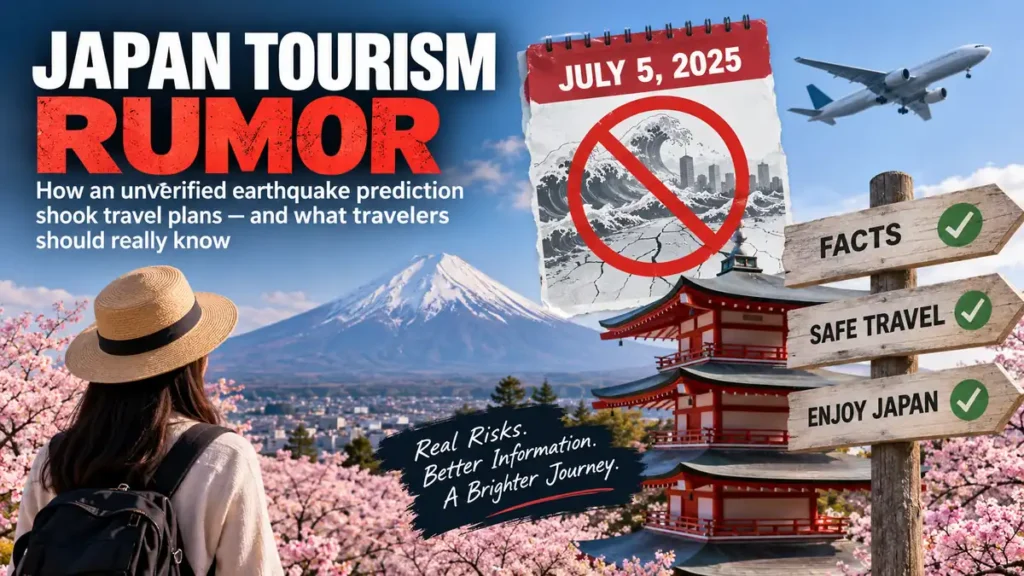
A viral prediction once made thousands of travelers reconsider trips to Japan. The claim spread so widely that visitor numbers from Hong Kong fell sharply, airlines adjusted some routes, and Japanese officials publicly urged people to rely on scientific information rather than online speculation.
The japan tourism rumor generally refers to the widely circulated claim that a catastrophic earthquake or tsunami would strike Japan around July 5, 2025. The rumor was linked to manga artist Ryo Tatsuki and her work The Future I Saw. Scientists and Japanese authorities said there was no scientific basis for predicting an earthquake on that specific date, and July 5 passed without the predicted catastrophe.
The episode matters beyond an old internet story. It shows how quickly disaster predictions can influence international tourism—and why travelers should distinguish between Japan’s genuine earthquake risk and claims that a major earthquake can be forecast for an exact day.
What Was the japan tourism rumor?
The story that dominated travel discussions in 2025 involved a supposed prediction of a devastating natural disaster in Japan.
The rumor became associated with Japanese manga artist Ryo Tatsuki, whose manga Watashi ga Mita Mirai, usually translated as The Future I Saw, originally appeared in 1999. A complete edition published in 2021 contained material describing a dream involving a major disaster in July 2025.
Online discussions gradually transformed that material into a much more specific claim: that a massive earthquake, sometimes described as a “megaquake,” would strike Japan on July 5, 2025.
That distinction is important.
The viral internet version became more precise and dramatic than the underlying material, with social-media posts, videos and retellings adding interpretations about the exact date, earthquake magnitude and possible tsunami.
By the first half of 2025, the story had spread widely across parts of Asia, particularly Hong Kong, while also attracting attention in places such as South Korea and Taiwan.
Quick Takeaway
| Claim | What the evidence showed |
|---|---|
| A catastrophic earthquake would hit Japan on July 5, 2025 | No scientific evidence supported the claim |
| Scientists could predict the exact date | Earthquakes cannot currently be reliably predicted by exact date, location and magnitude |
| The rumor was linked to a manga | Yes |
| The prediction affected tourism | Yes, particularly travel from Hong Kong |
| The predicted July 5 catastrophe occurred | No |
| Japan has genuine earthquake risk | Yes |
The crucial point is that a false prediction does not mean earthquake risk in Japan is false. Japan is a seismically active country. What was unsupported was the claim that a catastrophic earthquake could be reliably forecast for that particular date.
Where Did the Japan Earthquake Rumor Come From?
Understanding the origin requires separating Tatsuki’s work from the way it was interpreted online.
Ryo Tatsuki and The Future I Saw
Ryo Tatsuki is a Japanese manga artist associated with The Future I Saw. The work became famous partly because readers later connected material surrounding it with the March 2011 Great East Japan Earthquake and tsunami.
That association helped give later claims unusual credibility online.
A complete edition released in 2021 contained material involving a dream about a major disaster in July 2025. As discussion moved from the manga into videos, social platforms and news coverage, the prediction increasingly became associated with July 5.
The story became especially compelling because it combined several emotionally powerful ingredients:
- a real country with significant seismic activity;
- memories of the devastating 2011 Tōhoku earthquake and tsunami;
- an apparently mysterious earlier prediction;
- a precise future date;
- dramatic tsunami scenarios;
- and rapid amplification through social media.
That combination allowed an unsupported prediction to influence real travel decisions.
Was the Nankai Trough involved?
Online discussions frequently connected the rumor with the Nankai Trough, one of Japan’s major earthquake-risk zones.
Travelers should not confuse the two issues.
The possibility of a future major Nankai Trough earthquake is a legitimate subject of Japanese disaster planning and scientific research. That does not validate claims that someone can identify the exact day on which such an earthquake will happen.
Japan’s long-term seismic hazards and the July 5 prophecy are therefore fundamentally different subjects.
Why Did the japan tourism rumor Become So Popular?
Natural-disaster rumors are not unusual, but this one had measurable effects on travel.
One reason was the perceived connection between Tatsuki’s work and the 2011 disaster. Another was repetition: once videos, posts and news stories began discussing July 5, people encountered the same date repeatedly.
A 2025 Japanese survey cited by Nippon.com found that 49.4% of respondents had heard about the prophecy. Among people who knew about it, YouTube was the most commonly reported source, followed by television, online news, family or friends, and X.
That illustrates how a rumor can move between social and traditional media rather than remaining confined to one platform.
The story also gained traction because Japan really does experience earthquakes. A fabricated prediction about an impossible event might be easy to dismiss. A fabricated date attached to a genuine natural hazard can sound more plausible.
That is exactly why the distinction between hazard assessment and earthquake prediction matters.
Did the Earthquake Rumor Actually Hurt Japan Tourism?
Yes. This is one of the most significant parts of the story.
The earthquake prediction itself lacked scientific evidence, but its economic consequences were real.
Hong Kong visitor numbers fell sharply
According to data reported from the Japan National Tourism Organization (JNTO), arrivals from Hong Kong fell to about 166,800 in June 2025, down roughly one-third from the previous year. Overall international arrivals still increased 7.6% that month and reached approximately 3.4 million.
In other words, Japan’s overall tourism industry did not collapse. The impact was concentrated much more heavily in particular markets where the rumor had spread.
A separate survey reported by Nippon.com provides another useful picture. Among respondents planning July or August travel, 1.5% canceled their trips and 9.5% postponed them because of the rumor. The effect was substantially stronger among respondents from Hong Kong.
Flights were affected too
Falling demand wasn’t limited to hotel reservations or individual travel plans.
Some airlines reduced or canceled services as demand weakened. ABC News reported in July 2025 that Hong Kong Airlines had canceled some flights amid declining demand connected with the disaster prediction.
Regional airports felt the effects as well.
Takamatsu Airport in Kagawa Prefecture, for example, was still dealing with weaker Hong Kong traffic after the predicted date had passed. South China Morning Post reported that Hong Kong passenger arrivals there fell during the period surrounding the rumor and that suspended flights had not immediately returned.
This is a useful example of how misinformation can produce real economic consequences even when the predicted event never happens.
What Happened on July 5, 2025?
The predicted catastrophe did not occur.
July 5 came and went without the massive earthquake and tsunami described in viral versions of the rumor.
That outcome matters because internet rumors sometimes survive failed deadlines by shifting the interpretation—changing the date, widening the time period or connecting unrelated earthquakes with the original prediction.
Japan experiences seismic activity regularly, so an earthquake occurring somewhere in or around the country is not by itself evidence that a prophecy was accurate.
A meaningful prediction would need to specify an event in a scientifically testable way before it happened.
Did tourism recover afterward?
Travel interest began returning after the feared date passed.
Reports from Hong Kong described rising inquiries and bookings after July 5, including a sharp increase in searches for Tokyo flights.
Some regional effects, however, lasted longer. Takamatsu Airport was still reporting difficulties restoring traffic from Hong Kong later in August 2025.
The pattern demonstrates something important about tourism psychology: rumors can disappear faster than their economic consequences.
Can Scientists Predict an Earthquake on an Exact Date?
No current scientific method can reliably tell travelers that a major earthquake will occur in a particular place on a particular future day.
That doesn’t mean seismologists know nothing about earthquakes.
Scientists can study:
- active faults;
- plate boundaries;
- historical earthquake patterns;
- seismic activity;
- ground deformation;
- tsunami exposure;
- probabilities over longer periods;
- and areas facing elevated earthquake risk.
Those tools support disaster preparedness and long-term risk assessment.
They do not provide a calendar showing exactly when the next major earthquake will occur.
Japanese officials responding to the 2025 rumor emphasized that predicting the specific date, time and location of an earthquake is not possible with current scientific knowledge.
Prediction and early warning are different
This distinction frequently causes confusion.
Earthquake prediction would mean knowing sufficiently far in advance that an earthquake will occur at a specified future time and location.
An earthquake early warning, by contrast, detects an earthquake after it has begun and attempts to provide seconds of warning before stronger shaking reaches certain locations.
Early-warning technology is valuable, but it does not mean scientists predicted the earthquake days, weeks or months beforehand.
Does the Failed Rumor Mean Japan Has No Earthquake Risk?
No.
This is probably the biggest mistake travelers can make after learning that the July 5 prediction was unfounded.
Japan sits in one of the world’s most tectonically active regions. Earthquakes, volcanic activity and tsunamis are genuine hazards, and emergency preparedness is a normal part of life in the country.
A sensible approach is therefore neither panic nor complacency.
Think of it this way:
“A huge earthquake will happen on this exact date” is an unsupported prediction. “Japan has meaningful earthquake risk and travelers should understand emergency procedures” is responsible risk awareness.
The same principle applies to typhoons, volcanic activity, heavy rain and other natural hazards.
Is Japan Safe to Visit After the japan tourism rumor?
Travel decisions should be based on current official conditions, not the old July 2025 prophecy.
The Japan National Tourism Organization maintains a Safe Travel Information service covering emergency warnings, earthquakes and other events that may affect visitors. Its current guidance also provides area-specific updates when disasters occur.
This matters because conditions can change.
For example, a traveler visiting an area affected by an actual earthquake needs different information from someone planning a trip hundreds of kilometers away. Headlines saying “earthquake in Japan” often fail to communicate Japan’s geographic scale or the precise location of the disruption.
Check the affected prefecture, transport routes, accommodation status and official warnings rather than assuming that an incident automatically makes the entire country inaccessible.
Japan Tourism in 2026: Did the Rumor Permanently Damage Travel?
No evidence suggests that the 2025 rumor permanently undermined Japan’s overall inbound tourism industry.
JNTO reported approximately 42.7 million international visitors in 2025, according to a 2026 interview with the organization’s communications manager.
Tourism remained substantial in 2026.
Official JNTO figures recorded 3,618,900 visitors in March 2026.
JNTO subsequently reported:
| Month | International visitors |
|---|---|
| March 2026 | 3,618,900 |
| April 2026 | 3,692,200 |
| May 2026 | 3,559,900 |
| June 2026 | 3,148,600 |
| July 2026 | 3,442,100 |
JNTO’s published releases show that visitor volumes continued to reach millions per month through 2026.
The composition of inbound tourism has changed, however.
Chinese arrivals were substantially lower during parts of 2026, while markets including South Korea and Taiwan recorded strong numbers. July 2026 reached a record for that month at about 3.44 million foreign visitors, with South Korea and Taiwan leading the market.
That broader context is useful: fluctuations in Japan tourism cannot automatically be attributed to the old earthquake rumor. Exchange rates, airline capacity, holidays, diplomatic relations, economic conditions and actual natural disasters can all influence visitor numbers.
How Travelers Can Check Japan Tourism Rumors Before Changing a Trip
A viral post should not be treated as a travel advisory simply because thousands of people have shared it.
Use a simple verification process.
- Identify the original claim. Determine whether the information actually comes from a government agency, scientific organization or emergency authority.
- Check the date. Old earthquake stories and travel warnings frequently recirculate as though they happened today.
- Look for the exact location. An emergency affecting one prefecture does not necessarily affect Tokyo, Osaka, Kyoto, Hokkaido, Kyushu or other regions.
- Check JNTO travel information. JNTO publishes information specifically intended for international visitors.
- Check scientific and emergency authorities. For earthquakes, tsunamis, volcanic activity and severe weather, use official Japanese meteorological information rather than social-media predictions.
- Verify transportation separately. Airlines, JR railway operators and local transport companies provide service updates during disruptions.
- Check your accommodation. A hotel can often provide the clearest information about immediate local conditions.
This approach works much better than trying to decide whether an influencer, viral video or anonymous social-media account “sounds convincing.”
What Should You Do If an Earthquake Happens While Visiting Japan?
Even though the July 2025 prophecy was baseless, basic earthquake preparedness is worthwhile.
If strong shaking begins indoors, protect your head and avoid windows or objects that could fall. Do not rush outside while debris may be falling. Follow instructions from staff if you’re inside a hotel, railway station, shopping center or attraction.
After the shaking stops, check official alerts.
If you’re near the coast and authorities issue a tsunami warning—or if you experience severe or prolonged shaking—follow evacuation instructions and move toward designated higher ground when directed.
Travelers should also know their hotel’s emergency exits and keep essentials such as identification and a charged phone accessible.
JNTO’s official Safe Travel Information portal consolidates emergency information for international visitors and points travelers toward relevant warnings and assistance.
Why Tourism Rumors Can Be So Powerful
The japan tourism rumor is a useful case study in modern travel misinformation because the claim moved from entertainment and speculation into measurable behavior.
People postponed vacations.
Others canceled trips.
Some airlines reduced flights.
Visitor numbers from Hong Kong declined.
Regional airports experienced lingering effects.
Yet the predicted catastrophe itself never happened.
The episode demonstrates three forces working together.
Fear spreads faster when the underlying hazard is real
Japan genuinely experiences earthquakes. That makes an unsupported prediction more believable than a completely impossible claim.
Exact dates make rumors memorable
“Japan may someday experience another major earthquake” isn’t particularly shareable.
“Japan will experience a catastrophic earthquake on July 5” is.
Specificity can make misinformation appear authoritative even when no evidence supports it.
Repetition can look like confirmation
Seeing the same prediction across TikTok, YouTube, X, Facebook and news reports doesn’t necessarily mean five independent sources verified it.
Sometimes every post ultimately traces back to the same original claim.
That is why source tracing matters more than share counts.
Other Japan Tourism Rumors Travelers May Encounter
The 2025 earthquake story isn’t the first misleading Japan travel claim to gain international attention.
During the COVID-19 era, reports circulated suggesting that Japan would effectively pay half the travel costs of foreign tourists through its Go To Travel campaign.
That wasn’t accurate.
The program was designed to stimulate domestic tourism, and Japan’s tourism authorities clarified that it wasn’t an offer to subsidize half the vacation expenses of overseas visitors.
More recently, online discussions have sometimes blurred together accommodation taxes, departure charges, visa fees and proposed tourist-pricing policies into sweeping claims that “Japan is doubling prices for foreigners.” Individual costs and policies need to be checked separately rather than treated as one nationwide tourist tax.
The pattern is familiar: a real policy, risk or discussion gets simplified until the viral version says something the original source never actually said.
Reliable Sources for Japan Travel Information
For time-sensitive travel decisions, source quality matters more than the number of articles discussing a story.
The Japan National Tourism Organization (JNTO) should be one of the first places international visitors check. It publishes visitor statistics, tourism announcements and official travel resources.
Its Safe Travel Information resources are particularly useful during earthquakes, extreme weather and other emergencies.
Travelers should also rely on Japan’s meteorological and disaster-management authorities for natural-hazard information, alongside direct updates from airlines, rail operators and local governments.
Social media can be useful for discovering that something is happening. It should rarely be the final source used to decide whether a trip is safe.
The Bottom Line on the japan tourism rumor
The most widely discussed japan tourism rumor was the claim that a catastrophic earthquake or tsunami would strike Japan around July 5, 2025. It originated from interpretations surrounding Ryo Tatsuki’s manga The Future I Saw and became amplified through social media and international coverage.
There was no scientific basis for predicting a major earthquake on that specific date, and the predicted catastrophe did not occur.
The tourism consequences, however, were genuine. Hong Kong arrivals fell sharply, some flights were reduced, travelers postponed or canceled trips, and certain regional tourism markets continued feeling the effects after the date had passed.
Japan still has genuine seismic risks, just as it did before the rumor. The practical lesson isn’t to ignore earthquake safety; it’s to separate real hazard preparedness from unsupported predictions.
For any future Japan travel rumor, check the date, identify the original source, confirm the affected location and compare the claim with current information from JNTO and Japanese emergency authorities before changing your plans.