Mumbai rarely reveals itself from a single viewpoint. One moment you are standing beside a colonial-era landmark, the next you are eating vada pav beside a busy railway station, watching waves crash along Marine Drive, or wandering through a forest surprisingly close to high-rise neighborhoods.
If you are looking for things to do in mumbai, start with the Gateway of India, explore the UNESCO-listed Elephanta Caves and Chhatrapati Shivaji Maharaj Terminus, walk along Marine Drive, discover Colaba and Bandra, taste local street food, visit museums and temples, and make time for Sanjay Gandhi National Park. These experiences reveal Mumbai’s history, architecture, food, spirituality, coastline, and everyday life.
1. Start at the Gateway of India
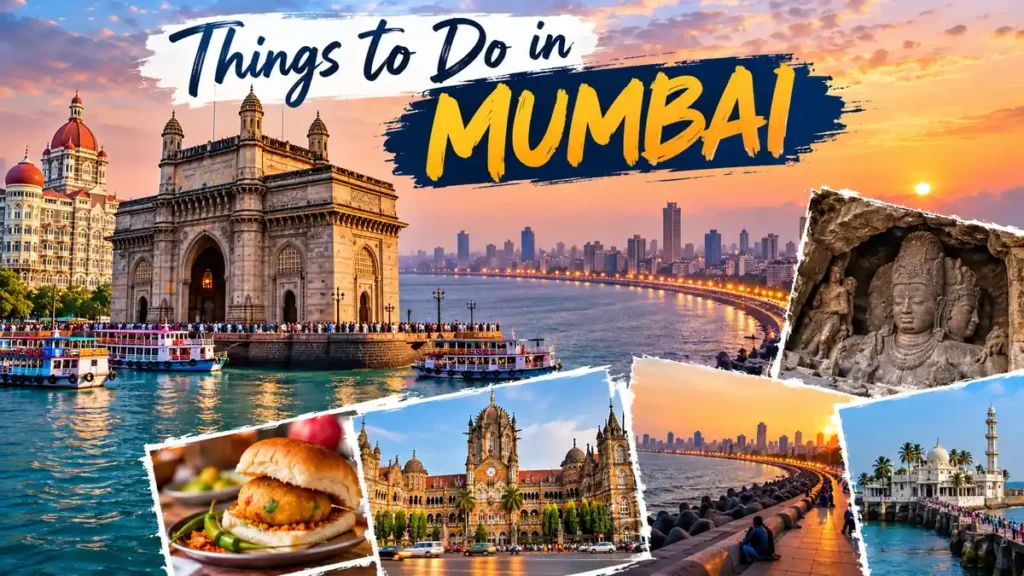
The Gateway of India is the natural starting point for a first visit to Mumbai. Standing beside the Arabian Sea in Colaba, the monumental arch has become one of the city’s most recognizable symbols.
The waterfront location matters as much as the monument itself. Ferries move across the harbor, photographers work the promenade, visitors gather around the plaza, and the historic Taj Mahal Palace stands nearby.
The Gateway also provides the departure point for trips to Elephanta Island. India’s official tourism portal recommends pairing it with Elephanta Caves and Marine Drive. Incredible India
Quick tip: Come early in the morning if you want cooler weather and a quieter experience.
2. Take the Ferry to Elephanta Caves
One of the most rewarding historical things to do in Mumbai requires leaving the mainland.
The Elephanta Caves are rock-cut cave temples on Elephanta Island. The site is particularly celebrated for its monumental sculptures connected with Shiva, including the famous Trimurti.
The journey is part of the experience. Boats leave from the Gateway of India, giving you a different perspective on Mumbai’s harbor and skyline before reaching the island. The caves are a UNESCO World Heritage Site, and official tourism information places their principal rock-cut temples between the 5th and 7th centuries. Incredible India
Allow roughly half a day rather than trying to squeeze Elephanta into an already crowded South Mumbai itinerary.
3. Watch the Sunset at Marine Drive
Few Mumbai experiences are simpler—or better—than sitting beside the Arabian Sea as daylight fades.
Marine Drive stretches along the South Mumbai coastline and is popularly known as the Queen’s Necklace because of the illuminated curve it forms at night.
Official tourism information describes the waterfront boulevard as approximately 3.6 km long. Incredible India
You do not need an itinerary here. Walk, sit on the promenade, watch people exercising and socializing, and stay until the lights come on.
For photographers, the transition between sunset and blue hour is particularly attractive.
4. See the City from Girgaum Chowpatty
Continue toward Girgaum Chowpatty at the northern end of Marine Drive.
The beach is less about swimming and more about atmosphere. Families gather here in the evening, food stalls become busy, and the Mumbai skyline provides the backdrop.
This is also a convenient place to sample snacks such as bhel puri, sev puri and pav bhaji.
Visit around sunset and combine Chowpatty with your Marine Drive walk rather than making two separate trips.
5. Explore Chhatrapati Shivaji Maharaj Terminus
A railway station might sound like an unusual tourist attraction until you see Chhatrapati Shivaji Maharaj Terminus.
Formerly Victoria Terminus, CST is one of Mumbai’s architectural landmarks and remains an intensely active railway station.
UNESCO describes it as an exceptional example of Victorian Gothic Revival architecture combined with traditional Indian architectural influences. Designed by F. W. Stevens, construction began in 1878 and took approximately a decade. It became a UNESCO World Heritage Site in 2004. UNESCO World Heritage Centre
Look for its stone dome, turrets, pointed arches, carvings and elaborate façade.
Seeing CST also illustrates something fundamental about Mumbai: historic monuments here are often still woven directly into daily city life.
6. Walk Through Mumbai’s UNESCO Architecture
Do not stop your architecture tour at CST.
The Victorian Gothic and Art Deco Ensembles of Mumbai form another UNESCO World Heritage Site. Around Oval Maidan, you can see Victorian Neo-Gothic public buildings facing later Art Deco structures.
The contrast tells the story of Mumbai’s transformation during the 19th and 20th centuries. UNESCO notes that local climatic adaptations—including balconies and verandas—were incorporated into the Gothic architecture, while Indian motifs helped produce a distinctive form of Art Deco sometimes called Indo-Deco. UNESCO World Heritage Centre
Walk around Oval Maidan, Fort and the surrounding streets rather than viewing individual buildings only from a vehicle. Details that disappear from a car become obvious on foot.
7. Visit Chhatrapati Shivaji Maharaj Vastu Sangrahalaya
For a deeper understanding of Indian art and history, spend a couple of hours at Chhatrapati Shivaji Maharaj Vastu Sangrahalaya, commonly abbreviated as CSMVS.
Formerly known as the Prince of Wales Museum of Western India, it occupies a striking Indo-Saracenic heritage building near the Gateway of India.
According to Mumbai’s city administration, its collection contains more than 60,000 artifacts. Mumbai City
The museum works particularly well in the middle of a South Mumbai day because several major attractions are nearby.
8. Wander Around Kala Ghoda
Right beside Mumbai’s museum district is Kala Ghoda, one of the best areas for experiencing the city’s creative side.
The neighborhood combines heritage architecture, galleries, cafés, boutiques and cultural spaces. Instead of rushing from one attraction to another, give yourself time to explore its side streets.
Kala Ghoda is particularly useful for travelers interested in photography, design, architecture and contemporary culture.
Combine it with CSMVS, Fort and Colaba to create a compact walking day.
9. Shop Along Colaba Causeway
For shopping with plenty of Mumbai energy, head to Colaba Causeway.
The street is packed with clothing, jewelry, accessories, handicrafts, souvenirs and inexpensive fashion. Maharashtra Tourism highlights Colaba Causeway as a place to experience Mumbai’s lively street culture as well as shop for handicrafts, jewelry and clothing. Maharashtra Tourism
Bargaining is common at many street stalls, but keep it friendly.
The bigger appeal is the neighborhood itself. Cafés, old buildings, shops and the constant movement of people make Colaba enjoyable even if you buy nothing.
10. Eat Your Way Through Mumbai
Food should be treated as an attraction in Mumbai rather than something fitted between sightseeing stops.
Start with vada pav, perhaps the city’s most famous quick snack: a spiced potato fritter tucked into a bun and served with chutneys and chilies.
Then look for:
- Pav bhaji
- Bhel puri
- Sev puri
- Pani puri
- Bombay sandwiches
- Kebabs
- Parsi dishes
- Maharashtrian food
Official tourism guides specifically identify vada pav, pav bhaji, bhel puri and sev puri among Mumbai’s signature street-food experiences. Incredible India
Food hygiene varies. Choose busy stalls with high turnover, particularly if you are not accustomed to local street food, and prefer freshly cooked items served hot.
11. Experience the Energy of Crawford Market
Markets show a different side of Mumbai from its monuments.
Crawford Market—officially Mahatma Jyotiba Phule Mandai—is a historic market where the attraction is as much the activity as the shopping.
Expect narrow passages, vendors, fruit and vegetables, household products and constant movement.
Go earlier in the day if you want to see the market functioning at full pace. Keep your belongings secure in crowded areas and ask before taking close-up photographs of vendors.
12. Visit Haji Ali Dargah
Few religious landmarks in Mumbai have a setting as memorable as Haji Ali Dargah.
The mosque and tomb stand on an islet off Mumbai’s coast and are connected to the mainland by a narrow causeway. Maharashtra Tourism describes the shrine as a major spiritual attraction known for its Indo-Islamic architecture. Maharashtra Tourism
Because access is affected by sea conditions and tides, check current local conditions before going.
Dress respectfully and remember that this remains an active place of worship rather than simply a sightseeing stop.
13. Visit Siddhivinayak Temple
Another major spiritual landmark is Shree Siddhivinayak Ganapati Temple, dedicated to Lord Ganesha.
It attracts large numbers of worshippers, and the atmosphere can be particularly intense on busy religious days.
For visitors unfamiliar with Hindu temples, observing respectfully can be as meaningful as examining the architecture. Dress modestly, follow posted instructions and expect security procedures.
Current traveler rankings continue to place Siddhivinayak among Mumbai’s most popular attractions. Tripadvisor
14. Escape into Sanjay Gandhi National Park
Mumbai’s density makes Sanjay Gandhi National Park feel almost improbable.
Covering around 87 square kilometers, the park protects a substantial green area inside the metropolitan region. Maharashtra Tourism reports more than 1,300 plant species, 274 bird species, 35 mammal species and 170 butterfly species within the park. Maharashtra Tourism
Walking, cycling and seasonal greenery make this one of the best things to do in Mumbai for travelers who need a break from traffic and dense neighborhoods.
The main entrance is at Borivali, so factor Mumbai’s travel times into your schedule.
15. Discover the Kanheri Caves
Inside Sanjay Gandhi National Park are the Kanheri Caves, making it possible to combine nature and archaeology in one outing.
The rock-cut Buddhist cave complex spreads across a hillside and provides a dramatic contrast with modern Mumbai beyond the forest.
Wear comfortable shoes, carry drinking water and expect climbing.
If you have enough time, dedicate most of a day to the national park and caves instead of trying to fit them into a South Mumbai sightseeing itinerary.
16. Spend an Evening in Bandra
South Mumbai contains many famous historical attractions, but Bandra gives you a better sense of contemporary Mumbai.
Explore Bandra West for cafés, restaurants, shopping and street art. Walk past old bungalows and churches, then head toward the waterfront.
The area works especially well in late afternoon and evening when the heat begins to ease.
Recent travel coverage also highlights Bandra West for its food, nightlife and craft-beer scene, showing how the neighborhood complements rather than duplicates South Mumbai sightseeing. Lonely Planet
17. Walk Along Bandstand
Bandra Bandstand is an easy place to slow down.
The seaside promenade faces the Arabian Sea and attracts walkers, couples, families and visitors throughout the day. Come toward sunset for better temperatures and coastal views.
Nearby, you can see the remains of Bandra Fort and continue toward the Bandra-Worli Sea Link viewpoints.
It is a good alternative if you want a waterfront experience without returning to Marine Drive.
18. See Dhobi Ghat from Above
Mumbai’s Mahalaxmi Dhobi Ghat is a large open-air laundry area that has become one of the city’s unusual visual landmarks.
From public viewpoints around the Mahalaxmi area, you can see rows of washing spaces and laundry being processed at scale.
Remember that this is a workplace. Observe respectfully rather than treating workers as exhibits, and avoid intrusive photography.
That principle applies to any tour focused on Mumbai’s residential or working communities: choose operators and experiences that respect residents’ privacy and dignity.
19. Explore Chor Bazaar
Travelers interested in antiques, vintage objects and chaotic markets can explore Chor Bazaar.
Shops and stalls in the surrounding district sell everything from old furniture and decorative pieces to hardware, clocks, movie memorabilia and miscellaneous curiosities.
Do not expect a polished flea market. Its appeal lies in browsing.
Check quality carefully before buying expensive items and be cautious about claims regarding age or authenticity.
20. Ride a Mumbai Local Train
For millions of residents, Mumbai’s suburban railway is not an attraction—it’s essential infrastructure.
For a visitor, however, a short off-peak journey provides a revealing glimpse into how the enormous city functions.
Avoid weekday rush hours if you are unfamiliar with the system. Platforms and trains can become extremely crowded, and navigating them while carrying luggage is unnecessarily difficult.
CST itself demonstrates just how important rail remains to Mumbai: UNESCO describes the station as serving millions of commuters each day. UNESCO World Heritage Centre
Best Free Things to Do in Mumbai
You can experience a surprising amount of Mumbai without spending heavily.
Walking Marine Drive, exploring heritage streets around Fort, browsing Colaba Causeway, watching sunset from Bandstand, visiting beaches and photographing the exterior of CST can fill much of a day.
A particularly good low-cost route is:
Gateway of India → Colaba → Kala Ghoda → Oval Maidan → Marine Drive → Girgaum Chowpatty
Much of this route can be explored on foot, though Mumbai’s heat and humidity may make short taxi journeys worthwhile.
Things to Do in Mumbai with Family
Families have plenty of choices beyond monuments.
Sanjay Gandhi National Park provides open space and nature, while museums offer an indoor alternative during hot or rainy weather. Marine Drive and the Gateway of India are easy additions for mixed-age groups.
Elephanta Caves can be rewarding for older children interested in history, but remember that the outing involves a boat journey, walking and steps.
Avoid overloading the day. Mumbai’s traffic means three well-chosen experiences can be more enjoyable than six rushed attractions.
Things to Do in Mumbai at Night
Mumbai changes character after dark.
Marine Drive is the classic evening destination, when the curved coastline lights up and creates the famous Queen’s Necklace effect. Bandra is better suited to restaurant hopping, cafés and a more contemporary evening.
Night photography around illuminated heritage districts can also be rewarding, but remain aware of traffic and your surroundings.
For a relaxed first night, have dinner in Colaba or Fort and finish with a drive or walk along Marine Drive.
Hidden and Unusual Things to Do in Mumbai
Once you have covered the major sights, look beyond the standard checklist.
Explore the lanes of Khotachiwadi for traces of old Mumbai architecture, search Bandra for street art, visit independent galleries around Kala Ghoda, explore heritage precincts on foot, or simply spend an hour in a neighborhood café watching everyday city life.
Architecture enthusiasts should pay particular attention to Mumbai’s Art Deco buildings. The city’s UNESCO-listed ensemble documents an important period when European architectural ideas mixed with Indian design and created the distinctive Indo-Deco style. UNESCO World Heritage Centre
These slower experiences often reveal more about Mumbai than another hurried monument visit.
Best Time to Visit Mumbai
For most sightseeing, the cooler months are generally the easiest time to explore Mumbai on foot.
Mumbai’s monsoon, however, creates a completely different atmosphere. The city becomes intensely green, dramatic clouds gather over the Arabian Sea, and coastal areas take on a powerful character.
Heavy rainfall can also disrupt transport and outdoor plans, so flexibility matters.
Interestingly, Maharashtra Tourism recommends June through February for Sanjay Gandhi National Park, noting that monsoon conditions transform its vegetation while winter offers comfortable conditions for trekking and wildlife observation. Maharashtra Tourism
Whenever you visit, check current weather, ferry schedules, attraction opening days and local advisories before setting out.
How Many Days Do You Need in Mumbai?
Two days are enough for the major highlights, but three to four days create a much better experience.
One day in Mumbai
Concentrate on South Mumbai:
Gateway of India → CSMVS → Kala Ghoda → Colaba Causeway → Marine Drive
Two days in Mumbai
Use your first day for South Mumbai and dedicate the second to either Elephanta Caves or Bandra and central Mumbai.
Three days in Mumbai
Add Sanjay Gandhi National Park and Kanheri Caves.
Four days or more
You can explore markets, neighborhoods, museums, religious sites and Mumbai’s food scene at a more natural pace.
The biggest planning mistake is underestimating distance. Mumbai stretches far beyond its historic southern districts, and traffic can turn apparently short journeys into lengthy ones.
Practical Tips for Exploring Mumbai
Mumbai rewards flexible planning more than rigid schedules.
Group attractions geographically. Gateway of India, Colaba, Kala Ghoda, Fort and Marine Drive belong naturally in the same South Mumbai itinerary. Bandra deserves another block of time, while Sanjay Gandhi National Park should generally be treated as a separate excursion.
Use suburban trains or the Metro when they make sense, but avoid experimenting with crowded local trains during peak commuting hours. App-based taxis and auto-rickshaws are useful depending on the neighborhood.
Carry water, sun protection and comfortable walking shoes. During monsoon season, add a compact umbrella and footwear that can handle wet streets.
For street food, favor popular vendors with rapid turnover. At temples, mosques and other religious sites, dress modestly and follow photography and entry rules.
Most importantly, leave empty space in your schedule. Mumbai’s character often emerges between attractions—in a crowded café, an old building discovered on foot, a local train passing overhead or an unexpected view of the Arabian Sea.
Making the Most of the Best Things to Do in Mumbai
The best things to do in mumbai are not limited to checking famous landmarks off a list. The Gateway of India, Elephanta Caves, Marine Drive and CST deserve their reputations, but markets, street food, neighborhood walks, religious sites, Art Deco architecture and everyday railway life make the city memorable.
Start with South Mumbai to understand its history. Take time for the waterfront and food. Then move outward—to Bandra for contemporary city life or Sanjay Gandhi National Park for greenery and ancient caves.
Mumbai can feel overwhelming when treated as a checklist. Explore it neighborhood by neighborhood, and the apparent chaos begins to form a story.