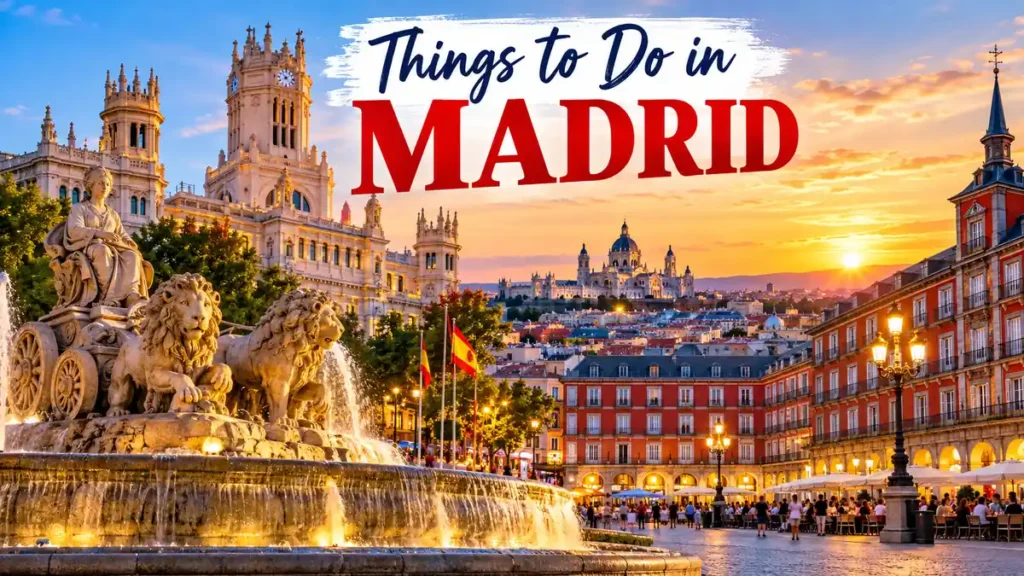
Madrid is a city that rewards curiosity. Its headline attractions are exceptional, but much of the pleasure comes from walking between them: stopping for tapas, wandering through historic neighborhoods, relaxing in leafy parks, and staying out later than you planned.
The best things to do in madrid include visiting the Prado Museum and Royal Palace, walking through El Retiro Park, exploring Plaza Mayor and Puerta del Sol, seeing Picasso’s Guernica at the Reina Sofía, eating tapas in La Latina, browsing El Rastro, watching flamenco, and enjoying sunset views from the Temple of Debod.
Madrid is especially convenient for first-time visitors because many of its major sights are concentrated around the historic center, Paseo del Arte, and Retiro. Yet neighborhoods such as Malasaña, Chueca, Lavapiés, and Chamberí show completely different sides of the Spanish capital.
1. See Spanish Masterpieces at the Prado Museum
For art lovers, the Museo Nacional del Prado belongs at the top of any Madrid itinerary.
The Prado forms part of the city’s celebrated Paseo del Arte, or Art Walk. Madrid’s cultural core contains three internationally important museums—the Prado, Reina Sofía, and Thyssen-Bornemisza—within a relatively compact area.
The Prado is particularly associated with European masters and Spain’s great painters. Works by Diego Velázquez, Francisco Goya, El Greco, Peter Paul Rubens, and Hieronymus Bosch make it possible to move through centuries of European art without leaving the building.
One common mistake is trying to see everything. Unless you are an art specialist with an entire day available, choose a manageable group of highlights and give them proper attention.
A focused first visit might include Velázquez’s Las Meninas, Bosch’s The Garden of Earthly Delights, and major works by Goya.
Quick takeaway: Allow roughly two to three hours for a first visit rather than treating the Prado as a quick photo stop.
2. Tour the Royal Palace of Madrid
The Palacio Real is one of Madrid’s most impressive historic attractions.
At more than 135,000 square meters with 3,418 rooms, the Royal Palace of Madrid is described by Patrimonio Nacional as the largest royal palace in Western Europe. It remains an official royal residence and is also used for state ceremonies and official events.
Visitors can explore lavish ceremonial spaces such as the Throne Room, Hall of Columns, Royal Chapel, Royal Armoury, and Gasparini Room.
The scale becomes apparent before you even enter. Stand in Plaza de la Armería and take in the palace exterior before beginning the interior tour.
Because capacity is limited, Patrimonio Nacional recommends buying tickets online in advance. Opening arrangements can also change when official events take place, so checking the current schedule before visiting is sensible.
Afterward, walk toward the nearby Almudena Cathedral or continue into the historic Austrias quarter.
3. Relax in El Retiro Park
After museums and monuments, El Retiro provides a welcome change of pace.
This former royal garden covers more than 125 hectares and forms part of Madrid’s UNESCO-listed cultural landscape. Its combination of trees, gardens, monuments, exhibition spaces, and recreational areas makes it much more than an ordinary city park.
Among the highlights are:
- Palacio de Cristal, or Crystal Palace
- The Great Pond
- Monument to Alfonso XII
- Rose Garden
- Parterre Garden
- Tree-lined walking paths
Renting a rowboat on the Great Pond is one of the classic Madrid experiences, but simply walking through the park can be equally enjoyable.
The Crystal Palace is particularly striking. Its iron-and-glass architecture catches the changing daylight beautifully and makes it one of Madrid’s most recognizable structures.
Retiro is also easy to combine with the Prado Museum and Puerta de Alcalá.
4. Walk Through Plaza Mayor
Plaza Mayor sits at the heart of Habsburg Madrid and remains one of the city’s most recognizable public spaces.
Its enclosed rectangular layout, red façades, arcades, and balconies make the square feel distinct from Madrid’s busier modern avenues.
Instead of simply walking into the plaza, taking a picture, and leaving, explore the surrounding streets. This is one of the best areas for appreciating the older layout of central Madrid.
Nearby streets lead toward Mercado de San Miguel, Calle Mayor, Puerta del Sol, and the Royal Palace.
The restaurants directly on famous squares tend to prioritize location and atmosphere. For a more local dining experience, walk a few streets away before choosing where to eat.
5. Experience the Energy of Puerta del Sol
Puerta del Sol is one of the busiest and most famous squares in Madrid and an excellent geographical reference point for exploring the center.
Look for the statue of the Bear and the Strawberry Tree, one of Madrid’s best-known symbols, and the Kilometer Zero marker associated with Spain’s radial road network.
Sol is also closely connected with Spanish New Year’s Eve traditions, when crowds gather around the clock at the Real Casa de Correos.
From here, you can easily walk toward Gran Vía, Plaza Mayor, the Literary Quarter, or the Royal Palace.
Sol is rarely Madrid’s quietest corner. That is part of the point: come here for movement, street life, and the feeling of standing in the center of the capital.
6. See Picasso’s Guernica at the Reina Sofía
If the Prado introduces you to earlier Spanish masters, the Museo Nacional Centro de Arte Reina Sofía takes the story into modern and contemporary art.
Its defining masterpiece is Pablo Picasso’s Guernica, one of the most influential anti-war paintings of the 20th century.
The museum’s broader collection helps place Picasso alongside figures such as Salvador Dalí and Joan Miró.
Do not rush straight to Guernica and immediately leave. Seeing the surrounding works and historical material makes the painting considerably more meaningful.
The Reina Sofía, Prado, and Thyssen-Bornemisza together form Madrid’s famous Golden Triangle of Art, one of the reasons the city has such an international reputation for museums.
7. Complete the Art Triangle at the Thyssen-Bornemisza
Travelers who want a broader view of Western art should also visit the Museo Nacional Thyssen-Bornemisza.
Where the Prado is particularly strong in historic European masters and the Reina Sofía focuses heavily on modern art, the Thyssen helps bridge different periods and styles.
That makes the three museums complementary rather than interchangeable.
Trying to visit all three major museums properly in one day can be exhausting. A better approach is to choose one major museum per day or pair a longer museum visit with a park, neighborhood walk, or food experience.
8. Explore Madrid de los Austrias
One of the best ways to understand Madrid’s history is simply to walk through Madrid de los Austrias, the city’s Habsburg-era center.
The official tourism board describes Austrias as Madrid’s oldest area, combining landmarks such as the Royal Palace and Plaza Mayor with the lively streets surrounding them.
A useful walking route connects:
Royal Palace → Plaza de Oriente → Calle Mayor → Plaza Mayor → Puerta del Sol.
Along the way, look beyond the monumental buildings. Small plazas, balconies, churches, taverns, and narrow side streets reveal the scale of older Madrid more effectively than racing between individual attractions.
For first-time visitors, this is one of the most rewarding free things to do in Madrid.
9. Eat Your Way Through Madrid’s Tapas Scene
Madrid is a serious food city.
Tapas can be as simple as olives, tortilla española, croquetas, anchovies, cheese, or jamón, but the social ritual matters as much as the individual dish.
Rather than ordering an entire evening’s meal at one place, try moving between a few bars and ordering one or two specialties at each.
La Latina is particularly well known for its tapas scene. Calle Cava Baja is packed with bars and taverns and is regularly highlighted as a place for tapas hopping.
Other foods worth trying include:
- Tortilla española
- Bocadillo de calamares
- Jamón ibérico
- Croquetas
- Patatas bravas
- Cocido madrileño
- Churros con chocolate
Madrid’s official tourism information also emphasizes everything from century-old taverns to contemporary restaurants and rooftop bars as part of the city’s food culture.
10. Visit Mercado de San Miguel
Just outside Plaza Mayor, Mercado de San Miguel is one of the most famous food markets in central Madrid.
Its location makes it extremely easy to include while exploring the historic center.
Rather than thinking of it as a traditional grocery market alone, approach it as a food hall where you can sample different Spanish flavors in one place.
It can become busy, especially around popular meal times. Visiting earlier in the day often makes browsing easier.
Prices may be higher than at neighborhood bars, so the market works best as an experience and tasting stop rather than your only introduction to Madrid’s food culture.
11. Browse El Rastro on Sunday
If you are in Madrid on a Sunday or public holiday, make time for El Rastro.
This famous open-air flea market takes over streets around La Latina, drawing shoppers looking for everything from second-hand goods and clothing to collectibles, household items, and unusual finds. Madrid’s official tourism information identifies it as the city’s classic Sunday market.
Arrive earlier if you want more comfortable browsing. Later in the day, the surrounding streets can become extremely crowded.
The best plan is to combine El Rastro with lunch or tapas in La Latina afterward.
Even if you buy nothing, the market offers an entertaining glimpse of Madrid’s street culture.
12. Watch the Sunset at the Temple of Debod
An authentic ancient Egyptian temple in central Madrid sounds improbable, but that is exactly what makes the Temple of Debod so memorable.
The monument sits near Parque del Oeste and Plaza de España and has become particularly popular around sunset.
The elevated surroundings offer broad views toward western Madrid, while the changing light creates one of the city’s classic evening scenes.
Arrive before sunset rather than exactly at sunset. This gives you time to walk around the monument, find a viewpoint, and watch the sky gradually change.
It is also one of the easiest free activities to add to a Madrid itinerary.
13. Walk Down Gran Vía
Gran Vía represents a different side of Madrid from the narrow streets around Plaza Mayor.
Here the city feels grander and more metropolitan, with monumental architecture, theaters, shops, hotels, restaurants, cinemas, and constant pedestrian traffic.
Look upward as you walk. Some of Gran Vía’s most interesting details are above street level, including elaborate façades, domes, statues, and rooftop structures.
The surrounding Sol–Gran Vía district is one of Madrid’s busiest tourist areas.
For a memorable evening, walk Gran Vía after dark when illuminated signs and buildings give the avenue a completely different atmosphere.
14. Discover Barrio de las Letras
Barrio de las Letras, or the Literary Quarter, is closely associated with Spain’s Golden Age of literature.
Major writers once lived in this area, and Madrid’s tourism board still presents the neighborhood through that literary heritage.
Today, its narrow streets combine history with cafés, restaurants, independent businesses, and nightlife.
It is especially convenient because it lies between the central tourist zone and Paseo del Arte.
Instead of following a strict sightseeing checklist here, wander. Barrio de las Letras is better experienced through its streets and atmosphere than through a single headline monument.
15. Experience Madrid’s Neighborhoods
Some of the best things to do in madrid involve leaving the main sightseeing route for a few hours.
Malasaña
Malasaña is associated with alternative culture, vintage shopping, nightlife, and the legacy of Madrid’s countercultural Movida movement.
The official tourism board describes it as a center of bohemian and underground culture.
Chueca
Chueca is energetic and cosmopolitan, with restaurants, nightlife, shops, and a strong LGBTQ+ identity.
It works particularly well for an evening of dinner, drinks, and walking.
Lavapiés
Lavapiés is one of Madrid’s most multicultural neighborhoods. Its mixture of cultural influences makes it especially interesting for food, independent cultural spaces, and street life.
Chamberí
For a more residential atmosphere, explore Chamberí. Its traditional architecture and neighborhood restaurants offer a contrast to the heavily visited streets around Sol.
Exploring at least one neighborhood beyond the historic core can make a short trip feel considerably richer.
16. See a Flamenco Performance
Flamenco developed primarily in southern Spain, particularly Andalusia, but Madrid has long been an important stage for professional performers.
The city has numerous tablaos where visitors can watch singers, dancers, and guitarists perform in relatively intimate spaces. Madrid’s official tourism organization lists flamenco among the city’s signature cultural experiences.
Quality matters more than spectacle.
Look for a venue where the performance itself is the focus rather than treating flamenco merely as background entertainment during dinner.
If you have never seen flamenco live, pay attention to the interaction among the singer, guitarist, dancer, and rhythmic hand clapping. Much of its intensity comes from that communication.
17. Visit Santiago Bernabéu Stadium
Football fans will recognize the Santiago Bernabéu as the home of Real Madrid.
The stadium is one of Madrid’s major modern attractions, and the city’s official tourism resources place it among the capital’s headline sights.
A stadium visit can be worthwhile even when no match is scheduled, particularly for travelers interested in the history of Real Madrid and European football.
On match days, the surrounding Castellana area becomes part of the experience as supporters gather before kickoff.
If attending a match or booking a stadium experience is important to your trip, verify the current schedule and visitor arrangements beforehand.
18. Admire Cibeles and Puerta de Alcalá
Not every Madrid attraction requires a long visit.
Two landmarks worth including on a walking route are the Cibeles Fountain and Puerta de Alcalá.
Cibeles is one of Madrid’s most recognizable symbols and stands near the beginning of the city’s Art Walk. Puerta de Alcalá, built under Charles III in the 18th century, forms a monumental gateway near Retiro Park.
Both work naturally as part of a route connecting Gran Vía, Plaza de Cibeles, Paseo del Prado, and Retiro.
The key is not to schedule them as separate half-day attractions. Treat them as impressive landmarks encountered while walking between larger sights.
19. Spend Time in Casa de Campo or Madrid Río
Retiro gets most of the attention, but Madrid has much more green space.
Casa de Campo offers a dramatically larger outdoor environment west of the historic center. Madrid’s official tourism site describes it as Spain’s largest urban park.
It is a useful choice when you want to escape dense city streets for several hours.
Madrid Río, meanwhile, follows the Manzanares River and provides green space for walking, cycling, recreation, and family activities.
These areas are especially valuable on longer trips when you have already covered Madrid’s major museums and historic landmarks.
20. See Madrid From Above
Madrid changes character when viewed from a rooftop.
Central Madrid has numerous rooftop terraces and viewpoints where you can see Gran Vía, historic rooftops, church domes, modern towers, and the mountains beyond the city on clear days.
Popular viewing areas include central rooftops around Gran Vía and Cibeles as well as the Temple of Debod area around sunset.
Madrid’s official tourism information also highlights rooftop bars and panoramic viewpoints as part of the city’s visitor experience.
Try to schedule at least one elevated viewpoint near the end of your trip. Recognizing streets and monuments you have already explored makes the panorama more meaningful.
Best Free Things to Do in Madrid
Madrid does not have to be an expensive destination.
Some of its most enjoyable experiences involve simply exploring the city on foot. Good free activities include walking through Plaza Mayor and Puerta del Sol, exploring Gran Vía, wandering Madrid de los Austrias, relaxing in Retiro Park, browsing El Rastro, visiting the Temple of Debod area, and exploring neighborhoods such as Malasaña and La Latina.
Several major cultural attractions also offer free-entry periods under specific conditions. For example, the Royal Palace publishes designated free-admission times and eligibility requirements, although these can involve capacity restrictions.
Always check the attraction’s official information before building an itinerary around free admission.
Saving money is useful, but spending an hour in a queue to save an admission fee may not be worthwhile on a short trip.
Things to Do in Madrid at Night
Madrid is famously lively after dark.
Evenings tend to start later than visitors from some countries expect, and neighborhoods can remain busy well into the night.
Start with dinner or tapas, continue with a flamenco performance, walk along illuminated Gran Vía, or head to a rooftop for drinks and city views.
La Latina is a natural choice for traditional tapas. Malasaña offers alternative nightlife, while Chueca has a broad selection of restaurants and bars.
You do not have to stay out until sunrise to experience Madrid’s nighttime atmosphere. Even an evening walk through the center after dinner shows how differently the city operates once daytime sightseeing ends.
Things to Do in Madrid With Families
Madrid works surprisingly well for families because major attractions can be mixed with large outdoor spaces.
Retiro Park provides room for children to move around between museum visits, while Madrid Río and Casa de Campo offer additional recreational space. The official tourism board specifically maintains family-oriented activity recommendations.
A family itinerary should avoid stacking multiple museums back-to-back.
Instead, alternate structured attractions with parks, food stops, plazas, and short walks.
For example:
Morning: Royal Palace
Lunch: Historic center
Afternoon: Retiro Park
Evening: Early dinner and a walk through Gran Vía
That rhythm usually works better than trying to complete an adult sightseeing checklist with children in tow.
How Many Days Do You Need in Madrid?
Three days is a strong starting point for a first visit.
With three full days, you can experience the major historic sights, one or two important museums, Retiro Park, several neighborhoods, and Madrid’s food scene without turning the trip into a race.
A practical three-day itinerary looks like this:
| Day | Morning | Afternoon | Evening |
|---|---|---|---|
| 1 | Royal Palace and Austrias | Plaza Mayor and Sol | La Latina tapas |
| 2 | Prado Museum | Retiro and Puerta de Alcalá | Gran Vía or rooftop |
| 3 | Reina Sofía or Thyssen | Barrio de las Letras and neighborhood exploring | Flamenco |
With four or five days, add El Rastro if your visit includes Sunday, Santiago Bernabéu, Casa de Campo, Madrid Río, more museums, or slower neighborhood exploration.
Madrid’s tourism board also publishes dedicated 24-hour, 48-hour, and week-long itinerary resources, reflecting how easily a visit can be scaled to different trip lengths.
What Is the Best Area of Madrid for First-Time Visitors?
For a first trip, staying around Centro, Sol, Gran Vía, Austrias, Barrio de las Letras, or the Retiro/Paseo del Arte area keeps many attractions within easy reach.
Sol–Gran Vía places you at the center of the action. Austrias works well for historic atmosphere, while Barrio de las Letras provides a good balance between museums, restaurants, and walkability.
La Latina is attractive for tapas and nightlife. Chueca and Malasaña suit travelers who prioritize restaurants, bars, shopping, and evening activity.
There is no single “best” neighborhood for everyone. The right choice depends on whether you value quiet evenings, nightlife, museum access, historic character, or transport convenience.
Practical Tips for Visiting Madrid
A little planning can make a substantial difference.
Book high-priority attractions such as the Royal Palace in advance when possible. The palace itself recommends advance online purchase because visitor capacity is limited.
Group attractions geographically rather than crossing the city repeatedly. Prado, Retiro, Cibeles, and Puerta de Alcalá fit naturally together. The Royal Palace, Plaza Mayor, Mercado de San Miguel, and Sol form another convenient cluster.
Madrid is highly walkable in its central districts, but comfortable shoes matter. A day that looks modest on a map can involve many hours on your feet.
Keep meal times in mind too. Madrid operates later than many visitors expect, particularly in the evening.
Most importantly, leave unscheduled time. Some of the city’s most memorable moments happen between the attractions rather than inside them.
Making the Most of Madrid
The best things to do in madrid combine world-famous attractions with ordinary city life.
See Velázquez and Goya at the Prado, walk through the rooms of the Royal Palace, spend an afternoon beneath the trees of Retiro, and stand before Picasso’s Guernica. Those experiences deserve their reputations.
But do not stop there.
Browse El Rastro on Sunday, order tapas in La Latina, wander through Barrio de las Letras, watch the sunset near the Temple of Debod, explore Malasaña or Chueca after dark, and spend some time doing nothing more ambitious than sitting in a plaza and watching Madrid go by.
That balance—great art, royal history, food, parks, neighborhoods, and an unusually energetic street culture—is what makes Madrid worth more than a checklist of attractions.