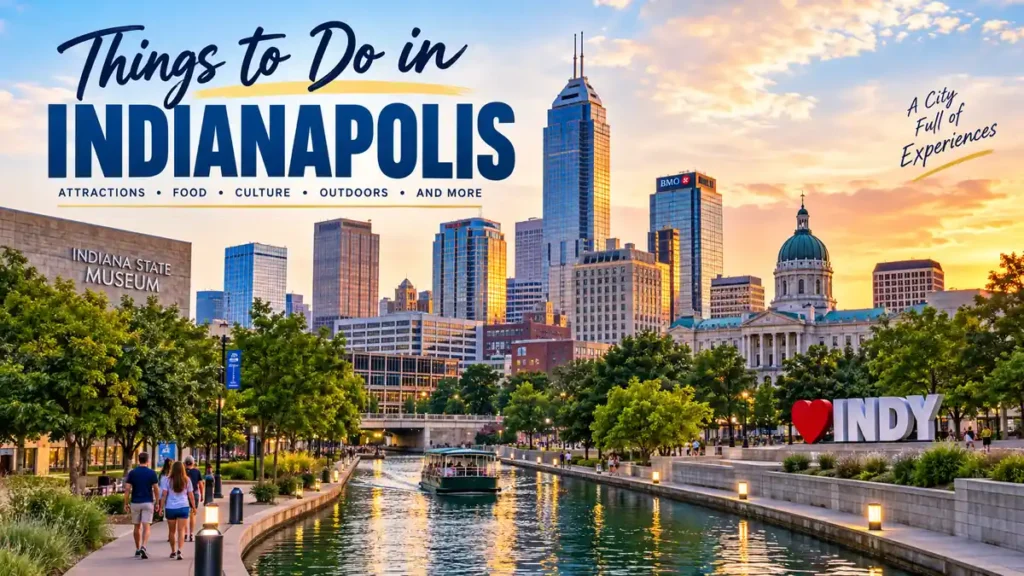
Indianapolis has a habit of surprising first-time visitors. You may arrive thinking mainly about the Indy 500, then discover a walkable downtown packed with museums, canals, public art, sports venues, historic neighborhoods, gardens, and one of the world’s largest children’s museums.
If you’re looking for things to do in indianapolis, start with the Indianapolis Motor Speedway, White River State Park, the Children’s Museum of Indianapolis, Monument Circle, Newfields, and the Indianapolis Cultural Trail. Add the city’s distinctive neighborhoods, local history museums, parks, sports, and food districts, and you can easily fill a long weekend.
This guide focuses on the attractions and experiences that give Indianapolis its personality, including options for families, couples, history lovers, sports fans, and travelers searching for free things to do.
Best things to do in indianapolis for first-time visitors
A first trip to Indianapolis is easiest to plan around three areas: downtown and White River State Park, the Indianapolis Motor Speedway west of downtown, and the cultural neighborhoods linked by trails and short drives.
Here are the standout places worth prioritizing.
| Indianapolis attraction | Best for | Approximate time to allow |
|---|---|---|
| Indianapolis Motor Speedway Museum | Racing and history | 2–3 hours |
| The Children’s Museum of Indianapolis | Families | Half to full day |
| White River State Park | Walking and multiple attractions | 2–5 hours |
| Indianapolis Zoo | Families and wildlife | 3–5 hours |
| Monument Circle | Architecture and city views | 30–90 minutes |
| Newfields | Art, gardens, nature | 3–5 hours |
| Indianapolis Cultural Trail | Biking and neighborhoods | 1–4 hours |
| Eiteljorg Museum | Native and Western art | 2–3 hours |
| Indiana State Museum | Indiana history and science | 2–3 hours |
| Mass Ave | Dining, nightlife, local culture | 2–4 hours |
1. Experience the Indianapolis Motor Speedway Museum
Indianapolis and auto racing are inseparable, so the Indianapolis Motor Speedway Museum deserves a place near the top of almost any first-time itinerary.
The museum sits at the famous Indianapolis Motor Speedway, home of the Indianapolis 500. Even people who don’t follow motorsports often find the place more interesting than expected because it deals with engineering, technology, personalities, design, competition, and more than a century of racing history.
The museum reopened in April 2025 following a major 17-month, $60.5 million renovation. The redesigned facility now contains about 80,000 square feet, more than 55,000 artifacts and a collection of more than 200 vehicles.
Interactive experiences and expanded galleries make it far more than a room filled with old cars. Racing simulators, historic vehicles, trophies, photography, engineering exhibits, and Indianapolis 500 stories help put the Speedway’s importance into context.
What actually works: Allow at least two hours instead of trying to squeeze the museum into a short stop. Racing fans can easily spend longer.
If you’re visiting around Memorial Day weekend, remember that the Indianapolis 500 transforms the entire Speedway area. The atmosphere is extraordinary, but traffic, crowds, schedules, and ticket availability are very different from a normal sightseeing day.
Family things to do in indianapolis
Indianapolis is particularly strong for family travel. Several of its headline attractions are designed for children without feeling like places adults simply have to endure.
2. Spend a day at The Children’s Museum of Indianapolis
The Children’s Museum of Indianapolis is one of the city’s signature attractions and a reasonable reason to visit Indianapolis even if little else were on your itinerary.
It bills itself as the world’s largest children’s museum, with approximately 485,000 square feet of public space, five floors of indoor exhibits, and 7.5 acres of outdoor experiences.
The variety is the real advantage. Families can move from dinosaurs and science to history, culture, space-themed experiences, interactive exhibits, and outdoor sports rather than spending an entire day on one subject.
The outdoor Riley Children’s Health Sports Legends Experience is especially useful when children need to run rather than look at another display.
How long do you need at the Children’s Museum of Indianapolis?
A half day is the minimum that makes sense for most families. A full day is better if your children enjoy interactive museums.
One common mistake is planning the museum for two hours and then placing several other major attractions on the same day. There is enough here to make that schedule frustrating.
3. See wildlife at the Indianapolis Zoo
The Indianapolis Zoo sits inside White River State Park, making it unusually convenient for travelers staying downtown.
The zoo combines animal habitats with an aquarium and botanical elements. Dolphins, orangutans, elephants, big cats, birds, reptiles and other animals make it broad enough for several hours rather than a quick walk-through.
One of its major newer attractions is the Penny & Jock Fortune International Chimpanzee Complex, designed with multiple indoor and outdoor areas that allow chimpanzees to move around and choose between spaces.
That location also makes itinerary planning easier. You can visit the zoo in the morning, walk through White River State Park afterward, and continue toward museums or downtown without spending the whole day driving around Indianapolis.
4. Explore White River State Park
If you want several of the best things to do in indianapolis concentrated in one area, start at White River State Park.
The roughly 250-acre downtown park combines green space and waterways with major cultural attractions including the Indianapolis Zoo, Indiana State Museum, Eiteljorg Museum, Central Canal, IMAX theater, Victory Field and Everwise Amphitheater.
That concentration is one of Indianapolis’s underrated strengths.
Instead of treating the park as a single attraction, think of it as an itinerary hub. You could spend most of a day here without needing your car.
A practical route is:
- Start near the Indiana State Museum or Eiteljorg Museum.
- Walk part of the Central Canal.
- Continue through the park toward the Indianapolis Zoo.
- Return toward downtown around sunset.
- Finish the evening near Monument Circle or the Wholesale District.
Free things to do in indianapolis
You don’t need an attraction ticket for every hour of an Indianapolis trip. Some of the most memorable experiences are outdoors and free.
5. Walk the Indianapolis Canal Walk
The Central Canal gives downtown Indianapolis one of its most recognizable landscapes.
The Canal Walk forms a roughly three-mile loop running from White River State Park north toward 11th Street. It is used by walkers, runners, cyclists and visitors simply looking for a quieter way to see the center of the city.
Walk it early in the morning for a peaceful start to the day, or return around sunset when the skyline and water are more atmospheric.
The trail passes near several museums, public spaces and memorials, so you can use it as transportation as well as an attraction.
6. Visit Monument Circle and the Soldiers & Sailors Monument
Monument Circle is the symbolic heart of Indianapolis.
At its center stands the Soldiers & Sailors Monument, completed in the late 19th and early 20th centuries and formally dedicated in 1902. The monument commemorates Indiana veterans from conflicts prior to World War I.
Even if you don’t go inside, walk the entire circle. The surrounding buildings help explain why Indianapolis is sometimes called the Circle City.
The observation level reopened in August 2026 following a long closure, giving visitors another opportunity to see downtown from above. Current official information lists limited opening days, so check the schedule before building your itinerary around it.
At night, Monument Circle also hosts the Shining A Light projection presentation, turning the monument into a large-scale visual display.
7. Bike or walk the Indianapolis Cultural Trail
Few infrastructure projects explain modern Indianapolis better than the Indianapolis Cultural Trail.
The urban trail connects downtown cultural districts and neighborhoods including Mass Ave, Fountain Square, Indiana Avenue and the White River area, while links such as the Monon Trail extend the cycling network farther north toward Broad Ripple.
Renting a bicycle can therefore be more than recreation—it is a practical way to understand how the city’s neighborhoods fit together.
For a casual outing, ride between downtown, Mass Ave and Fountain Square. More enthusiastic cyclists can continue onto the Monon Trail.
Quick takeaway: Downtown Indianapolis is more pedestrian- and bike-friendly than its Midwestern location may suggest. You can see a surprising amount without repeatedly moving your car.
Museums and cultural attractions in Indianapolis
One of the biggest gaps in quick Indianapolis itineraries is treating the city purely as a sports destination. Its museum lineup is strong enough to occupy several days.
8. See art and gardens at Newfields
Newfields is where Indianapolis blends art, architecture, landscaped gardens and nature particularly well.
The 152-acre campus includes the Indianapolis Museum of Art galleries, gardens, historic homes, performance spaces, a nature preserve and a sculpture park.
That combination makes Newfields different from a conventional art museum. You can spend an hour indoors looking at art, walk outside through formal gardens, visit sculpture-filled landscapes, and continue into wooded areas.
Art lovers may want most of a day. Visitors more interested in gardens can still enjoy Newfields without examining every gallery.
Seasonal installations and temporary exhibitions change, so check the current program before visiting.
9. Explore Native and Western art at the Eiteljorg Museum
The Eiteljorg Museum of American Indians and Western Art stands in White River State Park and offers one of the more distinctive museum collections in the Midwest.
Its collections and exhibitions examine Indigenous peoples of North America and the art, histories and cultures associated with the American West. The Native American collection incorporates works from many Native nations, while the Western collection includes historic and contemporary artists.
The museum is especially worthwhile if you’re looking for something culturally specific rather than another broad city history museum.
Plan two hours, perhaps three if a temporary exhibition interests you.
10. Learn Indiana’s story at the Indiana State Museum
The Indiana State Museum is another major White River State Park attraction.
Rather than concentrating on one period, its exhibits explore Indiana’s natural history, science, people, culture and historical development.
That makes it a good choice for visitors who have just arrived in the state and want context. You’ll leave with a better understanding of Indiana beyond Indianapolis itself.
It also works well on bad-weather days because you can combine it with the neighboring Eiteljorg Museum without moving your car.
11. Visit the Kurt Vonnegut Museum and Library
Indianapolis-born writer Kurt Vonnegut is closely associated with the city, and literary travelers should make time for the Kurt Vonnegut Museum and Library on Indiana Avenue.
The institution explores Vonnegut as an author, artist, World War II veteran, free-expression advocate and Indianapolis figure. It occupies a building in an area historically connected with Indiana Avenue’s Black cultural and jazz heritage.
Even readers who know only Slaughterhouse-Five will gain more context about his life and worldview.
This is an especially useful addition if your itinerary already includes nearby downtown attractions and you want something more personal than a large museum.
12. Explore the Indiana War Memorial district
Indianapolis has an unusually extensive collection of war memorials.
The Indiana War Memorial Plaza Historic District incorporates the Indiana War Memorial, Veterans Memorial Plaza, University Park, American Legion Mall and other sites.
The Indiana War Memorial Museum presents Indiana’s involvement in American conflicts through chronological exhibits. Current official hours list the museum as open Wednesday through Sunday, although schedules can change around holidays.
The district is easy to walk from Monument Circle, making it a good free or low-cost extension to a downtown sightseeing day.
Outdoor things to do in indianapolis
Indianapolis is not a mountain or beach destination, but travelers who want green space have more options than the downtown skyline suggests.
13. Wander around Holliday Park
Holliday Park is one of the best places to escape traffic without leaving Indianapolis.
Wooded trails, playgrounds and nature areas give it a neighborhood feel, but its most recognizable feature is The Ruins, a sculptural installation built around architectural remnants.
Visit during spring or fall when the surrounding trees make walking especially pleasant.
It works particularly well when you’ve spent the previous day indoors at museums.
14. Visit Garfield Park and its gardens
Garfield Park, south of downtown, combines historic landscaping, recreational areas, gardens and the Garfield Park Conservatory.
The Conservatory contains tropical plants and waterfalls, while the Sunken Garden adds a formal outdoor garden experience. The site dates to Indianapolis’s early park-planning era and remains a good stop for travelers who prefer plants to crowded attractions.
Because construction and horticultural displays can temporarily change access to sections of the gardens, confirm current conditions before traveling specifically for them.
15. Get outdoors at Fort Harrison State Park
For more substantial trails and nature, head northeast to Fort Harrison State Park.
The park covers roughly 1,700 acres and includes walking, running and cycling routes as well as recreation connected to the site’s former military history.
It’s particularly appealing in autumn when central Indiana’s foliage begins changing color.
If your Indianapolis trip lasts four or five days, this is a good counterbalance to downtown museums and sporting venues.
Indianapolis neighborhoods worth exploring
Some of the best experiences in Indianapolis are not individual attractions at all. They’re neighborhoods.
16. Walk Mass Ave
Massachusetts Avenue, usually called Mass Ave, is one of the easiest districts to recommend to first-time visitors.
Restaurants, independent businesses, theaters, bars, murals and public art line the corridor, and the Cultural Trail makes it easy to reach by foot or bicycle from central downtown.
Go in the late afternoon so you can browse before dinner and see the district become livelier after dark.
Mass Ave is also close to the Bottleworks District, a redevelopment of a former Coca-Cola bottling plant that now mixes historic architecture with entertainment and dining.
17. Spend an evening in Fountain Square
Fountain Square has a more eclectic personality.
Expect independent restaurants, music venues, bars, vintage shops, art spaces and older neighborhood architecture. Together with nearby Fletcher Place, it feels less corporate than the convention-center core of downtown.
It’s a strong choice for couples or groups who want dinner followed by live entertainment without going to a large arena.
18. Discover Broad Ripple Village
North of downtown, Broad Ripple Village has long been associated with restaurants, nightlife, independent businesses and the Monon Trail.
During the day, combine the neighborhood with cycling or walking. In the evening, it becomes more nightlife-oriented.
Broad Ripple makes the most sense for travelers with an extra day because it sits outside the compact cluster of central attractions.
19. Learn about Indiana Avenue
Indiana Avenue played an important role in Indianapolis’s Black business, entertainment and cultural history during the early 20th century.
Jazz clubs and Black-owned businesses once made the district one of the city’s major cultural centers. Today, sites such as the Kurt Vonnegut Museum and nearby cultural landmarks can help visitors understand that history. Visit Indy continues to highlight Indiana Avenue as one of the city’s historic cultural districts.
Rather than simply passing through, read about the neighborhood before walking it. Much of what made the avenue historically significant is easier to appreciate with context.
Sports things to do in Indianapolis
Calling Indianapolis a sports city almost understates it. Major sporting venues sit unusually close to downtown hotels and cultural attractions.
20. See a game at Lucas Oil Stadium or Gainbridge Fieldhouse
Lucas Oil Stadium is home to the NFL’s Indianapolis Colts, while Gainbridge Fieldhouse hosts the NBA’s Indiana Pacers and WNBA’s Indiana Fever.
Even if your trip doesn’t coincide with a game, check event schedules. Both venues also host concerts and major events.
Lucas Oil Stadium is particularly convenient for downtown visitors because it connects closely with the Indiana Convention Center and central hotel district.
During basketball season, Gainbridge Fieldhouse gives visitors an easy way to combine sightseeing with an evening sporting event.
21. Watch baseball at Victory Field
Victory Field, home of the Indianapolis Indians minor-league baseball team, sits beside White River State Park.
That location makes a summer baseball game remarkably easy to add to a sightseeing itinerary.
Spend the afternoon at the Eiteljorg Museum or Indiana State Museum, walk through the park, then catch an evening game.
Even people who aren’t serious baseball fans often enjoy minor-league games because the environment is relaxed and usually more intimate than a major-league stadium.
Unique things to do in Indianapolis
Once you’ve covered the obvious attractions, a few experiences reveal a different side of the city.
Walk through Lockerbie Square
Lockerbie Square is one of Indianapolis’s oldest surviving residential districts.
Its restored 19th-century homes, brick sidewalks and intimate streets provide a sharp contrast with downtown’s large monuments and sports venues.
It’s an easy detour from Mass Ave and works best as a leisurely walk rather than a destination requiring hours.
Explore the Benjamin Harrison Presidential Site
History travelers can visit the home associated with Benjamin Harrison, the 23rd president of the United States.
The property explores Harrison’s family life, political career and late-19th-century America.
Indianapolis is highlighting the site during America’s 250th-anniversary programming in 2026, making it particularly timely for visitors interested in U.S. history.
Look for public art and murals
Indianapolis rewards slow exploration.
The Cultural Trail and districts such as Fountain Square and Mass Ave contain public art installations and murals that are easy to miss when traveling only between famous attractions.
Leave some unscheduled time to explore rather than treating every stop as a museum reservation.
Things to do in indianapolis for couples
A good Indianapolis date day doesn’t require anything particularly elaborate.
Start with coffee and a morning walk along the Central Canal. Spend late morning at Newfields, then explore the gardens before heading toward Mass Ave or Fountain Square for dinner.
For another option, bicycle part of the Cultural Trail, stop at White River State Park, and finish around Monument Circle after dark.
Couples who prefer activities over sightseeing can build a day around an Indianapolis Indians game, a performance, live music, or a Speedway experience.
The strongest combination is usually one major attraction + one neighborhood + one relaxed outdoor activity. Trying to cram four ticketed attractions into the same day takes away much of what makes the city enjoyable.
Things to do in indianapolis with kids
For families, prioritize quality over quantity.
A practical three-day family itinerary might look like this:
Day 1: Spend most of the day at the Children’s Museum of Indianapolis.
Day 2: Visit the Indianapolis Zoo, walk around White River State Park and explore the Canal Walk.
Day 3: Tour the Indianapolis Motor Speedway Museum, then spend the late afternoon around Monument Circle.
Older children may also enjoy the Indiana State Museum, Cultural Trail, Victory Field or interactive racing exhibits at the Speedway Museum.
Families with very young children should avoid overplanning. The Children’s Museum and zoo can each consume most of a day.
What can you do in Indianapolis for free?
If you’re visiting on a limited budget, combine several no-cost or low-cost attractions rather than skipping sightseeing altogether.
You can walk around Monument Circle, explore much of the Canal Walk, use sections of the Cultural Trail, visit downtown memorials, wander neighborhoods such as Lockerbie Square, relax in public parks, and explore outdoor public art.
Some museums also offer occasional free-admission periods or special community days. For example, the Eiteljorg Museum has listed First Friday free admission during designated hours in its current schedule.
Because free-day programs change, verify the date before arriving.
What is Indianapolis best known for?
Indianapolis is best known internationally for the Indianapolis 500 and the Indianapolis Motor Speedway.
But the city’s broader identity includes professional sports, the Children’s Museum of Indianapolis, White River State Park, Indiana government, war memorials, the Cultural Trail, and neighborhoods with distinct food and arts scenes.
That mixture is what makes a visit more interesting than a racing-only itinerary.
The city also uses the nickname Crossroads of America, reflecting Indiana’s long-standing role as a transportation hub.
How many days do you need in Indianapolis?
Two days are enough for the highlights, but three days is the sweet spot for most first-time visitors.
With two days, prioritize:
- Indianapolis Motor Speedway Museum
- White River State Park
- Monument Circle
- One major museum
- Mass Ave or Fountain Square
With three days, you can add Newfields, the Children’s Museum, Indianapolis Zoo, additional neighborhoods or a sporting event without rushing.
Four or more days give you time for places outside the downtown core, including Broad Ripple, Fort Harrison State Park or nearby Conner Prairie in Fishers.
Is downtown Indianapolis walkable?
Yes, many major downtown Indianapolis attractions are reasonably close together.
White River State Park, the Central Canal, Monument Circle, Gainbridge Fieldhouse, Lucas Oil Stadium and several museums can be connected on foot.
The Cultural Trail expands those possibilities by linking central neighborhoods and cultural districts.
You’ll still want a car, rideshare or transit for places such as Newfields, the Children’s Museum, Broad Ripple and the Indianapolis Motor Speedway.
Visit Indy also emphasizes the unusually dense cluster of attractions, hotels and green spaces around the downtown core.
Best time to visit Indianapolis
Late spring and early fall generally offer the easiest combination of pleasant temperatures and outdoor activities.
Spring
Spring brings improving weather and the buildup to the Indianapolis 500.
May is particularly exciting for racing fans, though hotel demand and crowds can increase around race weekend.
Summer
Summer is best for baseball, outdoor concerts, parks, cycling and evening walks along the canal.
Expect hotter and more humid days, particularly in July and August.
Fall
September and October are excellent for neighborhood exploration, trails and parks.
Fall is arguably the most comfortable season if racing is not your main reason for visiting.
Winter
Winter can be cold, but Indianapolis has enough substantial indoor attractions to remain viable.
The Children’s Museum, Newfields galleries, Indiana State Museum, Eiteljorg Museum and Speedway Museum make a cold-weather weekend easy to fill.
How to plan a perfect Indianapolis weekend
If you only have a weekend, don’t try to visit every highly rated attraction.
Friday evening
Walk around Monument Circle, then head to Mass Ave or the Bottleworks District for dinner and an evening stroll.
Saturday
Start at the Indianapolis Motor Speedway Museum.
Return downtown afterward and explore White River State Park, the Central Canal and either the Eiteljorg Museum or Indiana State Museum.
Finish with a sporting event, live performance or dinner in Fountain Square.
Sunday
Choose between Newfields and the Children’s Museum of Indianapolis, depending on who you’re traveling with.
If the weather is good, end your trip with part of the Indianapolis Cultural Trail or a walk through one of the city’s parks.
Practical tips for visiting Indianapolis
The biggest planning advantage in Indianapolis is geographical concentration. Many top attractions sit close together, so organize your schedule by neighborhood rather than ranking everything from one to twenty.
Check opening hours directly before visiting, especially for monuments, gardens and smaller museums. Hours and seasonal access can change more often than major attraction pages imply.
Book extra time around major sporting events. Colts games, Pacers games, large conventions and especially Indianapolis 500 activities can dramatically change downtown traffic and parking.
Don’t spend every meal in the immediate convention-center district. Mass Ave, Fountain Square, Fletcher Place and Broad Ripple reveal more of the city’s neighborhood character.
And leave room for walking. The Central Canal, Monument Circle, Cultural Trail and White River State Park are not filler between attractions; they’re part of the Indianapolis experience.
Choosing the best things to do in indianapolis
The best things to do in indianapolis depend on what brought you to the city, but a few places consistently deserve priority.
Start with the Indianapolis Motor Speedway Museum for the city’s defining racing story, White River State Park for the downtown experience, The Children’s Museum of Indianapolis for families, and Newfields for art and gardens. Add Monument Circle, the Cultural Trail, Eiteljorg Museum and one or two neighborhoods to see Indianapolis beyond its headline attractions.
A well-planned Indianapolis trip isn’t about checking off the longest possible list. Pick a major attraction each day, connect it with a neighborhood or outdoor experience, and give yourself enough time to discover why the Circle City is much more than the Indy 500.