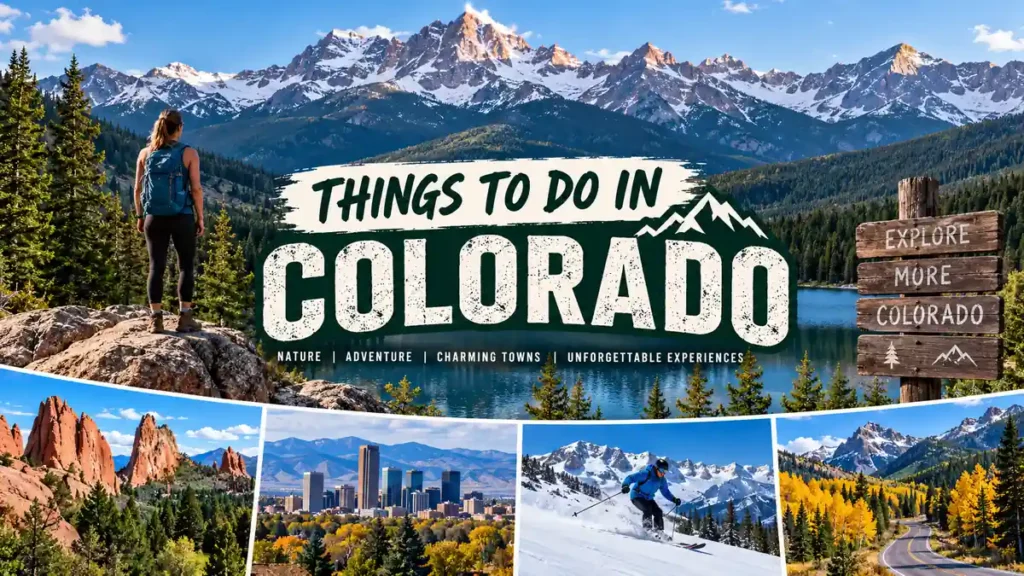
Colorado can feel almost impossible to plan because the state offers several very different trips at once. You can hike above the tree line in the morning, explore ancient cliff dwellings in the afternoon, soak in mineral-rich hot springs after sunset, or spend an entire weekend enjoying Denver’s museums, restaurants, and live music.
The best things to do in colorado include exploring Rocky Mountain National Park, visiting Mesa Verde and Great Sand Dunes national parks, seeing Garden of the Gods, attending a concert at Red Rocks, driving mountain byways, riding historic trains, soaking in hot springs, skiing, rafting, wildlife watching, and exploring cities such as Denver, Boulder, and Colorado Springs.
Colorado is a true four-season destination, but where you go matters just as much as when you go. High-elevation roads can remain snowy long after Denver warms up, summer afternoons often bring mountain thunderstorms, and some of the state’s most popular attractions require advance reservations.
Here are the experiences most worth building a Colorado trip around.
Best things to do in colorado for first-time visitors
If this is your first trip, concentrate on experiences that show Colorado’s range rather than trying to cross the entire state.
| Experience | Best for | Ideal season | Typical time needed |
|---|---|---|---|
| Rocky Mountain National Park | Hiking, wildlife, mountain scenery | Summer–early fall | Full day or longer |
| Garden of the Gods | Easy sightseeing, families, geology | Year-round | 2–4 hours |
| Red Rocks Park & Amphitheatre | Music, views, short hikes | Spring–fall | 2 hours or evening |
| Great Sand Dunes | Sandboarding, unusual landscapes | Spring–fall | Half to full day |
| Mesa Verde National Park | History and archaeology | Late spring–fall | Full day |
| Pikes Peak | High-elevation scenery | Summer–fall | Half day |
| Glenwood Springs | Hot springs and relaxation | Year-round | 1–2 days |
| Durango & Silverton Railroad | Scenic train travel | Spring–fall | Full day |
| Denver | Museums, food, culture | Year-round | 1–3 days |
| Colorado ski country | Skiing and snowboarding | Winter | 2+ days |
The mistake many first-time visitors make is looking at Colorado on a map and assuming destinations are close simply because they are in the same state. Mountain roads, elevation changes, construction, weather, and scenic stops can turn what appears to be a straightforward drive into a major part of the day.
A better approach is to choose one region, then combine nearby attractions.
1. Explore Rocky Mountain National Park
Rocky Mountain National Park is the clearest answer to the question, “What should I not miss in Colorado?”
The park combines alpine lakes, elk-filled valleys, forests, waterfalls, tundra, dramatic mountain passes, and dozens of hiking options. It works equally well for travelers who want an ambitious trail and visitors who mainly want scenic overlooks.
Trail Ridge Road is one of the park’s signature experiences. The road rises above the tree line and reaches 12,000-foot elevations, giving motorists broad views across the Rocky Mountains. It is seasonal and normally closes when winter conditions make high-country travel unsafe.
Popular stops include:
- Bear Lake
- Sprague Lake
- Moraine Park
- Alberta Falls
- Emerald Lake
- Many Parks Curve
- Alpine Visitor Center
- Trail Ridge Road
- Kawuneeche Valley
Wildlife watching is another major reason to visit. Elk are common, while mule deer, marmots, bighorn sheep, and other species may also appear.
Do you need a reservation for Rocky Mountain National Park?
During the 2026 peak season, yes, at certain times.
Rocky Mountain National Park is using two timed-entry options. The general timed-entry reservation covers most of the park but excludes the Bear Lake Road Corridor, while a separate reservation includes Bear Lake Road. The general reservation window runs during daytime peak hours, and Bear Lake access has a longer reservation window.
Because rules can change from year to year, check current National Park Service information shortly before your visit rather than relying on an old itinerary.
Quick takeaway: If you have only one full day for Colorado mountain scenery, Rocky Mountain National Park is one of the strongest choices.
2. Walk among the red rocks at Garden of the Gods
Garden of the Gods in Colorado Springs delivers spectacular scenery without requiring a difficult mountain hike.
Huge red sandstone fins rise from the landscape with Pikes Peak appearing behind them on clear days. The park is particularly good for families, photographers, older travelers, and anyone who wants impressive landscapes without committing to an all-day backcountry adventure.
Walking trails weave through formations such as Balanced Rock and the Central Garden area. You can also explore the park by bicycle, drive, guided tour, or horseback, depending on the experience you want.
The contrast is what makes the landscape memorable: red rock, green vegetation, blue sky, and the Front Range all appear in the same view.
Go early in the morning if possible. You will usually find better light, cooler temperatures, and a calmer atmosphere than you would around the busiest part of the afternoon.
3. See a concert—or simply explore—Red Rocks
Red Rocks Park & Amphitheatre near Morrison is one of Colorado’s most recognizable cultural landmarks.
The open-air amphitheater is framed by enormous sandstone formations, creating a setting that feels as much like a geological attraction as a music venue.
A concert is the classic experience, but you do not necessarily need event tickets to enjoy Red Rocks. During non-event periods, visitors come for views, exercise, trails, photography, and the amphitheater itself.
Pair Red Rocks with Denver if you are staying along the Front Range. It is close enough to fit into a city itinerary while still giving you a taste of Colorado’s rugged landscape.
For music fans, few Colorado experiences combine scenery and live performance quite as effectively.
4. Sandboard at Great Sand Dunes National Park
Great Sand Dunes National Park and Preserve looks almost surreal.
Massive dunes rise from the San Luis Valley while snow-capped mountains stand behind them. Instead of simply viewing the dunes, visitors are allowed to walk across them, climb their ridges, sled down them, and ride sandboards.
Proper sandboards and sand sleds work considerably better than ordinary snow equipment because they are designed with slick bases suited to dry sand.
Some of the most popular activities include:
- Hiking into the dunefield
- Sandboarding
- Sand sledding
- Photographing sunset
- Stargazing
- Exploring Medano Creek when water is flowing
- Driving Medano Pass Primitive Road in a suitable high-clearance 4WD vehicle
- Hiking nearby trails
Medano Creek is seasonal, so do not assume it will be flowing strongly whenever you arrive. The National Park Service recommends checking current conditions when planning around the creek.
Summer also creates a specific hazard: the sand surface can become extremely hot. The park advises visiting the dunes earlier or later in the day during hot weather.
5. Explore Mesa Verde National Park
Mesa Verde gives Colorado something that mountain-focused itineraries often overlook: an extraordinary window into Indigenous history.
The park protects ancestral Pueblo sites, including remarkable masonry structures built within sandstone alcoves. Cliff Palace is the best-known, but Balcony House, Long House, Step House, and other archaeological sites reveal a much broader cultural landscape.
This is not simply a collection of ruins. Mesa Verde tells the story of Ancestral Pueblo communities who lived, farmed, built, traded, and raised families across this region for generations.
Can you enter the cliff dwellings?
Many cliff dwellings can only be entered on reserved ranger-led tours. In 2026, the main cliff-dwelling tour season runs from May into October, while Step House provides a self-guided option when open and does not require the same tour reservation.
Balcony House is especially adventurous. The visit involves ladders, a narrow tunnel, stairs, and exposed sections, making it better suited to travelers comfortable with confined spaces and physical climbing.
Do not underestimate driving time inside Mesa Verde. The park entrance is far from some major archaeological areas, and the National Park Service advises allowing substantial time to reach tour locations.
Quick takeaway: Mesa Verde deserves a full day. Trying to squeeze it into a quick roadside stop misses much of what makes the park significant.
6. Look into Black Canyon of the Gunnison
Black Canyon of the Gunnison National Park offers a darker, steeper, more dramatic landscape than Colorado’s better-known alpine parks.
The Gunnison River has cut through hard rock to create an exceptionally narrow canyon with sheer walls and plunging viewpoints.
For most first-time visitors, the South Rim is the practical introduction. Scenic overlooks provide different perspectives into the canyon, while trails range from short walks to more demanding routes.
Black Canyon is particularly appealing if you want national-park scenery without recreating the typical Rocky Mountain National Park itinerary.
Photographers should stay through changing light. The canyon’s appearance shifts dramatically as sunlight enters or leaves different sections of the gorge.
7. Ride the Pikes Peak Cog Railway
Pikes Peak dominates the skyline around Colorado Springs and has long been one of the state’s iconic high-elevation destinations.
You can experience the mountain in several ways, but the Broadmoor Manitou and Pikes Peak Cog Railway offers one of the easiest ways to reach the upper mountain without hiking.
The journey begins around Manitou Springs and climbs through changing ecological zones toward the summit area.
At high elevation, temperatures may be dramatically cooler than in Colorado Springs. Pack an extra layer even when the weather feels comfortable at the base.
People coming from low elevations should also move more slowly than usual. At 14,000 feet, altitude affects some visitors surprisingly quickly.
8. Drive a Colorado scenic byway
One of the best free things to do in Colorado is simply drive.
Colorado’s mountain roads pass through alpine terrain, historic mining areas, river valleys, forests, high passes, and small towns. The journey often becomes more memorable than the destination.
Popular scenic routes include:
- San Juan Skyway
- Peak to Peak Scenic Byway
- Million Dollar Highway
- Trail Ridge Road
- Independence Pass
- Guanella Pass
- Collegiate Peaks Scenic Byway
- Highway 550 through southwest Colorado
The Million Dollar Highway between Silverton and Ouray is particularly famous for dramatic mountain scenery and steep terrain.
If you are uncomfortable with exposed mountain roads, research the route before committing. Some drives feature sharp curves, substantial elevation changes, narrow shoulders, or winter restrictions.
September brings another reason to take a scenic drive: fall color. Aspen groves turn brilliant shades of gold, especially across Colorado’s higher country. Routes around Aspen, Crested Butte, Telluride, Guanella Pass, and the Peak to Peak corridor are popular during foliage season.
9. Ride the Durango & Silverton Narrow Gauge Railroad
Historic railroads offer a completely different way to experience Colorado’s mountain landscapes.
The Durango & Silverton Narrow Gauge Railroad follows a historic route through southwest Colorado, passing rugged terrain that cannot always be appreciated from ordinary highways.
The combination of historic rolling stock, mountain views, river scenery, and the old mining town of Silverton makes the journey especially appealing to families, rail enthusiasts, and travelers who prefer sightseeing without a strenuous hike.
Trip schedules and operating patterns vary seasonally, so allow most or all of the day rather than treating the train as a short attraction.
Other scenic rail experiences around the state include the Georgetown Loop Railroad and Leadville-area train rides.
10. Soak in Colorado’s hot springs
After hiking, skiing, or driving mountain passes all day, few things feel better than soaking in warm mineral water.
Colorado has more than 30 hot-springs destinations according to the state’s official tourism office.
Popular hot-spring areas include:
- Glenwood Springs
- Ouray
- Pagosa Springs
- Steamboat Springs
- Buena Vista
- Nathrop
- Hot Sulphur Springs
Each has a different atmosphere. Some are large developed swimming complexes, while others emphasize smaller pools, mountain views, spa facilities, or rustic settings.
Glenwood Springs works particularly well for families and first-time visitors because it combines hot springs with restaurants, lodging, hiking, and other attractions.
Ouray offers perhaps the most dramatic setting, surrounded by the San Juan Mountains.
Pagosa Springs is another excellent choice if southwest Colorado is already on your route.
11. Go hiking in the Rocky Mountains
Hiking is one of the defining Colorado activities.
The state’s official tourism site highlights roughly 39,000 miles of trails, meaning there is no single “best Colorado hike.”
What matters is choosing a trail appropriate for your fitness, experience, elevation tolerance, weather, and season.
Good hiking regions include:
- Rocky Mountain National Park
- Boulder
- Aspen
- Crested Butte
- Telluride
- Breckenridge
- Estes Park
- Colorado Springs
- Buena Vista
- Leadville
- Ouray
Should you hike a Colorado fourteener?
Colorado is famous for peaks exceeding 14,000 feet, commonly called fourteeners.
Climbing one can be rewarding, but it should not be treated as a casual tourist activity just because thousands of people do it.
High-altitude hiking introduces rapidly changing weather, intense sun exposure, lightning risk, cold temperatures, dehydration, difficult terrain, and altitude-related illness.
For beginners, a beautiful lower-elevation hike is usually far more enjoyable than chasing a summit simply for bragging rights.
Start early, carry water and layers, monitor weather, and know when to turn around.
12. Ski or snowboard in winter
Colorado’s ski culture is internationally famous.
Major resort destinations include:
- Vail
- Breckenridge
- Aspen Snowmass
- Steamboat
- Winter Park
- Telluride
- Copper Mountain
- Keystone
- Beaver Creek
- Crested Butte
The Colorado Tourism Office currently lists 28 ski resorts across the state.
Beginners should not feel pressured to choose the biggest or most famous resort. Smaller ski areas can offer easier logistics, quieter slopes, and a more relaxed introduction.
Experienced skiers may prefer resorts with substantial expert terrain, bowls, glades, and back bowls.
Winter visitors who do not ski can still enjoy snowshoeing, tubing, sleigh rides, snowmobiling, hot springs, scenic gondolas, mountain-town dining, and winter festivals.
13. Visit Aspen beyond ski season
Aspen is commonly associated with skiing, but summer and fall are equally compelling.
Warm-weather activities include hiking, cycling, festivals, dining, scenic drives, and excursions toward the Maroon Bells area.
Fall brings spectacular foliage as aspen trees turn gold across surrounding valleys and mountainsides.
The town itself also has an arts and cultural scene that differentiates it from purely outdoor-focused destinations.
Aspen can be expensive, so travelers interested mainly in scenery may prefer staying elsewhere in the Roaring Fork Valley and visiting as a day trip.
14. See the Maroon Bells
The Maroon Bells near Aspen are among Colorado’s most photographed mountain scenes.
Two distinctive peaks rise beyond Maroon Lake, creating an almost perfectly composed landscape when conditions are calm.
Demand is high, and vehicle access, shuttle arrangements, parking, and overnight-use rules may require reservations depending on the season.
This is an example of a Colorado attraction where spontaneous planning can fail. Check access requirements before driving toward the trailhead.
For photographers, early morning often produces calmer reflections and softer light.
15. Spend a day exploring Denver
Colorado is more than mountains.
Denver gives travelers museums, neighborhoods, restaurants, sports, breweries, performing arts, and historic architecture, making it useful at either the start or end of a road trip.
Popular stops include:
- Denver Art Museum
- Denver Museum of Nature & Science
- Denver Botanic Gardens
- Denver Zoo Conservation Alliance
- Union Station
- LoDo
- RiNo Art District
- Colorado State Capitol
- Meow Wolf Denver
The official Colorado tourism site specifically highlights the Denver Museum of Nature & Science, the zoo, and the botanic gardens among notable statewide attractions.
Union Station works as more than a transit building. Its restaurants, shops, architecture, and central location make it an easy starting point for exploring downtown.
Denver is also a practical base for day trips to Boulder, Golden, Red Rocks, and parts of the Front Range.
16. Explore Boulder and the Flatirons
Boulder blends outdoor recreation with a lively university town.
The Flatirons rise immediately behind the city, making mountain scenery unusually accessible from an urban setting.
Chautauqua is a classic starting point for walking and hiking. Afterward, Pearl Street provides cafés, shops, street activity, and restaurants.
Boulder works especially well for travelers who want hiking without committing to a full national-park day.
The city is also known for cycling, climbing, natural-food culture, breweries, and access to nearby foothills.
17. Visit Colorado Springs
Colorado Springs deserves more than a quick Garden of the Gods stop.
The region combines natural landmarks, high-elevation sightseeing, history, family attractions, and trails.
Major attractions include:
- Garden of the Gods
- Pikes Peak
- Manitou Springs
- U.S. Olympic & Paralympic Museum
- Seven Falls
- Cave of the Winds Mountain Park
- Cheyenne Mountain Zoo
You could easily spend two or three days here, especially if traveling with children.
Manitou Springs adds a walkable historic district, mineral springs, restaurants, and easy access to the Pikes Peak Cog Railway.
18. Discover Telluride
Telluride sits in one of Colorado’s most spectacular mountain settings.
The former mining town is surrounded by steep peaks, waterfalls, and hiking terrain, yet it also has restaurants, festivals, historic architecture, and a polished resort atmosphere.
Summer brings hiking and events, winter brings skiing, and fall delivers vivid foliage.
One of Telluride’s standout features is the gondola linking Telluride with Mountain Village, providing both transportation and excellent views.
Telluride is fairly remote, which is part of its appeal. Rather than squeezing it into a rushed statewide road trip, give southwest Colorado several days.
19. Drive through Ouray and the San Juan Mountains
Ouray is often called the “Switzerland of America” because mountains rise dramatically around the small town.
The surrounding San Juan Mountains provide hiking, waterfalls, scenic drives, off-road routes, hot springs, and access toward Silverton.
Box Canyon Falls is one of the most accessible local natural attractions.
Ouray also serves as a strong base for driving part of the San Juan Skyway or the Million Dollar Highway.
Winter transforms the town into a snowy mountain destination, while warmer months open a far larger network of roads and trails.
20. Go whitewater rafting
Colorado’s rivers become major adventure destinations during warmer months.
Popular rafting regions include:
- Arkansas River
- Clear Creek
- Colorado River
- Animas River
- Poudre River
The Arkansas River near Buena Vista, Salida, and Cañon City supports everything from relatively approachable family trips to exciting whitewater.
Clear Creek near Idaho Springs is convenient for travelers staying around Denver.
Conditions vary by river flow and season, so rafting difficulty is not fixed. A stretch that feels moderate at one water level can become much more intense at another.
Choose a trip based on current conditions and your group’s comfort level rather than selecting the biggest rapids automatically.
21. Visit Royal Gorge
Royal Gorge near Cañon City combines deep-canyon scenery with one of Colorado’s best-known bridges.
The Arkansas River runs far below the gorge rim, and the surrounding area offers viewpoints, rafting, railway experiences, and adventure attractions.
This makes Royal Gorge useful for mixed groups. Some travelers may want high-energy activities while others prefer sightseeing.
Cañon City also fits naturally into a larger Colorado Springs itinerary.
22. See Colorado’s mining history
The state’s gold- and silver-mining era shaped many of the towns visitors explore today.
Historic mining destinations include:
- Leadville
- Silverton
- Cripple Creek
- Central City
- Georgetown
- Idaho Springs
Some towns retain Victorian-era buildings, old mine structures, museums, historic railways, and tours.
Leadville is particularly interesting because its historic district sits at unusually high elevation while surrounded by some of Colorado’s tallest mountains.
Georgetown pairs well with the Georgetown Loop Railroad and can be visited from Denver.
Silverton combines mining heritage with access to the San Juan Mountains and the Durango railroad.
23. Watch wildlife responsibly
Colorado wildlife viewing can be outstanding even when you are not actively searching for animals.
Depending on the region, you may encounter:
- Elk
- Bighorn sheep
- Mule deer
- Moose
- Marmots
- Black bears
- Mountain goats
- Bald eagles
Rocky Mountain National Park is particularly well known for elk. Autumn is memorable because males bugle during the rut.
Estes Park can also have elk wandering close to developed areas, but their apparent familiarity with people does not make them tame.
Keep your distance, never feed wildlife, and use a zoom lens instead of approaching for a photograph.
Wild animals may change behavior abruptly, particularly around offspring or during mating seasons.
24. Experience Colorado’s fall colors
Colorado’s fall foliage season is short but spectacular.
Aspen trees create bands of yellow and gold across mountain slopes, often contrasting with dark evergreen forests.
Popular leaf-peeping areas include:
- Kebler Pass
- Crested Butte
- Aspen
- Maroon Bells
- Telluride
- San Juan Mountains
- Guanella Pass
- Peak to Peak Scenic Byway
- Kenosha Pass
Timing varies by elevation and weather rather than following one statewide date.
Higher elevations generally begin changing first, followed by lower areas.
In September 2026, recent local coverage has again highlighted routes such as Guanella Pass, Peak to Peak Scenic Byway, and Kenosha Pass for seasonal foliage trips.
If leaf color is the main purpose of your trip, build flexibility into your itinerary rather than booking one specific mountain pass months ahead and assuming peak color will occur on schedule.
25. Stargaze under Colorado’s dark skies
Colorado’s dry climate, elevation, open landscapes, and remote communities create excellent stargazing opportunities.
The state’s official tourism office currently identifies 15 International Dark Sky Places.
Great Sand Dunes is particularly memorable after sunset because the dunes create an open foreground beneath an enormous night sky.
Other strong areas include remote parts of southwest Colorado, the San Luis Valley, Gunnison-region communities, and designated dark-sky destinations.
Avoid a bright full moon if seeing the Milky Way is your priority.
Allow your eyes time to adjust and use dim red lighting rather than repeatedly turning on a bright phone flashlight.
Best things to do in colorado by season
Colorado changes so much between seasons that the same itinerary will not work year-round.
Spring
Spring is a transition period.
Lower-elevation hiking around Denver, Boulder, Colorado Springs, and western Colorado may be pleasant while high mountain trails remain buried under snow.
Good spring activities include:
- Garden of the Gods
- Denver museums
- Boulder
- Hot springs
- Desert and canyon hiking
- Great Sand Dunes
- Early-season rafting
- Mesa Verde as seasonal services reopen
Expect muddy trails and unpredictable mountain weather.
Summer
Summer offers the broadest access to Colorado’s high country.
This is the best season for:
- Hiking
- Scenic mountain passes
- Camping
- Wildflowers
- Rafting
- National parks
- Historic railroads
- Mountain biking
- Festivals
- Alpine lakes
It is also the busiest period.
Start outdoor days early. Afternoon thunderstorms are common in the mountains and can be dangerous above the tree line.
Fall
September into early October can be exceptional.
Aspen foliage, cooler hiking weather, elk activity, and smaller post-summer crowds make fall one of Colorado’s most rewarding seasons.
However, the season can change quickly. High mountain roads may receive early snow.
Winter
Winter belongs to skiing and snow sports, but those are not the only reasons to visit.
Try:
- Skiing
- Snowboarding
- Snowshoeing
- Snowmobiling
- Hot springs
- Winter train rides
- Tubing
- Denver museums
- Mountain-town dining
Driving requires more planning. Mountain passes can experience snow, ice, closures, and traction restrictions.
Free things to do in Colorado
A Colorado vacation does not need to revolve around expensive resort activities.
Some of the best low-cost or free experiences are landscapes themselves.
Garden of the Gods is a standout example, while scenic drives, many hiking trails, historic downtowns, viewpoints, and public art districts can also fill a day without major admission costs.
Good budget-friendly ideas include walking through downtown Telluride, exploring Pearl Street in Boulder, visiting scenic overlooks, photographing mountain passes, walking around historic mining towns, and watching wildlife from appropriate distances.
National parks charge entrance fees unless you have a qualifying pass, but the cost can still be reasonable when a full day of hiking and sightseeing is included.
Fun things to do in Colorado with kids
Colorado works particularly well for families because outdoor and educational attractions are easy to combine.
Strong choices include Great Sand Dunes, Garden of the Gods, Denver Museum of Nature & Science, Denver Zoo Conservation Alliance, scenic railroads, hot springs, easy lake walks, Cave of the Winds, and beginner-friendly rafting trips.
At Great Sand Dunes, children often enjoy sand sledding because the experience feels more like play than traditional sightseeing.
Mesa Verde can also be fascinating for older children, particularly those interested in history, but check physical requirements before booking cliff-dwelling tours involving ladders.
Families visiting high elevations should schedule lighter activity at the beginning of the trip rather than immediately attempting strenuous hikes.
Best things to do in Colorado for couples
Couples can build an excellent trip around scenery rather than traditional romantic attractions.
Consider:
- Sunset at Red Rocks
- A hot-springs stay
- Scenic drives through the San Juan Mountains
- A weekend in Telluride
- Fall foliage around Aspen
- Dinner in Denver
- A scenic train journey
- Stargazing at Great Sand Dunes
- A quiet cabin near Rocky Mountain National Park
The strongest itineraries usually mix activity with downtime.
A morning hike followed by a hot-spring soak or mountain-town dinner tends to feel more enjoyable than trying to complete five attractions in one day.
What are the most unique things to do in Colorado?
If you want experiences that feel distinctly Colorado, prioritize activities that combine unusual geography, high elevation, history, and mountain culture.
Sandboarding against a backdrop of alpine peaks at Great Sand Dunes is difficult to replicate elsewhere.
Exploring Ancestral Pueblo cliff dwellings at Mesa Verde offers a completely different sense of place.
Watching a concert between towering sandstone formations at Red Rocks, riding a historic narrow-gauge railroad through the San Juans, driving above the tree line, or soaking in hot springs while snow falls are similarly memorable.
These experiences tell you more about Colorado than simply checking famous landmarks off a list.
How many days do you need in Colorado?
You can enjoy Colorado in three or four days, but a week gives you far more flexibility.
For a short first trip, stay along the Front Range and combine Denver, Red Rocks, Boulder, Rocky Mountain National Park, Garden of the Gods, and Colorado Springs.
With seven to ten days, you can add western or southern destinations such as Great Sand Dunes, Aspen, Glenwood Springs, Durango, Mesa Verde, Ouray, or Telluride.
Avoid planning a loop that requires several hours of driving every day. Colorado’s scenery deserves stops, and mountain weather can slow travel unexpectedly.
A useful rule is to spend at least two nights in major mountain regions rather than moving hotels every evening.
What is the best month to visit Colorado?
There is no single best month because the answer depends on what you want to do.
June through September generally provides the widest access to hiking trails and high mountain roads.
September is particularly attractive for fall foliage and pleasant daytime temperatures.
December through March is the heart of ski season at many resorts.
Late spring can provide smaller crowds but less predictable mountain access.
If your priority is outdoor sightseeing rather than skiing, late June through September is usually the most versatile window.
Important Colorado travel tips
Colorado becomes much easier to enjoy when you plan around altitude and geography.
Give yourself time to adjust to elevation
Denver already sits roughly a mile above sea level, and many mountain towns are much higher.
Drink water, limit strenuous exertion during your first few hours, and pay attention to unusual headache, nausea, dizziness, or fatigue.
Ascending gradually is generally more comfortable than flying in and heading directly into an intense high-altitude hike.
Start mountain activities early
Morning usually provides cooler temperatures, better parking options, and a lower likelihood of afternoon thunderstorms.
This matters especially when hiking above the tree line.
Carry layers
Colorado weather can change quickly.
A sunny morning can become windy, rainy, or cold at elevation within hours.
Keep a light insulating layer and rain protection available even in summer.
Respect seasonal road closures
Some of Colorado’s most beautiful roads cross very high mountain passes.
Snow can close them for months, and opening dates vary according to conditions.
Never build an itinerary around a seasonal road without confirming it is open.
Check reservations before leaving
Rocky Mountain National Park timed entry, Mesa Verde cliff-dwelling tours, Maroon Bells access, campsites, and other high-demand experiences may require advance booking.
For example, Rocky Mountain National Park’s 2026 timed-entry program applies during the main summer and early-fall season, while Mesa Verde requires reservations for most cliff-dwelling entries.
Do not underestimate driving distances
A winding 100-mile mountain drive is not equivalent to 100 miles on an interstate.
Add time for overlooks, traffic, construction, wildlife, weather, and meals.
A simple first-time Colorado itinerary
If you have seven days and want variety without spending the whole trip in the car, a Front Range and central-mountain itinerary works well.
Day 1: Explore Denver, Union Station, museums, and neighborhoods.
Day 2: Visit Red Rocks and Boulder.
Day 3: Spend a full day in Rocky Mountain National Park and Estes Park.
Day 4: Drive toward Colorado Springs and explore Garden of the Gods.
Day 5: Ride the Pikes Peak Cog Railway or explore Manitou Springs and nearby attractions.
Day 6: Head toward Buena Vista, the Arkansas River Valley, or a hot-springs destination.
Day 7: Take a scenic drive or easy hike before returning toward Denver.
For a second trip, focus on southwest Colorado instead. Durango, Mesa Verde, Silverton, Ouray, and Telluride create one of the state’s strongest regional road trips.
Final thoughts on things to do in colorado
The best things to do in colorado are not confined to a single mountain town or national park. The state rewards travelers who combine its landscapes with its history, culture, wildlife, and small communities.
Start with Rocky Mountain National Park, Garden of the Gods, Red Rocks, Great Sand Dunes, or Mesa Verde if you want iconic sights. Then add experiences that fit your interests—hot springs, skiing, rafting, scenic trains, historic mining towns, fall foliage, museums, or stargazing.
Most importantly, leave space in your schedule. Colorado is the kind of place where an unplanned mountain overlook, a herd of elk beside the road, or an hour spent watching light move across the Rockies can become the part of the trip you remember longest.