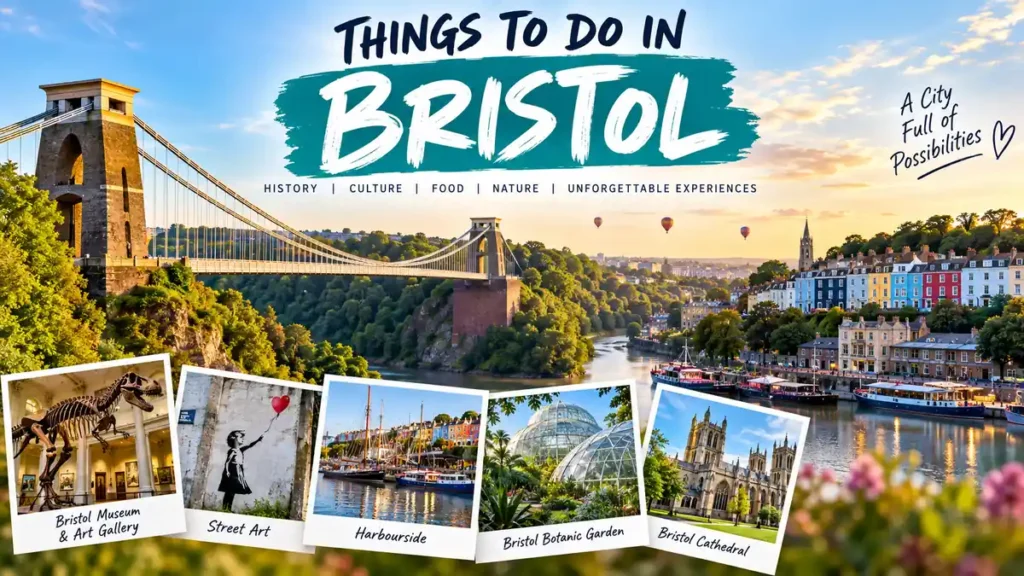
Bristol rewards people who explore it on foot. One minute you are beside colourful houses and historic ships on the Harbourside; the next you are climbing towards Clifton, discovering a Banksy mural, browsing an independent market or looking across the Avon Gorge.
If you are searching for things to do in bristol, start with Clifton Suspension Bridge, Bristol Harbourside, Brunel’s SS Great Britain, Banksy street art, M Shed and St Nicholas Market. Add Clifton Village, Brandon Hill, Ashton Court and a boat trip for a trip that combines Bristol’s maritime history, creative culture, green spaces and independent character.
Best things to do in bristol for first-time visitors
A first visit does not need an overloaded itinerary. Bristol’s strongest attractions naturally group into a few areas, particularly the Harbourside, Old City and Clifton.
| Bristol experience | Best for | Typical visit |
|---|---|---|
| Clifton Suspension Bridge | Views and architecture | 1–2 hours |
| Bristol Harbourside | Walking and atmosphere | 2–3 hours |
| SS Great Britain | Maritime history | 2–3 hours |
| Banksy street art | Art and photography | 1–2 hours |
| M Shed | Bristol history | 1–2 hours |
| St Nicholas Market | Food and independent shops | 1–2 hours |
| Brandon Hill & Cabot Tower | Free city views | 1 hour |
| We The Curious | Families and science | 2–3 hours |
| Bristol Museum & Art Gallery | Art and history | 1–2 hours |
| Ashton Court Estate | Nature and walking | 2–4 hours |
1. Walk across Clifton Suspension Bridge
Few landmarks identify a city as instantly as Clifton Suspension Bridge identifies Bristol.
The bridge spans the dramatic Avon Gorge and was designed by Victorian engineer Isambard Kingdom Brunel. It opened in 1864, several years after Brunel’s death, and remains one of Bristol’s defining landmarks.
Walking across is the best way to appreciate its setting. Pedestrians and cyclists can cross free of charge, while motorists pay a toll. The bridge itself is open around the clock under normal operations.
Don’t simply walk across and leave. Spend time looking into the Avon Gorge, then visit the free museum on the Leigh Woods side. Exhibits explain Brunel’s design, construction of the bridge and how the structure is maintained.
For something less obvious, underground vault tours operate seasonally and reveal enormous chambers beneath the Leigh Woods tower.
Quick takeaway: Go early in the morning or later in the day if you want a quieter walk and better conditions for photographs.
2. Explore Clifton Village
Combine the suspension bridge with Clifton Village rather than treating the bridge as an isolated attraction.
This elegant part of Bristol is known for Georgian architecture, leafy streets, independent businesses and cafés. Wandering without a rigid route works particularly well here.
Look around the streets near Clifton Arcade, continue towards the bridge and make time for the green spaces overlooking the gorge.
Clifton also provides a useful contrast with central Bristol. The Harbourside feels maritime and energetic; Stokes Croft is colourful and alternative; Clifton feels calmer and more architectural.
3. Discover Bristol Harbourside on foot
If you only have a few hours in Bristol, make the Harbourside your base.
Bristol’s historic docks have evolved into a waterfront district filled with museums, galleries, restaurants, cultural venues and walking routes. The official city guide highlights the Harbourside for its combination of maritime history, museums, boat trips and places to eat and drink.
A simple waterfront walk can connect several major sights without requiring public transport.
Start around the central waterfront and Millennium Square, then work your way towards M Shed, Wapping Wharf and the historic dockyards. Depending on your route, you can continue towards Spike Island and Brunel’s SS Great Britain.
The pleasure is not only in the attractions. Boats, cranes, converted warehouses and colourful houses climbing the surrounding hills make the harbour one of the best places to understand Bristol’s character.
4. Step aboard Brunel’s SS Great Britain
Brunel’s SS Great Britain is much more than an old ship displayed beside the harbour.
Launched in Bristol in 1843, it combined an iron hull with screw propulsion on a scale that made it groundbreaking for its era. The vessel was built in the Great Western Dockyard and today sits in the same dry dock where it was constructed.
Visitors can explore the ship alongside the wider historic dockyard experience and the Being Brunel Museum, which examines the ideas and life of Isambard Kingdom Brunel.
Allow enough time to explore rather than rushing through the decks. The recreated spaces and dockyard context make the engineering story much easier to understand.
The attraction is especially worthwhile for visitors interested in industrial history, engineering, ships or Victorian Britain.
Street art, culture and museums in Bristol
5. Go looking for Banksy street art
Street art is not a decorative extra in Bristol. It is part of the city’s cultural identity.
Bristol is closely associated with Banksy, whose identity remains anonymous and whose work helped bring international attention to the city’s graffiti scene. Current Bristol tourism material continues to treat street art as one of the city’s defining visitor experiences.
You can search independently for murals or take a street-art walking tour. The advantage of a guided walk is context: you learn how particular neighbourhoods, artists and pieces fit into Bristol’s broader creative history.
Areas around Stokes Croft and central Bristol are especially associated with street art.
Keep in mind that this is a living art scene. Murals can be painted over, restored or changed, so an old online map should never be treated as permanent.
6. Experience Stokes Croft
For a less polished side of the city, walk north from the centre towards Stokes Croft.
Murals, independent businesses, music venues and alternative cultural spaces give the neighbourhood a noticeably different atmosphere from Clifton.
It is one of the best areas to explore if your idea of sightseeing involves understanding how a city actually expresses itself rather than moving between conventional monuments.
Combine Stokes Croft with a Banksy and street-art walk so the artwork has context rather than becoming a simple photo checklist.
7. Learn Bristol’s story at M Shed
M Shed is one of the most useful places to visit near the beginning of a Bristol trip because it explains the city itself.
Its displays explore Bristol’s people, places and development from prehistoric times to the present. That includes the city’s industrial and maritime history alongside the people and social movements that shaped modern Bristol.
Entry to the permanent museum is free, although donations are welcomed. At the time of writing, M Shed is normally open Tuesday to Sunday from 10am to 5pm; visitors should verify current arrangements before travelling.
Because it sits directly on the Harbourside, M Shed fits easily into a waterfront itinerary.
8. Visit Bristol Museum & Art Gallery
For broader collections, head to Bristol Museum & Art Gallery.
The museum brings together art, archaeology, natural history and material from ancient cultures, including Egyptology. This variety makes it a good rainy-day option and particularly useful for groups whose interests differ.
It also works well geographically with Clifton. Visit the museum before continuing uphill towards Clifton Village and the suspension bridge.
9. See contemporary art at Arnolfini and Spike Island
Bristol’s creative reputation extends far beyond street art.
Arnolfini, on the Harbourside, is associated with contemporary visual arts, performances and cultural events. A little farther around the harbour, Spike Island presents contemporary art exhibitions and houses more than 70 artists’ studios.
These are useful stops for repeat visitors who have already covered Bristol’s biggest landmarks.
They also demonstrate something that standard sightseeing lists can miss: Bristol’s cultural scene is not confined to museums preserving the past. Artists continue to actively shape the city.
Free things to do in bristol
You can experience a substantial part of Bristol without paying admission fees. Walking the Harbourside, crossing Clifton Suspension Bridge on foot, exploring street art and visiting parks can easily fill most of a day.
10. Climb Cabot Tower on Brandon Hill
For panoramic views without paying for an observation deck, head to Brandon Hill.
At its summit stands Cabot Tower, built in 1897 to commemorate the 400th anniversary of John Cabot’s voyage from Bristol towards Newfoundland. The tower rises 105 feet and provides broad views over Bristol and towards the surrounding landscape.
The climb involves stairs, so it will not suit every visitor. Even without going up the tower, Brandon Hill is worth visiting as one of the city’s historic green spaces.
It is also conveniently close to the Harbourside, making it easy to add to a walking itinerary.
11. Walk through Ashton Court Estate
When central Bristol starts to feel busy, head towards Ashton Court Estate.
The estate offers extensive green space close to the city, with walking and cycling opportunities and areas associated with deer. Visit Bristol also highlights Ashton Court for trails, mountain biking and nature.
It is a particularly good choice for a longer visit because it introduces another side of Bristol: a city where substantial countryside-like spaces sit remarkably close to urban neighbourhoods.
Bring footwear suitable for potentially muddy paths if the weather has been wet.
12. Explore Leigh Woods
Across the Avon Gorge from Clifton is Leigh Woods, another strong choice for walkers.
Woodland trails provide a peaceful counterpoint to the city centre and can be combined with Clifton Suspension Bridge in the same outing. Visit Bristol specifically recommends the area for wildlife spotting and outdoor exploration.
A bridge-and-woods combination works particularly well on a dry morning: explore Clifton, cross the bridge on foot, walk through Leigh Woods and return for lunch.
13. Follow Bristol’s street art for free
You do not have to pay for a formal Banksy tour.
Create your own walking route through central Bristol and Stokes Croft and simply look around. Some of the most interesting pieces are discovered between established landmarks rather than at designated attractions.
This is also an activity that changes between visits. Bristol’s street-art landscape evolves, giving repeat visitors something genuinely new to find.
Food, markets and independent Bristol
14. Eat your way around St Nicholas Market
If you want an attraction that combines local history with lunch, choose St Nicholas Market, commonly called St Nicks.
The market has traded since 1743 and sits in Bristol’s Old City. It combines independent retailers with food stalls and historic architecture.
Inside, the Covered Market, Exchange Hall and Glass Arcade contain a mixture of books, gifts, fashion, handcrafted products and food. The indoor market currently lists more than 60 independent retailers.
The Glass Arcade is particularly useful when everyone in a group wants something different to eat.
Current listed hours for the indoor market are Monday to Saturday, 9:30am–5pm, but trading arrangements can change, so check before making a special journey.
15. Wander through Bristol’s Old City
After St Nicholas Market, do not immediately move to another attraction.
Explore the surrounding Old City on foot. Its historic streets reveal an older Bristol that can be easy to miss when travelling directly between the harbour and Clifton.
Corn Street is an obvious starting point. From there, allow yourself to wander through nearby lanes and historic streets.
This area works particularly well for travellers interested in architecture and photography because details often matter more than individual headline attractions.
16. Explore Wapping Wharf
Wapping Wharf brings a more contemporary atmosphere to the Harbourside.
The neighbourhood has become known for independent food and drink businesses and makes an easy lunch or evening stop during a harbour walk.
Rather than travelling across Bristol solely for a meal, build Wapping Wharf into a wider waterfront route: M Shed, the harbour, Wapping Wharf and SS Great Britain can all form part of the same half-day.
That clustering is one of the simplest ways to experience Bristol efficiently without turning the day into a race between attractions.
Fun things to do in bristol with kids
17. Spend a few hours at We The Curious
Families looking for interactive indoor activities should consider We The Curious on the Harbourside.
The science centre focuses on hands-on exploration rather than simply displaying objects behind glass. Visit Bristol describes it as having more than 300 exhibits and highlights its planetarium as part of the experience.
Its central location is particularly useful for families because you can combine it with Millennium Square, the harbour and nearby attractions without spending much of the day travelling.
On wet days, it becomes an especially practical option.
18. Visit Bristol Aquarium
Another central family attraction is Bristol Aquarium, where themed habitats contain marine and freshwater species.
The aquarium is close to other Harbourside attractions, so families can easily combine an indoor visit with a waterfront walk rather than dedicating an entire day to one venue.
For younger children, that flexibility can be more valuable than trying to complete an ambitious city-wide itinerary.
19. Step into Wake The Tiger
For something distinctly different from a conventional museum, consider Wake The Tiger.
The attraction combines interactive environments, art, storytelling, mazes and hidden spaces. Visit Bristol describes it as the world’s first “Amazement Park.”
It suits families with older children, groups of friends and visitors looking for unusual things to do in Bristol rather than another historical attraction.
Because it is not directly beside the main Harbourside sightseeing cluster, plan your transport rather than squeezing it between waterfront stops.
20. Meet wildlife at Bristol Zoo Project
The historic zoo in Clifton has closed, but visitors looking for a wildlife attraction can head to Bristol Zoo Project outside the central city.
The site covers around 50 acres and houses animals including giraffes, zebras, cheetahs and lemurs, with conservation and habitat protection central to the visitor experience.
Because it is away from central Bristol, allow more time than you would for a Harbourside attraction.
Unusual things to do in bristol
See Concorde at Aerospace Bristol
Aviation enthusiasts should make the journey to Aerospace Bristol.
The museum explores the region’s aerospace history, but its headline exhibit is particularly memorable: visitors can step aboard the last Concorde ever to fly.
It is farther from the historic centre than Bristol’s major harbour attractions, so it makes more sense as a dedicated half-day outing.
Take a boat trip around the Floating Harbour
Bristol makes much more sense when seen from the water.
A harbour boat trip gives you a different perspective on the city’s docks, bridges, warehouses and waterside attractions. It also connects modern Bristol with the maritime activity that shaped its development.
For an active alternative, kayaking and paddleboarding are available on the Floating Harbour, while sightseeing trips offer a more relaxed experience.
Cycle the Bristol and Bath Railway Path
If you have extra time and enjoy cycling, consider the Bristol and Bath Railway Path.
The traffic-free route follows a former railway corridor between the two cities and is one of the area’s established cycling experiences. Visit Bristol recommends it for both cycling and walking.
You do not need to complete the entire route. A shorter out-and-back ride still provides a break from central sightseeing.
Try inland surfing at The Wave
Yes, you can surf near Bristol without going to the coast.
The Wave is an inland surfing lake where controlled waves make surfing accessible away from the sea. Visit Bristol identifies it as the UK’s first inland surfing lake.
It is outside the centre, so factor travel time into your day and check sessions before visiting.
Things to do in bristol when it rains
Rain does not ruin a Bristol trip because many of the city’s strongest attractions are indoors or partly indoors.
Good wet-weather choices include SS Great Britain, M Shed, Bristol Museum & Art Gallery, We The Curious, Bristol Aquarium, Wake The Tiger, Arnolfini, St Nicholas Market and Aerospace Bristol.
A practical rainy-day route is St Nicholas Market followed by M Shed and SS Great Britain. You will still spend short periods outside around the harbour, but most of the day can be sheltered.
If the forecast is changeable rather than consistently wet, save Clifton Suspension Bridge, Cabot Tower, Leigh Woods and Ashton Court for the clearest part of the day.
Things to do in bristol at night
Bristol changes character after the daytime attractions close.
The Harbourside is an obvious starting point for an evening walk, particularly when waterfront buildings and boats are illuminated.
For entertainment, look at programmes from Bristol’s theatres, independent cinemas, live-music venues and cultural spaces. The city’s musical heritage is substantial: Massive Attack, Portishead, Tricky and Roni Size are all closely associated with the influential Bristol music scene.
Neighbourhood choice matters. The centre and Harbourside work well for a straightforward evening, while Stokes Croft offers a more alternative atmosphere.
Seasonal events worth planning around
Bristol has several events large enough to influence when you might choose to visit.
The Bristol International Balloon Fiesta is one of the city’s signature experiences, filling the sky with hot-air balloons when conditions permit. Bristol also hosts the Harbour Festival, while Upfest celebrates the city’s street-art culture. The official tourism organisation continues to highlight these events among Bristol’s major annual attractions.
Event dates, programmes and weather-dependent activities change from year to year. Check the current schedule before arranging a trip specifically around one event.
How to spend one day in Bristol
With only one day, resist the temptation to cover every neighbourhood.
A sensible first-time route is:
- Start around Bristol’s Harbourside.
- Visit M Shed or SS Great Britain.
- Walk through the Old City.
- Stop at St Nicholas Market.
- Continue towards Brandon Hill if time allows.
- Head to Clifton Village.
- Finish at Clifton Suspension Bridge.
This route gives you maritime history, food, architecture, city views and Bristol’s most recognisable landmark without requiring constant transport.
If street art matters more to you than museums, replace one indoor attraction with a walk through central Bristol and Stokes Croft.
How to spend a weekend in Bristol
Two days provide a much better feel for the city.
Day one: Harbour, history and Old City
Begin at the Harbourside and explore M Shed. Walk through Wapping Wharf and continue towards Brunel’s SS Great Britain.
Later, head into the Old City for St Nicholas Market and spend time exploring the surrounding streets. Finish around the central waterfront.
Day two: Clifton, street art and green Bristol
Start in Clifton Village before walking across Clifton Suspension Bridge.
If the weather is good, continue into Leigh Woods or spend time at Ashton Court. Later, return towards central Bristol and explore street art around Stokes Croft.
Families could replace the street-art section with We The Curious, Bristol Aquarium or Wake The Tiger.
What can you do in Bristol without a car?
Quite a lot — and for a short city break, a car is often unnecessary.
Many major attractions cluster around the Harbourside and central Bristol. M Shed, Wapping Wharf, SS Great Britain, St Nicholas Market, Bristol Cathedral, Brandon Hill and several cultural venues can be linked on foot.
Clifton is farther uphill but can still be reached by walking or bus. The number 8 bus is one option for reaching the Clifton area near the suspension bridge.
Attractions farther from the centre, such as Aerospace Bristol, Bristol Zoo Project and The Wave, require more transport planning.
What is Bristol best known for?
Bristol is difficult to reduce to one landmark.
Its identity comes from several overlapping stories: Brunel’s engineering, the Floating Harbour and maritime trade, Clifton Suspension Bridge, Banksy’s street art, independent culture, music, hot-air balloons and an unusually strong relationship between urban neighbourhoods and green space.
That combination explains why the best things to do in bristol are not limited to conventional attractions.
See the famous bridge and board the historic ship, but leave room for the experiences between them. Walk beside the harbour, look for street art, climb a hill, browse an independent market and explore a neighbourhood without an itinerary. Those unscripted parts are often where Bristol’s character becomes clearest.