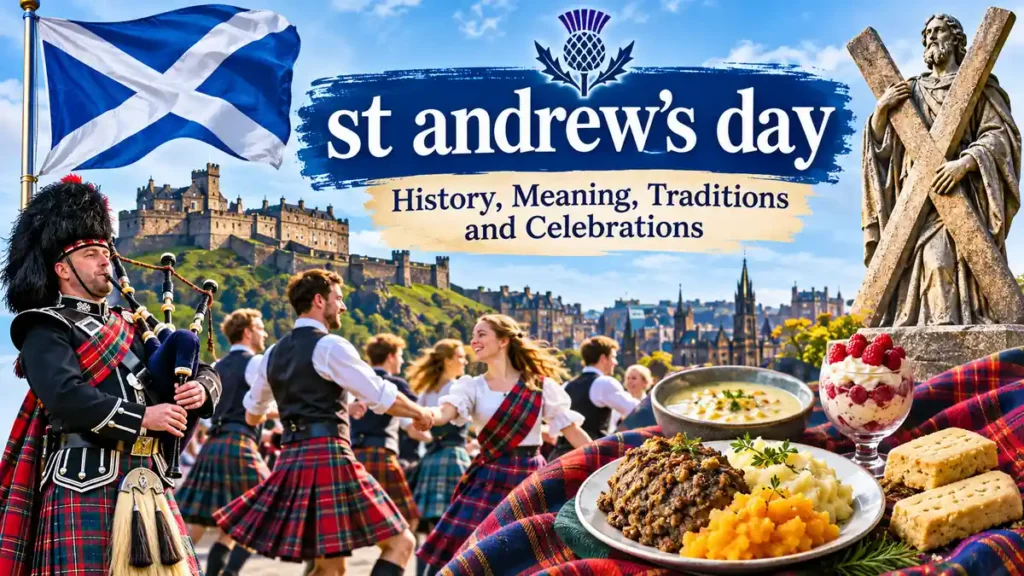
Every year on November 30, Scotland celebrates its patron saint with traditional music, dancing, storytelling and displays of national pride. But why is St Andrew so important to Scotland, and how did a Christian apostle become one of the country’s most recognizable national symbols?
st andrew’s day is Scotland’s national day, celebrated annually on November 30 in honor of Saint Andrew, the country’s patron saint. The occasion celebrates Scottish history, culture and heritage through ceilidh dancing, traditional food, music and community events. It is also a bank holiday in Scotland, although not everyone automatically receives a day off work.
The celebration combines centuries-old religious traditions with modern expressions of Scottish identity. Its most famous symbol, the white diagonal cross on a blue background, appears on Scotland’s national flag, known as the Saltire.
When Is st andrew’s day in 2026?
st andrew’s day falls on Monday, November 30, 2026. The celebration takes place on the same calendar date every year, regardless of the day of the week.
| Year | Date | Day |
|---|---|---|
| 2025 | November 30 | Sunday |
| 2026 | November 30 | Monday |
| 2027 | November 30 | Tuesday |
| 2028 | November 30 | Thursday |
| 2029 | November 30 | Friday |
| 2030 | November 30 | Saturday |
In Scotland, November 30 is recognized as a bank holiday under the St Andrew’s Day Bank Holiday (Scotland) Act 2007.
When the date falls on a weekend, a substitute weekday is normally designated for banking purposes. However, a Scottish bank holiday does not automatically require every business, school or workplace to close.
For 2026, the holiday falls directly on Monday, November 30, so no substitute date is needed.
Who Was Saint Andrew?
Απόστολος Ανδρέας |Εργαστήριο Βυζαντινών Εικόνων Ή Άμπελος
St Andrews & Fife Day Trip Tour from Edinburgh
9 Amazing Things to do in St Andrews | VisitScotland
6
Saint Andrew was one of the twelve apostles of Jesus Christ and the brother of Simon Peter, also known as Saint Peter.
According to the New Testament, Andrew and Peter worked as fishermen before becoming followers of Jesus. Andrew is traditionally remembered as one of the earliest disciples called to follow Christ.
His name appears in several important biblical accounts, including the calling of the first disciples and the feeding of the five thousand.
Saint Andrew’s life and religious significance
Andrew lived during the first century AD in the region of Galilee, an area associated with modern-day Israel.
The Gospel of John describes Andrew as a follower of John the Baptist before he became a disciple of Jesus. Andrew subsequently introduced his brother Simon Peter to Jesus.
Christian traditions describe Andrew as a missionary who traveled to preach Christianity after the death and resurrection of Jesus.
Later accounts associate his missionary activity with areas around the Black Sea, Greece and parts of Eastern Europe. These journeys are rooted largely in religious tradition rather than independently confirmed historical records.
How did Saint Andrew die?
According to Christian tradition, Andrew was martyred in Patras, Greece, during the Roman period.
He is commonly depicted as having been crucified on an X-shaped cross, sometimes called a saltire cross or crux decussata.
The familiar story that Andrew requested this particular cross because he considered himself unworthy to die in the same manner as Jesus comes from later tradition.
Historical evidence does not establish the exact shape of the cross used in his execution.
Nevertheless, the diagonal cross became Andrew’s most recognizable symbol and eventually formed the basis of Scotland’s national flag.
Why Is Saint Andrew the Patron Saint of Scotland?
Saint Andrew’s connection with Scotland developed through medieval religious traditions, the veneration of his relics and the growing importance of his cult in the Scottish kingdom.
Although Andrew never appears in reliable historical records as having visited Scotland, his religious influence became deeply embedded in Scottish national identity.
The legend of Saint Regulus
One of Scotland’s best-known traditions concerns Saint Regulus, also called Saint Rule.
According to the legend, Regulus was instructed through a divine vision to take some of Saint Andrew’s relics from Patras and transport them to a distant land for safekeeping.
His journey supposedly brought him to the eastern coast of Scotland, where the relics were placed in a settlement that later became associated with the town of St Andrews in Fife.
The story helps explain the town’s historic religious importance, although historians regard its miraculous elements as legend rather than established fact.
The Battle of Athelstaneford
Another famous tradition connects Saint Andrew with a battle involving a Pictish king named Óengus, or Angus, and an opposing army.
According to the legend, the king prayed for divine assistance before the battle. A white diagonal cross appeared against the blue sky, inspiring his forces to victory.
This vision became associated with the Saltire, Scotland’s national flag.
The battle is traditionally linked to Athelstaneford in East Lothian, often described as the birthplace of the Scottish flag.
However, the story was recorded long after the supposed event. It should be understood as an important national legend rather than a fully verified historical account.
How Andrew became a national symbol
By the medieval period, devotion to Saint Andrew had become especially influential in Scotland.
The town of St Andrews developed into a major religious center, and its cathedral became one of the most important churches in medieval Scotland.
Saint Andrew’s association with the Scottish kingdom was also strengthened through religious and political symbolism.
The 1320 Declaration of Arbroath, an important document asserting Scotland’s independence, invoked Saint Andrew as the country’s patron.
Over time, Andrew became closely connected with Scotland’s religious history, national identity and political independence.
The History of st andrew’s day
The origins of the celebration lie in the Christian feast day dedicated to Saint Andrew.
November 30 has long been observed in the Christian calendar as the Feast of Saint Andrew, honoring the apostle’s life and martyrdom.
During the Middle Ages, religious festivals played an important role in community life. Churches held services, while feast days provided opportunities for gathering and celebration.
In Scotland, devotion to Saint Andrew became particularly prominent because of his status as the country’s patron saint.
Medieval celebrations and religious observance
In medieval Scotland, Saint Andrew’s feast day was primarily religious.
Communities might attend church services, participate in prayers and observe traditions associated with the saint.
The religious center at St Andrews attracted pilgrims who visited shrines and sites associated with the apostle’s relics.
The construction of St Andrews Cathedral, begun in the twelfth century and consecrated in 1318, reflected the town’s importance within medieval Christianity.
Following the Scottish Reformation in the sixteenth century, many traditional Catholic practices declined or changed. However, Saint Andrew continued to hold an important place in Scottish cultural and national symbolism.
How the celebration developed into a national day
Modern celebrations emphasize Scotland’s culture as much as its religious heritage.
Music, dancing, food, poetry and national symbols are central to many events.
Scottish communities abroad also celebrate the occasion, using it as an opportunity to maintain connections with their ancestry and cultural traditions.
In 2006, the Scottish Parliament passed legislation establishing a formal bank holiday for Saint Andrew’s Day.
The St Andrew’s Day Bank Holiday (Scotland) Act 2007 came into force in January 2007, giving the occasion official bank holiday recognition.
This was an important milestone, although it did not make November 30 a compulsory day off for every worker.
How Is st andrew’s day Celebrated in Scotland?
Glasgow Hosts The 2025 World Pipe Band Championships
Historic building along city street with flags and clocktower
10
Celebrations bring together traditional Scottish customs, modern entertainment and local community activities.
Events vary across Scotland, but music, dancing, food and national symbols are common features.
Traditional ceilidh dancing
A ceilidh is a social gathering featuring traditional Scottish music and group dancing.
Ceilidhs are particularly popular during national celebrations because they encourage people of different ages and abilities to participate.
Common dances include the Gay Gordons, Strip the Willow and the Dashing White Sergeant.
Many ceilidhs have a caller who explains the steps, allowing beginners to join without previous dancing experience.
Live bands often perform using fiddles, accordions and other traditional instruments.
Bagpipes and Scottish folk music
Bagpipes are among Scotland’s most recognizable musical symbols.
During celebrations, pipers and traditional bands may perform at community gatherings, festivals and public events.
Scottish folk music also features instruments such as the fiddle, accordion, harp and whistle.
Traditional songs and performances help preserve Scotland’s musical heritage while introducing younger generations to established customs.
Wearing tartan and kilts
Tartan is a patterned textile closely associated with Scottish identity.
During national celebrations, people may wear kilts, tartan scarves, sashes or other clothing featuring traditional designs.
Many tartans are associated with Scottish clans, families, districts or organizations.
However, people do not need to belong to a particular clan to participate in Scottish cultural celebrations.
Tartan clothing is optional, and everyday dress is equally appropriate for most events.
Community festivals and gatherings
Communities organize a variety of activities around November 30, including concerts, cultural performances, storytelling sessions and shared meals.
Some events highlight Scotland’s Gaelic and Scots linguistic heritage.
Others focus on traditional crafts, local history or activities for children.
VisitScotland identifies feasting, dancing and community gatherings as characteristic parts of the national celebration. VisitScotland+1
Traditional Scottish Foods for st andrew’s day
Scottish Foods: Fabulous Scottish Cuisine To Enjoy
Traditional Cullen Skink | Live Breathe Scotland
Cranachan: A Traditional Scottish Dessert Recipe – Scottish Scran
5
Food plays an important role in Scottish celebrations, especially when families and communities gather for a shared meal.
There is no single compulsory dish for the occasion. Instead, menus often feature foods associated with Scotland’s culinary heritage.
| Traditional food | Description |
|---|---|
| Haggis | Savory dish made from sheep’s offal, oatmeal, onion and spices |
| Neeps and tatties | Mashed turnips or swede and potatoes |
| Cullen skink | Creamy soup made with smoked haddock and potatoes |
| Scotch broth | Hearty soup with barley, vegetables and often lamb or beef |
| Cranachan | Dessert featuring cream, oats, raspberries and traditionally whisky |
| Scottish shortbread | Rich, crumbly biscuits made with butter, flour and sugar |
| Stovies | Comforting potato dish often made with onions and meat |
Haggis, neeps and tatties
Haggis is one of Scotland’s best-known traditional dishes.
It is commonly served with mashed potatoes and mashed swede, known as tatties and neeps.
Although haggis is particularly associated with Burns Night on January 25, it is also a suitable dish for celebrating Scottish culture on November 30.
Vegetarian versions are available, often using lentils, oats, vegetables and spices.
Cullen skink and Scotch broth
Scotland’s colder autumn weather makes warming soups especially appealing during late-November celebrations.
Cullen skink originated in the fishing town of Cullen in Moray and is traditionally prepared using smoked haddock, potatoes and onions.
Scotch broth is another familiar Scottish dish, usually made with pearl barley, vegetables and meat.
Both can be served at informal family meals or community gatherings.
Cranachan and Scottish shortbread
Cranachan is a traditional Scottish dessert combining whipped cream, toasted oats and raspberries. Some recipes include honey and whisky.
Shortbread offers a simpler alternative and is widely associated with Scottish hospitality.
These desserts are particularly suitable for community celebrations because they can be prepared or served in portions for groups.
The Saltire: Scotland’s National Flag and Its Meaning
Drapeau écossais : le Saltire, plus vieux drapeau d’Europe
The Saltire is one of the strongest visual connections between Saint Andrew and Scotland.
The flag features a white diagonal cross against a blue background. The cross is traditionally associated with the martyrdom of Saint Andrew.
What does the white X on Scotland’s flag mean?
The diagonal white cross represents Saint Andrew’s Cross.
Its design reflects the tradition that Andrew was crucified on an X-shaped structure rather than the more familiar upright Latin cross.
The blue background is closely associated with the sky in the legend of the Battle of Athelstaneford.
The Saltire has been used as a Scottish national symbol for centuries, although the precise origins and development of the flag are more complex than the legend suggests.
Is the Saltire the same as the Union Jack?
No. The Saltire is Scotland’s national flag, while the Union Flag, commonly called the Union Jack, represents the United Kingdom.
The Union Flag incorporates elements associated with three patron saints:
- Saint Andrew, representing Scotland
- Saint George, representing England
- Saint Patrick, representing Ireland
Wales does not have a separate cross represented in the Union Flag’s design.
On November 30, the Saltire is especially prominent at public buildings, cultural venues and community celebrations.
Scottish Government flag-flying guidance for 2026 specifically designates the Saltire for St Andrew’s Day. Scottish Government+1
Is st andrew’s day a Public Holiday in Scotland?
Yes. November 30 is an official Scottish bank holiday, but that does not mean every employee automatically receives paid time off.
Under Scottish holiday arrangements, employers may remain open, and employees’ entitlements depend on their contracts and applicable employment rules.
Are schools closed?
Schools are not automatically closed throughout Scotland.
School calendars are determined by local authorities, so arrangements may differ between council areas.
Some schools remain open and organize activities exploring Scottish history, music and traditions.
Others may have local holiday arrangements.
Parents should check the official school calendar published by their local council rather than assuming November 30 is a school holiday.
Are shops and businesses open?
Many shops, restaurants, attractions and other businesses continue operating.
Some may adjust their hours, particularly where the holiday coincides with local events.
Banks do not necessarily close on Scottish bank holidays, and other businesses are not legally required to shut.
The Scottish Government confirms that paid leave is not automatically guaranteed simply because a date is designated as a bank holiday. Scottish Government+1
Is the holiday observed throughout the UK?
Saint Andrew’s Day is a bank holiday specifically in Scotland.
It is not a general bank holiday in England, Wales or Northern Ireland.
However, Scottish communities throughout the UK may organize cultural celebrations.
Where to Experience st andrew’s day Celebrations
12 Best Things to Do in Edinburgh, Scotland (2026 Guide)
7
Scotland’s larger cities and historic towns provide opportunities to experience national traditions.
St Andrews, Fife
The town of St Andrews has a particularly strong historical connection with the patron saint.
Visitors can explore the remains of St Andrews Cathedral, the medieval religious center associated with Saint Andrew’s relics.
The town also contains St Rule’s Tower, St Andrews Castle and the University of St Andrews, founded in 1413.
For 2026, the town’s official Big Hoolie programme lists celebrations on Saturday, November 28, ahead of the national holiday.
The announced programme includes live music, ceilidh dancing, a torchlight procession and fireworks at West Sands. Event arrangements may change, so visitors should check the organizer’s latest information. St Andrews Day 2026+1
Edinburgh
Edinburgh offers a combination of historic landmarks, museums, cultural institutions and Scottish music.
The Royal Mile, Edinburgh Castle and the Old Town provide an atmospheric setting for exploring Scottish history.
Seasonal cultural programmes may include performances, exhibitions and events around the holiday period.
Visitors should distinguish confirmed St Andrew’s Day events from other festivals taking place in late November.
Glasgow
Glasgow has a lively music and arts scene, making it a suitable place to experience Scottish cultural performances.
Traditional music sessions, ceilidhs and community activities may take place in venues across the city.
Event schedules vary from year to year, so local listings are the best source for specific programmes.
Other parts of Scotland
Smaller towns and rural communities may hold their own celebrations, often reflecting local traditions.
Highland communities, island settlements and towns across the Scottish Borders may feature traditional music, storytelling or community gatherings.
The experience can be less formal than a major city festival, with an emphasis on participation and local heritage.
How to Celebrate st andrew’s day at Home or School
You do not need to be in Scotland to participate in the celebration.
Families, teachers and Scottish communities overseas can mark the occasion through educational and cultural activities.
Ideas for families and children
- Learn the story of Saint Andrew. Explain his role as an apostle and how he became associated with Scotland.
- Make a Saltire flag. Use blue paper and white diagonal strips to recreate Scotland’s national flag.
- Listen to traditional Scottish music. Introduce children to bagpipes, fiddles and folk songs.
- Explore Scottish geography. Locate Edinburgh, Glasgow, St Andrews, the Highlands and the Scottish islands on a map.
- Prepare Scottish food. Try making shortbread or a simple version of a traditional Scottish recipe.
- Learn a Scottish dance. Practice a beginner-friendly ceilidh dance using clear instructions.
- Read Scottish stories. Explore traditional folklore, poetry and historical legends.
Classroom activities for teachers
Schools can use the celebration to connect history, geography, literature and cultural education.
A history lesson might examine the difference between the historical Saint Andrew and the legends surrounding his connection with Scotland.
Geography lessons can explore Scotland’s landscapes, cities, islands and position within the United Kingdom.
Art activities can focus on tartan patterns, Scottish architecture and the Saltire.
Teachers may also introduce students to the Scots language and Scottish Gaelic, explaining that they are distinct linguistic traditions.
Celebrating Scottish heritage abroad
Scottish diaspora communities in Canada, the United States, Australia, New Zealand and other countries often organize cultural gatherings.
St Andrew’s societies and Scottish cultural organizations have historically helped people maintain connections with Scottish identity and traditions.
Celebrations may feature traditional dinners, Highland dancing, bagpipe performances or talks about Scottish history.
The occasion provides an opportunity for people of Scottish descent to share their heritage with friends and younger generations.
st andrew’s day Around the World
Although most closely associated with Scotland, Saint Andrew is venerated in several other countries and Christian traditions.
He is also a patron saint of Greece, Russia, Romania and other places, though the nature of his patronage and the way his feast is observed vary.
Greece
In Greece, Saint Andrew is particularly associated with the city of Patras, where tradition holds that he was martyred.
The city’s Cathedral of Saint Andrew is an important Orthodox Christian landmark.
Religious observances on November 30 may include church services, prayers and commemorations of the apostle.
Romania
Saint Andrew, known in Romanian as Sfântul Andrei, is an important religious figure in Romania.
November 30 is a national public holiday.
The day combines Christian observances with various regional folk customs.
Some Romanian traditions involve garlic, household protection and beliefs associated with the beginning of winter.
Russia and Eastern Orthodox traditions
Saint Andrew holds an important place in Russian Orthodox Christianity and is associated with traditions about the spread of Christianity.
He is also connected with the Russian naval ensign, which features a blue diagonal cross on a white background.
Eastern Orthodox churches may observe his feast according to different liturgical calendars, so the civil date of the celebration can vary.
Poland and Andrzejki
Poland has a distinctive tradition known as Andrzejki, associated with Saint Andrew’s Eve on November 29.
Historically, the occasion involved fortune-telling customs, particularly those concerning future marriage.
Today, Andrzejki is also associated with social gatherings and parties.
Although connected to the same saint, these Polish traditions are different from Scotland’s national celebration.
How Does st andrew’s day Compare With Other UK National Days?
The United Kingdom’s constituent nations have different patron saints and cultural celebrations.
| Nation | Patron saint | Traditional feast day |
|---|---|---|
| Scotland | Saint Andrew | November 30 |
| England | Saint George | April 23 |
| Wales | Saint David | March 1 |
| Northern Ireland | Saint Patrick | March 17 |
These occasions share a connection with religious history, but their modern cultural and legal significance differs.
Saint Patrick’s Day, for example, is a public holiday in Northern Ireland and the Republic of Ireland.
Saint George’s Day is celebrated in England but is not generally a bank holiday.
Saint David’s Day is widely observed in Wales, particularly through traditional dress, school events and national symbols, but it is not a general bank holiday.
Scotland’s celebration is distinctive because November 30 has formal Scottish bank holiday status.
Interesting Facts About Saint Andrew and Scotland
Several details make Saint Andrew’s connection with Scotland especially fascinating.
Saint Andrew was a fisherman. According to the Gospels, he worked as a fisherman with his brother Simon Peter before becoming a disciple of Jesus.
He is associated with more than one country. His religious significance extends beyond Scotland to several Eastern European and Mediterranean traditions.
The town of St Andrews became a major pilgrimage destination. Its medieval cathedral and religious institutions helped establish its importance in Scottish history.
Scotland’s flag is linked to a legendary battle. The story of a white cross appearing in the sky at Athelstaneford remains a prominent part of Scottish national folklore.
The Declaration of Arbroath invoked Saint Andrew. This document, dated April 6, 1320, is one of the most significant surviving statements of medieval Scottish independence.
St Andrews is home to Scotland’s oldest university. The University of St Andrews was founded in 1413.
Saint Andrew’s Day is not the same as Burns Night. Burns Night, celebrated on January 25, commemorates the Scottish poet Robert Burns, while Saint Andrew’s Day honors Scotland’s patron saint.
The holiday is separate from Hogmanay. Hogmanay refers to Scottish New Year’s Eve celebrations on December 31.
Together, these traditions reflect different aspects of Scotland’s religious, literary and cultural history.
Why st andrew’s day Still Matters Today
The modern significance of Saint Andrew’s Day extends beyond its religious origins.
For many people, November 30 represents an opportunity to celebrate Scottish identity, cultural traditions and shared heritage.
The day highlights the country’s history, music, literature, languages and community life.
It also provides an opportunity to explore the distinction between historical evidence and national legends. Both contribute to an understanding of how cultural identity develops over time.
The celebration is not limited to people who are religious or have Scottish ancestry. Many events welcome anyone interested in learning about Scotland and its traditions.
At its heart, st andrew’s day is a celebration of Scotland’s past and present. From the story of a first-century apostle to the Saltire flying above modern Scottish towns, the occasion connects centuries of history with contemporary cultural life.
On Monday, November 30, 2026, people across Scotland and beyond will have another opportunity to celebrate that heritage through music, food, dancing, storytelling and community gatherings.