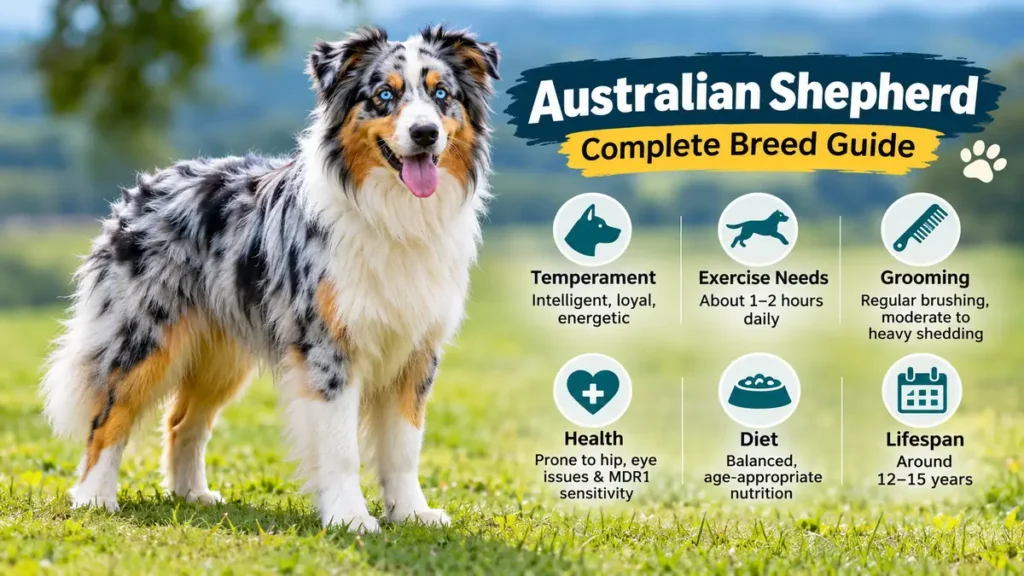
The australian shepherd is one of the most intelligent, energetic, and recognizable herding dogs in the world. Known for its striking blue or multicolored eyes, beautiful merle coat, and remarkable working ability, this breed combines athleticism with strong loyalty to its family.
Despite its name, the australian shepherd was developed primarily in the United States, where it became an essential working companion on ranches and livestock farms.
The australian shepherd is a medium-sized herding dog known for intelligence, trainability, high energy, and strong family bonds. Adults typically weigh 40–65 pounds, stand 18–23 inches tall, and live approximately 12–15 years. They need substantial daily exercise, mental stimulation, consistent training, and regular grooming to remain healthy and well-adjusted. American Kennel Club+1
australian shepherd Breed Overview
Florida Australian Shepherd Association – Home
Le Berger Australien : Guide complet sur cette race de chien
9
Australian Shepherds, affectionately called Aussies, belong to the American Kennel Club’s Herding Group. They were developed to manage livestock, respond quickly to commands, and work independently when necessary.
Their combination of intelligence, agility, and endurance makes them highly versatile dogs. Although many now live as family companions, their working instincts remain strong.
| Characteristic | Details |
|---|---|
| Breed name | Australian Shepherd |
| Common nickname | Aussie |
| Country of development | United States |
| Breed group | Herding |
| Male height | 20–23 inches |
| Female height | 18–21 inches |
| Male weight | 50–65 pounds |
| Female weight | 40–55 pounds |
| Average lifespan | 12–15 years |
| Coat type | Medium-length, double coat |
| Standard colors | Blue merle, red merle, black, red |
| Temperament | Intelligent, loyal, energetic, attentive |
| Exercise requirements | High |
| Shedding | Moderate to heavy |
| Trainability | Very high |
| Best suited for | Active, engaged households |
These measurements reflect the AKC’s published breed profile. Individual dogs may fall outside the typical ranges. American Kennel Club
Where Did the Australian Shepherd Originate?
The name is misleading because the breed did not originate in Australia.
Its development is associated with sheep-herding dogs brought to the American West, including dogs connected to Basque shepherds and livestock imported through Australia.
During the nineteenth and twentieth centuries, ranchers in the western United States selectively developed versatile herding dogs capable of managing sheep and cattle.
California ranching culture played a particularly important role in establishing the modern breed.
Australian Shepherds eventually became familiar sights at rodeos, horse shows, and working ranches.
The Australian Shepherd Club of America (ASCA) was established in 1957, helping preserve the breed’s working heritage. The American Kennel Club approved its breed standard in 1991, with the standard taking effect in 1993. ASCA+1
Australian Shepherd Appearance, Size, and Coat Colors
Australian Shepherds have athletic, balanced bodies designed for stamina and quick movement.
They are slightly longer than they are tall, with strong shoulders, muscular hindquarters, and an agile gait.
Their expressive faces, triangular ears, and distinctive coat patterns contribute to their recognizable appearance.
Australian Shepherd Size and Growth
Adult males are generally larger and heavier than females.
| Measurement | Male | Female |
|---|---|---|
| Height | 20–23 inches | 18–21 inches |
| Weight | 50–65 pounds | 40–55 pounds |
| Build | Muscular, athletic | Athletic, moderately lighter |
Most Australian Shepherds approach their adult height by around 12 months, although muscular development and physical maturity can continue beyond their first birthday.
Puppy growth varies according to genetics, nutrition, and individual development. Weight alone should not determine whether a puppy is growing normally.
Veterinarians assess growth using body condition, physical examination, and growth patterns.
Australian Shepherd Coat Colors Explained
Southern Soul Australian Shepherds – Home
Blue merle
Black patches or mottling against a gray background.
Oakhurst Australian Shepherds • Bred By
Red merle
Reddish-brown patches against a lighter red or cream background.
Australian shepherd dog with open mouth portrait in summer. Stand in forest
Black
Solid black or black with white and copper markings.
Chien Berger Australien CH. pine spring aliyah Steal my show
Red
Liver-brown, sometimes with white and copper markings.
The four recognized base coat colors are blue merle, red merle, black, and red. Each may occur with or without white markings and tan or copper points.
Aussies can also have different eye colors, including brown, blue, amber, or combinations of these colors.
Some have heterochromia, where the two eyes are different colors, or multiple colors within one iris.
These variations can be normal characteristics of the breed. ASCA+1
Why Do Some Australian Shepherds Have Short Tails?
Australian Shepherds may be born with naturally short tails, known as natural bobtails, or with full-length tails.
Historically, tail docking was practiced in some working and show populations.
However, docking solely for appearance raises animal welfare concerns and is restricted or prohibited in some jurisdictions.
The American Veterinary Medical Association opposes cosmetic tail docking. A naturally long tail does not make an Australian Shepherd less capable as a companion or working dog. PetMD
australian shepherd Temperament and Personality
The australian shepherd temperament is best described as intelligent, attentive, affectionate, and highly motivated.
These dogs are known for forming close relationships with their families and paying careful attention to their surroundings.
However, their intelligence and strong working drive also mean they need clear expectations and regular engagement.
Are Australian Shepherds Good Family Dogs?
Australian Shepherds can make excellent family companions when their exercise, training, and social needs are met.
They often enjoy participating in family activities and may form especially strong attachments to the people who care for them.
Their positive characteristics include loyalty, eagerness to learn, playfulness, and an ability to adapt to structured routines.
However, families should understand that Aussies are not naturally low-maintenance dogs.
Without sufficient stimulation, some develop excessive barking, destructive chewing, frustration, or unwanted herding behavior.
Are Australian Shepherds Good With Children?
Many Australian Shepherds interact well with children, especially when raised with appropriate socialization and gentle handling.
Their herding instincts can create challenges, however.
A dog may attempt to control running children by circling, blocking movement, or nipping at heels.
This behavior does not necessarily indicate aggression, but it must be addressed because it can frighten or injure children.
Teach children to respect the dog’s space, avoid rough play, and never disturb a dog while eating or sleeping.
Adult supervision remains essential, particularly around younger children.
Are Australian Shepherds Aggressive?
Australian Shepherds are not inherently aggressive.
The official breed standard describes them as good-natured, intelligent, and generally even-tempered. Some are naturally reserved when meeting unfamiliar people. United States Australian Shepherd Association
Aussies may display protective or watchful behavior, but excessive fearfulness or aggression is not a desirable breed characteristic.
Behavior depends on multiple factors, including genetics, socialization, training, health, and past experiences.
Early positive exposure to people, animals, sounds, and environments helps puppies develop confidence.
Dogs displaying persistent aggression or significant fear should be assessed by a veterinarian and a qualified behavior professional.
Can Australian Shepherds Live With Other Pets?
Australian Shepherds can coexist successfully with other dogs and cats.
However, their instinct to chase or control moving animals may require careful management.
Introduce pets gradually, reward calm behavior, and provide supervised interactions.
A dog that becomes intensely focused on chasing smaller animals should not be left unsupervised with them.
Australian Shepherd Exercise Needs and Daily Activity
Australian Shepherds were developed for demanding physical work, so their exercise requirements are substantially higher than those of many companion breeds.
They need opportunities to run, explore, solve problems, and use their natural abilities.
A short walk around the block is unlikely to satisfy a healthy adult Aussie.
How Much Exercise Does an Australian Shepherd Need?
Many healthy adult Australian Shepherds benefit from approximately 1–2 hours of daily physical activity, sometimes more depending on their individual energy level and conditioning.
This is a practical guideline rather than a fixed veterinary requirement.
Exercise should include a combination of movement, training, and mentally engaging activities.
Suitable options include:
- Brisk walking and hiking
- Fetch and controlled retrieving games
- Swimming, when safe and supervised
- Agility training
- Herding activities
- Obedience and trick training
- Scent games and puzzle-based activities
High-intensity exercise should be introduced gradually. Puppies should not be pushed into prolonged forced running or repetitive high-impact activities while their bodies are developing.
Senior dogs and those with joint or medical conditions may require modified routines.
Mental Stimulation Is Just as Important
An Australian Shepherd can be physically tired yet remain mentally restless.
These dogs enjoy learning and often respond enthusiastically to new challenges.
Useful activities include food puzzles, scent searches, hide-and-seek games, and short obedience sessions.
A practical approach is to combine exercise with small training opportunities throughout the day.
For example, a walk can include loose-leash practice, recall games, and opportunities to investigate safe new environments.
Sample Daily Routine for an Adult Aussie
| Time | Activity | Duration |
|---|---|---|
| Morning | Walk, play, or structured exercise | 30–45 minutes |
| Midday | Puzzle feeding or training | 10–15 minutes |
| Afternoon | Supervised play or scent activity | 15–20 minutes |
| Evening | Walk, agility, or active game | 30–45 minutes |
| Before bed | Calm enrichment and settling | 10 minutes |
This is an example, not a universal prescription. Adjust the schedule to the dog’s age, fitness, health, and ability to relax.
Quick takeaway: A well-adjusted Aussie needs more than physical exhaustion. Regular opportunities to think, learn, and settle calmly are equally valuable.
Australian Shepherd Training and Socialization
Australian Shepherds are among the more trainable dog breeds, but intelligence alone does not guarantee good behavior.
They learn patterns quickly, including habits that owners unintentionally reinforce.
A consistent training approach helps channel their energy and natural instincts into appropriate behavior.
How Easy Are Australian Shepherds to Train?
Aussies typically respond well to positive reinforcement, particularly when training involves rewards, praise, toys, and interactive games.
Their willingness to work makes them suitable for obedience, agility, rally, and other dog sports.
However, repetitive sessions can become boring.
Short, engaging lessons are often more productive than lengthy drills.
Start with foundational commands such as sit, stay, come, leave it, and settle.
Recall training is particularly valuable because herding dogs may become distracted by moving animals, bicycles, or vehicles.
Training an Australian Shepherd Puppy
Early training should focus on building confidence, communication, and positive associations.
A useful progression includes:
- Name recognition: Reward the puppy for responding to its name.
- House training: Establish regular toilet breaks and reward appropriate elimination.
- Crate introduction: Make the crate a comfortable resting space rather than a punishment.
- Leash manners: Reward walking near you without pulling.
- Socialization: Introduce unfamiliar sights, sounds, people, and safe environments gradually.
- Impulse control: Practice waiting, releasing objects, and remaining calm around distractions.
- Independent relaxation: Teach the puppy to settle without constant attention.
Puppies can begin age-appropriate socialization before completing their entire vaccination series, provided exposure is managed according to veterinary advice and local disease risks.
Avoid overwhelming puppies with crowded or frightening situations.
How to Manage Herding and Nipping Behavior
Herding behavior is one of the most frequently misunderstood Australian Shepherd characteristics.
Some Aussies instinctively chase moving objects or attempt to control movement by nipping.
Punishment can increase stress without teaching an appropriate alternative.
Instead, interrupt unwanted chasing safely and redirect the dog toward a trained behavior.
For example, reward the dog for coming when called, remaining on a mat, or engaging with a toy.
Structured herding activities and impulse-control exercises can also provide appropriate outlets.
If the behavior becomes persistent or difficult to manage, consult a qualified reward-based trainer.
Can Australian Shepherds Be Left Alone?
Australian Shepherds can learn to tolerate time alone, but many prefer frequent interaction with their families.
Dogs left alone for extended periods without sufficient enrichment may develop boredom-related behaviors.
Separation anxiety is different from ordinary boredom and may involve intense distress, vocalization, escape attempts, or destructive behavior when an owner leaves.
Gradual independence training, predictable routines, and appropriate enrichment can help.
A dog displaying genuine separation-related distress may need a structured behavior treatment plan developed with a veterinarian or qualified professional.
Australian Shepherd Grooming, Shedding, and Coat Care
Dealing with Australian Shepherd Shedding: Tips and Tricks | Hero Pet Health
Australian Shepherds have medium-length, weather-resistant double coats.
The outer coat protects against environmental conditions, while the undercoat provides insulation.
Their fur can be straight or slightly wavy, with longer feathering around the legs, chest, and hindquarters.
Although Aussies do not usually require elaborate professional haircuts, they need consistent grooming.
Do Australian Shepherds Shed a Lot?
Yes. Australian Shepherds shed throughout the year and often experience heavier seasonal shedding.
The amount varies with climate, coat density, and individual genetics.
Regular brushing helps remove loose hair before it accumulates around the home.
A practical grooming routine includes brushing two or three times weekly, increasing the frequency during heavier shedding periods.
Dogs with particularly dense coats may need more frequent attention.
How to Groom an Australian Shepherd
A typical grooming session involves several steps.
- Check the coat for tangles, debris, and skin irritation.
- Use a slicker brush or suitable pin brush to remove loose hair.
- Work through the undercoat gently with an appropriate comb or rake.
- Pay attention to areas behind the ears, beneath the legs, and around the hindquarters.
- Check the paws, ears, and nails.
- Reward the dog for calm cooperation.
Avoid aggressively pulling through tangles, which can irritate the skin.
If mats develop close to the skin, professional grooming assistance may be safer than attempting to cut them out.
Should You Shave an Australian Shepherd?
Routine shaving is generally not recommended for a healthy Australian Shepherd.
The double coat contributes to insulation and protection from sunlight.
Removing it does not reliably make the dog more comfortable in hot weather and may increase sun exposure.
Exceptions may be necessary for medical procedures or severe matting under professional guidance.
During hot weather, provide shade, cool drinking water, indoor cooling, and exercise during cooler hours.
Bathing, Nail Care, and Dental Hygiene
Most Australian Shepherds need bathing when dirty or when their coat develops an unpleasant odor.
Frequent unnecessary bathing can dry the skin.
Use a dog-specific shampoo and rinse thoroughly.
Nails should be trimmed whenever they become too long, while ears should be checked for redness, odor, or discharge.
Daily toothbrushing with dog-safe toothpaste is ideal for dental health.
A consistent grooming routine also creates opportunities to notice lumps, skin changes, parasites, and injuries early.
Australian Shepherd Health Problems and Lifespan
Australian Shepherds are generally athletic dogs with an expected lifespan of approximately 12–15 years.
However, the breed has several recognized hereditary health risks.
Responsible health screening, preventive veterinary care, appropriate nutrition, and early recognition of symptoms can improve long-term welfare.
Common Australian Shepherd Health Conditions
| Health condition | What owners should know |
|---|---|
| Hip dysplasia | Abnormal hip development that may cause pain and mobility problems |
| Elbow dysplasia | Developmental joint problems affecting the front legs |
| Hereditary cataracts | Lens clouding that can impair vision |
| Progressive retinal atrophy (PRA) | Inherited retinal degeneration that can lead to vision loss |
| Collie eye anomaly (CEA) | Inherited eye-development disorder |
| Epilepsy | Recurrent seizures requiring veterinary assessment |
| MDR1 drug sensitivity | Genetic variation affecting responses to certain medications |
| Allergies | May cause itching, inflammation, or recurring ear problems |
| Autoimmune diseases | Disorders involving inappropriate immune system activity |
| Certain cancers | Including hemangiosarcoma and lymphoma |
These conditions are documented by the Australian Shepherd Health & Genetics Institute. Their presence in the breed does not mean every Aussie will develop them. Australian Shepherd Health & Genetics Institute+1
MDR1 Gene Mutation and Medication Sensitivity
One particularly important genetic issue in Australian Shepherds involves the MDR1 gene, also known as ABCB1.
This gene helps regulate the transport of certain substances, including medications, across protective barriers in the body.
Some Aussies inherit a mutation that makes them more sensitive to particular drugs.
Depending on the medication and dosage, affected dogs may experience serious neurological reactions.
Drugs of concern can include certain antiparasitic medications and other veterinary treatments.
Importantly, not every drug in a broad medication category is unsafe at every dose.
Genetic testing can identify whether a dog carries the mutation.
Owners should share the result with their veterinarian before medications are prescribed. Never discontinue or change prescribed treatment without veterinary guidance. Australian Shepherd Health & Genetics Institute
Eye Problems in Australian Shepherds
Australian Shepherds may develop several inherited eye conditions.
Hereditary cataracts can appear in young or adult dogs and may gradually reduce vision.
Some hereditary cataract risk is associated with variants in the HSF4 gene.
Other conditions include progressive retinal atrophy, collie eye anomaly, and iris coloboma.
Warning signs of eye problems may include cloudiness, bumping into objects, difficulty navigating dim environments, or visible changes in the eyes.
Sudden vision loss, eye pain, or marked redness requires prompt veterinary assessment.
Regular ophthalmic examinations are particularly important for breeding dogs.
Why Double Merle Breeding Is Dangerous
Merle is a coat pattern associated with variations in the PMEL gene.
A dog carrying one typical merle allele can have the distinctive mottled coat seen in blue merle and red merle Aussies.
However, breeding two merle dogs together can produce puppies with two merle alleles.
These dogs, commonly called double merles, have an increased risk of serious eye abnormalities and deafness.
Some may be born with substantial vision or hearing impairment.
Responsible breeding practices use appropriate genetic testing and avoid pairings that could produce affected double-merle puppies. Australian Shepherd Health & Genetics Institute+1
Recommended Health Screening
The United States Australian Shepherd Association identifies hip evaluations, elbow evaluations, and regular ophthalmologist examinations as core health screening measures for breeding dogs.
Additional genetic tests can assess risks involving MDR1, HSF4-related cataracts, and collie eye anomaly.
The Orthopedic Foundation for Animals (OFA) provides recognized health evaluation and record systems.
The Canine Health Information Center (CHIC) also helps document breed-specific screening.
A responsible breeder should provide verifiable test results rather than relying on statements that the parents appear healthy. cdn.akc.org+1
How to Help an Australian Shepherd Live Longer
No routine can guarantee a particular lifespan, but good preventive care reduces avoidable health risks.
Maintain a healthy body condition, provide balanced nutrition, and schedule regular veterinary examinations.
Keep vaccinations and parasite prevention appropriate for the dog’s location and lifestyle.
Dental care, joint health, and early investigation of unusual symptoms also matter.
As dogs age, adjustments to exercise and nutrition can help preserve comfort and mobility.
Australian Shepherd Diet, Feeding, and Weight Management
Australian Shepherds need balanced nutrition that supports their activity level, body condition, and stage of life.
Their dietary requirements vary considerably.
An energetic adult involved in herding or competitive agility may require more calories than a less active companion.
What Should an Australian Shepherd Eat?
A complete and balanced commercial dog food formulated for the appropriate life stage is a practical choice for many owners.
Look for a nutritional adequacy statement aligned with recognized standards such as the Association of American Feed Control Officials (AAFCO), where applicable.
Puppies need diets designed for growth, while adult dogs generally need maintenance nutrition.
Senior dogs may benefit from dietary adjustments based on their weight, activity, and medical needs.
A veterinarian can help determine whether a specialized diet is appropriate.
How Much Should an Australian Shepherd Eat?
There is no universal feeding quantity suitable for every Aussie.
Daily food requirements depend on weight, age, activity, reproductive status, and the calorie density of the diet.
Food package recommendations provide a starting point, but portions should be adjusted according to body condition.
A healthy adult dog should generally have a visible waist when viewed from above, with ribs that can be felt beneath a thin layer of tissue.
Divide the daily food allowance into regular meals and account for training treats.
Treats should generally represent no more than about 10% of daily calorie intake.
Foods and Feeding Habits to Avoid
Australian Shepherds should not be given foods known to be toxic to dogs, including chocolate, grapes, raisins, xylitol-containing products, onions, and garlic.
Avoid feeding cooked bones that may splinter.
Rapidly introducing a new diet can cause digestive upset, so transitions should usually happen gradually.
Always provide access to fresh drinking water.
Dogs participating in strenuous activities may need individualized feeding and hydration plans.
Australian Shepherd Living Environment and Lifestyle Suitability
Australian Shepherds can adapt to different living arrangements, but the household must accommodate their physical and behavioral needs.
Their ideal environment is not defined solely by the size of the property.
A large yard is useful, but it cannot replace structured activity, training, or interaction.
Can Australian Shepherds Live in Apartments?
Yes, some Australian Shepherds can live successfully in apartments.
However, apartment living requires a committed approach to exercise, enrichment, and noise management.
A dog that receives meaningful daily activity and learns to relax indoors may adapt better than one living in a large yard without stimulation.
Potential challenges include barking at hallway noises, limited space for energetic play, and difficulty meeting exercise needs during busy workdays.
Are Australian Shepherds Good for First-Time Owners?
Australian Shepherds can be challenging for inexperienced dog owners.
Their intelligence, sensitivity, high energy, and strong herding instincts require consistency.
First-time owners who enjoy training and have sufficient time may succeed with the breed.
However, someone seeking a quiet, low-exercise companion may find an Aussie overwhelming.
Working-line Australian Shepherds may have especially intense activity requirements compared with some dogs bred primarily for companionship. VCA Animal Hospitals+1
Do Australian Shepherds Bark a Lot?
Some Australian Shepherds are naturally vocal and may bark when excited, bored, or alerted to unfamiliar activity.
Their watchful nature can make them effective alert dogs, but excessive barking can become disruptive.
Training should focus on identifying the reason for barking.
For example, barking caused by boredom requires a different approach from barking associated with fear or separation distress.
Rewarding quiet behavior, reducing unnecessary triggers, and providing suitable activity can help.
Are Australian Shepherds Good in Hot or Cold Weather?
Their double coat offers some protection in cooler conditions, but Australian Shepherds still need appropriate shelter.
They should not be left outdoors in extreme cold or heat.
During hot weather, avoid strenuous activity in the hottest part of the day.
Watch for excessive panting, weakness, disorientation, vomiting, or collapse.
Heatstroke is a veterinary emergency.
Move an affected dog to a cooler area, begin safe cooling with cool water, and seek emergency veterinary care immediately.
Australian Shepherd vs Other Similar Herding Breeds
Australian Shepherds share several characteristics with other intelligent herding dogs, but important differences exist.
Understanding these distinctions helps explain their particular working style and care requirements.
Australian Shepherd vs Border Collie
Australian Shepherd
Top 20 Short-Haired Dog Breeds: Small, Medium & Large
Border Collie
Both breeds are highly intelligent, energetic, and responsive to training.
Border Collies are particularly associated with precision sheep-herding work and intense responsiveness to movement.
Australian Shepherds were developed as versatile American ranch dogs, often working with different types of livestock.
Both need considerable exercise and mental engagement.
Neither is automatically easier to manage simply because it is slightly smaller or larger.
Australian Shepherd vs Australian Cattle Dog
File:Red merle australian shepherd.jpg – Wikimedia Commons
Australian Shepherd
Perro de Ganado Australiano – Guía Completa de la Raza | PawChamp
Australian Cattle Dog
Despite their similar names, these are distinct breeds.
The Australian Cattle Dog was developed in Australia and is particularly associated with moving cattle over demanding terrain.
It generally has a shorter coat and a compact, muscular build.
The Australian Shepherd was developed in the United States and has a medium-length coat with more prominent feathering.
Both can be intense working companions and require substantial training.
Australian Shepherd vs Miniature American Shepherd
The Miniature American Shepherd is a separate recognized breed that developed from smaller Australian Shepherd stock.
It resembles the larger Aussie in appearance and herding characteristics but has a smaller frame.
The American Kennel Club recognizes the Miniature American Shepherd independently.
The informal term “mini Australian Shepherd” is still commonly used, but it should not be confused with the official breed name.
Smaller size does not necessarily mean lower exercise or training requirements.
Australian Shepherd Puppies and Early Development
Pastore australiano (Australian Shepherd) | Wamiz
Australian Shepherd puppies are curious, active, and often quick to investigate their surroundings.
Their early experiences influence how confidently they respond to people, animals, and unfamiliar environments.
Australian Shepherd Puppy Growth Stages
| Age | Typical developmental focus |
|---|---|
| Birth–8 weeks | Nursing, early social development, interactions with mother and littermates |
| 8–12 weeks | Settling into a new home, gentle socialization, toilet training |
| 3–6 months | Basic obedience, bite inhibition, confidence building |
| 6–12 months | Adolescent behavior, impulse control, continued socialization |
| 12–18 months | Increasing physical maturity and training consistency |
| 18–24 months | Continued behavioral and muscular maturity |
These are approximate stages. Individual puppies develop at different rates.
Common Puppy Training Mistakes
One common mistake is providing constant entertainment without teaching relaxation.
An Aussie puppy that always expects stimulation may struggle to settle independently.
Another mistake is using excessive exercise to manage unwanted behavior.
Young dogs need age-appropriate activity, adequate sleep, and predictable routines.
Owners should also avoid encouraging chasing games that reinforce inappropriate herding behavior.
Reward calm choices from an early age.
How Much Sleep Do Australian Shepherd Puppies Need?
Young puppies commonly sleep for much of the day, often around 18–20 hours in early puppyhood.
Their sleep requirements gradually decrease as they mature.
Overtired puppies may become more excitable, mouthy, or difficult to settle.
Provide a quiet, comfortable resting space and avoid repeatedly disturbing a sleeping puppy.
Is the australian shepherd the Right Dog for You?
The australian shepherd is a rewarding companion for people who enjoy an active lifestyle and regular interaction with their dogs.
Its intelligence, loyalty, and versatility make it an excellent partner for training, outdoor recreation, and many canine sports.
However, those same qualities create responsibilities.
Aussies need daily exercise, mental challenges, socialization, coat maintenance, and consistent guidance.
They are generally better suited to households that can offer meaningful activity than to people seeking a mostly sedentary pet.
Before welcoming one into your home, consider your available time, living environment, previous training experience, and ability to provide long-term veterinary care.
The most important factor is not the dog’s striking coat or eye color. It is whether your lifestyle can meet the needs of an intelligent working breed.
With appropriate care, patience, and training, an Australian Shepherd can become a deeply connected and dependable companion for many years.