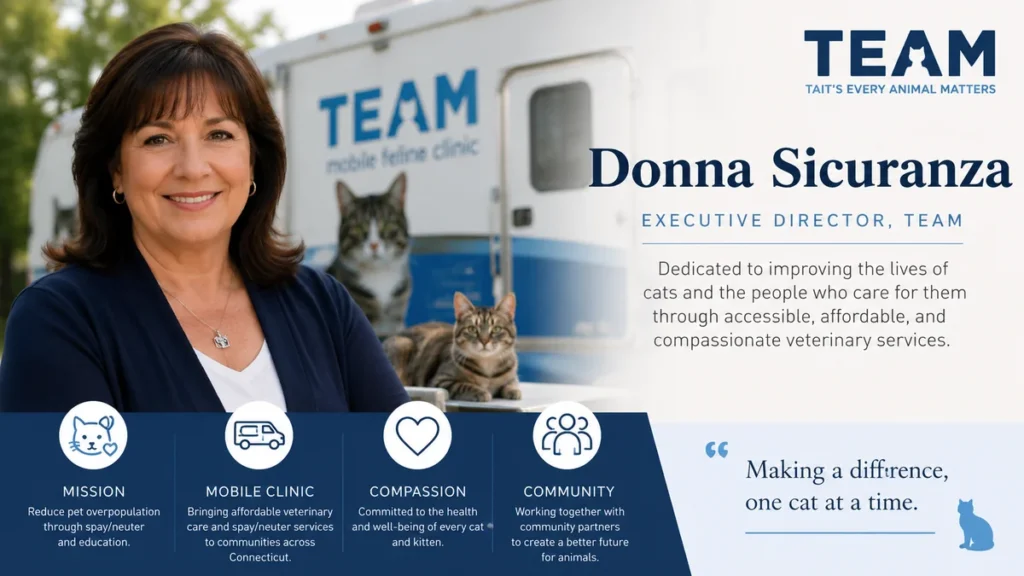
Donna Sicuranza is best known for her long-standing work in animal welfare and her leadership at Tait’s Every Animal Matters (TEAM), a Connecticut nonprofit focused on affordable veterinary services for cats. Her public career combines an earlier background in writing and public relations with decades of nonprofit work centered on feline spay/neuter access.
Unlike a conventional celebrity biography, the story of Donna Sicuranza is mostly documented through professional records, TEAM publications, interviews, and animal-welfare reporting. That distinction matters because online searches can also surface information about another woman named Donna Marie Sicuranza, who died in New York in 2017. The two should not be confused.
Quick answer: Donna J. Sicuranza is an American nonprofit leader associated with Tait’s Every Animal Matters (TEAM) in Westbrook, Connecticut. She helped establish TEAM’s mobile feline spay/neuter clinic with veterinarian Dr. John A. Caltabiano in 1997 and has served as the organization’s Executive Director. TEAM’s work focuses on making preventive veterinary care more affordable and accessible to cat caretakers across Connecticut.
Who Is Donna Sicuranza?
Donna Sicuranza is a nonprofit executive, writer, editor, and animal-welfare advocate whose public profile is closely connected to Tait’s Every Animal Matters.
TEAM is also associated with the longer organizational name Vernon A. Tait All-Animal Adoption, Preservation and Rescue Fund. Its best-known program is a mobile veterinary clinic dedicated to feline spaying, neutering, vaccinations, and related preventive care.
A 2019 TEAM publication identifies Donna J. Sicuranza as Executive Director. The same publication credits her and the late veterinarian Dr. John Caltabiano with establishing the mobile clinic in 1997 to make spay and neuter procedures easier for cat caretakers to access and afford.
That work rather than entertainment, politics, or social-media fame explains why her name appears in public records.
Donna Sicuranza at a Glance
| Detail | Publicly documented information |
|---|---|
| Name | Donna J. Sicuranza |
| Also associated with | Donna Sicuranza Marconi |
| Profession | Nonprofit executive; former writer, editor and PR professional |
| Known for | Leadership at Tait’s Every Animal Matters (TEAM) |
| Organization | Tait’s Every Animal Matters |
| Location associated with her work | Westbrook, Connecticut |
| Major program | TEAM Mobile Feline Spay/Neuter Clinic |
| Clinic established | 1997 |
| Co-founder | Dr. John A. Caltabiano |
| Education | Fairfield University; Trinity College-Hartford |
| Birth date/age | Not reliably established in the public professional record |
The lack of verified personal information is worth emphasizing. Several newer biography pages attempt to fill those gaps with estimated ages, family information, or unrelated records. A careful biography should separate documented facts from speculation.
Donna Sicuranza’s Education and Early Professional Background
Public professional information indicates that Sicuranza studied at Fairfield University from 1978 to 1982 and later attended Trinity College-Hartford from 1989 to 1992. Her academic background was in English Language and Literature.
That education fits naturally with the career she pursued before becoming known for animal-welfare work.
Before her leadership at TEAM, Sicuranza worked in writing, editing, journalism-related communications, and public relations. Reporting about TEAM describes her as working in journalism and PR when she and Caltabiano were considering how the nonprofit could address Connecticut’s animal-welfare problems.
Her communications background is an important but sometimes overlooked part of her professional story.
Running a nonprofit requires more than understanding the cause itself. Organizations need to communicate with donors, volunteers, local communities, veterinarians, government agencies, and people seeking assistance.
Writing and public-relations experience therefore translated well into Sicuranza’s later responsibilities.
How Donna Sicuranza Became Involved With TEAM
To understand Sicuranza’s contribution, it helps to understand the problem TEAM was attempting to solve.
Dr. John A. Caltabiano was a veterinarian with extensive experience in mobile veterinary medicine. According to Connecticut Magazine, he had previously created an animal-adoption nonprofit and later received funding connected to the estate of businessman and animal lover Vernon A. Tait. That support helped establish what became the Vernon A. Tait All-Animal Adoption, Preservation and Rescue Fund, commonly called TEAM.
The organization initially needed to determine where its resources could have the greatest effect.
Caltabiano created a phone line through which people could discuss their animal-related concerns. Sicuranza later recalled that many of the calls involved excessive numbers of cats and kittens and problems resulting from unwanted litters.
That pattern helped clarify the problem.
Rather than concentrating exclusively on finding homes after kittens had already been born, TEAM could work further upstream by reducing unwanted reproduction.
The result was a focus on affordable feline spaying and neutering.
The TEAM Mobile Feline Spay/Neuter Clinic
In 1997, Donna Sicuranza and Dr. John Caltabiano worked together to put TEAM’s mobile feline clinic on the road.
TEAM’s own publication describes it as Connecticut’s first mobile spay/neuter and vaccination clinic specifically for cats. Its purpose was straightforward: make essential veterinary procedures more accessible and affordable by bringing services closer to communities.
The clinic reportedly altered 12 cats on its first day. By 2019, it was traveling to more than 25 Connecticut communities, according to TEAM’s newsletter.
This model addresses a practical barrier that animal-welfare organizations regularly encounter.
People may understand the benefits of sterilizing their pets but still face obstacles such as:
- veterinary costs,
- transportation,
- limited access to nearby services,
- difficulties managing feral cats,
- or large numbers of community cats requiring treatment.
A mobile service cannot eliminate every obstacle, but it can reduce several of them at once.
Why Spaying and Neutering Became Central to TEAM’s Mission
Animal rescue often becomes visible only after a problem has developed: abandoned animals need homes, shelters reach capacity, or feral colonies increase.
Spay and neuter programs take a preventive approach.
By reducing unintended litters, sterilization programs can help lower the number of cats entering already strained rescue and shelter systems. They can also provide an opportunity for vaccination and other basic veterinary care.
TEAM’s model was therefore not simply about performing individual surgeries.
Its broader goal was to interrupt the cycle producing unwanted kittens in the first place.
Connecticut Magazine’s account of TEAM’s history shows that reports of unwanted litters played a major role in defining this mission. Sicuranza and Caltabiano responded by creating a service built around accessibility rather than waiting for every cat owner or caretaker to reach a conventional veterinary facility.
Why a Mobile Clinic Matters
The mobile-clinic model offers several practical advantages.
Accessibility: The veterinary service travels to communities rather than operating from only one permanent location.
Affordability: TEAM was established specifically to make feline sterilization more financially accessible.
Prevention: Sterilizing cats helps prevent unwanted litters instead of requiring shelters to deal with the consequences later.
Community reach: Both owned and feral cats can potentially benefit from targeted feline services.
Additional care: TEAM’s published service information has included vaccinations and other preventive treatments alongside sterilization.
These features explain why a relatively specialized nonprofit can have an impact far beyond a single shelter or town.
Donna Sicuranza and Dr. John A. Caltabiano
Dr. John A. Caltabiano is central to the history of TEAM and therefore to Donna Sicuranza’s professional story.
Caltabiano was an experienced veterinarian who established a mobile veterinary practice in 1980. In 1997, he helped launch the TEAM Mobile Feline Unit.
Sicuranza worked alongside him as TEAM developed its mission and mobile clinic.
Their partnership was also personal. Contemporary records describing Caltabiano’s death in November 2009 identify Sicuranza as his longtime partner. A Connecticut Department of Agriculture publication stated that she would continue his work at TEAM and with FeralStat following his death.
That contemporary evidence is particularly useful because it distinguishes the animal-welfare leader from unrelated people sharing the same name.
Caltabiano’s death represented a major transition for the organization, but TEAM’s mobile program continued.
Sicuranza’s long-term leadership became an important source of continuity.
Donna Sicuranza as Executive Director of TEAM
TEAM’s 2019 organizational material formally lists Donna J. Sicuranza as its Executive Director.
An executive director of a small nonprofit often performs a broader range of duties than the same title might imply at a large corporation.
Leadership can involve fundraising, program administration, public communications, volunteer coordination, donor relationships, strategic planning, partnerships, and maintaining the organization’s mission over time.
Sicuranza’s communications experience was especially relevant here.
She was also identified as editor of TEAMWORKS, TEAM’s newsletter, showing how her writing background remained connected to her nonprofit responsibilities.
The combination makes sense: effective animal-welfare work depends not only on veterinary professionals performing procedures but also on someone maintaining the organizational structure that allows those services to reach the public.
How Significant Has TEAM’s Work Been?
Numbers describing TEAM’s cumulative impact vary depending on when a source was published.
One useful historical benchmark comes from 2010.
An Animal People report published after Caltabiano’s death stated that TEAM, then being continued by Sicuranza, had already sterilized more than 128,000 cats.
Later organizational and secondary sources report substantially higher cumulative totals as the clinic continued operating.
The larger point is not a single snapshot number. It is the duration of the program.
A clinic launched in 1997 and maintained across decades represents sustained preventive work rather than a short campaign. Each procedure potentially prevents additional unintended litters while giving individual cats access to veterinary care.
That cumulative model is what gives TEAM’s work its significance.
Donna Sicuranza and FeralStat
Another part of the historical record involves FeralStat, a proposed approach to controlling reproduction among feral cats.
Caltabiano developed FeralStat as an oral contraceptive concept for feline population management. Contemporary reporting shows that the project attracted interest but also concerns about the synthetic hormone involved and potential side effects.
The Connecticut Department of Agriculture’s 2010 publication stated that Sicuranza would continue Caltabiano’s work with both TEAM and FeralStat following his death.
Court records from later years also identify Donna J. Sicuranza in connection with FeralStat, Inc.
This part of the story needs careful wording.
FeralStat should not be treated as equivalent to TEAM’s established mobile spay/neuter program. Surgical sterilization remained the clear, documented foundation of TEAM’s public-facing work, while FeralStat had a more complicated and limited history.
From Communications Professional to Nonprofit Leader
One of the most interesting aspects of Sicuranza’s career is how skills from one profession carried into another.
At first glance, journalism and animal welfare may seem unrelated.
In practice, nonprofit leadership depends heavily on communication.
A nonprofit must explain why a problem matters. It must make technical subjects understandable to ordinary people. It must build trust with donors and communities. It needs newsletters, educational material, public outreach, fundraising messages, and relationships with local organizations.
Those are communication problems as much as administrative ones.
Sicuranza’s career demonstrates how professional writing and public-relations experience can support mission-driven work outside traditional media.
Her role as both TEAM’s Executive Director and newsletter editor makes that connection particularly visible.
Is Donna Sicuranza the Woman Who Died in 2017?
No reliable evidence supports treating the two women as the same person.
This is one of the most important points for anyone researching Donna Sicuranza online.
An obituary exists for Donna Marie Sicuranza, born March 24, 1942, who died March 10, 2017 at age 74. She lived in the New York area, attended St. Catherine’s School and Good Counsel Academy, worked at Walker Studios and the Bank of New York, and married Angelo Sicuranza in 1960.
Those details belong to Donna Marie Sicuranza.
They should not automatically be assigned to Donna J. Sicuranza, the Connecticut animal-welfare professional.
The distinction becomes obvious when comparing the records. TEAM documentation lists Donna J. Sicuranza as Executive Director in 2019—two years after Donna Marie Sicuranza’s documented death.
Some online biography pages have blended these identities, which can create inaccurate claims about age, husband, children, career history, and death.
How Old Is Donna Sicuranza?
A reliably verified birth date for the Donna Sicuranza associated with TEAM is not established in the authoritative public sources reviewed.
Her education timeline provides some historical context: her public professional profile lists Fairfield University from 1978 to 1982 and Trinity College-Hartford from 1989 to 1992.
However, using university attendance to calculate an exact birth year would still be an assumption.
People begin undergraduate education at different ages, take breaks, return to school, or follow nontraditional academic paths.
For that reason, an exact age should not be presented as fact without a reliable primary source.
The frequently repeated March 24, 1942 birth date belongs to Donna Marie Sicuranza of New York, not demonstrably to the TEAM Executive Director.
Is Donna Sicuranza Married?
Public sources provide much clearer information about her earlier relationship with Dr. John Caltabiano than about her current personal life.
Caltabiano’s 2009 obituary identifies Donna Sicuranza of Westbrook as his longtime partner.
Some current web sources use the name Donna Sicuranza Marconi, but a surname alone should not be used to construct a detailed marriage history without supporting primary documentation.
For the same reason, information about a husband named Angelo belongs to Donna Marie Sicuranza’s obituary and should not be transferred to the TEAM executive.
This is a good example of why responsible biographical research sometimes requires leaving a question unanswered rather than filling the gap with a plausible-looking detail.
What Is Donna Sicuranza’s Net Worth?
There is no credible publicly documented net-worth figure for Donna Sicuranza.
She is a nonprofit executive rather than a celebrity whose earnings, business holdings, contracts, or investment portfolio receive regular financial coverage.
Any precise number presented as her “net worth” without transparent financial evidence should therefore be treated skeptically.
Public nonprofit records may sometimes provide organizational financial information or compensation data, but those figures are not the same thing as personal net worth.
A salary tells you what someone earned during a particular period. Net worth requires information about assets and liabilities that is generally private.
For Sicuranza, the available evidence is much stronger when discussing her professional contributions than when attempting to estimate personal wealth.
Why Donna Sicuranza’s Work Matters
The most meaningful way to evaluate Sicuranza’s public career is through the problem her organization has spent decades addressing.
Cat overpopulation is not solved simply by finding more adopters.
Rescue and adoption remain essential, but if uncontrolled reproduction continually produces more unwanted kittens, shelters and rescue groups remain under pressure.
Preventive veterinary programs work earlier in that cycle.
TEAM’s strategy brought spay/neuter services into communities and reduced some of the financial and geographic barriers that can prevent caretakers from sterilizing cats.
That approach has several broader implications.
It Focuses on Prevention
Preventing unwanted litters can reduce future pressure on shelters and rescue organizations.
It Expands Veterinary Access
Mobile services can reach people and communities that may have difficulty using conventional veterinary clinics.
It Supports Feral and Community Cats
Feral-cat management presents challenges different from ordinary pet ownership. Accessible sterilization is an important part of managing populations humanely.
It Creates Long-Term Community Impact
A single sterilization procedure affects one animal immediately, but preventing reproduction can have effects extending far beyond that individual cat.
This prevention-focused philosophy is the clearest thread connecting Sicuranza’s work with TEAM.
What Can Be Reliably Said About Donna Sicuranza?
The internet often encourages biographies to become more detailed than the available evidence allows.
In Donna Sicuranza’s case, the reliable public record supports several clear conclusions.
She has a background in writing, editing, and public relations. She became closely involved with Dr. John Caltabiano and TEAM’s animal-welfare mission. Together, they helped establish the mobile feline spay/neuter clinic in 1997. After Caltabiano’s death in 2009, she continued working with TEAM. Organizational records later identify her as Executive Director and editor of TEAM’s newsletter.
Those facts tell a substantial professional story without requiring speculation about private details.
Donna Sicuranza’s Lasting Contribution to Animal Welfare
Donna Sicuranza’s public legacy is closely tied to an unusually practical idea: if veterinary care is difficult for people to reach, bring the service closer to them.
That concept helped shape TEAM’s mobile feline clinic.
What began in 1997 with a relatively small mobile operation became a long-running Connecticut animal-welfare program serving domestic and feral cats. TEAM’s own historical materials credit Sicuranza and Caltabiano with establishing the clinic specifically to make spaying and neutering more affordable and accessible.
Her contribution also illustrates something broader about nonprofit work.
Large social problems are not always addressed through dramatic national campaigns. Sometimes impact comes from doing one specific job consistently for years: identifying a preventable problem, building an accessible service around it, communicating its value to the public, and keeping that service operating.
For Donna Sicuranza, that work has centered on cats, preventive veterinary care, and the communities TEAM serves in Connecticut.
Her biography is therefore best understood not as a celebrity story but as the career of a communications professional who became deeply involved in animal welfare and helped sustain a community-based solution for decades.