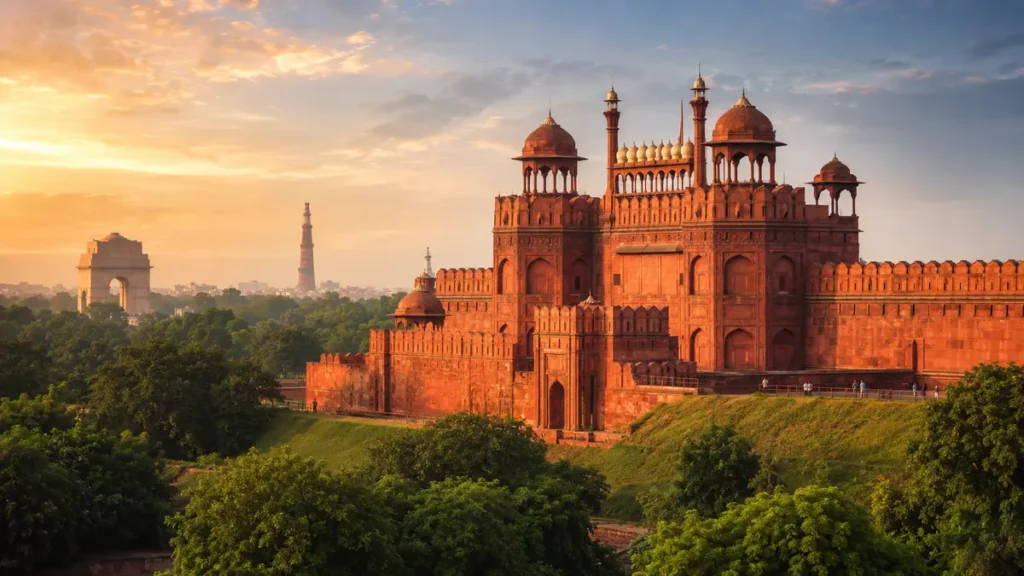
Delhi can feel like several cities compressed into one. Mughal forts rise above crowded bazaars, tree-lined avenues lead to grand government buildings, and medieval tombs sit inside peaceful gardens surrounded by modern neighborhoods.
The best places to visit in delhi include the Red Fort, Qutub Minar, Humayun’s Tomb, India Gate, Jama Masjid, Lotus Temple, Akshardham, Chandni Chowk, Lodhi Garden, and Gurudwara Bangla Sahib. First-time visitors should allow at least two or three days and group attractions by neighborhood to avoid spending much of the trip in traffic.
This guide covers Delhi’s major landmarks, spiritual sites, markets, museums, green spaces, and lesser-known ruins. It also explains how to organize them into a realistic itinerary.
Best places to visit in delhi at a glance
Delhi’s headline attractions span more than 800 years of history. The city contains three UNESCO World Heritage Sites—Qutub Minar, Humayun’s Tomb, and the Red Fort—alongside buildings associated with the Delhi Sultanate, Mughal Empire, British India, and the modern republic.
| Place | Best for | Area | Suggested time |
|---|---|---|---|
| Red Fort | Mughal history | Old Delhi | 2–3 hours |
| Jama Masjid | Architecture and Old Delhi views | Old Delhi | 45–60 minutes |
| Chandni Chowk | Markets and street life | Old Delhi | 2–3 hours |
| Humayun’s Tomb | Mughal architecture | Nizamuddin | 1.5–2 hours |
| Qutub Minar | Medieval history | Mehrauli | 1.5–2 hours |
| India Gate | Evening walks | Central Delhi | 45–60 minutes |
| Lotus Temple | Modern religious architecture | Kalkaji | 45–60 minutes |
| Akshardham | Art, faith, and exhibitions | East Delhi | 3–5 hours |
| Gurudwara Bangla Sahib | Sikh heritage | Central Delhi | 45–60 minutes |
| Lodhi Garden | Tombs and greenery | Lodhi Estate | 1–2 hours |
| National Museum | Indian history and art | Janpath | 2–3 hours |
| Sunder Nursery | Gardens and heritage | Nizamuddin | 2 hours |
Opening hours, entry fees, security restrictions, and weekly closing days can change. Check the attraction’s official website or Delhi Tourism shortly before visiting.
Historical places to visit in delhi
1. Red Fort
The Red Fort, or Lal Qila, is the defining monument of Old Delhi. Mughal emperor Shah Jahan commissioned the red-sandstone citadel after moving his capital from Agra to Shahjahanabad in the 17th century.
Visitors enter through Lahore Gate and pass the covered Chatta Chowk bazaar before reaching ceremonial and residential buildings. Important structures include the Diwan-i-Aam, Diwan-i-Khas, Rang Mahal, Khas Mahal, and the white-marble Moti Masjid.
The complex suffered extensive damage and alteration after the uprising of 1857, so some spaces feel more open than their original Mughal layout suggests. Even so, its surviving halls, gardens, defensive walls, and museums provide an excellent introduction to imperial Delhi.
Arrive near opening time for cooler temperatures and fewer crowds. The fort generally requires more time than list-style itineraries allow, particularly if you plan to visit its museums.
2. Qutub Minar and the Qutub complex
Qutub Minar is a 72.5-meter tower surrounded by some of Delhi’s most significant medieval remains. Construction began under Qutb-ud-din Aibak around the end of the 12th century and continued under later rulers, including Iltutmish.
The minaret’s alternating angular and rounded fluting, carved inscriptions, balconies, and changing stonework reveal how it developed across different periods. Visitors cannot climb inside, but the exterior is impressive from several viewpoints around the complex.
Do not stop after photographing the tower. Explore the Quwwat-ul-Islam Mosque, the Iron Pillar, Iltutmish’s Tomb, Alai Darwaza, and the unfinished Alai Minar. Together, these structures explain the early architectural language of the Delhi Sultanate far better than the minaret alone.
Late afternoon provides softer light, although early morning is usually quieter.
3. Humayun’s Tomb
Humayun’s Tomb is one of Delhi’s finest examples of Mughal architecture. Commissioned by the emperor’s widow, Bega Begum, the mausoleum introduced the monumental garden-tomb form that influenced later Mughal projects, including the Taj Mahal.
The main tomb stands on a high platform within a formal charbagh, or four-part garden. Its red sandstone, white marble, geometric proportions, arched façades, and double dome produce a balanced design that rewards close inspection.
The wider complex contains several important structures, including Isa Khan’s Tomb, the Arab Serai gateway, Nila Gumbad, and Bu Halima’s garden. Set aside enough time to see these instead of walking directly to the central mausoleum.
Morning is particularly atmospheric and usually more comfortable. Delhi Tourism currently advises that the complex is open daily, but visitors should confirm timings and ticket information before departure.
4. Purana Qila
Purana Qila, meaning “Old Fort,” is traditionally linked with ancient Indraprastha and more firmly associated with the 16th-century rulers Humayun and Sher Shah Suri.
Its huge gateways and defensive walls enclose the Qila-i-Kuhna Mosque and Sher Mandal, an octagonal tower connected with Humayun’s death. Archaeological excavations have uncovered occupation layers from multiple historical periods, adding depth to the site’s identity.
Purana Qila receives fewer visitors than the Red Fort, making it a good choice for travelers who prefer open ruins and slower exploration. It also pairs conveniently with the nearby National Zoological Park and Crafts Museum.
5. Agrasen ki Baoli
Agrasen ki Baoli is a historic stepwell hidden among the office buildings near Connaught Place. Its long flight of stone steps descends through three levels of arched chambers, creating an unexpectedly dramatic space in central Delhi.
The surviving structure is generally associated with rebuilding during the medieval period, although traditions connect it with the legendary king Agrasen. Its precise early history remains uncertain, so claims that assign it an exact ancient date should be treated carefully.
Visit early if you want unobstructed photographs. The baoli is compact and usually takes 20–30 minutes to explore.
6. Mehrauli Archaeological Park
Mehrauli Archaeological Park is one of the most rewarding places for travelers interested in layered history. Spread across roughly 200 acres near Qutub Minar, it contains remains spanning several centuries.
Highlights include Jamali Kamali Mosque and Tomb, Rajon ki Baoli, Gandhak ki Baoli, Balban’s Tomb, Quli Khan’s Tomb, and scattered gateways and enclosures. Some monuments are restored, while others remain weathered and partially absorbed into the landscape.
Paths and signage can be inconsistent, so a guided heritage walk helps connect the sites and their stories. Wear proper walking shoes and visit during daylight.
Quick takeaway: Qutub Minar, Humayun’s Tomb, and the Red Fort are essential for a first trip. Mehrauli Archaeological Park and Purana Qila offer a quieter, less polished encounter with Delhi’s past.
Old Delhi places to visit for markets, food, and street life
7. Jama Masjid
Jama Masjid stands at the heart of Shah Jahan’s former imperial capital. Completed in the 17th century, it remains one of India’s largest and best-known mosques.
A broad staircase leads to a vast courtyard framed by red sandstone and white marble. The mosque’s three domes, tall minarets, cusped arches, and commanding position make it one of Old Delhi’s great architectural experiences.
Non-Muslim visitors should avoid prayer periods, dress conservatively, remove their shoes, and follow staff instructions. Rules governing photography, clothing, and access to the minaret may change.
The steps and courtyard can become extremely hot during summer afternoons. Morning or the period before sunset is more comfortable.
8. Chandni Chowk
Chandni Chowk is not a single monument but an entire historic district. Created as part of Shahjahanabad, it remains packed with specialist markets, religious buildings, food stalls, merchants, cycle rickshaws, and pedestrians.
Different lanes have distinct identities:
- Dariba Kalan is known for silver jewelry.
- Kinari Bazaar sells decorative trims and wedding accessories.
- Khari Baoli is associated with spices and wholesale goods.
- Paranthe Wali Gali is famous for stuffed fried breads.
- Nai Sarak specializes in books and stationery.
The area is stimulating but can be overwhelming. Keep valuables secure, use the Metro rather than a private car, and treat hygiene carefully when sampling street food. Choose busy vendors that cook food freshly and serve it hot.
9. Khari Baoli
At the western end of Chandni Chowk, Khari Baoli is often described as one of Asia’s largest wholesale spice markets. Shops and storerooms overflow with chilies, turmeric, dried fruit, tea, nuts, grains, and aromatic spice mixtures.
The market is a working commercial district rather than a curated attraction. Porters move heavy loads through narrow lanes, scooters squeeze through crowds, and airborne spice dust can irritate the eyes and throat.
A local guide can make the experience easier and explain what is being traded. Anyone with asthma or respiratory sensitivity may prefer to keep the visit brief or wear a suitable mask.
10. Raj Ghat
Raj Ghat is the memorial where Mahatma Gandhi was cremated following his assassination in 1948. A simple black-marble platform marks the location, surrounded by landscaped grounds.
The memorial offers a quiet contrast to the intensity of nearby Old Delhi. Visitors should dress respectfully, maintain silence, and remove footwear where instructed.
Raj Ghat works well between the Red Fort and central Delhi, but its restrained design makes more sense when visitors understand its historical significance beforehand.
Religious places to visit in delhi
Delhi’s religious landmarks are active places of worship, not merely sightseeing stops. Modest clothing, quiet behavior, and respect for photography restrictions are essential.
11. Gurudwara Bangla Sahib
Gurudwara Bangla Sahib is one of Delhi’s most welcoming spiritual landmarks. Its white façade, golden dome, and large sarovar create a serene setting close to Connaught Place.
The gurdwara is associated with Guru Har Krishan, the eighth Sikh Guru. Visitors of all faiths may enter, sit in the prayer hall, walk around the water tank, and observe the community kitchen, or langar, where free meals are served without distinction of background.
Cover your head, remove your shoes, wash your hands, and use the foot-washing area before entering. Scarves are usually available at the entrance.
The kitchen is more than a tourist curiosity. If invited, visitors may sit for a meal or ask whether volunteers are needed for simple tasks.
12. Lotus Temple
The Lotus Temple is a Bahá’í House of Worship designed as a flowering lotus with 27 marble-clad “petals.” Completed in 1986, it has become one of Delhi’s most recognizable modern buildings.
People of every religion may enter the central hall for silent prayer or reflection. Sermons and ritual ceremonies are not performed there, reflecting the Bahá’í principle of unity.
Queues can be long on weekends and public holidays. Visitors must remain silent inside, and photography is generally restricted in the prayer hall. Check its weekly closing day before traveling.
13. Swaminarayan Akshardham
Akshardham is a large Hindu cultural and spiritual complex on the eastern side of the Yamuna. Its intricately carved central monument is surrounded by gardens, exhibitions, water features, and visitor facilities.
Unlike Delhi’s medieval monuments, Akshardham is a contemporary complex inspired by traditional Indian architectural forms. The detailed carvings portray deities, teachers, musicians, dancers, plants, and animals.
Security is strict. Phones, cameras, electronic devices, and large bags may need to be deposited before entry, which can add considerable time. The main complex deserves at least half a day if you plan to see its exhibitions or evening water show.
14. Hazrat Nizamuddin Dargah
Hazrat Nizamuddin Dargah is the shrine of the influential Sufi saint Nizamuddin Auliya. Its lanes, flower sellers, devotional music, tombs, and constant flow of worshippers create an experience very different from Delhi’s formal monuments.
The poet Amir Khusrau is also buried within the complex. Qawwali performances are commonly associated with certain evenings, but schedules and access conditions can change.
Dress conservatively, cover your head where required, and be cautious of unsolicited guides or requests for donations. The approach involves crowded, narrow lanes; visitors uncomfortable with intense crowds may prefer a guided walk.
15. Laxminarayan Temple
Also called Birla Mandir, the Laxminarayan Temple is dedicated primarily to Vishnu and Lakshmi. Mahatma Gandhi inaugurated the temple in 1939 on the condition that it remain open to people of all castes.
The complex combines colorful shrines, carved towers, courtyards, fountains, and gardens. It is conveniently located west of Connaught Place and can be paired with Gurudwara Bangla Sahib.
Electronic devices may need to be stored outside, and photography restrictions should be respected.
Places to visit in delhi for gardens and architecture
16. Lodhi Garden
Lodhi Garden combines landscaped lawns with tombs dating from the Sayyid and Lodi periods. Major structures include the tombs of Muhammad Shah and Sikandar Lodi, along with Bara Gumbad and Shish Gumbad.
Delhi residents use the garden for walking, running, yoga, picnics, and birdwatching. That everyday activity makes the site feel alive rather than preserved behind museum barriers.
Go early in the morning for cooler weather or near sunset for softer light. Entry is generally free, making it one of the best low-cost attractions in the city.
17. Sunder Nursery
Sunder Nursery is a restored heritage park beside Humayun’s Tomb. Its gardens contain lakes, tree-lined paths, ecological zones, flower beds, and several Mughal-era monuments.
Notable structures include Sunder Burj, Lakkarwala Burj, and the monumental Azim Ganj Serai gateway. The park’s restoration has brought together landscape design, biodiversity, and architectural conservation.
It is an excellent place to decompress after Humayun’s Tomb. Families may prefer its open lawns, while photographers will find good compositions around the water and restored monuments.
18. Garden of Five Senses
The Garden of Five Senses near Saket was designed as a recreational landscape rather than a formal botanical garden. Sculptures, rocky paths, water features, planting areas, and themed spaces encourage slow exploration.
It is popular with couples and local families, particularly in pleasant weather. Maintenance and seasonal conditions can vary, so expectations should be realistic.
Combine it with Qutub Minar or Mehrauli Archaeological Park rather than crossing the city solely for this attraction.
19. Safdarjung’s Tomb
Safdarjung’s Tomb is an 18th-century garden mausoleum built for the Mughal statesman Safdarjung. Its central building, water channels, gateways, and symmetrical enclosure follow the garden-tomb tradition on a smaller scale than Humayun’s Tomb.
The monument is less crowded than Delhi’s UNESCO sites. Its weathered sandstone and relatively intimate proportions make it rewarding for architecture enthusiasts and photographers.
Because it sits close to Lodhi Garden, both can be visited in one relaxed morning or afternoon.
Central Delhi landmarks and museums
20. India Gate and the National War Memorial
India Gate was designed by Edwin Lutyens as a memorial to soldiers of the Indian Army who died during World War I and the Third Anglo-Afghan War. Its monumental arch anchors the ceremonial avenue now known as Kartavya Path.
Behind India Gate, the National War Memorial commemorates members of India’s armed forces who died in conflicts after independence. Its concentric design includes the Amar Chakra and an eternal flame.
The area is especially popular after sunset, when temperatures fall and the monuments are illuminated. Security restrictions or ceremonial events can occasionally limit access.
21. Rashtrapati Bhavan and Kartavya Path
Rashtrapati Bhavan, formerly the Viceroy’s House, is the official residence of the President of India. Its immense scale, central dome, colonnades, and blend of European planning with Indian architectural details make it a landmark of New Delhi.
Visitors can appreciate the exterior from Kartavya Path and the surrounding avenues. Access to interior circuits and the Amrit Udyan gardens is controlled and normally requires advance registration during designated periods.
Nearby government buildings include North Block, South Block, and the Parliament complex. Photography and pedestrian access may be restricted around sensitive areas, so follow security instructions.
22. National Museum
The National Museum on Janpath is one of the best places to understand the civilizations represented across Delhi’s monuments.
Its collections traditionally span Harappan objects, Buddhist art, sculpture, miniature paintings, coins, manuscripts, textiles, decorative arts, and material from different regions of India. Available galleries can change because of renovations or object rotation.
Allow at least two hours. Attempting to inspect every display usually leads to museum fatigue; select a few collections that match your interests and explore them carefully.
23. National Crafts Museum and Hastkala Academy
The National Crafts Museum presents Indian craft traditions through galleries, textiles, paintings, metalwork, woodwork, jewelry, and reconstructed vernacular buildings.
Its village-complex setting feels quieter than many conventional museums. Depending on the program, visitors may also see artisans demonstrating traditional techniques.
The museum pairs naturally with Purana Qila, Pragati Maidan, or the National Science Centre. Confirm which galleries are open before visiting.
24. Gandhi Smriti
Gandhi Smriti occupies Birla House, where Mahatma Gandhi spent the final months of his life and was assassinated on January 30, 1948.
Displays examine Gandhi’s life, political philosophy, personal belongings, and final days. The preserved room and pathway leading toward the location of his assassination give the museum a direct emotional quality.
Gandhi Smriti and Raj Ghat serve different purposes: the former explains the final chapter of his life, while the latter is the cremation memorial.
Modern neighborhoods and places to visit in delhi at night
25. Connaught Place
Connaught Place, commonly called CP, is one of New Delhi’s central commercial and social districts. Its concentric colonnaded blocks contain shops, cafés, restaurants, cinemas, offices, and access to the Rajiv Chowk Metro interchange.
The central park often hosts public events, while Janpath Market and the underground Palika Bazaar attract bargain hunters. Quality and pricing vary widely, so inspect purchases and negotiate only where bargaining is customary.
CP is most useful as an evening base after visiting India Gate, Gurudwara Bangla Sahib, Agrasen ki Baoli, or the National Museum.
Hauz Khas
Hauz Khas combines medieval remains with restaurants, boutiques, galleries, and residential streets. The historic complex overlooks a reservoir and includes the tomb of Firuz Shah Tughlaq, a madrasa, pavilions, and ruined chambers.
The heritage zone is most attractive in daylight. The surrounding village becomes livelier in the evening, although individual venues and nightlife conditions change frequently.
Visit the ruins first, walk around nearby Deer Park, and stay for a meal if the neighborhood appeals to you.
Dilli Haat
Dilli Haat INA is an open-air crafts and food market designed to represent traditions from different Indian states. Stalls sell textiles, pottery, jewelry, paintings, leather goods, and decorative objects, while food counters serve regional dishes.
Unlike a temporary street market, Dilli Haat has controlled entry and a more organized layout. Prices may still require comparison, and “handmade” does not automatically mean locally produced or unique.
It is a convenient option for travelers who want regional food and souvenir shopping without traveling between multiple markets.
Quick takeaway: For an evening in Delhi, choose India Gate and Kartavya Path for an open-air walk, Connaught Place for central dining, or Dilli Haat for crafts and regional food.
Hidden and unusual places to visit in delhi
Famous monuments only tell part of Delhi’s story. These quieter sites reveal how ruins, neighborhoods, and public spaces continue to evolve.
Feroz Shah Kotla
The ruins of Feroz Shah Kotla belong to the 14th-century city of Firozabad, built by Sultan Firoz Shah Tughlaq. The complex contains the remains of a palace, a mosque, underground chambers, and an Ashokan pillar installed atop a pyramidal structure.
The site is also connected with contemporary beliefs involving djinns. Visitors sometimes leave written petitions, although access practices may be regulated to protect the monument.
Tughlaqabad Fort
Tughlaqabad Fort is a massive 14th-century fortress constructed by Ghiyas-ud-din Tughlaq. Its sloping walls, bastions, gateways, and broken chambers spread across rugged terrain in southeast Delhi.
The scale is impressive, but the ruins are exposed and require more physical effort than manicured attractions. Carry water, wear sturdy shoes, avoid isolated areas near closing time, and do not visit during extreme midday heat.
Majnu ka Tila
Majnu ka Tila is a Tibetan settlement known for monasteries, restaurants, bakeries, clothing stores, and narrow pedestrian lanes. It offers a distinct cultural and culinary experience removed from Delhi’s Mughal sightseeing circuit.
Try Tibetan dishes such as momos, thukpa, or tingmo, but remember that this is a residential and religious community. Avoid blocking lanes for photographs and ask permission before photographing people.
Shalimar Bagh and Sheesh Mahal
Shalimar Bagh was once a Mughal garden associated with Shah Jahan’s period. Its restored Sheesh Mahal reopened to visitors in 2025 after extensive conservation work, bringing renewed attention to this less-visited part of North Delhi.
Because access arrangements around newly restored heritage sites can change, verify current opening hours before making a special journey.
Best places to visit in delhi with family
Families should balance monuments with interactive museums, gardens, and shorter activities. Strong options include:
- National Science Centre: Hands-on exhibits for school-age children, though some galleries may feel dated.
- Nehru Planetarium: Astronomy programs near Teen Murti; show schedules and language options should be checked in advance.
- National Rail Museum: Historic locomotives, coaches, railway exhibits, and outdoor displays.
- Sunder Nursery: Open lawns, lakes, shaded walks, and heritage structures.
- Lodhi Garden: Free space for walking and picnics among historic tombs.
- Dilli Haat: Regional food and manageable souvenir shopping in one enclosed venue.
- Shankar’s International Dolls Museum: A large collection of dolls representing countries and Indian regions.
Young children may find back-to-back monument visits tiring. One major heritage site, one interactive attraction, and one garden is a more realistic daily plan.
Free places to visit in delhi
Delhi offers several worthwhile experiences that generally require no admission charge:
- India Gate and Kartavya Path
- National War Memorial
- Gurudwara Bangla Sahib
- Lotus Temple
- Lodhi Garden
- Raj Ghat
- Jama Masjid’s main courtyard, subject to current visitor rules
- Hauz Khas Complex
- Connaught Place
- Hazrat Nizamuddin Dargah
“Free” does not necessarily mean there are no incidental costs. Shoe storage, photography, parking, guided assistance, food, and donations may involve optional or regulated charges.
How to plan a two-day Delhi itinerary
Trying to visit attractions in list order wastes time because Delhi is geographically spread out. Organize each day around one part of the city.
Day 1: Old Delhi and central New Delhi
- Begin at the Red Fort near opening time.
- Walk or take a short cycle-rickshaw ride to Jama Masjid.
- Explore Chandni Chowk and selected market lanes.
- Visit Raj Ghat after lunch.
- Continue to Gurudwara Bangla Sahib.
- Finish at India Gate and the National War Memorial after sunset.
This is a full day. Remove Raj Ghat or shorten the market visit if you prefer a slower pace.
Day 2: South Delhi and Nizamuddin
- Start at Qutub Minar.
- Choose Mehrauli Archaeological Park or the Lotus Temple.
- Visit Humayun’s Tomb in the afternoon.
- Walk through Sunder Nursery or Lodhi Garden.
- End with dinner around Connaught Place, Hauz Khas, or another convenient neighborhood.
Akshardham should usually replace several attractions rather than being squeezed between them. Security, exhibitions, and the size of the complex make it a half-day destination.
Best time to visit Delhi
October through March generally offers the most comfortable temperatures for sightseeing, particularly from November to February. However, winter can bring fog, reduced visibility, cold mornings, and severe air pollution.
April through June is intensely hot, with afternoon temperatures sometimes becoming unsafe for extended outdoor walking. If visiting then, explore monuments early, rest indoors around midday, and carry water and sun protection.
The monsoon period, broadly from July to September, brings humidity, heavy showers, waterlogging, and greener gardens. Build flexibility into the schedule because traffic disruption can follow strong rainfall.
Check the local weather forecast and air-quality index each morning. Travelers with asthma, heart conditions, or other respiratory vulnerabilities should take pollution advisories seriously.
Getting around Delhi
The Delhi Metro is usually the fastest and most predictable way to travel between major districts. It connects Old Delhi, central New Delhi, South Delhi, the airport, railway stations, and much of the wider National Capital Region.
Use a Metro smart card or other currently accepted ticketing method if making several journeys. Women may use the designated women-only coach, normally located at one end of the train.
For the final stretch between a station and an attraction, use an auto-rickshaw, cycle rickshaw, taxi, or app-based ride. Confirm that an auto driver will use the meter or agree on the fare before departure.
A private car is comfortable for families but can lose significant time in congestion. It is also inconvenient around Chandni Chowk, where walking, Metro travel, and cycle rickshaws are more practical.
Practical advice for visiting Delhi attractions
Verify closures before leaving
Some monuments and museums close one day each week, while others may close temporarily for maintenance, state ceremonies, religious observances, or security arrangements. Do not build a rigid itinerary using hours copied from an old blog post.
Buy official tickets
Use the official attraction counter or authorized online platform. Avoid handing money to people claiming they can guarantee immediate entry unless they are clearly accredited.
Start early
Early mornings bring cooler air, lighter traffic, smaller crowds, and cleaner photographs. This is particularly useful at Humayun’s Tomb, Qutub Minar, the Red Fort, and Lodhi Garden.
Dress for both weather and worship
Loose, breathable clothing works well for much of the year. Carry a light scarf for religious sites, wear shoes that are easy to remove, and avoid clothing that exposes shoulders or knees when visiting active places of worship.
Prepare for security checks
Major landmarks may inspect bags and restrict tripods, food, liquids, power banks, or electronic devices. Akshardham has especially strict controls, so read its current visitor policy before arriving.
Protect yourself in crowded markets
Keep your phone and wallet in secure front pockets or a closed bag. Ignore persistent touts, confirm prices before accepting a service, and do not let strangers lead you to an unofficial “tourist office.”
Be careful with food and water
Drink sealed bottled water or reliably filtered water. For street food, choose busy stalls with high turnover and order items cooked fresh at high heat. Raw garnishes, cut fruit, and ice require more caution.
Which Delhi attractions should first-time visitors prioritize?
For a first visit, prioritize one landmark from each major side of Delhi:
- Old Delhi: Red Fort, Jama Masjid, and Chandni Chowk
- South Delhi: Qutub Minar
- Nizamuddin: Humayun’s Tomb and Sunder Nursery
- Central Delhi: India Gate, National War Memorial, and Gurudwara Bangla Sahib
- Modern spiritual architecture: Lotus Temple or Akshardham
- Green heritage: Lodhi Garden
These places to visit in delhi provide a balanced introduction to the city’s Mughal history, Sultanate architecture, religious diversity, markets, public monuments, and everyday urban life. Begin early, group nearby attractions together, and leave room for one unplanned walk—the moments between Delhi’s famous landmarks are often as memorable as the monuments themselves.