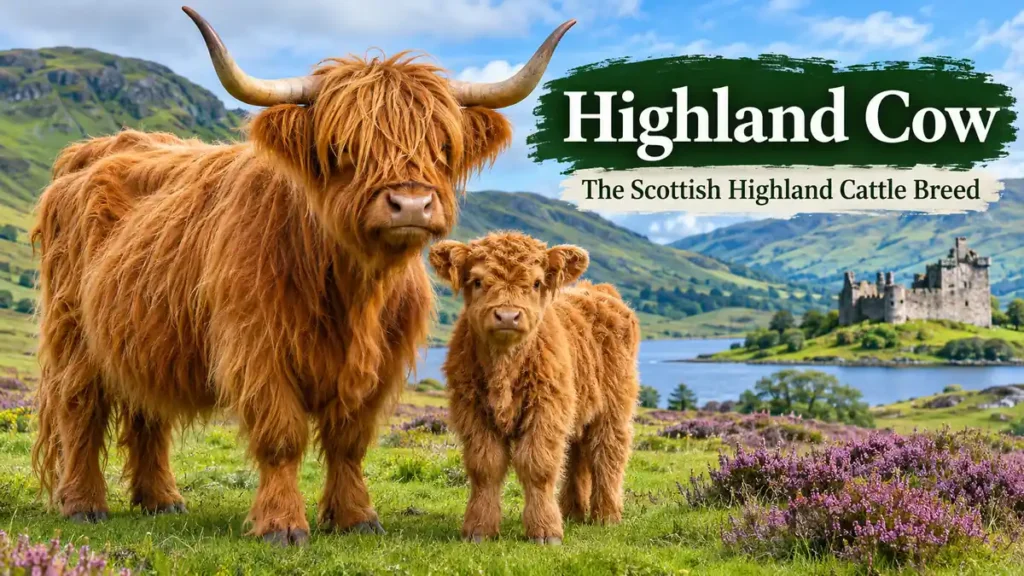
With its long, shaggy coat, sweeping horns, and distinctive fringe covering its eyes, the highland cow is one of the most recognizable cattle breeds in the world. Its appearance may seem almost ornamental, but this hardy Scottish animal was developed to survive conditions that many other cattle breeds find challenging.
Native to the Scottish Highlands and Western Isles, Highland cattle have adapted to cold temperatures, wet weather, rugged hillsides, and relatively poor grazing land.
A highland cow is a female Highland cattle animal belonging to a traditional Scottish beef breed known for its long double coat, prominent horns, calm disposition, and ability to thrive in harsh climates. Highland cattle are generally slow-maturing, long-lived, and efficient at grazing rough pasture, although they still require appropriate nutrition, shelter, veterinary care, and safe handling.
What Is a highland cow?
The Highland is a heritage breed of domestic cattle (Bos taurus) originating in Scotland. It is especially associated with the mountainous Scottish Highlands and the islands off Scotland’s western coast.
Highland cattle are sometimes called Scottish Highland cattle, Highlanders, or Heilan coos, a Scots expression commonly used to describe these distinctive animals.
Although people frequently use the term “highland cow” for any member of the breed, a cow is technically an adult female that has calved. Males are bulls, young females that have not calved are heifers, and young animals are calves.
The breed is traditionally raised for beef, but it also plays a role in conservation grazing, landscape management, small-scale farming, and heritage livestock preservation.
Where did Highland cattle originate?
Highland cattle developed over centuries in the challenging environment of northern and western Scotland.
The region’s cold winters, persistent rain, strong winds, and limited grazing resources favored animals capable of maintaining body condition under demanding circumstances.
Historically, Highland cattle were important to rural Scottish communities. They provided meat and economic value, and cattle were driven from remote areas to markets farther south.
The breed became formally organized through the Highland Cattle Society, established in 1884. Its first herd book was published in 1885, helping establish systematic pedigree recording.
Today, Highland cattle are found well beyond Scotland, including in England, the United States, Canada, Australia, and several European countries.
Are Highland cattle an ancient breed?
Highland cattle are widely regarded as one of Britain’s oldest established cattle breeds.
Their ancestry predates modern pedigree registration by centuries, although exact claims about the breed’s age are difficult to verify.
Historical accounts sometimes distinguish between smaller, often black cattle associated with the Western Isles and larger cattle from the mainland Highlands.
Over time, these populations contributed to the modern Highland breed.
Highland Cow Appearance and Physical Characteristics
Brown highland cow, green field and blue sky, Scotland
Highland Cow posing center to the frame, staring into camera
Highland-Cattle Highland Fleisch – Galerie
8
The Highland breed’s appearance reflects its adaptation to an environment where warmth, weather resistance, and physical resilience are essential.
Long, shaggy double coat
One of the most distinctive Highland cattle characteristics is the thick double coat.
It consists of two layers:
- Outer coat: Long, coarse guard hairs that help shed rain and protect against wind.
- Undercoat: A softer, insulating layer that helps retain warmth in cold weather.
This natural insulation reduces the breed’s dependence on thick layers of body fat for warmth.
Highland cattle also shed much of their winter coat during warmer months.
However, their cold-weather adaptation does not mean they are equally comfortable in hot conditions. In warm climates, shade, ventilation, clean drinking water, and heat-stress management become especially important.
Why do Highland cows have long hair over their eyes?
The long fringe covering a Highland animal’s forehead is commonly called a dossan.
It helps shield the eyes from wind, rain, flying insects, and other environmental irritants.
Despite its appearance, the fringe does not necessarily prevent the animal from seeing.
Nevertheless, unusually dense hair or eye irritation can interfere with vision, and individual animals may require assessment or grooming.
Do female Highland cows have horns?
Yes. Both male and female Highland cattle naturally grow horns.
Their horns are one of the breed’s defining features, although horn shape varies considerably.
Mature cows often have horns that extend outward and curve upward, while bulls frequently develop thicker horns with a different forward or outward orientation.
These differences are general tendencies rather than reliable methods for determining sex.
Horns continue developing as cattle mature and require particular attention during handling, transport, feeding, and interactions with other animals.
Highland cattle coat colors
Although reddish-brown Highland cattle are especially familiar, the breed occurs in several recognized colors.
| Coat color | Typical appearance |
|---|---|
| Red | Copper, ginger, or reddish-brown |
| Black | Solid black or nearly black |
| Yellow | Pale cream to golden |
| Dun | Grayish-brown or muted taupe |
| Silver dun | Light silvery-gray |
| Brindle | Dark striping over a base color |
| White | White or very pale cream |
Red cattle are commonly associated with the breed in popular photographs, but black, yellow, dun, and other colors are equally part of its heritage.
Coat color does not independently determine an animal’s temperament, health, or productivity.
Highland Cow Size, Weight, and Lifespan
Highland cattle have a compact, sturdy build that can make them appear smaller than some large commercial beef breeds.
Their long coats also make judging body condition by appearance alone more difficult.
How big does a Highland cow get?
Adult size depends on genetics, sex, nutrition, age, and management.
The following figures are approximate, rather than strict breed standards.
| Characteristic | Adult female | Adult male |
|---|---|---|
| Typical weight | 400–600 kg (880–1,320 lb) | 650–900 kg (1,430–1,980 lb) |
| Shoulder height | 105–125 cm | 120–135 cm |
| Body type | Compact and sturdy | Heavier and more muscular |
| Horns | Often outward and upward sweeping | Usually thicker and heavier |
Some animals fall outside these ranges.
Highland cattle are often smaller-framed than large continental beef breeds, such as Charolais, although comparisons vary by breeding line and management.
How long do Highland cows live?
Highland cattle can live approximately 15–20 years, and some individuals survive beyond 20 years with appropriate care.
Their productive breeding lifespan varies.
Longevity depends on factors including dental health, nutrition, reproductive performance, parasite management, injury prevention, and veterinary care.
A long potential lifespan should not be confused with a guarantee of long-term health or fertility.
How quickly do Highland cattle grow?
Highland cattle are generally considered slow-maturing compared with many intensively selected commercial beef breeds.
Their growth rate is influenced by pasture quality, seasonal conditions, genetics, supplementary feeding, and overall management.
Slow maturation can be an advantage in extensive systems where resilience and forage utilization are priorities.
However, it may also mean animals require more time to reach a desired finishing weight.
Highland Cow Temperament and Behavior
Highland cattle are often described as calm, intelligent, and relatively easy to manage when they receive consistent, appropriate handling.
Their temperament has contributed to their popularity among smallholders and livestock enthusiasts.
Still, they are large, powerful animals with horns. A relaxed appearance should never be mistaken for an absence of risk.
Are Highland cows friendly?
Many Highland cattle become accustomed to familiar caretakers and routine human activity.
Well-socialized individuals may approach people calmly, especially when they associate human presence with feeding.
However, temperament varies between animals.
A cow protecting a calf, a breeding bull, or an animal that feels cornered can behave defensively or aggressively.
Visitors should never assume that a Highland cow welcomes touching, feeding, or close interaction.
Are Highland cows dangerous?
Highland cattle are not inherently more aggressive simply because they have prominent horns, but their size and horn structure can make unsafe encounters serious.
Potential risks include:
- Defensive behavior around newborn calves.
- Unpredictable reactions to dogs.
- Injuries caused by horns during close contact.
- Accidental crushing or trampling.
- Aggression from breeding bulls.
- Stress-related behavior during handling or transport.
People walking through grazing areas should maintain distance, avoid getting between cows and calves, and follow local livestock safety guidance.
Dogs should be kept under effective control, with particular caution around cattle with young.
Do Highland cattle live in herds?
Yes. Highland cattle are social animals that naturally form groups.
A traditional Highland herd is often called a fold.
Within the group, cattle establish social relationships and dominance patterns that influence movement, feeding, and access to resources.
Keeping cattle with suitable companions generally supports normal social behavior.
Isolating a herd animal without a sound management or veterinary reason can create unnecessary stress.
Highland Cow Diet and Grazing Habits
Highland cattle are grazing ruminants with a digestive system adapted to processing fibrous plant material.
Their ability to use rough forage is one reason they are valued in extensive farming systems.
What do Highland cows eat?
Their diet primarily consists of grass and other suitable forage.
Depending on the environment and season, they may consume:
- Pasture grasses.
- Hay and haylage.
- Suitable herbs and broadleaf plants.
- Rushes and other coarse vegetation.
- Selected shrubs and woody plants.
- Supplementary feed when nutritional needs cannot be met through forage alone.
They also require continuous access to clean drinking water and an appropriate mineral supply.
Highland cattle can utilize relatively low-quality pasture, but this does not mean they can remain healthy on nutritionally inadequate feed.
Pregnant cows, lactating cows, growing calves, and animals experiencing extreme weather may have increased nutritional requirements.
How much does a Highland cow eat per day?
Forage intake varies with body weight, forage digestibility, production stage, and environmental conditions.
As a broad starting point, cattle may consume approximately 1.5–2.5% of their body weight in dry matter daily, although actual requirements differ.
For example, a 500 kg cow consuming 2% of its body weight would require approximately 10 kg of feed dry matter per day.
This is not equivalent to 10 kg of fresh grass because fresh forage contains substantial water.
A livestock nutritionist or veterinarian can help determine suitable rations based on forage analysis and the animal’s condition.
Can Highland cattle survive on poor pasture?
Highland cattle are comparatively well adapted to rough grazing.
Their ability to forage across uneven terrain and consume coarse vegetation makes them useful in environments where more demanding cattle breeds may perform less efficiently.
However, prolonged nutritional deficiencies can still cause weight loss, reproductive problems, weakened immunity, and poor calf development.
Regular body-condition scoring is especially valuable because the breed’s thick coat can conceal changes in weight.
Highland Cow Care and Climate Requirements
Highland cattle have a reputation for being hardy and relatively low-maintenance.
That reputation is partly justified by their environmental adaptations, but responsible management remains essential.
Can Highland cows survive cold winters?
Highland cattle are particularly well adapted to cold and wet conditions.
Their double coat provides effective insulation, while their sturdy build and foraging behavior support life in exposed landscapes.
Nevertheless, extreme weather can still create welfare problems.
Cold conditions become especially dangerous when animals are underfed, sick, very young, or unable to find protection from persistent wind and precipitation.
Suitable shelter, adequate forage, dry resting areas, and unfrozen drinking water remain important.
Can Highland cattle live in hot climates?
They can live in some warmer regions when management is adapted to the local environment.
However, their heavy coat makes heat stress a significant consideration.
Signs of heat stress may include rapid breathing, increased respiratory effort, reduced feed intake, excessive salivation, and unusual lethargy.
Effective heat management includes accessible shade, ample drinking water, good airflow, and avoiding unnecessary handling during the hottest periods.
Severe heat stress requires prompt veterinary attention.
What health problems affect Highland cattle?
Highland cattle can develop many of the same diseases and health conditions as other domestic cattle.
Important concerns include internal and external parasites, respiratory disease, lameness, reproductive disorders, mineral deficiencies, and infectious livestock diseases.
Young calves may also be vulnerable to diarrhea, inadequate colostrum intake, and environmental exposure.
Preventive care should include a locally appropriate vaccination program, parasite control, hoof and mobility assessments, reproductive monitoring, and routine veterinary examinations.
Requirements vary by country and region, so livestock keepers should follow local animal-health regulations.
Do Highland cows need grooming?
Healthy Highland cattle naturally shed their coats, and routine intensive grooming is not generally necessary in extensive systems.
However, grooming or inspection may be useful when animals develop matted hair, excessive dirt accumulation, external parasites, or problems around the eyes.
Any grooming must be carried out using safe restraint and appropriate livestock-handling practices.
Highland Cow Reproduction and Calves
Highland cattle are valued for maternal behavior and their ability to rear calves in extensive environments.
Their relatively moderate frame and traditional selection history contribute to their reputation for calving ability.
However, no breed is completely free from reproductive complications.
How long is a Highland cow pregnant?
Gestation in Highland cattle is approximately nine months, commonly around 283 days.
Actual gestation length varies with individual genetics, calf sex, and other factors.
Cows usually produce one calf per pregnancy.
Twins can occur but are relatively uncommon.
What are Highland calves like?
Highland Cow Family Asks for Help Rescuing Stuck Calf in Scotland – PetHelpful
Highland calves are born with soft, fluffy coats and typically develop the breed’s distinctive appearance as they mature.
Newborn calves need prompt access to colostrum, the antibody-rich first milk produced by their mothers.
Adequate colostrum intake during the first hours of life is essential for passive immune protection.
Calves should also be monitored for nursing behavior, mobility, body temperature, and signs of illness.
Are Highland cows good mothers?
Highland cows are widely regarded as attentive mothers.
Many demonstrate strong protective behavior and can successfully rear calves in extensive grazing conditions.
That protective instinct is beneficial for calf survival but creates additional risks for people approaching newborn animals.
Calving cows should be observed from a safe distance, with intervention by experienced handlers or veterinary professionals when necessary.
At what age can Highland cattle breed?
Puberty depends on growth, body condition, genetics, and nutrition.
Some heifers become sexually mature before they are physically ready for breeding.
Breeding decisions should therefore be based on appropriate body development and veterinary guidance rather than age alone.
Because Highland cattle mature relatively slowly, careful planning is important to protect the health of young breeding females.
Highland Cow vs. Other Cattle Breeds
Highland cattle differ from many modern beef breeds in their physical appearance, growth patterns, and environmental adaptations.
The most meaningful differences involve coat structure, grazing behavior, maturity, and production priorities.
| Feature | Highland cattle | Angus cattle | Hereford cattle |
|---|---|---|---|
| Origin | Scotland | Scotland | England |
| Coat | Long, double-layered | Short, dense | Short, dense |
| Horns | Naturally horned | Naturally polled | Horned and polled lines |
| Mature size | Medium | Medium to large | Medium to large |
| Growth rate | Generally slower | Generally faster | Generally faster |
| Cold tolerance | Excellent | Good | Good |
| Rough grazing | Particularly well adapted | Adaptable | Adaptable |
| Main use | Beef, conservation grazing | Beef | Beef |
These are broad breed-level comparisons. Individual performance depends on breeding, nutrition, climate, and farm management.
What makes Highland beef different?
Highland cattle are traditionally raised for beef, particularly in pasture-based systems.
Their meat is often described as flavorful, relatively lean, and capable of developing good marbling.
However, meat composition varies with the animal’s age, genetics, diet, finishing system, and cut.
It would be misleading to claim that all Highland beef is automatically healthier or lower in cholesterol than every other type of beef.
The breed’s distinctive advantage is its ability to produce beef in extensive environments where efficient use of rough forage is valuable.
Are Highland cows used for milk?
Highland cows produce milk to feed their calves and were historically used for household milk production in some Scottish farming communities.
However, they are not specialized dairy cattle.
Their milk yield is generally much lower than that of modern dairy breeds such as Holstein-Friesian or Jersey cattle.
For this reason, Highland cattle are primarily associated with beef production rather than commercial dairying.
Mini Highland Cows and Common Misconceptions
Baby Highland Cow Nicknamed ‘Fluff Monster’ Totally Lives Up to the Title – PetHelpful
Mini Highland cows have become popular in photographs and social media, where their fluffy appearance and relatively compact size attract considerable attention.
However, the terminology deserves careful explanation.
Are mini Highland cows a separate breed?
Miniature Highland cattle are generally smaller animals or selectively bred lines rather than a universally recognized, separate cattle breed.
The term “mini Highland cow” is often used informally, and there is no single worldwide standard defining every animal marketed under that description.
Some unusually small animals may be young Highland cattle, crossbreeds, or individuals affected by genetic conditions.
A fluffy calf should not be assumed to remain miniature as an adult.
How big do mini Highland cows get?
Adult size varies significantly depending on breeding and ancestry.
Labels such as miniature, micro, and teacup are not reliable substitutes for documented adult measurements and pedigree information.
Even relatively small Highland cattle require appropriate livestock fencing, grazing space, companions, veterinary care, and safe handling facilities.
They are not household pets.
Are Highland cows the same as Scottish longhorn cattle?
Highland cattle are sometimes confused with other horned breeds.
The Scottish Highland is distinct from the English Longhorn and Texas Longhorn.
Although all three may possess prominent horns, their ancestry, coat characteristics, body conformation, and traditional farming roles differ.
The Highland’s heavy double coat and characteristic forehead fringe are particularly useful visual identifiers.
Highland Cattle in Conservation Grazing and Ecosystem Management
Highland cattle are increasingly associated with conservation grazing, a land-management approach that uses grazing animals to influence vegetation and habitat structure.
Their ability to consume coarse plants and browse certain shrubs makes them useful in selected conservation projects.
The Rare Breeds Survival Trust identifies Highland cattle as suitable for extensive grazing and browsing across varied landscapes, including sites containing coarse grasses and scrub vegetation. RBST+1
How do Highland cattle help maintain habitats?
In appropriate grazing systems, Highland cattle can help manage vegetation by consuming plants, disturbing small areas of soil, and creating variation in vegetation height.
These activities may support habitat diversity when stocking rates and grazing periods are carefully managed.
Their grazing and browsing can contribute to:
- Controlling excessive growth of coarse vegetation.
- Limiting some forms of scrub encroachment.
- Maintaining a mixture of short and tall vegetation.
- Creating varied habitat structures.
- Supporting traditional grassland management.
These benefits are not automatic.
Overgrazing, inappropriate stocking density, or poorly timed grazing can damage sensitive habitats and reduce biodiversity.
What plants can Highland cattle graze?
Highland cattle can consume a wider range of vegetation than highly selective grazing animals in some circumstances.
Their diet may include coarse grasses, sedges, rushes, and certain woody plants.
The Rare Breeds Survival Trust describes their usefulness in managing vegetation such as purple moor-grass and browsing some willow species.
However, Highland cattle do not safely consume every wild plant. Toxic vegetation, contaminated forage, and nutritional deficiencies remain important management concerns.
Are Highland cattle good for sustainable farming?
Highland cattle can contribute to lower-input livestock systems because they are adapted to extensive grazing and may require less concentrated feed under suitable conditions.
Their longevity and maternal characteristics may also support certain farm-management objectives.
However, sustainability depends on more than breed selection.
Land use, methane emissions, feed production, animal welfare, biodiversity effects, and overall farm efficiency all influence environmental outcomes.
No cattle breed is automatically environmentally sustainable in every production system.
Highland Cow History, Culture, and Interesting Facts
The Highland breed has become an internationally recognized symbol of rural Scotland.
Its unusual appearance connects modern livestock farming with traditional Scottish landscapes and agricultural heritage.
Why are Highland cows associated with Scotland?
Highland cattle developed in the region from which they take their name.
They became closely associated with crofting, traditional cattle droving, and life in the Highlands and Western Isles.
Their distinctive horns and shaggy coats also made them memorable subjects in Scottish art, photography, and tourism.
Today, Highland cattle are frequently seen in imagery promoting Scotland’s countryside.
What does “Heilan coo” mean?
“Heilan coo” is a Scots expression meaning “Highland cow.”
The pronunciation reflects Scots speech rather than standard English spelling.
The expression has become especially familiar through Scottish tourism, souvenirs, and popular culture.
Are Highland cows rare?
Highland cattle are not globally extinct or restricted to a handful of surviving herds.
They are maintained by breeders and breed societies in numerous countries.
In the United States, the breed graduated from The Livestock Conservancy’s Conservation Priority List in 2019 after its population and registration numbers increased sufficiently.
This represents a conservation success, although continued responsible breeding and genetic diversity remain important. The Livestock Conservancy
Interesting Highland cattle facts
- Both cows and bulls naturally develop horns.
- Their long forehead fringe is called a dossan.
- The breed has a recorded pedigree history extending back to 1885.
- Highland cattle are also known historically as Kyloes.
- Their double coat provides insulation against severe weather.
- Some cows remain reproductively active into their late teens.
- Highland cattle can be used for both beef production and conservation grazing.
- Black was historically an important coat color, even though red animals dominate many modern photographs.
The Highland Cattle Society maintains the breed’s historic herd book and continues to promote its distinctive characteristics. Highland Cattle Society+1
What Should You Know Before Keeping Highland Cattle?
Highland cattle can be well suited to extensive farms and experienced smallholders, but their hardiness should not be mistaken for an absence of management needs.
The most important considerations are suitable land, adequate nutrition, social companionship, veterinary care, and safe livestock infrastructure.
How much land does a Highland cow need?
There is no universally correct acreage requirement for an individual Highland cow.
The amount of land needed depends on pasture productivity, rainfall, soil conditions, grazing season, stocking density, and supplementary feeding.
A productive pasture may support more animals per hectare than rough upland grazing.
Overstocking can cause forage shortages, soil damage, parasite problems, and declining animal condition.
A local agricultural adviser can help determine an appropriate stocking rate for the specific land.
What kind of fencing do Highland cattle need?
Highland cattle require strong, secure fencing suitable for mature livestock.
Because they are horned animals, gateways, feeding areas, and handling facilities should be designed to reduce the risk of animals becoming trapped or injuring one another.
Fence strength and layout should reflect the size, age, and behavior of the herd.
Electric fencing can be useful in appropriate systems, but it must be installed and maintained correctly.
Can you keep just one Highland cow?
Cattle are social animals, so keeping a single Highland cow in isolation is generally undesirable.
They benefit from suitable bovine companionship and normal herd interactions.
A small group also requires sufficient feeding space, water access, and management to prevent competition and injuries.
What are the main challenges of raising Highland cattle?
The breed offers several practical advantages, but there are limitations.
| Advantages | Challenges |
|---|---|
| Excellent cold-weather adaptation | Heat stress in warm climates |
| Ability to use rough grazing | Slower growth and maturation |
| Strong maternal reputation | Protective behavior around calves |
| Potential for long productive life | Ongoing veterinary and feeding costs |
| Distinctive heritage breed | Horn-related handling requirements |
| Useful in conservation grazing | Requires careful stocking management |
The most successful Highland cattle systems match the breed’s natural characteristics to suitable land and realistic management practices.
Final Thoughts on the highland cow
The highland cow is far more than a photogenic animal with long hair and impressive horns. It represents centuries of adaptation to Scotland’s demanding environment and remains a valuable heritage livestock breed.
Its distinctive double coat, ability to utilize rough grazing, maternal qualities, and potential longevity help explain why Highland cattle continue to be raised around the world.
At the same time, their needs should not be underestimated. Good nutrition, appropriate shelter, safe handling, veterinary care, and suitable companionship are essential regardless of the breed’s reputation for toughness.
Understanding these characteristics provides a more complete appreciation of Highland cattle as both an enduring symbol of Scottish agricultural heritage and a practical breed with a continuing role in modern livestock and conservation systems.