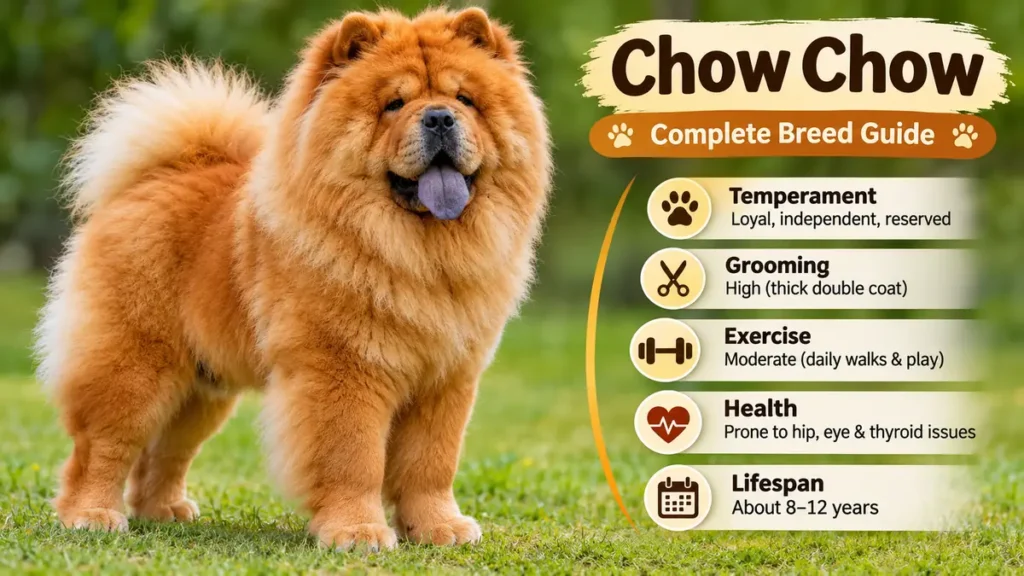
With its lion-like mane, teddy bear appearance, and distinctive blue-black tongue, the chow chow is one of the most recognizable dog breeds in the world. Behind that impressive coat is a serious-minded, independent dog whose personality can surprise people expecting an affectionate, playful companion.
Originally developed in China, this ancient breed combines loyalty, intelligence, and natural watchfulness with a strong preference for personal space.
The chow chow is a medium-sized, muscular dog breed originating from China, known for its thick double coat, blue-black tongue, and reserved temperament. Adults typically weigh 45–70 pounds, stand 17–20 inches tall, and live approximately 8–12 years. They require regular grooming, moderate exercise, early socialization, and patient training. American Kennel Club+1
chow chow Breed Overview
Understanding the breed’s basic characteristics helps explain its care requirements and suitability for different households.
| Characteristic | Details |
|---|---|
| Breed name | Chow Chow |
| Origin | China |
| Breed group | Non-Sporting (AKC) |
| Height | 17–20 inches (43–51 cm) |
| Weight | 45–70 pounds (20–32 kg) |
| Lifespan | Approximately 8–12 years |
| Temperament | Loyal, independent, reserved, dignified |
| Coat type | Thick double coat; rough or smooth |
| Coat colors | Red, black, blue, cinnamon, cream |
| Shedding | High |
| Grooming needs | High |
| Exercise needs | Moderate |
| Training difficulty | Moderate to challenging |
| Best suited for | Patient, experienced owners |
These ranges describe typical adults rather than guaranteed measurements for every dog. American Kennel Club+1
A chow chow is not usually a dog that enthusiastically greets every stranger. Many develop strong attachments to familiar people while remaining cautious around unfamiliar visitors and animals.
That reserved personality is normal for the breed, but excessive fear or aggression should never be dismissed as an unavoidable characteristic.
History and Origin of the chow chow
An ancient Chinese dog breed
The chow chow has a long history associated with northern China. Dogs resembling the modern breed appear in Chinese artifacts dating to the Han Dynasty, which lasted from 206 BCE to 220 CE.
Although the precise beginnings of the breed remain uncertain, historical evidence places its ancestors in China more than 2,000 years ago.
Unlike many modern companion breeds developed primarily for appearance, early Chow Chows performed several practical roles.
These included hunting, guarding property, herding, and pulling loads.
Their compact bodies, strong bones, protective instincts, and dense coats suited different working environments.
The breed is frequently classified among ancient spitz-type dogs, sharing certain physical characteristics with northern breeds, including erect ears, a curled tail, and a substantial double coat. American Kennel Club+1
How the breed reached Western countries
Chow Chows became known in Britain during the late eighteenth century, although wider interest developed during the nineteenth century.
Their unusual appearance attracted attention among dog enthusiasts and members of British society.
Queen Victoria was associated with the breed’s growing popularity, and organized dog breeding helped establish its modern appearance.
The American Kennel Club officially recognized the Chow Chow in 1903.
Today, the breed is primarily kept as a companion, although its historical guarding instincts remain an important part of its personality. VCA Animal Hospitals+1
Physical Appearance and Unique Characteristics
The chow chow has a distinctive silhouette created by its compact body, broad head, substantial neck ruff, and tail carried over the back.
Despite its fluffy appearance, this is a sturdy, muscular dog rather than a lightweight breed hidden beneath a large coat.
Why do Chow Chows have blue-black tongues?
One of the breed’s most recognizable features is its dark blue-black tongue.
The coloration results from pigmentation in the tongue tissue. Chow Chow puppies may initially have pink tongues that gradually darken during early development.
A dark tongue is a normal breed characteristic, not evidence of illness.
However, a sudden change in tongue color, especially accompanied by breathing difficulty or weakness, requires urgent veterinary attention.
The Chinese Shar-Pei is another breed associated with a naturally dark tongue.
Rough coat vs. smooth coat
Chow Chows have two recognized coat varieties.
| Feature | Rough coat | Smooth coat |
|---|---|---|
| Appearance | Dense, abundant, fluffy | Shorter, close-fitting |
| Neck ruff | Usually prominent | Less pronounced |
| Undercoat | Thick | Thick |
| Grooming | Frequent brushing | Regular brushing |
| Shedding | Heavy | Heavy |
| Matting risk | Higher | Generally lower |
Both varieties have a double coat consisting of protective outer hair and a softer undercoat.
A smooth-coated Chow Chow is not a separate breed. It simply expresses a different coat variety.
Recognized coat colors
According to the American Kennel Club breed standard, the five recognized colors are:
- Red
- Black
- Blue
- Cinnamon
- Cream
Red can range from lighter golden shades to deeper reddish tones. Cinnamon is often described as a warm, diluted reddish-brown shade, while blue appears as a diluted dark gray.
Color does not reliably predict temperament, intelligence, or overall health. American Kennel Club+1
Why do Chow Chows walk differently?
The breed is known for a relatively short, stilted gait associated with the structure of its hindquarters.
This characteristic movement should not be confused with limping or discomfort.
A healthy dog should still move comfortably and remain capable of normal daily activity. Stiffness, reluctance to walk, or obvious pain warrants veterinary examination.
chow chow Temperament and Personality
A chow chow’s personality is often described as cat-like because of its independence, cleanliness, and selective affection.
That comparison is useful, but it should not suggest that every dog behaves identically.
Individual temperament depends on genetics, socialization, training, experiences, and living conditions.
Are Chow Chows affectionate?
Chow Chows can form strong emotional attachments to their families.
However, many express affection differently from highly demonstrative breeds such as Golden Retrievers.
Rather than constantly seeking attention, they may prefer lying near their owner, following familiar routines, or quietly observing household activities.
Some enjoy physical affection, while others prefer limited handling.
Respecting the dog’s body language is essential.
A dog that turns away, stiffens, freezes, or repeatedly moves away from contact is communicating discomfort.
Are Chow Chows aggressive?
Chow Chows are not inherently aggressive simply because they are reserved or protective.
Nevertheless, their territorial instincts, independence, and potential wariness of unfamiliar people mean that poor socialization can create serious behavioral difficulties.
The American Kennel Club emphasizes that a properly socialized Chow Chow should be dignified rather than excessively fearful or aggressive.
Early positive experiences, predictable handling, and reward-based training help reduce the risk of defensive behavior. American Kennel Club+1
Are Chow Chows good family dogs?
They can be excellent companions in suitable households.
However, their tolerance for unpredictable handling may be lower than that of more socially outgoing breeds.
Chow Chows generally fit better with families that understand canine boundaries and can supervise interactions carefully.
Older children who know how to respect a dog’s space may be better companions than very young children who frequently hug, grab, or chase pets.
No child should be left unsupervised with a dog, regardless of breed or temperament.
Can Chow Chows live with other pets?
Some Chow Chows coexist peacefully with other dogs and cats, particularly when introduced carefully and raised with positive experiences.
Others may be selective about canine companions.
Successful introductions depend on individual behavior rather than breed labels alone.
Use controlled meetings, separate feeding spaces, and gradual exposure. Avoid forcing unfamiliar animals to interact.
Training and Socialization Requirements
Training a chow chow requires patience, consistency, and an understanding of independent canine behavior.
The breed is intelligent, but intelligence does not always translate into immediate obedience.
A Chow Chow may understand a command while remaining less motivated to repeat it than a highly cooperative working breed.
Start socialization early
Puppy socialization should begin with safe, positive experiences appropriate to the puppy’s age and vaccination status.
Useful experiences include meeting calm people, hearing everyday household sounds, walking on different surfaces, and observing other dogs from comfortable distances.
The goal is not to make the puppy interact with everyone.
Instead, socialization should teach the dog that unfamiliar experiences can be predictable and safe.
Essential commands
Begin with practical skills that support daily safety:
- Name recognition: Reward the puppy for looking toward you.
- Sit: Teach a simple position using rewards.
- Come: Practice recall in secure, distraction-free areas.
- Leave it: Encourage disengagement from unsafe objects.
- Stay or wait: Develop impulse control gradually.
- Loose-leash walking: Reward calm movement without pulling.
Short sessions are often more productive than prolonged drills.
Use food rewards, praise, and activities the dog enjoys.
Harsh corrections, intimidation, and physical punishment can damage trust and increase defensive reactions.
Common training mistakes
Owners sometimes interpret independence as deliberate disobedience.
That assumption can lead to unnecessary conflict.
Instead, examine whether the dog understands the behavior, whether distractions are too strong, and whether the reward is sufficiently motivating.
Consistency matters more than force.
The American Kennel Club recommends early training and positive reinforcement for this breed. American Kennel Club
Grooming and Coat Maintenance
Grooming is one of the most demanding parts of chow chow ownership.
Its thick double coat traps loose undercoat, particularly during seasonal shedding periods.
Without regular attention, tangles can develop into mats that pull against the skin and create discomfort.
How often should you brush a Chow Chow?
At minimum, thorough brushing several times weekly is advisable, with more frequent grooming for rough-coated dogs and during heavy shedding.
Some individuals benefit from daily brushing.
A practical routine includes:
- Use a suitable slicker brush to loosen surface tangles gently.
- Work through the coat in sections, reaching the undercoat without scraping the skin.
- Use a metal comb to check for remaining knots.
- Pay special attention behind the ears, around the neck, beneath the legs, and near the tail.
- Reward calm behavior throughout the session.
A coat that looks smooth on the surface may still contain compacted undercoat close to the skin.
Bathing and drying
Many Chow Chows can be bathed approximately every four to six weeks, depending on their coat condition and lifestyle.
Use a dog-appropriate shampoo and rinse thoroughly.
Drying is especially important because trapped moisture beneath the thick coat can contribute to skin irritation.
A cool or appropriately controlled dryer may help remove moisture without overheating the dog.
Should you shave a Chow Chow?
Routine shaving is generally discouraged.
The double coat provides insulation and protection, and clipping it extremely short can interfere with normal coat regrowth.
Shaving also does not eliminate the dog’s underlying vulnerability to overheating.
Medical treatment or severe matting may occasionally require clipping under professional guidance.
Do Chow Chows shed a lot?
Yes. Chow Chows are heavy shedders, especially when seasonal undercoat shedding increases.
They are not considered hypoallergenic.
Regular brushing helps manage loose hair, but it cannot completely prevent shedding or remove all dog allergens from the home. PetMD+1
Exercise, Diet, and Everyday Care
Despite their sturdy build and working history, Chow Chows generally have moderate exercise requirements.
They are not usually suited to prolonged running or demanding endurance activities.
How much exercise does a Chow Chow need?
Most healthy adults benefit from daily walks, gentle play, and mental enrichment.
Exercise recommendations vary among organizations. The PDSA suggests approximately one hour of daily activity, while the AKC emphasizes moderate walks and avoiding strenuous activity during hot weather.
The appropriate amount depends on age, health, fitness, temperature, and individual tolerance. PDSA+1
For many adults, shorter walks distributed throughout the day are preferable to one intense session.
Puppies should not be forced into prolonged exercise, and older dogs may require adjustments for joint discomfort.
Heat sensitivity and summer safety
Chow Chows can struggle in hot and humid conditions because of their dense coats and physical characteristics.
During warm weather:
- Walk during cooler morning or evening hours.
- Provide shade, ventilation, and fresh drinking water.
- Avoid hot pavement.
- Never leave the dog inside a parked vehicle.
- Stop activity if the dog shows excessive panting or distress.
Heatstroke is a veterinary emergency.
Warning signs can include severe panting, weakness, confusion, collapse, and abnormal breathing.
Move an affected dog into a cooler environment, begin cooling with cool water, and seek emergency veterinary care immediately.
What should a Chow Chow eat?
A balanced, complete diet appropriate for the dog’s age and health is essential.
Puppies require food formulated for growth, while adults need a diet that supports a healthy body condition without excessive calories.
The amount depends on the food’s calorie density, the dog’s weight, and activity level.
Avoid choosing portions based solely on the dog’s fluffy appearance.
Feel for the ribs beneath the coat and ask a veterinarian to assess body condition regularly.
Treats should form only a small portion of daily calorie intake.
Avoid toxic foods such as chocolate, grapes, raisins, onions, and products containing xylitol.
Fresh water should always be available.
chow chow Health Problems and Lifespan
The typical chow chow lifespan is approximately 8–12 years, although individual dogs may live shorter or longer lives.
Genetics, preventive healthcare, nutrition, body weight, and environmental conditions all influence long-term wellbeing.
The breed is predisposed to several orthopedic, eye, and endocrine conditions. VCA Animal Hospitals+1
Hip and elbow dysplasia
Hip dysplasia occurs when the hip joint develops abnormally, potentially causing instability, pain, and arthritis.
Elbow dysplasia involves abnormal development of structures within the elbow joint.
Possible symptoms include limping, difficulty rising, reduced activity, and reluctance to climb stairs.
Maintaining healthy body weight and obtaining appropriate veterinary care can help manage affected dogs.
Responsible breeding programs use orthopedic evaluations to reduce inherited risk.
Entropion and other eye disorders
Entropion occurs when an eyelid rolls inward, allowing eyelashes or surrounding hair to rub against the eye.
Symptoms may include:
- Excessive tearing
- Squinting
- Eye redness
- Repeated rubbing
- Corneal irritation
Untreated cases can cause painful corneal injury and threaten vision.
Chow Chows can also develop conditions such as glaucoma, cataracts, and other eyelid abnormalities.
Persistent squinting or eye pain should be examined promptly by a veterinarian. OFA+1
Hypothyroidism
Hypothyroidism occurs when the thyroid gland produces insufficient thyroid hormones.
Potential signs include unexplained weight gain, lethargy, thinning hair, and skin changes.
Diagnosis requires veterinary assessment and appropriate blood testing.
Dogs with confirmed hypothyroidism can often be managed successfully with prescribed medication and monitoring.
Skin allergies and irritation
Dense coats can make early skin problems difficult to notice.
Watch for scratching, redness, unusual odor, recurring ear irritation, and excessive licking.
Possible causes include environmental allergies, parasites, infections, or other dermatological conditions.
Not every itchy dog has a food allergy.
A veterinarian can help determine the cause before unnecessary dietary restrictions or treatments are introduced.
Health screening and preventive care
The national breed club recommendations listed by the AKC include:
| Health screening | Main purpose |
|---|---|
| Hip evaluation | Assess hip joint development |
| Elbow evaluation | Identify elbow abnormalities |
| Patella evaluation | Assess kneecap stability |
| Ophthalmologist evaluation | Detect inherited eye conditions |
| Thyroid evaluation | Identify thyroid abnormalities |
These tests are particularly relevant when evaluating breeding dogs.
Routine veterinary visits, vaccinations, parasite prevention, dental care, and weight monitoring remain essential throughout the dog’s life. American Kennel Club
Living With a Chow Chow: What Owners Should Expect
Living with this breed involves more than maintaining its impressive appearance.
The daily experience often revolves around predictable routines, calm interactions, and respect for the dog’s independent personality.
Can Chow Chows live in apartments?
Yes, some Chow Chows adapt well to apartment living.
Their relatively moderate activity requirements and generally quiet indoor behavior can make smaller homes workable.
However, apartment suitability depends on adequate exercise, comfortable temperatures, reliable training, and the dog’s response to neighbors and visitors.
A garden is helpful but does not replace daily walks or enrichment.
Can Chow Chows be left alone?
Many adult Chow Chows tolerate reasonable periods alone once gradually accustomed to separation.
However, independence does not mean a dog should be isolated for extended periods without care.
Puppies need frequent attention, toilet breaks, social experiences, and supervision.
Adult dogs also require exercise, companionship, and opportunities for mental stimulation.
Signs of separation-related distress may include persistent barking, destructive behavior, pacing, or inappropriate elimination.
Are Chow Chows good for first-time owners?
They are usually more challenging for inexperienced owners than highly cooperative companion breeds.
Their independent temperament, substantial grooming requirements, and need for thoughtful socialization create additional responsibilities.
A committed first-time owner can succeed with suitable professional guidance, but experience with canine behavior is a significant advantage.
How do Chow Chows compare with other fluffy breeds?
| Trait | Chow Chow | Samoyed | Pomeranian |
|---|---|---|---|
| General size | Medium | Medium | Toy |
| Typical social style | Reserved | Generally outgoing | Alert, often lively |
| Exercise needs | Moderate | Moderate to high | Moderate |
| Grooming needs | High | High | High |
| Training approach | Patient, consistent | Active, reward-based | Short, engaging sessions |
| Guarding tendency | Often pronounced | Generally less pronounced | Often alert and vocal |
These comparisons describe broad breed tendencies, not guaranteed behavior in individual dogs.
The Chow Chow generally suits someone who appreciates a quieter, more self-directed companion rather than a dog that constantly seeks interaction.
Chow Chow Puppies: Growth and Early Development
Chow Chow puppies look remarkably soft and rounded, but their early months are a critical period for physical and behavioral development.
Their future temperament is influenced by both inherited characteristics and experiences during puppyhood.
Puppy growth stages
| Age | Typical development |
|---|---|
| 0–8 weeks | Nursing, early movement, interaction with mother and littermates |
| 8–12 weeks | Adjustment to a new home, early training, positive socialization |
| 3–6 months | Rapid growth, teething, developing confidence |
| 6–12 months | Adolescence, increasing independence, continued physical development |
| 12–24 months | Further physical and behavioral maturity |
These are approximate stages; individual development varies.
Establish healthy habits from the beginning
Introduce brushing, nail handling, gentle examinations, and reward-based training early.
Teach the puppy to feel comfortable with a harness, leash, and routine veterinary handling.
Because Chow Chows can become wary of unfamiliar situations, gradual exposure is more effective than overwhelming them with constant interaction.
Avoid encouraging rough play or guarding behavior simply because it appears amusing in a small puppy.
Behaviors that seem harmless at eight weeks can become difficult to manage in a strong adult dog.
How to recognize responsible breeding practices
When evaluating a breeder, look for evidence of appropriate health testing, sound temperament, clean living conditions, and careful puppy socialization.
Responsible breeders should be willing to discuss inherited health concerns and provide documentation of relevant screening.
Extremely exaggerated facial folds, breathing difficulties, or impaired movement should raise concerns rather than be treated as desirable cosmetic features.
Rescue and adoption can also provide suitable opportunities for people prepared to meet the breed’s needs.
Advantages and Challenges of Owning a Chow Chow
Understanding both sides of ownership helps create realistic expectations.
| Potential advantages | Potential challenges |
|---|---|
| Strong loyalty to familiar people | Can be wary of strangers |
| Generally calm indoors | Requires careful socialization |
| Moderate exercise requirements | Sensitive to heat |
| Distinctive appearance | Heavy shedding and grooming |
| Often comfortable with routine | Independent training style |
| Can adapt to apartment living | Possible inherited health concerns |
The breed’s independence can be a benefit for people who prefer a companion that does not demand constant attention.
However, that same quality can make training more demanding.
Likewise, its protective instincts may be appreciated by some households, but they require responsible management to prevent inappropriate territorial behavior.
Is the chow chow the Right Dog for You?
A chow chow can be a deeply rewarding companion for someone who understands its temperament and is prepared for long-term care.
The breed is generally better suited to people who can provide consistent training, early socialization, frequent grooming, temperature-controlled living conditions, and regular veterinary care.
It may be less suitable for households seeking an extremely outgoing dog, families unable to supervise young children’s interactions, or owners who cannot commit to extensive coat maintenance.
The most important consideration is not the breed’s striking appearance but whether its physical and behavioral needs match your lifestyle.
With thoughtful care, respectful handling, and realistic expectations, a chow chow can become a loyal, dignified, and valued member of the household.