If you have searched for scan manga, you may have encountered Japanese manga pages, translated chapters, French-language scan websites, or online comic readers. Although these terms are often used interchangeably, they describe different ways of accessing and distributing manga.
Understanding the differences helps readers recognize what they are viewing, evaluate translation quality, and distinguish official publications from unauthorized copies.
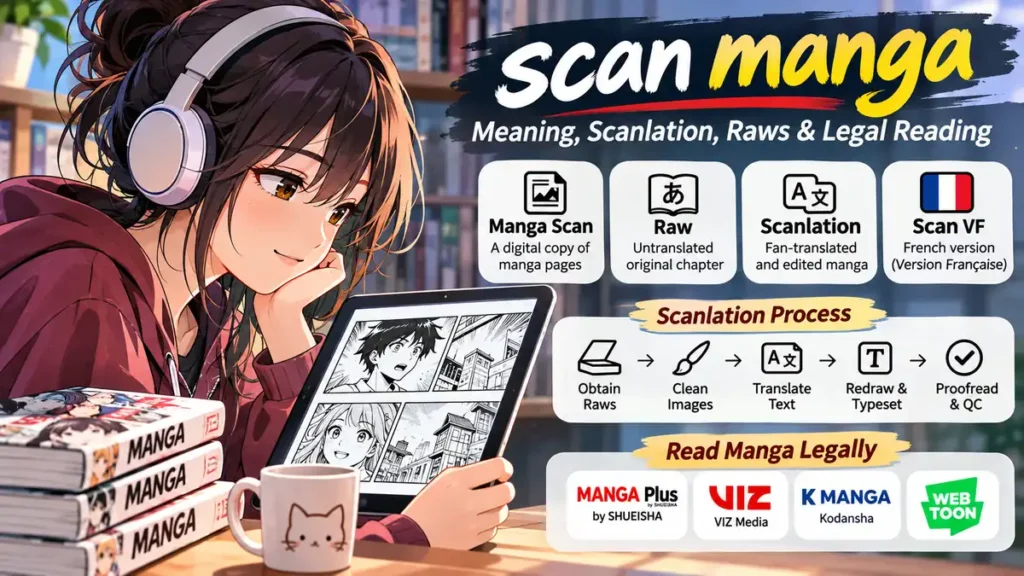
scan manga generally refers to manga pages or chapters reproduced in digital form. These may be scans of printed books, original-language digital pages called raws, or fan-translated versions known as scanlations. Unlike officially licensed digital manga, fan scanlations are usually created and distributed without permission from the copyright holder.
The term also reflects the history of international manga fandom, where readers began digitizing and translating Japanese comics long before official translations became widely accessible.
What Does scan manga Mean?
The expression scan manga describes manga content that has been digitized, usually for reading on electronic devices.
Originally, manga scanning involved placing printed pages from Japanese magazines or collected volumes onto a flatbed scanner. The resulting image files could then be viewed, edited, translated, or shared digitally.
Today, many manga chapters are created and published digitally. Consequently, the term scan is sometimes applied to digital copies even when no physical scanning takes place.
The meaning depends partly on the community using the expression.
In English-speaking communities, readers commonly encounter terms such as manga scans, manga raws, scanlations, and fan translations.
In French-speaking communities, expressions such as scan manga and scan VF frequently refer to manga chapters available in French.
The terminology also extends beyond Japanese comics to Korean manhwa, Chinese manhua, and digitally published webtoons.
Manga Scan vs. Raw vs. Scanlation
These terms describe different aspects of manga distribution and translation.
| Term | Meaning |
|---|---|
| Manga scan | A digital reproduction of a manga page or chapter |
| Manga raw | An untranslated manga chapter in its original language |
| Scanlation | A fan-produced translation edited into manga artwork |
| Scan VF | A French-language manga scan or translated chapter |
| Official digital manga | A publisher-authorized digital release |
| Simulpub | An official chapter published internationally around the time of its original release |
For example, a Japanese-language chapter reproduced from a printed magazine may be called a raw scan.
If fans translate its dialogue into English and replace the original text inside speech bubbles, the finished chapter becomes a scanlation.
If the copyright holder authorizes an English-language digital release, it is an official translation rather than a fan scanlation.
This distinction is fundamental to understanding the manga scanning community.
How Does scan manga Become a Scanlation?
Scanlation combines the words scan and translation. It refers to the fan-led process of translating and editing comics for readers who do not understand the original language.
Although scanlation groups vary in size and organization, the production process commonly includes sourcing, image preparation, translation, cleaning, typesetting, and quality checking. pdfs.semanticscholar.org+1
1. Obtaining the Original Manga Pages
The process begins with obtaining source material, often called raws.
Historically, raw providers acquired printed manga magazines or tankōbon volumes and scanned individual pages.
Modern source material may also come from digital editions.
The objective is to obtain readable pages that preserve the original artwork, dialogue, and panel arrangement.
A high-quality source makes later editing easier because fine lines, screen tones, and small Japanese characters remain distinguishable.
2. Cleaning and Preparing Images
Scanned pages may contain shadows, uneven brightness, dust, paper texture, or distortions caused by the book’s binding.
Image cleaners prepare the artwork by correcting problems such as:
- Crooked or misaligned pages.
- Excessive gray backgrounds.
- Dust and scanning artifacts.
- Poor contrast between artwork and text.
- Inconsistent page dimensions.
Editing software such as Adobe Photoshop or GIMP can help with these tasks.
However, aggressive image processing can erase fine details, damage screen tones, or make illustrations appear unnatural.
Good cleaning preserves the artist’s original visual style.
3. Translating Dialogue and Narration
Translators convert the original text into another language.
This work involves more than replacing Japanese words with English equivalents.
Japanese dialogue frequently relies on cultural context, honorifics, implied subjects, and expressions that do not translate directly.
For example, the honorific -san communicates a level of politeness that may not have a precise English equivalent.
Translators must decide whether to preserve such expressions, explain them, or adapt the wording.
Sound effects present another challenge because Japanese manga often integrates stylized onomatopoeia directly into the artwork.
A careful translation aims to preserve the meaning, tone, characterization, and narrative context of the original.
4. Redrawing and Typesetting
After translation, editors prepare the artwork for the new text.
Cleaning a speech bubble with a plain white background is relatively straightforward.
Removing Japanese characters that overlap detailed artwork is considerably harder.
A redrawer may need to reconstruct missing lines, textures, or background elements so the edited panel looks natural.
The typesetter then places translated dialogue into the appropriate speech bubbles.
Typesetting involves selecting fonts, adjusting line spacing, positioning text, and ensuring that the dialogue remains easy to follow.
Poor typesetting can make an otherwise accurate translation difficult to read.
5. Proofreading and Quality Control
Before a scanlation is considered complete, editors may review the entire chapter.
Quality checking can identify mistranslated dialogue, missing speech bubbles, spelling errors, inconsistent character names, and visual editing mistakes.
Some groups also review continuity between chapters to ensure that terminology remains consistent.
The finished result may look similar to a professionally localized manga chapter, although the production team and authorization status differ.
Why Did Manga Scanlation Become Popular?
Scanlation developed partly because international readers historically had limited access to translated Japanese manga.
Popular manga series could take months or years to receive official translations, while less commercially successful titles sometimes received no international publication.
Fan communities attempted to address these availability gaps by translating and circulating chapters themselves.
Academic research has documented scanlation as a collaborative fan practice involving translation, editing, and international online distribution. SciSpace+1
Limited International Availability
During the early growth of online manga communities, readers outside Japan often faced substantial publishing delays.
Some series were available only through imported Japanese magazines.
Others had no licensed English edition.
Scanlation provided access to stories that many international fans otherwise could not understand.
This contributed to the development of multilingual manga communities.
Faster Access to New Chapters
Weekly and monthly manga magazines created demand for frequent updates.
Fans wanted to follow ongoing stories without waiting for translated collected volumes.
Scanlation groups sometimes produced translations soon after Japanese chapters appeared.
Today, official simultaneous publication has reduced this delay for many major series, although international availability still varies by title and territory.
Interest in Lesser-Known Manga
Scanlation also brought attention to works that were unlikely to receive immediate international licensing.
These included older series, niche genres, short manga, and titles with smaller audiences.
For readers interested in unusual storytelling or specialized genres, fan translation communities sometimes served as discovery channels.
That cultural contribution does not, however, establish legal permission to reproduce or distribute copyrighted material.
Understanding Manga Raws and Different Comic Formats
Not every digital comic described as a manga scan has the same origin, format, or reading convention.
Recognizing these differences makes it easier to understand terminology used across manga communities.
What Are Manga Raws?
Manga raws are untranslated versions of manga chapters.
For Japanese manga, raws usually contain the original Japanese dialogue, narration, and sound effects.
The term describes the language and editing status of the material, not necessarily its physical origin.
A raw may be a scanned printed page or an original digital release.
Readers sometimes seek raws to examine original dialogue, study Japanese, or compare translations.
However, an untranslated copy is not automatically authorized for public distribution.
Manga vs. Manhwa vs. Manhua
Although the terms are sometimes grouped together, they refer to different comic traditions.
| Format | Primary association | Common presentation |
|---|---|---|
| Manga | Japan | Often black-and-white pages |
| Manhwa | South Korea | Print comics or digital vertical scrolling |
| Manhua | China | Printed or digital comics, often in color |
| Webtoon | Digital publishing format | Frequently vertical scrolling optimized for phones |
These distinctions are not absolute. Japanese manga can be published digitally in color, and Korean or Chinese comics may use traditional page layouts.
The term scanlation is now applied to translations of all these formats.
What Does Scan VF Mean?
VF is an abbreviation of the French expression version française, meaning French version.
A scan VF generally refers to a manga or related comic chapter available in French.
In online fan communities, the expression often describes unofficial French translations.
However, the language label alone does not establish whether a particular release is licensed.
Readers may also encounter VOSTFR, which means an original-language version with French subtitles, especially in anime discussions.
Scan VF and VOSTFR are therefore not interchangeable.
Is scan manga Legal?
The legality of manga scanning depends on copyright ownership, permission, intended use, and the laws of the relevant jurisdiction.
A digital manga image is not inherently illegal.
Official publishers routinely distribute copyrighted manga through authorized digital platforms.
Problems arise when copyrighted material is reproduced, translated, uploaded, or distributed without the necessary permission.
Copyright and Manga Scanning
Manga artwork and written dialogue are generally protected by copyright.
The relevant rights may belong to the creator, publisher, or other authorized rights holders, depending on contractual arrangements.
Scanning an entire copyrighted manga volume and making the pages publicly available without permission may infringe reproduction and distribution rights.
Translating a manga chapter can also implicate the copyright holder’s adaptation or translation rights.
Giving credit to the original artist does not automatically provide permission to distribute the work.
Likewise, distributing translations for free does not necessarily make them lawful.
Are Fan Scanlations Copyright Infringement?
Fan scanlations are commonly created without formal authorization.
Academic research describes the practice as involving unauthorized reproduction, translation, editing, and distribution of copyrighted comics. orbi.uliege.be+1
The precise legal consequences depend on local law and the circumstances.
Some jurisdictions recognize exceptions for certain private, educational, research, or transformative uses, but these exceptions are limited and should not be assumed to cover public distribution of complete translated chapters.
The fact that a scanlation is produced by volunteers does not automatically remove copyright obligations.
Is Reading Manga Scans Illegal?
Reading and distributing copyrighted material are legally distinct activities.
Whether merely accessing an unauthorized online copy creates liability depends on the applicable jurisdiction and the circumstances.
Downloading, reproducing, uploading, or redistributing material can raise additional issues.
For readers who want to avoid copyright uncertainty, authorized manga services are the clearest option.
Where Can You Read Manga Legally Online?
Licensed digital manga services have made international access considerably easier.
Some platforms offer selected chapters free of charge, while others use subscriptions, digital purchases, or mixed access models.
Availability varies by country, publisher, and title.
MANGA Plus by SHUEISHA
MANGA Plus by SHUEISHA provides authorized access to selected manga series associated with Japanese publisher Shueisha.
The platform is particularly relevant for readers following major ongoing titles.
Its catalog includes series associated with publications such as Weekly Shonen Jump.
Access rules, languages, and chapter availability vary.
Official website: MANGA Plus.
VIZ Media and Shonen Jump
VIZ Media publishes licensed English-language editions of numerous Japanese manga series.
Its digital offerings include Shonen Jump titles and other manga catalogs.
Some chapters may be accessible without payment, while broader reading access can depend on subscriptions, purchases, and regional availability.
Official website: VIZ Media.
K MANGA
K MANGA is associated with Kodansha, a major Japanese manga publisher.
It provides official digital access to selected manga titles.
Its availability and access system depend on the reader’s location and the specific work.
Official website: K MANGA.
WEBTOON
WEBTOON is particularly well known for vertically scrolling digital comics.
Its catalog includes original webtoons and licensed works across romance, fantasy, action, comedy, and other genres.
Although webtoons are not identical to traditional Japanese manga, readers interested in translated digital comics often explore both formats.
Official website: WEBTOON.
How Official Manga Differs From Fan Scans
| Feature | Official digital manga | Unofficial scanlation |
|---|---|---|
| Copyright permission | Authorized | Usually unauthorized |
| Translation | Licensed editorial process | Fan-produced |
| Quality control | Publisher-managed | Varies by group |
| Creator compensation | Supported through licensing arrangements | Usually no direct licensing payment |
| Release schedule | Publisher-controlled | Depends on volunteers |
| Availability | May be region-restricted | Varies across websites |
| Translation consistency | Generally editorially managed | Can vary significantly |
Official translations are not necessarily flawless, and fan translations are not necessarily poor.
The main distinction is authorization, not simply the visual quality of the finished chapter.
How to Identify High-Quality Manga Scans
Image quality strongly influences the reading experience.
Poor scans can obscure small text, reduce artwork detail, and make complex panels difficult to understand.
Several factors help distinguish readable digital manga from badly processed copies.
Resolution and Image Clarity
A good digital manga page should preserve fine lines, small lettering, and screen-tone patterns.
Low-resolution images may look acceptable as thumbnails but become blurry when enlarged.
Excessive sharpening can introduce artificial edges, while aggressive compression can create blocky artifacts.
The best resolution depends on the original artwork and intended display size rather than a single universal pixel requirement.
Accurate Translation
Translation quality is equally important.
Readers may notice problems such as unnatural dialogue, inconsistent terminology, missing context, or character names changing between chapters.
A translation can be grammatically correct yet fail to preserve the original meaning.
This is particularly relevant when a chapter contains cultural references, wordplay, specialized vocabulary, or ambiguous dialogue.
Clean Typesetting
Readable lettering should fit naturally within the artwork.
Speech bubbles should not be overcrowded, and font choices should remain consistent with the tone of the scene.
Dialogue order must also follow the original panel sequence.
A visually polished chapter can still contain translation mistakes, so image quality and language accuracy should be evaluated separately.
Reading Direction and Page Layout
Traditional Japanese manga is commonly read from right to left.
This affects page order, panel progression, and the sequence of speech bubbles.
Some digital readers support right-to-left page navigation, while others use continuous vertical scrolling.
Incorrect page ordering can make a story confusing even when every image is clear.
Can You Scan Manga for Personal Use?
Digitizing manga for personal reference is different from uploading copyrighted chapters to a public website.
However, whether personal scanning is permitted depends on local copyright rules.
Some jurisdictions provide private-copying exceptions under specific conditions, while others impose different restrictions.
For material you own or have permission to digitize, the technical process is relatively straightforward.
Basic Manga Scanning Process
- Prepare the pages. Make sure the paper is clean and positioned correctly.
- Choose a suitable scanner. A flatbed scanner can capture detailed illustrations without relying on camera perspective.
- Select the resolution. Around 300 dpi is a common starting point for printed material, although detailed restoration may benefit from higher resolution.
- Capture the page. Avoid shadows, skewing, and unnecessary cropping.
- Adjust the image. Correct orientation, contrast, and brightness without removing artwork details.
- Save an archival copy. A lossless format such as PNG or TIFF helps preserve detail.
- Create reading copies when needed. JPEG or WebP may reduce storage requirements, depending on compression settings.
These steps are useful for digitizing original artwork, public-domain comics, or other material where the necessary rights are available.
Which Image Format Is Best?
| Format | Main advantage | Limitation |
|---|---|---|
| PNG | Lossless image quality | Larger files |
| JPEG | Broad compatibility | Lossy compression |
| WebP | Efficient compression options | Compatibility depends on software |
| TIFF | Suitable for high-quality archival workflows | Large files |
| Convenient multipage organization | Not ideal for every editing workflow |
For black-and-white line art, excessive lossy compression may introduce visible artifacts around text and illustrations.
Keeping a high-quality master file allows smaller reading copies to be generated later without repeatedly degrading the original.
How Technology Is Changing scan manga
The manga scanning and translation landscape has changed significantly as digital publishing, image-processing software, and machine translation have improved.
These technologies affect both official localization and fan-created translations.
Optical Character Recognition
Optical character recognition, commonly called OCR, converts text visible in images into machine-readable characters.
For manga, OCR can help identify Japanese dialogue in speech bubbles.
However, recognition accuracy may decline when characters overlap artwork, use decorative fonts, or appear vertically.
Handwritten text and stylized sound effects can be especially difficult to process.
Tools such as ABBYY FineReader and specialized image translation applications are examples of software used in text extraction and editing workflows. BasicCAT
AI-Assisted Manga Translation
Machine translation tools can help readers understand basic dialogue or assist translators with initial drafts.
However, manga presents difficulties that ordinary text translation does not.
These include missing grammatical subjects, cultural references, character-specific speech patterns, and dialogue whose meaning depends on surrounding panels.
An automated translation may produce fluent sentences while misunderstanding the scene.
Human review remains valuable for preserving tone, context, and narrative consistency.
Digital-First Manga and Webtoons
As more comics are published digitally, physical scanning is no longer always part of the workflow.
Digital-first manga, Korean webtoons, and Chinese manhua may already exist as image files on authorized platforms.
This has changed the technical meaning of scanning within fan translation communities.
The term scanlation remains widely used even when the original artwork was never printed.
Simultaneous International Publishing
Simulpub, short for simultaneous publication, allows translated manga chapters to appear internationally at approximately the same time as their original release.
This model reduces the waiting period that historically encouraged readers to seek fan translations.
However, simultaneous availability is not universal.
Licensing agreements, translation resources, language demand, and regional restrictions still influence which series receive international releases.
Risks of Unofficial Manga Reading Websites
Beyond copyright concerns, unofficial manga websites can present technical and privacy risks.
Not every unofficial website is malicious, but readers should be cautious when a site uses deceptive advertising or requests unnecessary permissions.
Misleading Download Buttons
Some websites display advertisements that resemble download or reading controls.
Clicking these elements may redirect users to unrelated pages.
A legitimate online reader generally does not need to install an unknown executable file simply to display comic images.
Browser Notifications and Redirects
Unexpected requests for notification permissions can be a warning sign.
Some websites use notifications to deliver repeated advertisements or misleading alerts.
Readers should avoid granting unnecessary permissions and should review browser settings if unwanted notifications begin appearing.
Suspicious Extensions and Applications
An unfamiliar manga-reading extension or application may request access beyond what is needed to display comics.
Before installing software, check its publisher, permissions, and distribution source.
Using established authorized services reduces exposure to some of these risks, although normal online security precautions still apply.
Protecting Personal Information
Avoid entering passwords, payment information, or other sensitive details on unfamiliar websites.
A padlock symbol or HTTPS connection indicates an encrypted connection, not that the website is trustworthy or legally authorized to distribute manga.
Website reputation and authorization should be assessed separately.
The Cultural Impact of Manga Scanlation
Scanlation has influenced how manga reaches international audiences.
It helped connect readers who shared an interest in Japanese storytelling but lived in countries where translated editions were unavailable or difficult to obtain.
These communities developed specialized terminology, volunteer production roles, and collaborative editing practices.
Fan Translation Communities
Scanlation groups often bring together people with different skills.
Translators work with language, editors refine dialogue, cleaners restore artwork, and typesetters manage visual presentation.
This collaboration can create opportunities for language learning and creative practice.
Academic studies have examined scanlation as a form of participatory fan culture and cross-cultural communication. pdfs.semanticscholar.org
Translation Choices and Cultural Context
Fan translators sometimes preserve Japanese honorifics, untranslated expressions, or explanatory notes.
Official publishers may instead favor localization that reads naturally to a broader audience.
Neither approach guarantees perfect accuracy.
Translation involves balancing literal meaning, readability, cultural context, and the intended emotional effect.
Comparing different authorized translations or discussing translation choices can help readers better understand those challenges.
Supporting Manga Creators
Manga production involves writers, illustrators, editors, assistants, publishers, translators, and other professionals.
Authorized sales and licensing arrangements contribute to the commercial system that supports their work.
Readers can support creators through official digital chapters, licensed printed volumes, library collections, and other authorized distribution channels.
This is particularly relevant for smaller series whose future publication may depend on sustained readership and sales.
Final Thoughts on scan manga
The term scan manga covers several related concepts, from digitized Japanese comic pages to untranslated raws and fan-produced scanlations.
Understanding these distinctions makes it easier to recognize how manga is created, translated, distributed, and read internationally.
Scanlation has played a meaningful role in manga fandom, particularly when official international releases were limited. At the same time, copyright permission, translation quality, website security, and creator compensation remain important considerations.
For readers exploring digital manga, the most useful next step is to identify whether a chapter is an original-language raw, an unofficial fan translation, or a licensed edition. That simple distinction provides a clearer understanding of both the content and the source behind it.