Climbing the competitive ladder in Deadlock takes more than winning a few matches. You need to understand how rank points work, which matches affect your progress, and what separates average players from those reaching the highest tiers.
The deadlock ranking system has changed significantly since the game’s early testing, especially with the introduction of a dedicated Ranked Mode in July 2026 and the launch of Beta Season 2 in November.
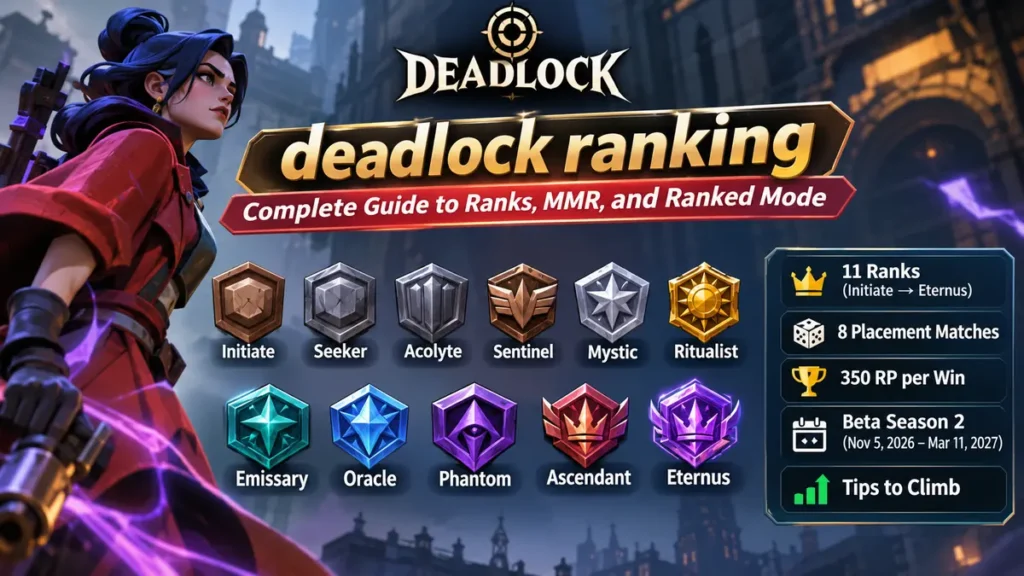
Deadlock has 11 competitive ranks, from Initiate to Eternus, with six subranks in each tier. Players unlock Ranked Mode by meeting eligibility requirements, complete eight placement matches, and then earn or lose rank points through competitive matches. Rankings reflect progress within a seasonal ladder, with Eternus representing the highest competitive tier. The Deadlock Wiki+1
All deadlock ranking Tiers in Order
Deadlock uses a tier-based progression system with distinct rank badges. Each tier represents a different position on the competitive ladder, although individual skill levels can overlap between neighboring ranks.
The current ranking structure contains 11 competitive tiers and 66 subranks. Obscurus is an additional unranked designation for players who have not completed calibration.
Complete Deadlock Rank List
| Order | Rank | Badge material | Subranks |
|---|---|---|---|
| 0 | Obscurus | Unranked | None |
| 1 | Initiate | Brick | I–VI |
| 2 | Seeker | Stone | I–VI |
| 3 | Acolyte | Iron | I–VI |
| 4 | Sentinel | Bronze | I–VI |
| 5 | Mystic | Silver | I–VI |
| 6 | Ritualist | Gold | I–VI |
| 7 | Emissary | Platinum | I–VI |
| 8 | Oracle | Diamond | I–VI |
| 9 | Phantom | Special badge | I–VI |
| 10 | Ascendant | Special badge | I–VI |
| 11 | Eternus | Special badge | I–VI |
The rank names and order reflect the system introduced in Valve’s July 30, 2026 matchmaking update. The Deadlock Wiki+1
What Each Rank Represents
Initiate, Seeker, and Acolyte
These are the opening tiers of the ranked ladder. Players progressing through them generally benefit from mastering basic movement, farming, hero abilities, and objective awareness.
Sentinel, Mystic, and Ritualist
These middle tiers reward increasingly consistent decision-making. Players often need better lane management, map awareness, item selection, and coordination to progress.
Emissary and Oracle
These higher tiers demand stronger execution. Knowing when to pressure objectives, retreat from unfavorable fights, and capitalize on enemy mistakes becomes especially valuable.
Phantom, Ascendant, and Eternus
These are the highest ranks. Players competing here generally need excellent mechanics, reliable teamwork, and a detailed understanding of Deadlock’s heroes and evolving strategies.
These descriptions are practical interpretations of skill progression, not official skill definitions assigned to each badge.
How the deadlock ranking System Works
Deadlock separates its matchmaking into Standard Mode and Ranked Mode.
Standard Mode is intended for lower-pressure matches, experimenting with unfamiliar heroes, and playing with friends. Ranked Mode is designed around competitive progression against players of comparable skill.
The dedicated Ranked Mode was introduced on July 30, 2026, replacing the previous unified Skill Rating arrangement. The Deadlock Wiki+1
Rank Points and Promotion
Ranked progression uses Rank Points (RP).
As of Beta Season 2, the main point rules are:
| Mechanic | Current value |
|---|---|
| Base points for a win | 350 RP |
| Typical subrank progression threshold | 1,000 RP |
| Progression into the next full rank | 1,500 RP |
| Subranks per rank | 6 |
| Initial placement matches | 8 |
The November 5 update increased the base points awarded for a win from 300 to 350 and reduced the full-rank promotion threshold from 2,000 to 1,500. The Deadlock Wiki+1
For example, a player at Mystic III works toward Mystic IV, then Mystic V and VI, before progressing into Ritualist I.
The amount of progress needed depends on the player’s current position, while losses and applicable rank protections also affect the climb.
Do Wins and Losses Affect Rank?
Yes. Winning Ranked matches contributes to upward progression, while losing can reduce rank progress.
However, winning one match does not necessarily mean advancing an entire subrank. Similarly, one defeat does not automatically result in demotion.
The outcome depends on existing points, progression thresholds, and any remaining loss protection.
Normal or Standard matches do not directly change the player’s competitive rank.
What Is MMR in Deadlock?
MMR stands for Matchmaking Rating. It is commonly used in competitive games to describe an estimate of player skill for matchmaking purposes.
In Deadlock, it is useful to distinguish between the game’s earlier Skill Rating system and the current visible Ranked progression system.
The current ranked badge and Rank Points indicate competitive progression. Players should not assume that an unofficial MMR estimate from a third-party tracker is identical to the game’s internal matchmaking calculations.
How to Unlock Ranked Mode and Get Your First Rank
New players cannot immediately enter competitive matchmaking.
Ranked Mode has eligibility requirements intended to ensure that players have sufficient experience before joining more competitive matches.
Ranked Mode Requirements
According to the current ranked rules, players need:
- At least 60 Standard Mode wins.
- At least three heroes unlocked for Ranked.
- Eight calibration matches to receive their initial rank.
Since the November 5 update, a hero requires 35 unlock points, with two points awarded for a win and one for a loss. This replaced the previous requirement of 15 wins per hero. Vi.ki+1
How Placement Matches Work
After meeting the eligibility requirements, a new Ranked player completes eight placement matches.
These games establish an initial position on the competitive ladder.
The system then assigns a starting badge based on calibration results and the relevant matchmaking evaluation.
For Beta Season 2, the maximum initial placement is Ascendant I for new ranked players, with eligible returning players potentially reaching Ascendant III.
Returning players who participated in the previous ranked season do not need to repeat the initial calibration process solely because a new season begins. The Deadlock Wiki
Can You Play Ranked With Friends?
Ranked supports solo and duo matchmaking, subject to skill restrictions between party members.
Standard Mode offers greater flexibility for groups, including parties with a wider range of skill levels.
For friends whose competitive ranks are too far apart, Standard Mode is the more practical option.
Deadlock Ranked Season 2: Latest Changes
Beta Season 2 began on November 5, 2026, and is scheduled to end on March 11, 2027.
Valve introduced several changes to competitive progression, making promotions faster in some situations while reducing protection against demotion.
Season 1 vs. Season 2 Comparison
| Feature | Beta Season 1 | Beta Season 2 |
|---|---|---|
| Base RP per match | 300 | 350 |
| Full-rank promotion threshold | 2,000 RP | 1,500 RP |
| Subrank threshold | 1,000 RP | 1,000 RP |
| Subrank loss protection | 2 shields | 1 shield |
| Full-rank loss protection | 5 shields | 3 shields |
| Protection at Phantom and above | Available | Removed |
| Hero bans per Ranked match | 3 | 4 |
| Hero unlock requirement | 15 wins | 35 points |
These changes were announced in the November 5, 2026 Ranked Beta Season 2 update. The Deadlock Wiki
How Rank Protection Works
Rank protection gives eligible players a limited number of losses at a rank boundary before demotion occurs.
For example, a player at Mystic I with no remaining Rank Points can receive three protected losses at the full-rank boundary before dropping to Sentinel.
At an ordinary subrank boundary, protection is limited to one match.
Phantom, Ascendant, and Eternus players no longer receive rank protection shields. This means mistakes and losing streaks can have more immediate consequences at the top of the ladder.
Does Deadlock Have Win Streak Bonuses?
Yes. Consecutive Ranked victories can provide bonus Rank Points.
The current system begins awarding a bonus of 70 points on the third consecutive win. The bonus increases by 20 points for subsequent wins, reaching a maximum of 130 bonus points at six consecutive victories.
These bonuses reward consistent winning, but a streak is not a guarantee of promotion because total points and rank thresholds still matter. The Deadlock Wiki
Deadlock Rank Distribution: What Is a Good Rank?
A rank’s meaning depends partly on how many other players occupy the same tier.
A player in Mystic may be considerably more experienced than someone in Initiate, but rank labels alone do not provide an exact percentile without population data.
Rank Distribution by Tier
The following historical snapshot comes from Tracklock data recorded on October 29, 2026, during Beta Season 1. It is useful for understanding the ladder but should not be treated as the current Season 2 distribution.
Deadlock ranked player distribution
Percentage of ranked players by tier, October 29, 2026 snapshot.
0%6%12%18%24%InitiateSeekerAcolyteSentinelMysticRitualistEmissaryOraclePhantomAscendantEternusHistorical Beta Season 1 distribution, based on the October 29, 2026 Tracklock snapshot reported by deadlock.run. deadlock.run
In that snapshot, Seeker was the largest individual rank group, while Phantom, Ascendant, and Eternus collectively represented approximately 4.5% of ranked players.
The median player was around Sentinel II.
However, the Season 2 reset and global redistribution mean these percentages should not be used to calculate a player’s exact current percentile.
Is Oracle a High Rank in Deadlock?
Oracle is the eighth of the 11 competitive tiers, placing it above Emissary and below Phantom.
It is a high position on the rank ladder and generally indicates substantial competitive experience.
What Is the Highest Deadlock Rank?
Eternus is the highest competitive rank.
Unlike the ordinary fixed-point subrank progression, Eternus uses percentile-based thresholds for its internal divisions.
The current documented thresholds are:
| Eternus subrank | Percentile threshold |
|---|---|
| Eternus I | 0% |
| Eternus II | 25% |
| Eternus III | 50% |
| Eternus IV | 70% |
| Eternus V | 85% |
| Eternus VI | 95% |
These thresholds apply within Eternus rather than across the entire Ranked population. The Deadlock Wiki
How to Improve Your Deadlock Ranking
Climbing in Deadlock requires a combination of individual mechanics, map control, teamwork, and consistent decision-making.
Winning is the objective, but improving the skills that contribute to winning is more reliable than focusing exclusively on the badge.
1. Master a Small Hero Pool
Start with two or three heroes you understand well.
Learning fewer heroes deeply makes it easier to develop reliable ability combinations, recognize favorable matchups, and make effective item decisions.
A useful hero pool should include a comfortable primary choice and alternatives for situations where your preferred hero is unavailable.
Because Ranked matches include hero bans, depending entirely on one character can create problems.
2. Improve Your Early-Game Farming
Souls are a core resource in Deadlock.
Efficient farming helps players purchase items and develop their heroes without falling behind.
Focus on securing lane troopers, collecting available resources, and avoiding unnecessary deaths that cost farming time.
A common mistake is chasing an opponent while missing several waves of farm. Even if the chase creates pressure, the lost resources may weaken your position later.
3. Prioritize Objectives Over Unnecessary Kills
Eliminations are valuable, but they are not the only way to win.
Deadlock’s objectives include Guardians, Walkers, Shrines, and the Patron. Controlling these structures and the surrounding map is central to winning matches.
After winning a team fight, consider whether your team can safely damage an objective rather than chasing surviving enemies.
A successful fight becomes much more valuable when it creates lasting map pressure.
4. Understand Item Builds
A good build responds to the match rather than following the same purchase order every time.
Consider the following questions:
- Is the enemy team dealing mostly weapon or spirit damage?
- Do you need additional survivability?
- Are enemy heroes relying on healing?
- Would mobility or crowd-control resistance help you survive?
- Does your team need more damage or utility?
Experiment with item choices in Standard Mode before relying on unfamiliar builds in Ranked.
5. Improve Map Awareness
Watch the minimap frequently and track where enemy heroes were last seen.
If several opponents disappear, avoid pushing an exposed lane without support.
Good map awareness helps prevent unnecessary deaths and creates opportunities to assist teammates, secure objectives, or farm safely.
6. Communicate Clearly
Useful communication is short and actionable.
Call out missing enemies, planned objective pushes, dangerous rotations, and opportunities to regroup.
Avoid blaming teammates after mistakes. Arguments consume attention and rarely improve the next fight.
7. Review Your Losses
After a difficult match, identify one or two decisions you could improve.
For example, ask whether you lost too much farm early, entered a fight without teammates, purchased an unsuitable item, or pushed too far without vision.
Improving one recurring mistake can have a larger long-term impact than constantly changing heroes or builds.
Deadlock Ranked Leaderboards and Match History
Deadlock provides leaderboards that allow players to compare their competitive progress with other ranked participants.
The Ranked menu in the Hideout displays a player’s badge, recent results, and progress.
Global and Hero Leaderboards
Deadlock has global and hero-specific leaderboards across regions including North America, South America, Europe, Asia, and Oceania.
The November 2026 Season 2 announcement updated leaderboard qualification rules.
To qualify for a seasonal leaderboard, players must have played at least 50 Ranked matches during that season within the preceding 30 days.
For a hero-specific leaderboard, the requirement is at least 15 Ranked matches using that hero during the preceding 30 days.
Global ranking is based on current badge progression, while hero-specific ranking also considers recent performance on the selected hero. The Deadlock Wiki
Where Can You Check Your Deadlock Rank?
The in-game Ranked menu is the primary place to view your competitive progress.
Third-party community resources may provide additional information about hero statistics, historical results, and rank distributions.
Examples include Deadlock Wiki and Deadlock Tiers.
Because community trackers depend on available match data and their own update schedules, their estimates may differ from in-game information.
Common Deadlock Ranked Problems and Mistakes
Understanding the system also helps explain why progression sometimes feels inconsistent.
Why Am I Not Ranking Up After Winning?
A victory adds progress, but a promotion requires reaching the relevant threshold.
You may still need additional points to advance, particularly when approaching a new full rank.
Previous losses can also offset recent wins.
Can You Lose Your Rank in Deadlock?
Yes. Losing enough Ranked matches can result in subrank or full-rank demotion.
Eligible players receive limited rank protection, but these shields do not prevent demotion indefinitely.
Players in Phantom, Ascendant, and Eternus have no loss protection under the current Season 2 rules.
What Happens If Someone Leaves a Ranked Match?
Abandoned matches follow special scoring rules.
If a player abandons before five minutes, the match becomes unscored and safe to leave for other players, except the abandoning player and their duo partner.
After five minutes, the abandoning player’s team receives conditional protection, while the opposing team can still receive a win under the applicable rules.
The exact outcome depends on when the abandonment occurs and whether the remaining players continue. The Deadlock Wiki
Why Did My Rank Change at the Start of a Season?
Deadlock uses seasonal resets and rank redistribution.
For Beta Season 2, the process involved adjusting the overall rank distribution and applying a soft reset averaging approximately one full badge, with additional adjustments based on previous-season win rate.
Because both adjustments interact, some players can begin a new season higher than their previous rank, while others may move lower.
Does Playing Standard Mode Improve Ranked MMR?
Standard Mode does not directly award or deduct Ranked Points.
However, practicing in Standard Mode can indirectly improve competitive results by helping players develop better mechanics, hero familiarity, and game knowledge.
It is particularly useful when testing unfamiliar heroes or experimenting with builds.
Final Thoughts on deadlock ranking
The deadlock ranking system provides a structured competitive ladder with 11 ranks, six subranks per tier, seasonal progression, and dedicated matchmaking.
Beta Season 2 has made full-rank promotions more accessible through higher match-point rewards and lower promotion thresholds, while reducing demotion protection.
For players aiming to climb from Initiate toward Eternus, the most effective approach is to build consistent habits: master a small hero pool, farm efficiently, understand objectives, communicate with teammates, and learn from losses.
Start by identifying the weakest part of your gameplay, improve it over several matches, and evaluate your progress through both match results and the quality of your decisions.