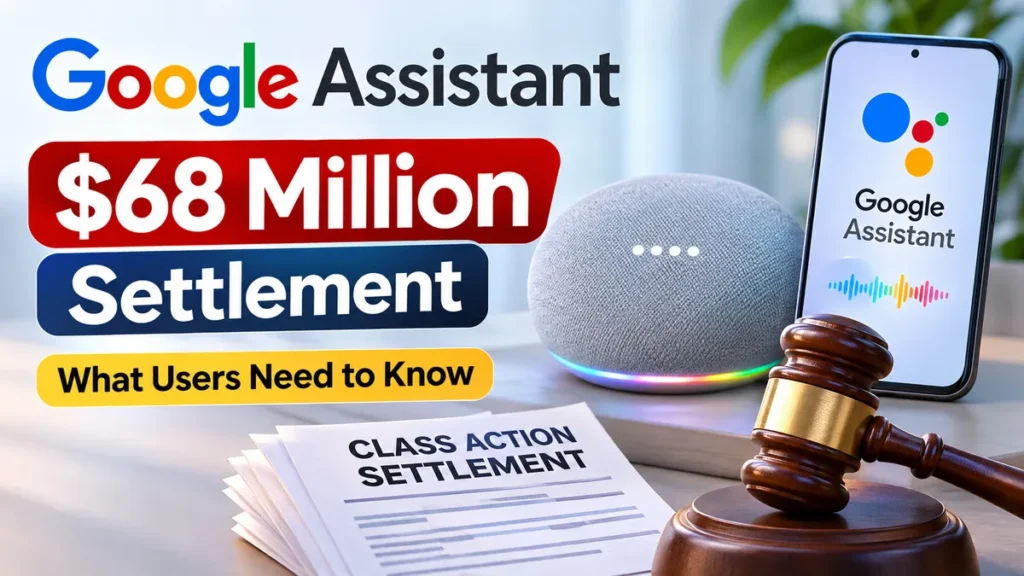
Google Assistant was designed to respond when users asked for help. But what happens when a voice assistant allegedly records conversations without being deliberately activated?
The google assistant $68 million settlement concerns a proposed resolution of a privacy class action involving allegations that Google’s voice assistant captured private conversations after unintended activations. The case raises questions about voice recordings, consumer consent, targeted advertising, and how technology companies handle audio collected by smart devices.
For Google Assistant users, the most pressing questions are whether they qualify for compensation, how payments would work, and whether they need to submit a claim. Understanding the difference between a proposed settlement and a court-approved payment program is essential before taking action.
What Is the google assistant $68 million settlement?
The settlement resolves a class-action lawsuit against Google LLC and its parent company, Alphabet Inc., concerning the operation of Google Assistant.
Plaintiffs alleged that Google Assistant sometimes activated without users saying the intended wake words. They claimed that private communications were recorded or shared without appropriate consent, potentially exposing personal information to outside reviewers or contributing to advertising-related privacy concerns.
Google denied the allegations and did not admit wrongdoing.
The company agreed to establish a $68 million settlement fund to resolve the litigation rather than continue a lengthy legal dispute. The agreement does not mean a court determined that Google unlawfully recorded every affected user’s conversations.
Key settlement facts
| Detail | Information |
|---|---|
| Settlement amount | $68 million |
| Defendants | Google LLC and Alphabet Inc. |
| Case | Google Assistant Privacy Litigation |
| Court | U.S. District Court, Northern District of California |
| Presiding judge | Beth Labson Freeman |
| Relevant period | May 18, 2016–March 19, 2026 |
| Claim deadline | August 27, 2026 |
| Final approval | October 13, 2026 |
| Settlement administrator | A.B. Data, Ltd. |
| Official website | Google Assistant Privacy Litigation |
The settlement received final approval on October 13, 2026. This is an important development because earlier reports published in January described the agreement as awaiting judicial approval. googleassistantprivacylitigation.com+2
Why Was Google Assistant Accused of Recording Private Conversations?
Google Assistant uses voice recognition technology to respond to spoken commands. On supported devices, users can activate the assistant by saying phrases such as “Hey Google” or “OK Google.”
The lawsuit focused on occasions when that activation process allegedly happened unintentionally.
How false activations work
A false activation, legally described in the settlement as a False Accept, occurs when a Google Assistant-enabled device detects what it interprets as a wake phrase even though nobody actually said one.
For example, imagine someone having a conversation in their living room. A television program or an ordinary spoken phrase sounds sufficiently similar to the assistant’s activation command. The device mistakenly activates and begins processing audio.
The settlement’s definition specifically concerns audio recorded and transmitted to Google’s servers following an incorrectly detected wake word.
That distinction matters. A device listening locally for an activation phrase is not necessarily doing the same thing as transmitting a conversation to a remote server.
What did the plaintiffs allege?
The lawsuit raised several related concerns:
- Unintended recording: Google Assistant allegedly captured conversations when users had not deliberately activated it.
- Transmission of audio: Certain recordings were allegedly sent to Google’s systems.
- Third-party review: Some communications were allegedly disclosed to outside vendors involved in reviewing assistant recordings.
- Advertising concerns: Plaintiffs alleged that improperly captured communications contributed to targeted advertising.
- Consumer expectations: Users questioned whether the assistant operated consistently with Google’s privacy representations.
These were allegations made in litigation, not findings that every alleged practice occurred in every instance.
Google disputed wrongdoing and maintained its denial while agreeing to settle. Reuters+1
Who Qualifies for the google assistant $68 million settlement?
Eligibility depends on the settlement’s formal class definitions. Merely owning an Android phone, using a Google account, or having Google Assistant installed does not automatically establish eligibility.
The agreement identifies two principal groups: the Purchaser Settlement Class and the Privacy Settlement Class.
Purchaser Settlement Class
This group generally includes qualifying individuals who purchased Google-made devices in the United States or its territories between May 18, 2016, and March 19, 2026.
The agreement defines qualifying users as U.S. or territorial residents whose Google accounts were associated with at least one Google Assistant-enabled device during the relevant period.
Examples of covered Google-made devices include:
- Google Home, Home Mini, and Home Max smart speakers.
- Google Nest Hub and Nest Hub Max smart displays.
- Google Pixel smartphones.
Purchases through third-party retailers may qualify, provided the device and purchaser meet the settlement requirements.
Privacy Settlement Class
This group addresses a different kind of alleged harm.
It includes qualifying Google Assistant users and household members whose communications were recorded or otherwise obtained because of a false activation, or recorded and disclosed to a third-party review vendor, during the covered period.
For this class, purchasing a Google-made device is not necessarily required. The relevant device must satisfy the agreement’s Google Assistant-enabled device definition.
A household member could potentially qualify even if someone else owned the device.
Comparing the two settlement classes
| Requirement | Purchaser Class | Privacy Class |
|---|---|---|
| Purchase of Google-made device | Required | Not necessarily |
| Relevant Google Assistant device | Yes | Yes |
| Alleged false recording or qualifying disclosure | Not required as an individual showing | Required |
| Household members potentially eligible | Based on their own qualifying purchase | Yes |
| Relevant period | May 18, 2016–March 19, 2026 | Same |
An individual could potentially belong to both classes if they met both definitions. Eligibility and payment depend on the administrator’s review of the claim and the settlement agreement. googleassistantprivacylitigation.com+1
How Much Money Can Eligible Google Assistant Users Receive?
The $68 million figure represents the overall settlement fund, not the amount payable to each person.
Before individual payments are distributed, the fund covers court-authorized expenses and other settlement obligations.
These may include legal fees, administrative expenses, applicable taxes, and service awards.
Expected individual settlement payments
Reporting following final approval described estimated payments in these ranges:
| Settlement class | Reported estimated payment |
|---|---|
| Purchaser Settlement Class | $18–$56 |
| Privacy Settlement Class | $2–$10 |
These figures are estimates, not guaranteed awards. Courthouse News Service
The final payment depends on the allocation formula, the number of accepted claims, deductions from the fund, and the applicable claim categories.
For example, a person qualifying for a purchaser-class payment may receive a different amount from someone whose valid claim concerns only privacy-related recordings.
Why isn’t the $68 million divided equally?
Class-action settlements often compensate different types of claims using different allocation rules.
A device purchaser’s claim may be evaluated differently from a claim involving an alleged privacy intrusion.
The settlement uses a Plan of Allocation to determine how the available money is distributed. Consequently, dividing $68 million by the number of Google Assistant users would not provide a meaningful estimate of individual compensation.
The administrator must account for valid claims and settlement expenses before determining final payments. googleassistantprivacylitigation.com
What Is the google assistant $68 million settlement Claim Deadline?
The deadline to submit a claim was August 27, 2026.
As of November 23, 2026, the ordinary claim submission period has closed.
The same date applied to several other important choices, including requests for exclusion and objections to the settlement.
Important dates in the case
| Date | Event |
|---|---|
| May 18, 2016 | Beginning of the settlement class period |
| 2019 | Privacy litigation initiated |
| January 2026 | $68 million agreement publicly reported |
| March 19, 2026 | Preliminary approval and end of class period |
| August 27, 2026 | Claim, exclusion, and objection deadline |
| October 1, 2026 | Final approval hearing |
| October 13, 2026 | Court granted final settlement approval |
The official settlement website confirms that the August deadline has passed. googleassistantprivacysettlement.com+1
Can someone still file a late claim?
The final approval proceedings acknowledged that numerous claims arrived after the deadline.
The settlement administrator has discretion concerning acceptance of late claims under the settlement agreement, but that does not establish a general extension or guarantee that an additional claim will be accepted.
Anyone who missed the deadline should contact the official administrator for current instructions rather than assume that a third-party claim website can reopen the process.
How Did the Google Assistant Settlement Claim Process Work?
During the claim period, eligible individuals could submit a claim electronically through the settlement website or mail a completed form to the settlement administrator.
The process generally involved the following steps.
- Review eligibility. Determine whether the individual met the Purchaser Settlement Class, Privacy Settlement Class, or both definitions.
- Provide identifying information. Enter the claimant’s name, contact information, and relevant Google account email address.
- Identify the claim category. Indicate whether the claim concerned a qualifying device purchase, privacy-related communications, or both.
- Make the required attestations. Confirm the applicable eligibility statements, including a good-faith belief about qualifying recordings when claiming under the Privacy Settlement Class.
- Submit before the deadline. Complete the online form or mail the paper form by August 27, 2026.
Individuals who received an official settlement notice could use the Unique ID and PIN supplied in that notice.
However, the settlement also permitted qualifying people without a notice ID to submit a claim.
A person filing on behalf of an eligible minor was required to follow the guardian and separate-claim instructions. googleassistantprivacylitigation.com
What information should previous claimants keep?
Anyone who submitted a claim should retain their submission confirmation, copies of relevant correspondence, and access to the email address or phone number provided to the administrator.
These records may be useful if additional verification is requested or payment instructions are sent.
Claimants should also ensure that the administrator has current contact information, especially if they have changed email addresses or telephone numbers since filing.
When Will Google Assistant Settlement Payments Be Sent?
Final approval is a significant legal milestone, but it does not necessarily mean payments are distributed immediately.
A settlement typically moves through claim validation, calculation of individual awards, administrative processing, and any remaining court-related requirements before distribution.
The administrator’s official materials describe payment communications being sent electronically.
Available payment methods may include PayPal, Venmo, Zelle, or ACH bank transfers.
How to check payment status
People who submitted valid claims can use the official settlement website to check published updates and contact the administrator about individual claim questions.
The published contact information is:
| Contact method | Details |
|---|---|
| Website | Official settlement portal |
| Telephone | 1-877-411-4704 |
| info@GoogleAssistantPrivacyLitigation.com | |
| Mailing address | Google Assistant Privacy Settlement, c/o A.B. Data, Ltd., PO Box 170500, Milwaukee, WI 53217 |
No individual payment date should be treated as confirmed unless it comes from an official administrator communication or settlement update. googleassistantprivacysettlement.com+1
How Does the Google Assistant Settlement Affect Consumer Privacy?
Beyond financial compensation, the case highlights a recurring challenge in voice-activated technology: balancing convenient hands-free interaction with meaningful control over personal information.
Voice assistants rely on microphones and automated recognition systems. Although the technology is intended to respond to specific commands, mistakes can occur when speech, background noise, or television audio resembles an activation phrase.
The Google Assistant lawsuit illustrates why consumers may want greater visibility into when audio is collected, how long it is retained, and who can access it.
Does the settlement mean Google admitted spying?
No. Google denied the allegations and agreed to settle without admitting wrongdoing.
The settlement resolves the covered legal claims. It does not establish that every Google Assistant device recorded private conversations improperly or that all captured conversations were used for advertising.
A financial settlement can resolve disputed claims without a judicial determination that the defendant committed the alleged misconduct.
How is this different from the Apple Siri settlement?
Google’s case is not the only major privacy dispute involving a voice assistant.
Apple agreed to a separate $95 million settlement in December 2024 involving allegations that Siri activated unintentionally and captured private conversations.
| Feature | Google Assistant case | Apple Siri case |
|---|---|---|
| Company | Apple | |
| Settlement amount | $68 million | $95 million |
| Technology | Google Assistant | Siri |
| Central allegations | Unintended activation and privacy violations | Unintended activation and privacy violations |
| Legal proceeding | Separate Google class action | Separate Apple class action |
Both cases brought attention to unintended voice assistant activations, but they involved different defendants, settlement agreements, eligibility rules, and claim procedures. Reuters
How Can Google Assistant Users Protect Their Privacy?
The settlement does not mean everyone needs to stop using voice assistants. It does, however, provide a reason to review settings that affect voice activation and audio data.
Review Google Assistant activation settings
On a compatible device, open the relevant Google Assistant or Google Home settings and look for voice activation controls.
Depending on the device and software version, users may be able to adjust or disable “Hey Google” detection.
Disabling voice activation can reduce the chance of unintended wake-word detection, although the exact controls differ across devices.
Check saved voice activity
Google account holders can review their activity through Google My Activity.
Depending on their account settings and the products used, this may include relevant Assistant interactions or saved audio activity.
Users can review available records, delete selected activity, and adjust retention settings.
Not every interaction necessarily creates a saved audio recording visible in the account.
Review microphone access
On Android devices, users can inspect app microphone permissions through the device’s privacy or permission settings.
The available controls depend on the Android version and manufacturer.
Restricting microphone access may limit some voice assistant functions, so users should consider which features they actually need.
Understand third-party access
The lawsuit also highlights the difference between automated speech processing and human review of recordings.
Consumers should examine available privacy disclosures concerning audio processing, data retention, service improvement, and third-party vendors.
A useful privacy review involves more than deleting old recordings. It also means understanding which settings govern future data collection.
How to Avoid Google Assistant Settlement Scams
Major class-action settlements can attract misleading websites, phishing emails, and fraudulent payment messages.
Because the Google Assistant settlement involves millions of dollars, users should verify any communication claiming to provide compensation.
Be cautious if a message:
- Promises a guaranteed large payment regardless of eligibility.
- Requests an upfront processing fee.
- Demands a Google account password or verification code.
- Directs users to an unfamiliar website resembling the official settlement portal.
- Claims the expired filing deadline has been extended without official confirmation.
Legitimate settlement communications should be checked against the administrator’s published information.
The official settlement website and administrator contact details are the safest starting points for verifying claim-related notices.
What Happens After Final Approval of the Settlement?
The October 13, 2026, final approval order marked a major stage in the litigation.
Following approval, the settlement process centers on implementing the agreement, resolving any outstanding legal or administrative matters, reviewing submitted claims, and calculating payments.
Final approval does not automatically establish that every submitted claim is valid.
The administrator must apply the settlement definitions and allocation procedures to determine which claims qualify.
For people who submitted timely claims, the practical next step is to monitor official communications and respond to legitimate requests for additional information.
For those who did not submit a claim, the ordinary deadline has expired, and payment should not be assumed.
Final Thoughts on the google assistant $68 million settlement
The google assistant $68 million settlement resolves a significant privacy dispute involving allegations that Google’s voice assistant recorded communications after unintended activations or disclosed certain recordings to outside reviewers.
Google denied wrongdoing, and the court granted final approval on October 13, 2026.
The settlement covers qualifying U.S. users and household members under two distinct class definitions. The regular claim deadline passed on August 27, 2026, and individual payments depend on valid claims and the approved allocation process.
For existing claimants, the most useful next step is to follow updates from the official settlement administrator. For Google Assistant users generally, the case is a reminder to review voice activation, audio retention, and microphone privacy settings.