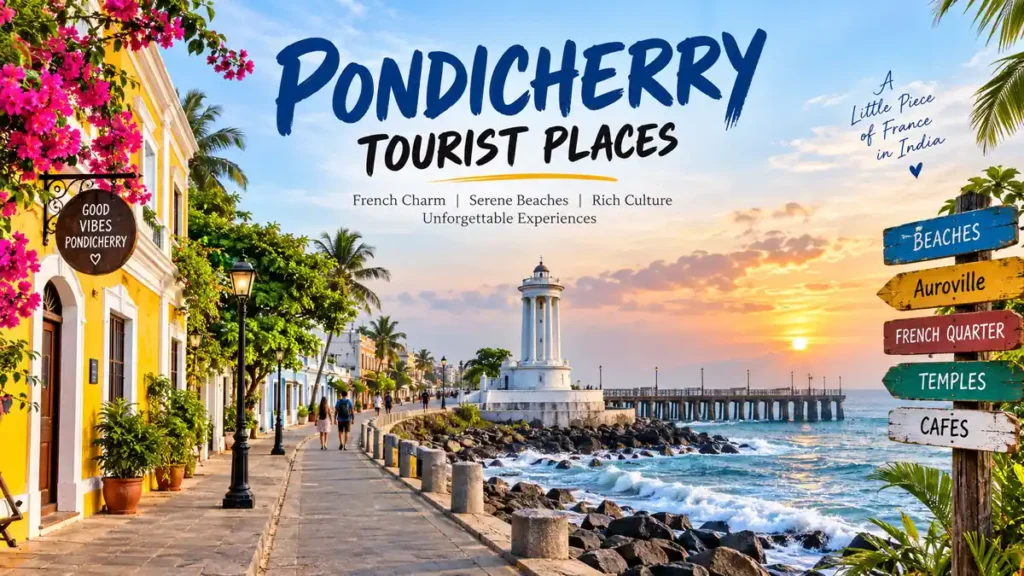
Pondicherry feels different from almost anywhere else in South India. One street can lead past mustard-yellow French villas and bougainvillea-covered walls; another takes you to a centuries-old Hindu temple, a quiet ashram, or the Bay of Bengal.
Officially called Puducherry, this coastal Union Territory blends Tamil culture, French colonial heritage, spirituality, beaches, cafés, churches, and archaeological history. The best pondicherry tourist places include White Town, Promenade Beach, Sri Aurobindo Ashram, Auroville and Matrimandir, Paradise Beach, Manakula Vinayagar Temple, the Basilica of the Sacred Heart of Jesus, Bharathi Park, Puducherry Museum, Arikamedu, and Ousteri Lake.
Quick answer: For a first visit, concentrate on White Town and Promenade Beach, then explore Sri Aurobindo Ashram and Manakula Vinayagar Temple. Set aside half a day for Auroville and Matrimandir, and another morning for Paradise Beach. Two or three days gives most travelers enough time to experience Pondicherry without rushing.
Best pondicherry tourist places for first-time visitors
Pondicherry’s major attractions fall naturally into four groups: heritage streets and monuments, spiritual places, beaches, and nature or archaeological sites.
| Place | Best for | Suggested time |
|---|---|---|
| White Town | Architecture and photography | 2–3 hours |
| Promenade/Rock Beach | Sunrise and evening walks | 1–2 hours |
| Sri Aurobindo Ashram | Spirituality and quiet reflection | 1 hour |
| Auroville & Matrimandir | Architecture and spiritual culture | Half day |
| Paradise Beach | Sand and coastal scenery | 2–4 hours |
| Manakula Vinayagar Temple | Hindu heritage | 30–60 minutes |
| Sacred Heart Basilica | Church architecture | 30–60 minutes |
| Bharathi Park | Relaxation | 30–60 minutes |
| Puducherry Museum | Local history | 1–2 hours |
| Arikamedu | Archaeology | 1–2 hours |
| Chunnambar Boat House | Boating and Paradise Beach access | 1–3 hours |
| Botanical Garden | Families and greenery | 1–2 hours |
Opening hours, ferry schedules, admission arrangements, and access restrictions can change, so check current information before setting out.
1. White Town: the French Quarter
If you have seen photographs of pastel buildings, arched windows, high compound walls and bougainvillea-lined lanes associated with Pondicherry, they were probably taken in White Town, also known as the French Quarter.
The neighborhood preserves some of the strongest visible reminders of Pondicherry’s French colonial period. Streets such as Rue Dumas, Rue Romain Rolland, Rue Suffren and Rue La Bourdonnais are particularly suitable for exploring on foot. India’s official tourism portal specifically recommends walking or cycling through this part of the city.
Don’t treat White Town as a single attraction that can be checked off in ten minutes. Its appeal is the neighborhood itself.
Walk slowly, notice the old villas and courtyards, and then continue toward the waterfront. Early morning is especially pleasant because temperatures are milder and the streets tend to feel quieter.
What makes White Town special?
Pondicherry remained under French rule until 1954, and its urban landscape still shows that influence. Yet describing the city simply as “French” misses half the story.
Crossing into older Tamil neighborhoods reveals another architectural tradition, including Tamil houses and streets shaped by local culture. The contrast is one reason a heritage walk is more rewarding than visiting only individual monuments.
Quick Takeaway: White Town is the best starting point for understanding why Pondicherry looks and feels different from many other Indian coastal cities.
2. Promenade Beach and Rock Beach
Promenade Beach, commonly associated with Rock Beach, forms the city’s most recognizable waterfront.
This isn’t primarily the kind of beach where you spread out a towel for an entire afternoon. Its real attraction is the seaside atmosphere: waves hitting the rocky shore, views over the Bay of Bengal, and an easy promenade for walking.
Sunrise is particularly worthwhile. Arrive while the sky is still changing color, walk along the waterfront, and then explore nearby White Town.
The promenade also places you close to several historical landmarks, making it easy to combine the waterfront with a heritage walk rather than making a separate journey. India’s tourism portal highlights Promenade Beach as one of the signature experiences around the French Quarter.
3. Sri Aurobindo Ashram
Among the most significant pondicherry tourist places, Sri Aurobindo Ashram offers something very different from the city’s beaches and colonial streets.
The spiritual community developed around philosopher and spiritual teacher Sri Aurobindo and Mirra Alfassa, known as The Mother. The ashram became formally established in 1926 and remains one of Pondicherry’s best-known spiritual destinations.
Visitors come for silence and reflection rather than sightseeing in the conventional sense. The Samadhi of Sri Aurobindo and The Mother is central to the experience.
This is a place where respectful behavior matters. Keep conversations quiet, follow photography restrictions, and avoid treating the premises like an ordinary tourist attraction.
Official tourism information currently lists visiting periods of 6:00 AM–12:00 PM and 2:00 PM–6:00 PM, but verify the schedule before visiting.
4. Auroville and Matrimandir
Around half a day should be reserved for Auroville, especially if this is your first Pondicherry trip.
Founded in 1968, Auroville was conceived as an experimental international township centered on ideas of human unity and peaceful coexistence. Residents from many nationalities live within the community.
Its most recognizable landmark is the Matrimandir, a striking golden spherical structure surrounded by landscaped grounds.
One common mistake is assuming that seeing Matrimandir and entering its inner meditation space are the same thing. They aren’t. Casual visitors can generally access designated viewing arrangements, while entry to the inner chamber follows separate procedures and may require advance arrangements.
Allow enough time to understand Auroville rather than rushing there solely for a photograph.
Besides Matrimandir, the wider community is associated with sustainable living, crafts, workshops, architecture and alternative approaches to community life.
5. Paradise Beach and Chunnambar Boat House
For travelers specifically looking for sandy beaches, Paradise Beach is one of the strongest choices around Pondicherry.
The journey is part of the experience. Visitors commonly reach the beach by boat from Chunnambar Boat House, traveling through the backwaters toward the coast. India’s official tourism portal describes Paradise Beach as a popular golden-sand destination reached by ferry from Chunnambar.
The landscape feels more removed from the urban waterfront than Promenade Beach.
Spend your time walking along the sand, enjoying the coastal scenery, or simply sitting near the water. If swimming is permitted during your visit, follow local safety instructions carefully because sea conditions can change.
Ferry operations are especially important to check. Don’t arrive late in the day assuming boats will continue until sunset; last departures can be earlier.
Paradise Beach vs Promenade Beach
The two beaches serve different purposes.
Choose Paradise Beach when you want sand, a boat ride and several relaxed hours near the sea.
Choose Promenade Beach when you want sunrise, a waterfront walk and easy access to White Town’s heritage attractions.
Ideally, see both.
6. Arulmigu Manakula Vinayagar Temple
A short distance from Sri Aurobindo Ashram stands Arulmigu Manakula Vinayagar Temple, one of Pondicherry’s important Hindu religious sites.
Dedicated to Lord Ganesha, the temple adds an essential Tamil dimension to a trip that can otherwise become overly focused on Pondicherry’s French heritage.
Inside, visitors encounter colorful paintings and murals depicting Hindu deities and stories. The temple’s name is associated with the Tamil words manal and kulam, referring to sand and pond.
Official tourism information currently gives visiting hours of 6:00 AM–12:00 PM and 4:00 PM–9:00 PM. Religious ceremonies and festivals can affect the experience, so schedules should be checked locally.
Dress respectfully and remember that this remains an active place of worship.
7. Basilica of the Sacred Heart of Jesus
Pondicherry’s religious landscape isn’t limited to temples and ashrams.
The Basilica of the Sacred Heart of Jesus is among the city’s prominent Christian landmarks and is known for its Gothic-inspired architecture, stained-glass work and religious artwork. The church dates from the early 20th century and remains an active place of worship.
Look beyond the exterior. Much of the architectural character is inside, particularly the stained glass and structural details.
Christmas and Easter can bring a very different atmosphere, but ordinary days are better if your priority is quietly examining the architecture.
8. Eglise de Notre Dame des Anges
Another church worth including on a White Town walk is Eglise de Notre Dame des Anges, or Our Lady of Angels Church.
It belongs naturally in an itinerary focused on French-era architecture because it sits within the historic quarter and helps show the religious and cultural influence of Pondicherry’s colonial period. India’s official tourism portal includes it among Puducherry’s principal attractions.
Pair it with White Town, Promenade Beach and the French War Memorial rather than making a separate journey across town.
9. Bharathi Park and Aayi Mandapam
When midday heat makes continuous sightseeing tiring, Bharathi Park provides a useful green pause in the center of old Pondicherry.
The Puducherry district administration describes the park as being at the heart of the old town, close to the beach.
At its center stands Aayi Mandapam, an elegant monument that has become one of the area’s recognizable landmarks.
The park works particularly well as a connecting stop: explore White Town, rest here, then continue toward the museum, churches or waterfront.
Families may appreciate it more than travelers trying to maximize the number of monuments they see.
10. Puducherry Museum
Architecture tells part of Pondicherry’s story; the Puducherry Museum adds historical context.
The museum is one of the major attractions promoted by India’s official tourism portal and can be combined easily with White Town, Bharathi Park and the French War Memorial.
It is particularly useful for travelers interested in understanding the layers of history behind the city rather than simply photographing colonial buildings.
Allow roughly an hour or more depending on your interest in archaeology and regional history, and confirm the current opening days before visiting.
11. French War Memorial
The French War Memorial is another compact heritage stop along the central sightseeing circuit.
It commemorates soldiers from French India who died during World War I and provides another visible link to Pondicherry’s French history. India’s national tourism portal lists the memorial among Puducherry’s key attractions.
You don’t need a large block of time here. Include it during a walk through White Town and the promenade area.
That approach works better than planning each central landmark as a separate excursion.
12. Arikamedu: Pondicherry’s archaeological side
Travelers interested in ancient history should make room for Arikamedu.
This archaeological site gives Pondicherry a historical dimension that predates its familiar French-colonial identity. It is recognized among the region’s notable heritage attractions by India’s official tourism portal.
Arikamedu is especially worthwhile for history enthusiasts because it helps place the region within much older maritime and trading networks.
Don’t expect the polished presentation of a large modern museum. The attraction is archaeological context and the chance to think about Pondicherry’s history on a much longer timeline.
Pairing Arikamedu with the Puducherry Museum makes sense if history is one of your main interests.
13. Botanical Garden
The Botanical Garden is a convenient option for families, plant lovers, and anyone who needs a break from temples, churches and heritage streets.
According to the Puducherry district administration, the garden contains old trees and a broad variety of plants.
Its central location also makes it relatively easy to add to a sightseeing itinerary.
Don’t rank it above Auroville, White Town or the main waterfront if you have only one day. With two or three days, however, the garden adds welcome variety.
14. Ousteri Lake and wetland
Pondicherry isn’t only architecture and beaches. Ousteri, also known as Osudu Lake, offers a quieter nature-focused experience outside the busiest sightseeing areas.
The wetland is particularly interesting to travelers who enjoy birdlife, open landscapes and slower outdoor experiences. India’s official tourism information identifies Ousteri Wetland and National Park among attractions around Puducherry.
The quality of a visit can vary with the season, water levels and bird activity, so nature enthusiasts should check current local conditions.
Morning generally makes more sense than the hottest part of the afternoon.
15. Serenity Beach
Serenity Beach provides another coastal option for travelers who want to spend more time around the sea.
Compared with the urban atmosphere around Promenade Beach, coastal areas farther from central White Town can feel more relaxed.
Come early for cooler temperatures and softer light. Conditions along India’s east coast can change quickly, so don’t assume that calm-looking water automatically means swimming is safe. Follow local warnings and lifeguard instructions wherever available.
If your itinerary already includes Paradise Beach, consider Serenity Beach an additional coastal experience rather than an essential replacement.
16. Eden Beach
Eden Beach has become another recognizable name among Pondicherry’s coastal attractions and appears prominently in current destination guides.
It can work well for visitors who want to explore beyond the central promenade and compare different sections of Pondicherry’s coastline.
As with every beach here, weather, tides and local restrictions should determine whether you enter the water.
17. Tamil Quarter
One of the biggest mistakes first-time visitors make is treating White Town as if it represents all of Pondicherry.
It doesn’t.
The Tamil Quarter reveals another side of the city’s architectural and cultural identity. Heritage walks that cross the old canal can reveal traditional Tamil houses alongside the colonial urban fabric. India’s tourism portal specifically points to restored Tamil mansions as part of the city’s heritage experience.
Walking through both areas makes the city’s mixed identity far clearer.
Rather than seeing Pondicherry simply as a surviving French enclave in India, you begin to see how Tamil and European influences developed beside one another.
18. Old Lighthouse and the waterfront heritage zone
The Old Lighthouse is another recognizable landmark around Pondicherry’s historic waterfront.
It works best as part of the larger promenade circuit rather than as a destination requiring a long standalone visit. Nearby heritage landmarks, public spaces and sea views mean you can cover several points of interest during the same walk.
This is one of the advantages of sightseeing in central Pondicherry: many attractions are close enough together that walking is often more enjoyable than repeatedly using a vehicle.
How many days are enough for pondicherry tourist places?
For most first-time visitors, two to three days is the sweet spot.
One day can cover the essential city sights, but you’ll move quickly. Two days allows time for White Town, spiritual attractions, Auroville and a beach. Three days creates room for historical sites, nature and a slower coastal experience.
One-day Pondicherry itinerary
Start around sunrise at Promenade Beach.
Walk through White Town and visit Sri Aurobindo Ashram and Manakula Vinayagar Temple. Continue through Bharathi Park and nearby heritage landmarks.
After lunch, travel to Auroville and see the Matrimandir viewing area if access arrangements permit.
Return to the city for an evening walk around White Town or the waterfront.
Two-day Pondicherry itinerary
Follow the first-day route for central Pondicherry and Auroville.
On day two, start at Chunnambar Boat House and visit Paradise Beach. Later, choose the Botanical Garden, Puducherry Museum or Arikamedu depending on whether you prefer nature or history.
Finish with another waterfront evening rather than squeezing in unnecessary extra attractions.
Three-day Pondicherry itinerary
A third day lets you slow down.
Visit Ousteri Lake in the morning, explore the Tamil Quarter, spend time at Serenity or Eden Beach, or return to Auroville for a deeper look at its community rather than treating Matrimandir as a quick photo stop.
This slower schedule suits Pondicherry particularly well.
Best time to visit Pondicherry
Weather makes a major difference to how much you’ll enjoy walking around Pondicherry.
The cooler months are generally the easiest for sightseeing. Lonely Planet’s 2026 guide particularly recommends January through March for cooler conditions and a lower likelihood of rain, while broader destination guides commonly identify roughly October through March as the preferred travel season.
Summer heat and humidity can make long heritage walks tiring, especially around midday.
If traveling during hotter months, start outdoor sightseeing early, rest during the hottest hours, and return outside later in the afternoon.
Rainy periods can create atmospheric streets and greenery but may disrupt beach plans, boat operations and outdoor sightseeing.
How to get around Pondicherry
Central Pondicherry is surprisingly walkable.
White Town, Promenade Beach, Bharathi Park, Sri Aurobindo Ashram, Manakula Vinayagar Temple and several heritage landmarks can be grouped into a walking route.
Bicycles are another enjoyable option; official tourism guidance specifically recommends walking or cycling through the heritage areas.
For Auroville, Ousteri, Chunnambar and more distant beaches, you’ll usually need motorized transport.
A practical strategy is simple: walk inside the heritage center and use a vehicle for outer attractions.
That saves time without missing the street-level details that make central Pondicherry interesting.
What is Pondicherry famous for?
Pondicherry is famous because several identities overlap within a relatively compact destination.
There is the French heritage of White Town, the Tamil cultural landscape, the spirituality associated with Sri Aurobindo and The Mother, the international experiment of Auroville, and a coastline facing the Bay of Bengal.
Food contributes another layer. French-influenced bakeries and cafés coexist with Tamil and broader South Indian cooking, reflecting the cultural mixture visible in the city’s architecture.
This variety explains why Pondicherry works for different types of travelers. History enthusiasts, architecture lovers, spiritual travelers, photographers, couples, families and beach visitors can all build quite different itineraries from the same destination.
Practical tips for visiting pondicherry tourist places
A few decisions can make sightseeing noticeably easier:
- Start early. Sunrise and early morning are better for Promenade Beach, photography and heritage walks.
- Group attractions geographically. White Town, the promenade, Bharathi Park, the ashram and nearby temples shouldn’t be planned as separate cross-city trips.
- Reserve enough time for Auroville. Matrimandir isn’t simply another monument where you arrive, photograph it and immediately leave.
- Check Matrimandir access arrangements beforehand. Viewing and entering the meditation chamber involve different procedures.
- Confirm Paradise Beach ferry times. Boat schedules determine how long you can stay.
- Respect religious spaces. Dress appropriately, speak quietly and follow photography rules in temples, churches and the ashram.
- Carry sun protection and drinking water. Pondicherry can feel hot and humid even outside peak summer.
- Don’t assume every beach is suitable for swimming. Observe local safety signs and current sea conditions.
- Keep some unscheduled time. Pondicherry rewards wandering through streets, sitting by the waterfront and exploring slowly.
Which Pondicherry places should you prioritize?
If you have limited time, don’t try to visit every attraction just because it appears on a checklist.
For a first visit, prioritize White Town, Promenade Beach, Sri Aurobindo Ashram, Auroville and Matrimandir, Paradise Beach and Manakula Vinayagar Temple. Together, they capture the city’s architecture, coast, spirituality and Tamil heritage.
For history and architecture, add Puducherry Museum, Arikamedu, the French War Memorial, Sacred Heart Basilica, Notre Dame des Anges and the Tamil Quarter.
For nature and beaches, spend more time at Paradise Beach, Serenity Beach, Eden Beach, Ousteri Lake and the Botanical Garden.
Families may prefer a balanced schedule combining the Botanical Garden, Chunnambar, Paradise Beach, Bharathi Park and an easy White Town walk rather than packing the day with monuments.
Final thoughts on pondicherry tourist places
The best pondicherry tourist places aren’t memorable because of one spectacular monument. Pondicherry works because very different experiences sit close together.
You can watch sunrise over the Bay of Bengal, walk through French-era streets, enter a Hindu temple, spend an hour in the quiet of Sri Aurobindo Ashram, explore Auroville’s vision of international community, take a boat toward Paradise Beach, and uncover ancient history at Arikamedu—all within the same short trip.
Give yourself at least two days if possible, three if you prefer traveling slowly. Start with White Town and the waterfront, dedicate proper time to Auroville, and choose beaches, museums, archaeological sites and nature stops according to your interests rather than trying to tick off every attraction.
That balance—heritage, spirituality, Tamil culture, architecture and the coast—is what makes Pondicherry worth exploring.