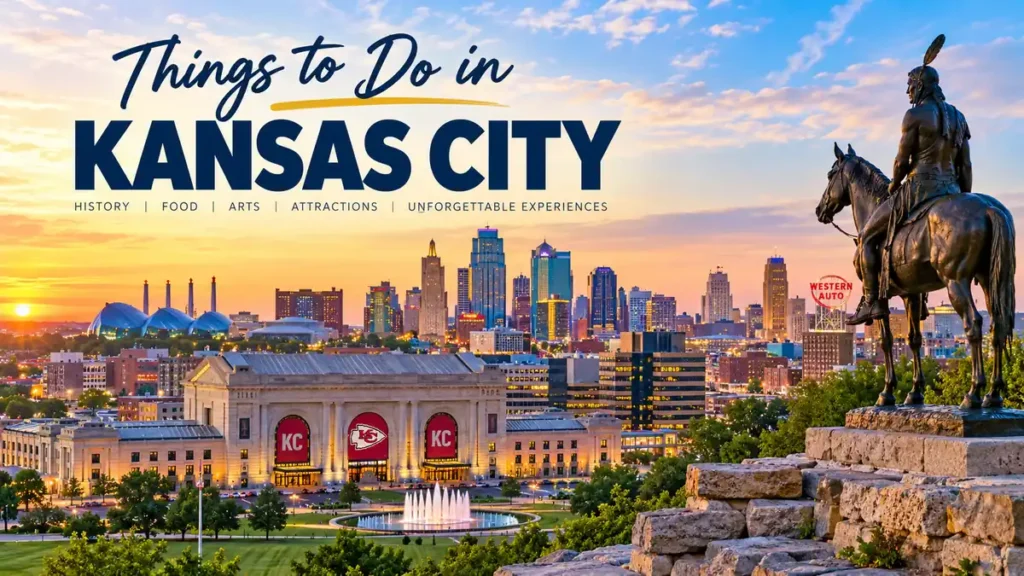
Kansas City is easy to underestimate until you actually start exploring it. One minute you are standing beneath a World War I memorial overlooking downtown; the next you are eating burnt ends, wandering through a world-class art museum, listening to live jazz, or riding a streetcar to a completely different neighborhood.
If you are looking for things to do in kansas city, start with the National WWI Museum and Memorial, Nelson-Atkins Museum of Art, Union Station, 18th & Vine Historic Jazz District, Country Club Plaza, River Market, Kansas City barbecue, and one of the city’s major sporting events. Families can add Science City and the Kansas City Zoo & Aquarium, while budget travelers have excellent museums, parks, fountains, markets, and fare-free streetcar rides to choose from.
Kansas City sits on the Missouri-Kansas border, but most of the famous downtown attractions associated with a first visit are in Kansas City, Missouri. The wider metropolitan area spreads into Kansas, so it pays to check the state whenever you enter an address.
Here are the experiences worth building your trip around.
Best things to do in kansas city for first-time visitors
A first trip does not need to involve racing between dozens of attractions. Kansas City’s strongest experiences revolve around history, art, music, food, distinctive neighborhoods, and sports.
| Attraction or experience | Best for | Suggested time |
|---|---|---|
| National WWI Museum and Memorial | History and skyline views | 2–3 hours |
| Nelson-Atkins Museum of Art | Art and free sightseeing | 2–3 hours |
| Union Station | Architecture and families | 1–3 hours |
| 18th & Vine | Jazz and Black history | Half day |
| River Market | Food and neighborhood exploring | 1–2 hours |
| Country Club Plaza | Architecture, fountains and dining | 2–3 hours |
| Kansas City barbecue | Local food culture | 1 meal or a food crawl |
| Crossroads Arts District | Galleries and nightlife | Half day |
| Kansas City Zoo & Aquarium | Families and animals | Half/full day |
| Professional sports | Local atmosphere | 3–4 hours |
The key is grouping nearby places rather than treating Kansas City like one giant checklist. Union Station and the National WWI Museum pair naturally. The American Jazz Museum and Negro Leagues Baseball Museum share the same cultural complex at 18th & Vine. River Market, downtown and the Crossroads are increasingly easy to connect by streetcar.
1. Visit the National WWI Museum and Memorial
The National WWI Museum and Memorial is one of the places that gives Kansas City far more historical depth than first-time visitors may expect.
Its exhibitions examine the First World War through artifacts, photographs, personal stories, maps, weapons, uniforms and immersive displays. Rather than rushing through, allow at least a couple of hours if military or social history interests you.
The Liberty Memorial tower and surrounding grounds also provide one of the most recognizable views of the Kansas City skyline, with Union Station directly below.
As of 2026, the museum generally operates daily during summer and Wednesday through Monday between Labor Day and Memorial Day, closing Tuesdays during that portion of the year. Check the official calendar before visiting because hours can change for special events and holidays.
Quick takeaway: Even travelers who normally skip military museums should consider this one because the museum, memorial architecture and skyline overlook work as three experiences in a single stop.
2. Explore Union Station Kansas City
Walk downhill from the memorial and you reach one of Kansas City’s grandest buildings.
Union Station opened in the early 20th century and remains both a historic landmark and an active entertainment complex. The huge Grand Hall, high ceiling and monumental windows make it worth seeing even if you do not buy a ticket to an attraction.
Inside and around the station you can find Science City, a planetarium, theaters, restaurants, rotating exhibitions and the Model Railroad Experience. Union Station has also served as a gathering place for some of Kansas City’s biggest civic celebrations.
This is an especially useful stop when the weather turns unpleasant because several activities can be combined without spending much time outside.
3. Spend a few hours at the Nelson-Atkins Museum of Art
The Nelson-Atkins Museum of Art is one of the strongest answers to anyone searching for free things to do in Kansas City.
General admission is free, yet its collection covers more than 5,000 years of art. You can move from Asian art and European painting to photography, decorative arts and contemporary work without needing to squeeze the visit into an expensive timed ticket.
Outside, the Donald J. Hall Sculpture Park is known for the giant Shuttlecocks spread across the lawn. The sculpture park is also free and opens from sunrise to sundown.
The indoor museum currently closes on Tuesdays and Wednesdays, so verify operating days before structuring an itinerary around it.
If your schedule is tight, two hours provides a useful introduction. Art lovers could easily stay much longer.
4. Discover jazz history at 18th & Vine
Kansas City’s contribution to American jazz deserves more than background music over dinner.
Head to the historic 18th & Vine Jazz District, where Kansas City’s jazz tradition is interpreted through museums, historic sites and live performance.
The American Jazz Museum explains the development of jazz through interactive exhibits, collections and performances. The district is closely associated with musicians including Kansas City-born Charlie Parker, whose statue stands nearby.
For a deeper experience, do not leave immediately after the galleries. Check whether live music is scheduled nearby. Jazz makes considerably more sense once you have both learned the history and heard the music performed.
5. Visit the Negro Leagues Baseball Museum
In the same 18th & Vine complex, the Negro Leagues Baseball Museum preserves an essential chapter of American sporting and social history.
The museum describes itself as the world’s only national museum dedicated to preserving and celebrating African American baseball and its role in America’s social advancement. It was founded in Kansas City in 1990, close to the Paseo YMCA where Rube Foster established the Negro National League in 1920.
Expect photographs, artifacts, films and stories connecting baseball stars with segregation, civil rights, business and changing American culture.
Allow at least an hour; the museum itself recommends that as a minimum for appreciating the exhibit. Tickets are separate from admission to the neighboring American Jazz Museum.
That ticket detail is easy to miss when planning a visit.
6. Eat real Kansas City barbecue
You cannot properly discuss fun things to do in Kansas City without talking about barbecue.
Kansas City barbecue is defined less by one cut of meat than by variety. Beef, pork, chicken, ribs, sausage and other meats all appear on local menus, generally cooked slowly and paired with the city’s recognizable sauce traditions.
The dish most visitors should know is burnt ends—smoky, bark-heavy pieces historically associated with brisket.
Visit KC says the metro has more than 100 barbecue restaurants and a barbecue tradition stretching back more than a century.
Instead of trying to identify one universally “best” restaurant, sample different approaches if you have time. Old-school counter-service joints, newer pitmasters and polished sit-down restaurants can deliver very different versions of the same Kansas City tradition.
A useful rule: order one thing you already know you like and one local specialty you have never tried.
7. Walk through the River Market
The River Market is one of the easiest neighborhoods to enjoy without an elaborate itinerary.
Its best-known attraction is City Market, a historic public-market district where produce vendors, specialty food businesses, shops and restaurants create a noticeably different atmosphere from office-heavy downtown streets.
Weekend mornings tend to feel livelier, while weekdays can be easier for relaxed exploring.
The neighborhood is also a good starting point for combining several downtown attractions without constantly moving your car.
Ride the streetcar, stop for coffee, browse the market and then continue south toward downtown, the Power & Light District, Crossroads or Union Station.
8. Ride the KC Streetcar
Public transportation has become an attraction-planning tool in its own right.
The KC Streetcar is fare-free. Following the Main Street Extension’s opening in October 2025 and the Riverfront Extension’s opening in May 2026, the system now runs about 6.5 miles from the Riverfront to UMKC with 32 platform stops.
That makes it substantially more useful to visitors than older Kansas City guides suggest.
You can use it to connect areas around the Riverfront, River Market, downtown, Crossroads, Union Station and farther south without finding a new parking spot at every stop.
Streetcars normally arrive frequently, but major events and road activity can affect service. Check live information on the day you travel.
9. Explore the Crossroads Arts District
Kansas City becomes more interesting when you stop treating individual attractions as isolated destinations and start exploring its neighborhoods.
The Crossroads Arts District is particularly good for galleries, murals, independent businesses, restaurants, breweries and nightlife.
One of the best times to experience it is around First Fridays, when galleries, studios and local businesses participate in neighborhood events. Visit KC regularly highlights First Friday weekends among the city’s recurring experiences.
Crowds can be part of the fun, but they also mean parking becomes more troublesome. Using the streetcar and walking is often easier than trying to park directly beside every destination.
10. See the Country Club Plaza
Country Club Plaza feels noticeably different from downtown.
The district combines shopping and restaurants with Spanish-inspired architecture, decorative tile, towers and numerous fountains. Visit KC describes the Plaza area as a 15-block district with more than 100 shops and dozens of restaurants.
You do not need to be interested in shopping to enjoy it.
Walk the side streets, find the J.C. Nichols Memorial Fountain, look at the architecture and stop for a meal or coffee. The district is especially attractive around dusk when exterior lighting gives the buildings more character.
Since the Main Street streetcar extension opened to the Plaza and UMKC area, reaching this part of Kansas City without driving has also become considerably easier.
Free things to do in kansas city
Kansas City works surprisingly well for travelers trying to keep daily expenses low.
Start at the Nelson-Atkins Museum of Art, where general admission and the sculpture park are free. Then mix in public spaces, architecture, neighborhood walks and the fare-free streetcar.
Some worthwhile low-cost or free ideas include:
- walking through the River Market and City Market area;
- riding the KC Streetcar;
- exploring Crossroads murals;
- photographing Union Station’s Grand Hall;
- walking around the Liberty Memorial grounds;
- visiting the Donald J. Hall Sculpture Park;
- exploring Country Club Plaza’s fountains and architecture;
- walking around Berkley Riverfront;
- browsing First Friday events;
- enjoying Kansas City’s skyline viewpoints.
Visit KC maintains an entire collection of free attractions and activities, which is useful because temporary exhibitions, festivals and seasonal events change throughout the year.
Quick takeaway: Do not assume a Kansas City sightseeing day requires buying admission to four attractions. Combine one paid museum with free art, neighborhoods and streetcar transportation and you can fill an entire day without feeling like you compromised.
Fun things to do in kansas city with kids
Families have more options than simply adapting adult attractions for children.
11. Spend the day at Kansas City Zoo & Aquarium
The Kansas City Zoo & Aquarium is one of the larger family outings, so give it substantially more time than a small indoor attraction.
A major feature is the Sobela Ocean Aquarium, a 650,000-gallon facility with 34 habitats and nearly 8,000 animals. Aquarium entry is included with zoo admission rather than requiring a completely separate attraction ticket.
That makes the zoo particularly useful when a family contains children with different interests.
Wear comfortable shoes and avoid planning another major attraction immediately afterward.
12. Explore Science City
Science City inside Union Station is built around hands-on learning rather than traditional display cases.
The attraction covers nearly 100,000 square feet of indoor and outdoor space and offers more than 300 interactive exhibits involving engineering, biology, water, physics, making and other STEM subjects.
There are activities aimed at younger children as well as exhibits older kids can engage with, making it easier for families traveling with mixed ages.
Because Science City is inside Union Station, parents can combine it with lunch, the station’s architecture and another activity without repeatedly loading everyone into a car.
13. Visit Crown Center
Crown Center sits close to Union Station and provides another practical family stop.
The district combines restaurants, shopping and kid-oriented attractions, including LEGOLAND Discovery Center. Visit KC lists Crown Center among its major attractions and family-friendly areas.
It works particularly well on a cold, rainy or exceptionally hot day when you want several indoor options close together.
Explore Kansas City’s sports culture
Kansas City sports are not simply evening entertainment. They are one of the clearest ways to experience how locals relate to the city.
14. Catch a Kansas City Chiefs game
Arrowhead Stadium is famous for the atmosphere surrounding Kansas City Chiefs football.
NFL game days become all-day events because tailgating is a major part of the culture. If you attend, arrive early rather than treating kickoff as your arrival time.
Even non-football fans may find the pregame atmosphere interesting because it shows a side of Kansas City that museums cannot.
15. Watch the Kansas City Royals
Baseball offers a slower, more relaxed sports experience at Kauffman Stadium, home of the Kansas City Royals.
A Royals game is an especially good option for families or summer visitors who want to spend an evening outdoors after sightseeing.
Visit KC lists the Royals among Kansas City’s major sports attractions.
16. See the KC Current at CPKC Stadium
One of the city’s newer sporting landmarks is CPKC Stadium at Berkley Riverfront.
The venue was created for the Kansas City Current of the National Women’s Soccer League and is recognized as the first stadium purpose-built for a women’s professional sports team. The project was announced as a $140 million soccer-specific stadium.
The Riverfront setting makes it particularly interesting for visitors because a match can be paired with exploring the surrounding area.
The KC Streetcar’s Riverfront Extension opened in May 2026, making the stadium district easier to reach from downtown without driving.
Things to do in kansas city for couples and adults
Kansas City can make a surprisingly good short couples’ getaway because dinner, music, art and neighborhood exploring fit naturally together.
17. Plan an art-and-dinner date
Start late afternoon at the Nelson-Atkins, particularly on a day when galleries remain open into the evening, then move toward Country Club Plaza for dinner.
You get art, architecture and food without spending the entire date driving between opposite sides of the metro.
18. Listen to live jazz
After visiting the American Jazz Museum, hearing live music gives the history context.
Kansas City’s jazz identity grew through clubs and musicians rather than museum displays alone. Look for current performances around 18th & Vine and elsewhere in the city.
Do not assume the best evening requires a huge concert. A smaller room with a good local ensemble often feels more connected to Kansas City’s musical tradition.
19. Explore local breweries and distilleries
Kansas City’s food-and-drink culture extends beyond barbecue.
Craft breweries, distilleries and cocktail bars are spread through areas including the Crossroads and other central neighborhoods. The official tourism organization highlights the city’s craft brewing culture as part of its broader visitor experience.
If drinking is part of the evening, planning around walkable neighborhoods or public transportation makes considerably more sense than hopping between distant locations by car.
20. Discover Kansas City’s fountains
Kansas City is widely nicknamed the City of Fountains, and fountains appear throughout parks, commercial districts and public spaces.
The J.C. Nichols Memorial Fountain near Country Club Plaza is among the best known, but seeking out fountains can become a casual sightseeing theme rather than a single attraction.
This works particularly well when traveling with someone who does not enjoy spending hours inside museums.
Combine fountains with architectural walks, public art and neighborhood restaurants rather than driving across town purely to check each one off a list.
21. Spend time at Berkley Riverfront
Berkley Riverfront is increasingly relevant to a modern Kansas City itinerary.
The Missouri River setting provides walking space and city views, while CPKC Stadium has made the area a significant sports destination. The streetcar’s 2026 Riverfront Extension now links the riverfront more directly with central Kansas City.
It is a useful break after spending several hours indoors at museums.
Go near sunset if your schedule allows, particularly when the weather is comfortable.
22. Find the best Kansas City skyline views
Kansas City does not have a single mandatory observation deck. Several ground-level viewpoints are more rewarding.
The lawn around the National WWI Museum and Liberty Memorial gives you the classic view toward Union Station and downtown.
Penn Valley Park offers additional perspectives, while riverfront areas show a completely different side of the city.
Visit KC specifically highlights skyline-viewing locations among the city’s attractions.
For photographers, early morning and the period around sunset usually provide more interesting light than midday.
23. Explore Westport
Westport provides another glimpse of Kansas City beyond its major museums.
The historic district is associated today with restaurants, bars and nightlife, making it more appropriate for an evening than an attraction-packed morning.
Visitors who spend every evening in the Power & Light District can leave thinking Kansas City’s nightlife is concentrated in a single downtown zone. It is not.
Westport, Crossroads, 18th & Vine and other neighborhoods each have different personalities.
Spend time in at least two if nightlife matters to you.
24. Check what is happening this weekend
One mistake with Kansas City travel guides is treating permanent attractions as the whole story.
Festivals, sports, First Fridays, concerts, touring exhibitions, markets and seasonal celebrations can completely change the best itinerary for a particular weekend.
For example, Union Station regularly hosts touring exhibitions, while Visit KC’s 2026 event calendar includes changing cultural festivals, seasonal celebrations and free weekend events.
Check the current event calendar shortly before arriving rather than building every hour of the trip months in advance.
What is Kansas City best known for?
For visitors, five themes explain much of Kansas City’s identity:
Barbecue: especially smoked meats, burnt ends and a long-established local barbecue culture.
Jazz: particularly the music history associated with 18th & Vine and Charlie Parker.
Fountains: visible throughout public spaces and responsible for the City of Fountains nickname.
Sports: the Chiefs, Royals and KC Current all have devoted followings.
Museums: particularly the National WWI Museum and Memorial, Nelson-Atkins Museum of Art, American Jazz Museum and Negro Leagues Baseball Museum.
That combination explains why Kansas City works for several types of traveler at once. A history enthusiast, sports fan, foodie and family with children can build completely different trips without leaving the metro.
How many days do you need in Kansas City?
Two days is enough for major highlights. Three days gives you a much better trip.
With one day, concentrate on Union Station, the National WWI Museum and one nearby district.
With two days, add Nelson-Atkins, Country Club Plaza, barbecue and 18th & Vine.
With three days, you can explore neighborhoods at a slower pace, attend a sporting event, visit the zoo or spend more time around River Market and the Crossroads.
A simple three-day structure works well:
| Day | Morning | Afternoon | Evening |
|---|---|---|---|
| 1 | National WWI Museum | Union Station | Crossroads + barbecue |
| 2 | Nelson-Atkins | Country Club Plaza | Jazz or Westport |
| 3 | River Market | 18th & Vine | Sports or Riverfront |
Families could replace the second or third afternoon with Science City or the Kansas City Zoo & Aquarium.
Is Kansas City walkable?
Kansas City is partly walkable, but not uniformly walkable.
Downtown, River Market, Crossroads, Country Club Plaza and individual entertainment districts are easy to explore on foot once you arrive. Traveling between widely separated parts of the metropolitan area may still require a car, rideshare or public transportation.
The fare-free KC Streetcar changes the equation considerably. Its expanded 6.5-mile route now connects the Riverfront with central districts and continues south toward UMKC.
For a visitor staying close to the streetcar corridor, it is increasingly realistic to spend a substantial portion of a short trip without driving.
Just remember that “Kansas City” describes a large metropolitan area crossing a state line. Attractions outside the central corridor can be many miles apart.
What is the best time to visit Kansas City?
Spring and fall generally provide the easiest conditions for sightseeing because you can mix museums with outdoor neighborhoods, parks and sports without relying entirely on indoor attractions.
Summer brings baseball, festivals and long evenings, but temperatures can become uncomfortable. Plan outdoor activities earlier in the day and save museums for hotter afternoon hours.
Winter can be cold, yet Kansas City has enough indoor attractions—Nelson-Atkins, Union Station, Science City, the American Jazz Museum and the Negro Leagues Baseball Museum—to support a worthwhile weekend.
Your preferred event may matter more than weather. Football fans will naturally favor NFL season, baseball fans summer, and festival travelers should choose dates around the event they actually want to attend.
Practical tips for visiting Kansas City
A few decisions make sightseeing noticeably easier.
Group attractions geographically. Do the National WWI Museum and Union Station together. Pair the two museums at 18th & Vine. Combine Nelson-Atkins with Country Club Plaza.
Use the streetcar strategically. The current route is much longer than it was in older travel guides, running from the Riverfront to UMKC and remaining free to ride.
Check museum closing days. Nelson-Atkins currently closes Tuesday and Wednesday, while the National WWI Museum follows different seasonal schedules.
Allow more time for 18th & Vine than expected. The American Jazz Museum averages around 90 minutes for many visitors, and the neighboring Negro Leagues Baseball Museum recommends at least an hour. Seeing both can easily occupy much of an afternoon.
Remember the state line. Kansas City, Missouri and Kansas City, Kansas are separate cities within the same metropolitan area. Check addresses before assuming two attractions are close.
Leave room for barbecue. Heavy barbecue immediately before three hours of walking is not always the brilliant scheduling decision it appears to be.
Choosing the best things to do in Kansas City
The most memorable things to do in kansas city are the experiences that reveal why the city developed the character it has: learning about World War I beneath Liberty Memorial, seeing world-class art for free at the Nelson-Atkins, hearing the story of jazz and Negro Leagues baseball at 18th & Vine, exploring distinctive neighborhoods and finally sitting down to Kansas City barbecue.
For a first visit, build the trip around three anchors: history, food and neighborhoods. Add art, family attractions or sports according to your interests, and use the expanded KC Streetcar to connect as much of the central city as possible.
Do that rather than trying to check off every attraction, and Kansas City starts feeling less like a collection of sights and more like a place you actually got to know.