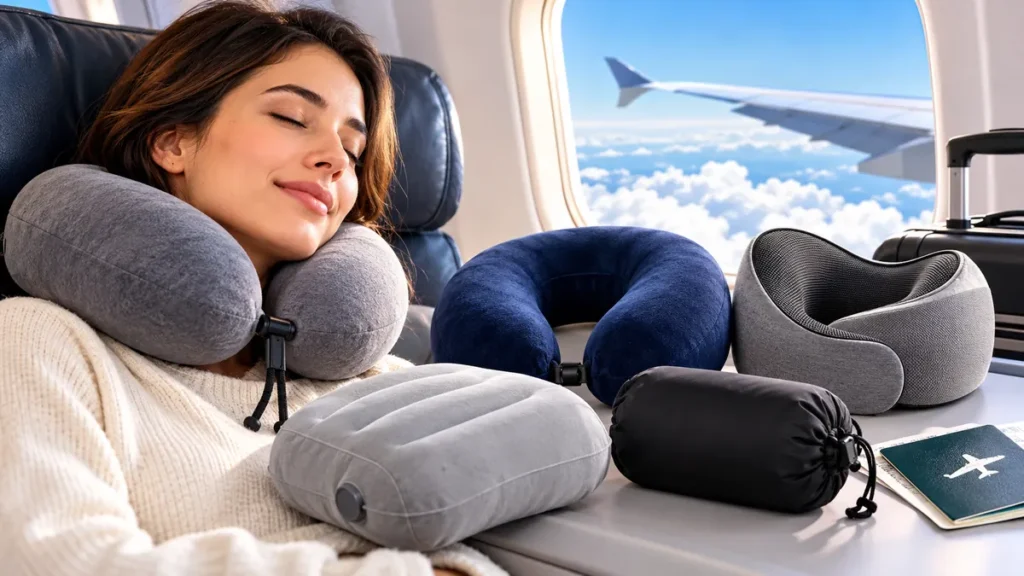
Sleeping upright on an airplane can leave you with a stiff neck, tired shoulders, and the uncomfortable feeling that you barely rested. A poorly designed travel pillow can make matters worse by pushing your head forward or failing to support it when you fall asleep.
The best travel pillows support your head and neck in a comfortable position while remaining lightweight and easy to carry. Memory foam, inflatable, wraparound, and ergonomic designs suit different sleeping habits. The right choice depends on your seat position, neck size, preferred firmness, and how much space you have for packing.
Modern travel pillows have moved far beyond the familiar U-shaped cushion. Some provide adjustable chin support, others use internal frames to stabilize the head, and several can be compressed into small carrying cases.
This guide explains the most useful travel pillow designs, how leading models compare, what features matter, and how to avoid common mistakes when sleeping on a plane, train, bus, or road trip.
H2: What Makes the best travel pillows Different?
A travel pillow has a different purpose from a traditional bed pillow. Instead of cushioning your head while lying horizontally, it needs to provide support when your body remains seated or partially reclined.
When you fall asleep sitting upright, the muscles that normally stabilize your head relax. Your head may drop forward, lean sideways, or move repeatedly as the vehicle changes direction.
An effective travel pillow helps limit these movements without forcing your neck into an unnatural position.
H3: Proper Neck and Head Support
The most useful feature is support in the direction your head naturally falls.
For example, someone whose head drops toward their chest may benefit from a wraparound design with chin support. A traveler who leans toward the window may prefer a taller side cushion.
The goal is to maintain a reasonably neutral neck position rather than holding the head rigidly in place.
H3: Comfortable Materials and Pressure Distribution
Travel pillows commonly use memory foam, polyester fiberfill, microbeads, or inflatable air chambers.
Memory foam responds to pressure and conforms to the head and neck. Polyester filling generally feels softer and less structured, while inflatable pillows allow users to change firmness by adjusting air pressure.
Comfort also depends on how pressure is distributed around the jaw, ears, shoulders, and back of the neck.
H3: Portability and Practical Design
A supportive pillow becomes inconvenient if it occupies too much luggage space.
Useful travel-friendly features include:
- Compressible construction or inflatable chambers
- Lightweight materials
- Removable, washable covers
- Adjustable closures
- Carrying cases and attachment loops
- Breathable fabrics and ventilation
- Multiple sleeping-position options
The best design balances comfort with convenience rather than maximizing cushioning alone.
H2: Best Travel Pillow Types and Their Advantages
There is no single pillow shape that works equally well for every traveler. Each design solves a different problem.
| Pillow type | Main advantage | Main limitation | Suitable for |
|---|---|---|---|
| U-shaped | Simple neck cushioning | May lack chin support | Occasional travelers |
| Memory foam | Contoured, structured support | Can retain heat | Long flights |
| Inflatable | Compact and adjustable | Can feel unstable when overinflated | Minimalist packers |
| Wraparound | Side and chin support | May feel restrictive | Upright sleepers |
| Scarf-style | Targeted side support | Requires careful positioning | Side-leaning sleepers |
| Infinity pillow | Flexible positioning | Takes more packing space | Multi-purpose use |
| Rectangular | Familiar cushion shape | Limited upright stability | Window seats and hotels |
| Hooded | Reduces light exposure | Bulkier and warmer | Light-sensitive travelers |
H3: Memory Foam Travel Pillows
Memory foam is popular because it compresses under pressure and gradually returns to its original shape.
Higher-density foam can offer more resistance to head movement, particularly when combined with raised sides and an adjustable closure.
However, dense foam may feel warm against the neck. It can also become uncomfortable if the pillow is too thick for the available space between your head and the seat.
A contoured shape and appropriate height matter more than foam density alone.
H3: Inflatable Travel Pillows
Inflatable pillows use air to provide cushioning, making them especially convenient for travelers with limited luggage space.
Their firmness can be adjusted by adding or releasing air.
One common mistake is inflating them completely. A very firm air chamber may push the head into an uncomfortable position or create concentrated pressure.
Slightly reducing the air often makes the pillow easier to position.
H3: Wraparound and Scarf-Style Pillows
Wraparound pillows surround more of the neck than traditional U-shaped designs.
Some overlap beneath the chin, while others include a flexible internal support structure.
Scarf-style products such as the Trtl Travel Pillow concentrate support along one side of the neck. They can be particularly useful when a traveler consistently leans in one direction.
Their main disadvantage is that some users dislike the feeling of fabric wrapped closely around the neck.
H3: Rectangular and Multi-Purpose Pillows
Rectangular travel pillows resemble smaller versions of ordinary bed pillows.
They work well when a traveler can lean against a window, wall, or reclining seat. They are also practical for hotel stays and camping.
Infinity pillows and convertible designs provide more flexibility. They can be folded, wrapped, or repositioned to support the neck, lower back, or arms.
These versatile designs are often softer but less effective at preventing sudden head movement.
H2: best travel pillows Compared: Popular Models in 2026
Several established brands appear consistently in travel and sleep publications, although their recommendations differ depending on testing methods and intended use.
Travel + Leisure’s August 2026 review evaluated 50 travel pillows, while Sleep Foundation published updated testing guidance in September 2026. These reviews highlight the importance of evaluating different pillow shapes rather than assuming one model will suit everyone.
Travel + Leisure
+1
The following comparison summarizes noteworthy designs and their practical differences. It draws on published product testing and specifications rather than independent hands-on testing conducted for this article.
H3: Quick Comparison of Leading Travel Pillows
| Travel pillow | Design | Notable feature | Potential drawback |
|---|---|---|---|
| Ostrichpillow Go | Wraparound memory foam | Adjustable neck and chin cushioning | Can feel warm |
| Cabeau Evolution S3 / TNE S3 | Ergonomic memory foam | Headrest attachment and structured support | Bulkier than minimalist styles |
| Trtl Travel Pillow | Scarf-style support | Internal neck support structure | Asymmetric cushioning |
| BCOZZY Neck Pillow | Overlapping wraparound | Adjustable chin support and multiple sizes | Less rigid support |
| Travelrest Nest | Contoured memory foam | Raised side support | Foam takes packing space |
| Infinity Pillow | Loop-shaped cushion | Multiple configurations | Limited firm stabilization |
| Coop AirJustable | Inflatable hybrid | Adjustable air pressure | Requires inflation |
| Samsonite 2-in-1 Magic | Convertible microbead | U-shaped or rectangular use | Softer support |
| Cabeau Evolution X | Compact modular foam | Ventilation and adjustable fit | Carrying case may be separate |
| Hest Pro Travel Pillow | Convertible foam blend | Neck, body, or rectangular configuration | Relatively bulky |
H3: Ostrichpillow Go Neck Pillow — Wraparound Comfort

The Ostrichpillow Go Neck Pillow uses a wraparound memory foam design intended to cushion the head, neck, and chin.
Its adjustable closure allows the wearer to control how closely the pillow fits. This can be useful for people who find conventional U-shaped cushions too loose.
The foam provides relatively plush support, but its insulating properties may make it less comfortable in warm environments.
Travel + Leisure selected it as its overall favorite in its August 2026 review, noting its balance of comfort, support, and portability.
Travel + Leisure
Main strengths: Adjustable fit, supportive cushioning, and a compact carrying format.
Main limitations: Potential heat buildup and a closer fit around the neck than some travelers prefer.
H3: Cabeau Evolution S3 and TNE S3 — Structured Head Support

Cabeau produces several neck-support models, including the Evolution S3 and The Neck’s Evolution TNE S3.
These designs combine contoured memory foam with adjustable closures and attachment features intended to reduce unwanted head movement.
The TNE S3 includes a headrest attachment system that can help stabilize the pillow against a compatible seat.
That feature is particularly relevant when a traveler’s head repeatedly falls forward during sleep.
However, attachment straps may not fit every airline headrest, and travelers should check compatibility before relying on them.
Condé Nast Traveller Middle East highlighted the TNE S3 for its structured support and updated 2026 features.
Condé Nast Traveller Middle East
Main strengths: Supportive foam, adjustable fit, and seat-stabilizing features.
Main limitations: More components to adjust and a potentially bulky profile.
H3: Trtl Travel Pillow — Side-Neck Support

The Trtl Travel Pillow looks more like a scarf than a conventional pillow.
It contains an internal support structure designed to hold the head comfortably when leaning to one side.
This approach avoids the large foam ring used by many traditional neck pillows.
The structure must be positioned correctly, however. If the support sits too far forward or backward, the head may not rest comfortably.
Some users also find the close-fitting fabric warmer or more restrictive than expected.
Main strengths: Targeted lateral support and a relatively slim design.
Main limitations: Requires positioning practice and is less symmetrical than wraparound pillows.
H3: BCOZZY Neck Pillow — Adjustable Chin Support

The BCOZZY Neck Pillow uses overlapping ends that can be placed beneath the chin or repositioned to provide side cushioning.
Its design is particularly relevant for people who experience forward head movement while sleeping upright.
The pillow is available in different sizes, making neck circumference and fit important considerations.
Unlike rigid support systems, its polyester filling feels softer and more flexible.
That flexibility improves comfort for some users but may provide less resistance to substantial head movement.
Main strengths: Adjustable positioning, chin cushioning, and multiple size options.
Main limitations: Softer support and a carrying case that may be difficult to repack tightly.
H3: Travelrest Nest — Contoured Memory Foam

The Travelrest Nest emphasizes contoured cushioning and raised sides to support the head during seated rest.
Its shape is intended to provide a more structured alternative to soft microbead or polyester-filled cushions.
It may suit travelers who prefer noticeable side support rather than a loose pillow that shifts around the neck.
As with other memory foam models, the actual fit depends on shoulder width, neck length, and seat geometry.
Main strengths: Structured cushioning and raised lateral support.
Main limitations: Less compressible than many inflatable alternatives.
H3: Infinity Pillow — Flexible Multi-Position Support

The Infinity Pillow uses a continuous fabric loop that can be wrapped and folded into several configurations.
It can provide cushioning around the neck, against an airplane window, beneath the arms, or behind the lower back.
Its bamboo-blend fabric and soft construction make it different from rigid neck-support designs.
The trade-off is stability. A soft loop may feel comfortable without reliably preventing the head from dropping forward.
Main strengths: Versatility, soft fabric, and multiple uses.
Main limitations: Greater bulk and less firm head stabilization.
H3: Coop AirJustable — Adjustable Inflatable Support
The Coop Sleep Goods AirJustable Travel Neck Pillow combines inflatable support with soft cushioning materials.
Users can adjust the amount of air to change the pillow’s firmness.
This is useful because an overly firm pillow may create pressure against the jaw or force the head into an awkward position.
Travel + Leisure identified the model as its preferred inflatable option in its 2026 testing.
Travel + Leisure
Its main advantage is customizable firmness, although inflation and deflation add a small step to the travel routine.
H3: Samsonite 2-in-1 Magic Travel Pillow — Convertible Cushioning
The Samsonite 2-in-1 Magic Travel Pillow transforms between a U-shaped neck cushion and a rectangular pillow.
This makes it useful for people who alternate between upright sleeping and leaning against a window.
Its microbead filling feels softer than dense memory foam, which can improve comfort but provide less structured neck support.
The convertible design is particularly practical when the same pillow will be used on planes, trains, and in hotel rooms.
H2: How to Choose the Right Travel Pillow for Your Sleeping Position
Your sleeping position is often more important than the brand or price of a travel pillow.
A pillow that feels comfortable while sitting upright at home may behave differently in an airplane seat with a fixed headrest.
H3: Best Travel Pillows for Side Sleepers
People who naturally tilt their heads toward one shoulder need enough cushioning to fill the space between the head and shoulder.
Useful designs include:
- Scarf-style pillows with internal side support
- Memory foam pillows with raised side panels
- Adjustable wraparound cushions
- Long body-style pillows for leaning against a window
The Trtl and Travelrest designs illustrate two different approaches: one uses a support structure, while the other relies on contoured cushioning.
Neither approach guarantees comfort. A pillow that is too tall may tilt the head in the opposite direction.
H3: Best Travel Pillows for Back Sleepers
Back sleepers often need support behind and beside the neck without excessive thickness directly behind the head.
A thick rear cushion can push the head forward, especially when an airplane seat already has a prominent headrest.
Contoured memory foam pillows with a thinner rear section may provide a better fit.
Adjustable headrest wings can also help limit sideways movement without requiring a bulky cushion.
H3: Best Travel Pillows for Forward Head Drooping
Some people fall asleep with their chin moving toward their chest.
Traditional U-shaped pillows frequently provide little resistance to this movement.
A wraparound pillow with overlapping front sections, such as the BCOZZY design, may provide more useful chin cushioning.
However, chin support should never force the jaw upward, restrict breathing, or place uncomfortable pressure against the throat.
H3: Best Travel Pillows for Window, Middle, and Aisle Seats
Seat location changes the available support.
| Seat position | Common challenge | Useful pillow design |
|---|---|---|
| Window | Leaning against a hard surface | Rectangular or side-support pillow |
| Middle | Limited room on both sides | Compact wraparound pillow |
| Aisle | Head falling sideways | Structured memory foam or scarf-style pillow |
| Reclining seat | Head movement during sleep | Contoured neck pillow |
| Upright seat | Forward head drooping | Chin-support or adjustable wraparound pillow |
Window passengers may benefit from a small rectangular cushion between the head and cabin wall.
Middle-seat passengers generally have fewer surfaces to lean against, making independent neck support more valuable.
Aisle passengers should avoid oversized pillows that protrude into the walkway.
Quick takeaway: Choose a pillow based on the direction your head moves when you relax, not simply the position in which you begin sleeping.
H2: Memory Foam vs. Inflatable Travel Pillows
Memory foam and inflatable travel pillows are among the most common options for airplane travel.
Both can provide comfortable cushioning, but their construction affects firmness, portability, temperature, and maintenance.
H3: Comfort and Support Differences
Memory foam distributes pressure across its surface and changes shape in response to body weight.
It often feels more stable than a basic inflatable cushion because the foam offers continuous resistance.
Inflatable pillows rely on air pressure. Their support changes depending on how much air is inside.
A partially inflated pillow can conform to the neck, while an overinflated one may become excessively rigid.
Neither material automatically provides better spinal alignment. Shape, size, and positioning remain essential.
H3: Weight and Packing Space
Inflatable pillows generally have an advantage when packing space is limited.
Many can be deflated and folded into a small pouch.
Memory foam pillows are usually heavier and bulkier, although some can be compressed into carrying bags.
Repeated compression should follow the manufacturer’s instructions because excessive or prolonged compression can affect certain foam products.
H3: Breathability and Temperature
Memory foam can trap warmth, particularly when surrounded by thick fabric.
Some manufacturers address this with perforated foam, mesh panels, or moisture-managing covers.
Inflatable pillows may feel cooler when they use thin, breathable outer fabrics, but the air chamber itself does not necessarily provide ventilation.
A fabric’s actual breathability depends on its construction, not just whether it is labeled cooling.
H3: Durability and Maintenance
Memory foam does not require inflation and cannot develop an air leak.
However, it may gradually lose resilience or develop permanent compression with extended use.
Inflatable pillows are vulnerable to punctures, damaged valves, and seam failures.
Both designs benefit from removable covers and proper storage.
| Feature | Memory foam | Inflatable |
|---|---|---|
| Cushioning | Pressure-responsive | Air-pressure-based |
| Firmness adjustment | Usually limited | Often adjustable |
| Packed size | Small to medium | Usually very compact |
| Puncture risk | None | Possible |
| Heat retention | Can be higher | Depends on cover |
| Setup | Usually immediate | Requires inflation |
| Long-term concern | Foam compression | Valve or air leakage |
For frequent long-haul travel, structured memory foam can be useful when neck stabilization is the priority. Inflatable designs make more sense when minimal packing volume and adjustable firmness matter most.
H2: How to Use a Travel Pillow Correctly on Long Flights
Even a well-designed pillow can feel uncomfortable when positioned incorrectly.
Proper adjustment should support the head while allowing normal breathing, circulation, and comfortable movement.
H3: Step 1 — Adjust Your Seat and Posture
Sit with your back supported by the seat.
Keep your shoulders relaxed and avoid deliberately pushing your chin forward.
If the headrest has adjustable side wings, position them before fitting the pillow.
Your head should rest comfortably without needing constant muscular effort to remain upright.
H3: Step 2 — Position the Pillow Where Support Is Needed
Place the cushioning beneath the part of your head or jaw that needs support.
A traditional U-shaped pillow is usually worn with the opening at the front, but some travelers find a reversed orientation more helpful for forward-drooping heads.
This depends on the pillow’s shape and manufacturer instructions.
For scarf-style designs, align the internal support with the side toward which your head naturally leans.
H3: Step 3 — Adjust the Closure and Firmness
A wraparound pillow should fit securely without squeezing the throat.
You should be able to breathe, swallow, and move your jaw normally.
For inflatable pillows, begin with moderate inflation and adjust gradually.
If the pillow forces your head away from its natural position, loosen or reposition it.
H3: Step 4 — Test the Position Before Sleeping
Close your eyes briefly while remaining seated.
Relax your neck muscles and notice where your head moves.
If your chin drops, your head tilts sharply, or pressure builds around your jaw, the support is not positioned correctly.
Try adjusting the pillow rather than tightening it excessively.
H3: Step 5 — Combine Neck Support With Healthy Travel Habits
A pillow may improve comfort, but it does not replace movement during long journeys.
The U.S. Centers for Disease Control and Prevention advises travelers to move their legs regularly and walk periodically during extended trips. Prolonged immobility can increase the risk of deep vein thrombosis, particularly in people with additional risk factors.
CDC
When permitted and safe, stand, stretch, and move around during long flights.
Other useful sleep accessories include an eye mask, earplugs, and comfortable layered clothing.
Keep your seat belt fastened as instructed by the cabin crew, even when using a travel pillow.
H2: Travel Pillow Comfort, Hygiene, and Safety
Travel pillows are frequently exposed to shared surfaces, changing temperatures, and repeated handling.
A comfortable design should also be easy to clean and safe to use in different travel environments.
H3: Are Travel Pillows Good for Neck Pain?
Travel pillows may reduce uncomfortable head movement and provide cushioning during seated rest.
However, they are not a medical treatment for neck pain, cervical spine disorders, or chronic muscle problems.
A poorly fitted pillow may aggravate symptoms by holding the neck in an awkward position.
Travelers with persistent neck pain, numbness, tingling, or symptoms extending into the arms should seek medical guidance rather than relying on a pillow to correct the problem.
The most useful design is one that supports a comfortable position without creating new pressure points.
H3: Are Travel Pillows Safe for Children?
Children require appropriately sized travel accessories.
An adult pillow may be too large, too tall, or too restrictive for a smaller child’s neck.
A child-sized pillow should never interfere with breathing, seat belts, or an approved child restraint system.
For infants, avoid adding loose pillows or positioning accessories to a safety seat unless the restraint manufacturer specifically permits them.
The Federal Aviation Administration recommends approved child restraint systems for young passengers and emphasizes using equipment appropriate for the child’s size.
Federal Aviation Administration
H3: How Often Should You Wash a Travel Pillow?
Cleaning frequency depends on use, exposure, and the manufacturer’s instructions.
A removable cover is especially convenient because it can often be washed separately.
A practical routine is to:
- Check the care label before washing.
- Remove the cover if the design allows.
- Wash the cover according to its fabric instructions.
- Spot-clean the internal foam if recommended.
- Allow all components to dry completely.
- Store the pillow in a clean, dry carrying case.
Do not assume memory foam can be machine-washed. Many foam cores can become damaged when fully saturated or subjected to mechanical agitation.
For inflatable pillows, clean the outer surface carefully and avoid allowing water into the inflation valve.
H3: Do Cooling Travel Pillows Actually Work?
Cooling travel pillows may use breathable mesh, perforated foam, moisture-wicking fabrics, or ventilated construction.
These features can improve airflow or reduce the feeling of trapped moisture.
However, cooling claims should not be interpreted as proof that a pillow actively lowers body temperature.
A pillow with open ventilation channels may feel more comfortable in a warm cabin than one with a thick, insulating cover.
Products such as the Cabeau Evolution X and Sleep Number Travel Pillow illustrate different approaches to ventilation and fabric comfort.
H3: Can Travel Pillows Be Used in Cars?
Passengers can use suitable travel pillows when they do not interfere with seat belts, head restraints, or vehicle safety equipment.
Drivers should not use a pillow that limits head movement, reduces awareness, or encourages sleeping while driving.
A travel pillow must never be treated as a substitute for taking a break when tired.
For children in car seats, follow the restraint manufacturer’s instructions and avoid unauthorized positioning accessories.
H2: Common Travel Pillow Mistakes and How to Avoid Them
Many disappointing experiences with travel pillows result from fit or positioning problems rather than defective materials.
H3: Choosing a Pillow That Is Too Thick
Excessive padding behind the neck can push the head forward.
This is particularly uncomfortable when the seat already has a thick headrest.
Choose a design that supports the neck without forcing it into flexion.
H3: Ignoring Neck Size and Shoulder Width
A pillow designed for a larger adult may fit loosely around a smaller neck.
Conversely, a narrow opening can create pressure around the jaw or throat.
Adjustable closures and multiple sizes help address these differences.
H3: Assuming Softer Always Means Better
Very soft pillows can feel pleasant initially but compress too much when the head rests against them.
Firm pillows provide more resistance but may create uncomfortable pressure.
The right firmness supports the head without feeling rigid.
H3: Overlooking Packing Dimensions
A pillow that looks small in photographs may occupy significant space inside a carry-on.
Check the packed dimensions, not just the dimensions when worn.
For frequent travelers, a compact carrying case can be as useful as the pillow’s shape.
H3: Forgetting to Test the Pillow Before Traveling
A short trial at home can reveal problems that are difficult to solve during a flight.
Sit in a chair with a backrest, position the pillow, and relax your head.
Check for pressure around the ears, jaw, throat, and shoulders.
Try different positions before deciding whether the design is comfortable.
H3: Expecting a Pillow to Guarantee Sleep
Cabin noise, light, temperature, stress, limited legroom, and flight schedules can all interfere with sleep.
A pillow addresses only part of the problem.
Even the most supportive design cannot guarantee uninterrupted rest during a long journey.
Quick takeaway: Fit, posture, and the direction of head movement matter more than extra padding or complicated features.
H2: How to Identify the best travel pillows for Your Needs
The most reliable approach is to match the pillow’s design to your travel habits rather than treating any published ranking as universally applicable.
H3: For Frequent Long-Haul Travelers
Prioritize structured support, a washable cover, and a design that remains comfortable after several hours.
Contoured memory foam and adjustable wraparound pillows are worth understanding because they can help stabilize the head in upright seats.
Models such as the Cabeau Evolution series and Ostrichpillow Go demonstrate these features.
H3: For Minimalist Travelers
Packed volume matters most when luggage space is limited.
Inflatable designs, including the Sea to Summit Aeros range, offer a different balance of portability and cushioning from traditional foam pillows.
Lightweight scarf-style supports may also be practical, depending on personal comfort.
H3: For Travelers Who Overheat
Consider removable covers, ventilated foam, and lightweight fabrics.
The Sleep Number Travel Pillow and Cabeau Evolution X demonstrate approaches focused on breathability.
Avoid assuming that a fabric labeled cooling will necessarily remain comfortable throughout an entire flight.
H3: For Occasional Travelers
A simple U-shaped pillow may be adequate for short journeys, especially when the traveler does not need substantial chin support.
Convertible cushions, such as the Samsonite 2-in-1 Magic, can also serve multiple purposes without requiring a specialized sleeping position.
H3: For Travelers Who Need Multiple Uses
The Hest Pro Travel Pillow, Infinity Pillow, and Purple Harmony Anywhere Pillow illustrate different approaches to versatile cushioning.
Some are useful for upright neck support, while others work better for hotel beds, camping, or leaning against a surface.
A rectangular pillow that feels excellent on a bed may not provide enough stability in an airplane’s middle seat.
H3: A Simple Travel Pillow Selection Checklist
Before settling on a design, evaluate these six factors:
- Support: Does it cushion the direction your head naturally falls?
- Fit: Does it match your neck size and shoulder shape?
- Comfort: Does it avoid pressure on your jaw, ears, and throat?
- Temperature: Does the fabric feel breathable against your skin?
- Portability: Can you carry and store it conveniently?
- Cleaning: Can the cover or pillow be cleaned according to clear instructions?
A pillow that performs well across these factors is more likely to be useful than one chosen solely because it appears in a popular product ranking.
H2: Final Thoughts on the best travel pillows
The best travel pillows are not necessarily the softest, thickest, or most expensive. They are the ones that provide appropriate head and neck support for a particular person, seat, and journey.
Memory foam designs offer contoured cushioning, inflatable pillows emphasize portability, scarf-style models provide targeted side support, and wraparound pillows can help with chin and lateral cushioning.
Products from Cabeau, Trtl, Ostrichpillow, BCOZZY, Travelrest, and other established manufacturers illustrate how differently travel pillows can approach the same basic problem.
For a comfortable journey, begin by identifying how your head moves when you relax in a seated position. Then consider pillow height, firmness, breathability, cleaning requirements, and packed size.
A properly fitted travel pillow can make seated rest more comfortable, but it works best alongside sensible posture, periodic movement, and realistic expectations about sleeping while traveling.