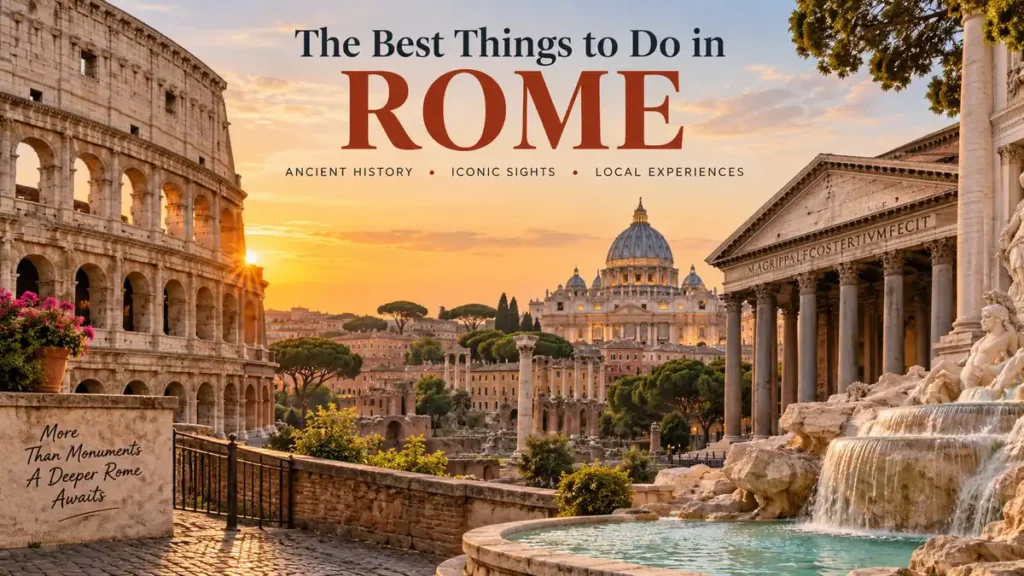
Rome can overwhelm you before you even arrive. The Colosseum, Vatican Museums, Pantheon and Trevi Fountain compete for space on the itinerary, while entire neighborhoods, archaeological sites, churches, markets and parks could fill another week.
The trick isn’t seeing everything. It’s choosing experiences that reveal different sides of the Eternal City.
The best things to do in rome include exploring the Colosseum and Roman Forum, seeing the Pantheon, visiting Vatican City and the Sistine Chapel, walking through Piazza Navona and the Trevi Fountain area, eating traditional Roman dishes in Testaccio, exploring Trastevere, cycling the Appian Way and watching sunset from one of Rome’s panoramic hills.
This guide combines the essential sights with quieter places and practical planning advice, so you can experience Rome rather than spend your entire trip rushing between monuments.
Best Things to Do in Rome for Ancient History
Rome’s historic center can feel like an open-air archaeological museum. Ancient columns emerge beside busy roads, temples survive inside later buildings, and modern neighborhoods sit directly above layers of Roman history.
If you’re visiting for the first time, start with the archaeological core around the Colosseum.
1. Step Inside the Colosseum
Few monuments make Rome’s history feel as immediate as the Colosseum.
Construction of the Flavian Amphitheatre began under Emperor Vespasian in the first century AD, with the arena becoming the setting for gladiatorial contests, animal hunts and other public spectacles.
Don’t treat it as something to photograph from the street and leave.
Walking through the structure helps you understand its scale, engineering and carefully organized seating system. Depending on your ticket, you may also be able to explore areas such as the arena floor or underground spaces.
The archaeological park currently requires a timed reservation for Colosseum entry, with standard ticket sales opening 30 days before the visit. Opening hours vary seasonally, so checking the official schedule shortly before your trip is sensible.
Practical tip: Morning visits usually make it easier to continue directly toward the Roman Forum before the hottest part of the day.
2. Walk Through the Roman Forum
The Roman Forum makes much more sense once you stop seeing it simply as a collection of ruins.
For centuries, this was a political, religious and commercial heart of ancient Rome.
Among its surviving landmarks are temples, basilicas, triumphal arches and the remains of buildings connected with public life in the Roman Empire.
Allow enough time to wander slowly.
Trying to combine the Colosseum, Forum, Palatine Hill, Vatican Museums and central Rome into one frantic sightseeing day is one of the easiest ways to exhaust yourself.
3. Climb Palatine Hill
The Palatine Hill rises above the Roman Forum and Circus Maximus.
According to Roman mythology, this is where Romulus founded Rome. Later, emperors constructed elaborate residences on the hill.
Today, the appeal is partly archaeological and partly visual. The elevated viewpoints help you understand how the Forum, Circus Maximus and surrounding districts fit together.
The Colosseum archaeological park’s current combined visitor information covers the Colosseum, Roman Forum and Palatine area, making these three places natural companions on an itinerary.
4. Enter the Pantheon
The Pantheon is one of those buildings whose interior matters even more than its famous façade.
Its enormous concrete dome and central oculus demonstrate the sophistication of Roman engineering.
Stand beneath the opening and look upward.
Natural light enters through the oculus and moves across the interior as the day progresses. The building’s later conversion into a church helped preserve it when many other ancient structures disappeared.
The artist Raphael is among the notable figures buried inside.
5. See the Baths of Caracalla
Travelers searching for ancient Rome without the same concentration of visitors should consider the Baths of Caracalla.
These monumental public baths once included bathing halls, exercise areas and social spaces.
The towering surviving walls give you a much better sense of Roman scale than photographs do.
They also reveal something the Colosseum doesn’t: what everyday civic and social infrastructure could look like in imperial Rome.
6. Walk or Cycle the Appian Way
Via Appia Antica offers a completely different Roman experience.
Rather than standing inside one monument, you’re following an ancient road through archaeological landscapes, greenery, tombs and ruins.
The Via Appia was one of ancient Rome’s major roads and became known as the Regina Viarum, or “Queen of Roads.” Modern travelers can explore sections on foot or by bicycle.
It is especially worthwhile if you have more than two or three days in the city.
Quick Takeaway: Put the Colosseum, Forum and Palatine Hill together. Save the Pantheon for the historic center, and give the Appian Way its own half-day if your schedule allows.
Things to Do in Rome Around Vatican City
You could spend most of a day around the Vatican without running out of major sights.
The mistake is treating the Vatican Museums, Sistine Chapel, St Peter’s Basilica and St Peter’s Square as one quick stop.
7. Explore the Vatican Museums
The Vatican Museums contain one of the world’s great art collections.
The museum complex includes ancient sculpture, Renaissance paintings, decorated papal rooms, galleries of maps and tapestries, and countless objects collected or commissioned by popes across centuries.
Trying to examine everything is unrealistic.
Instead, identify a few priorities and leave enough energy for the final rooms.
As of 2026, the museums normally open Monday through Saturday from 8:00 a.m. to 8:00 p.m., with final admission at 6:00 p.m. They also open on the last Sunday of each month from 9:00 a.m. to 2:00 p.m., when admission is free, subject to the Vatican’s conditions and calendar.
The Vatican explicitly warns visitors that its official ticket portal is the authorized online source and cautions against look-alike ticketing websites.
8. See Michelangelo’s Sistine Chapel
The Sistine Chapel is part of the Vatican Museums route rather than a separate attraction you simply enter from the street.
Michelangelo’s ceiling and The Last Judgment understandably receive most of the attention, but give yourself time to observe the chapel as a complete space.
The experience can be crowded. Knowing that before arriving helps set realistic expectations.
9. Visit St Peter’s Basilica
St. Peter’s Basilica is monumental even by Roman standards.
Inside you’ll encounter Michelangelo’s Pietà, immense architectural proportions and centuries of papal and Christian history.
Visitors interested in panoramic views can also investigate access to the dome.
Remember that this remains an active place of worship. Appropriate clothing and respectful behavior are expected in Roman churches, and current visitor guidance recommends covering shoulders and legs.
10. Stand in St Peter’s Square
Even if museums aren’t your priority, St. Peter’s Square is worth experiencing.
Gian Lorenzo Bernini’s sweeping colonnades frame the space and create one of Europe’s most recognizable urban compositions.
Walk toward the center and turn around rather than immediately heading for the basilica. The scale becomes much clearer when you see the square as a whole.
Classic Things to Do in Rome’s Historic Center
Central Rome rewards walking.
Many famous landmarks are surprisingly close together, and the streets connecting them often become as memorable as the attractions themselves.
11. Toss a Coin at the Trevi Fountain
The Trevi Fountain is theatrical, crowded and absolutely worth seeing.
Nicola Salvi’s Baroque fountain fills a relatively compact square with an enormous composition centered on Oceanus.
Tradition says tossing a coin into the fountain helps ensure a return to Rome.
You don’t need to take that literally to enjoy the ritual.
For a different atmosphere, walk past during the day and return after dark, when the illuminated stone and moving water transform the square.
12. Spend Time in Piazza Navona
Piazza Navona occupies the footprint of the ancient Stadium of Domitian.
Today it is defined by Baroque architecture and fountains, especially Bernini’s Fountain of the Four Rivers.
Rather than photographing it and moving on, spend a few minutes walking its full length.
That elongated shape is one of the clearest clues to the ancient stadium beneath the modern piazza.
13. Climb the Spanish Steps—But Don’t Sit on Them
Spanish Steps connect Piazza di Spagna with the church of Trinità dei Monti.
The area is especially attractive early in the morning, before the surrounding shopping streets become busy.
One practical rule catches visitors out: sitting on the Spanish Steps is prohibited and can result in a fine.
Walk them, photograph them and enjoy the view instead.
14. See Piazza del Popolo
Piazza del Popolo provides another example of Rome’s ability to make urban space feel monumental.
From here, climb toward the Pincian Terrace for elevated views across rooftops and domes.
It also connects naturally with Villa Borghese, making the square a useful transition between sightseeing and a quieter afternoon in the park.
Best Museums, Churches and Art in Rome
You don’t need to spend every hour outdoors among ruins.
Some of Rome’s greatest treasures are inside museums and churches—and many visitors walk directly past them.
15. Reserve the Borghese Gallery
Galleria Borghese is particularly rewarding for travelers who prefer a concentrated museum experience to enormous collections.
The gallery is associated with extraordinary works by Bernini, Caravaggio, Raphael, Titian and other major artists.
Reservations are important because access is controlled.
The surrounding Villa Borghese park makes it easy to combine art with a relaxed walk afterward. Current Rome museum guides continue to recommend booking the Galleria Borghese ahead.
16. Visit the Capitoline Museums
The Capitoline Museums are among the strongest choices for anyone who wants to understand Roman history through original sculpture and archaeological collections.
They’re located on Capitoline Hill around Piazza del Campidoglio.
The setting itself matters: Michelangelo redesigned the square, and viewpoints around the complex offer memorable perspectives over the Roman Forum.
17. Find Caravaggio Inside Rome’s Churches
Some remarkable art in Rome doesn’t require entering a conventional museum.
Churches across the historic center contain works by major artists, including Caravaggio.
The church of San Luigi dei Francesi, near Piazza Navona, is particularly famous for its paintings connected with St Matthew.
Rome has more than 900 churches, and many contain significant artworks spanning centuries.
This is one reason spontaneous wandering works so well here: an ordinary-looking doorway can lead to an extraordinary interior.
18. Explore Rome’s Contemporary Side at MAXXI
Rome isn’t frozen in antiquity and the Renaissance.
MAXXI—the National Museum of 21st Century Arts—provides a dramatic contrast to the city’s classical monuments.
Located in Flaminio, its contemporary architecture and exhibitions show a side of Rome many first-time itineraries miss.
Flaminio also provides access to cultural venues and less congested residential streets beyond the historical center.
Free Things to Do in Rome and the Best City Views
A trip to Rome doesn’t have to revolve around paid admission.
Some of the city’s most enjoyable experiences—piazzas, parks, fountains, streets and viewpoints—cost nothing.
19. Walk Through Villa Borghese
Villa Borghese covers roughly 80 hectares and offers trails, gardens, museums and recreational spaces in the heart of the city.
It’s useful strategically as well as aesthetically.
After several hours of museums, ruins and traffic, a quiet park gives your brain—and your feet—a break.
Walk toward the Pincian Terrace near sunset for a classic view over central Rome.
20. Watch Sunset from Gianicolo Hill
For a broader panorama, head toward Janiculum Hill, commonly called Gianicolo.
The hill sits above Trastevere and provides wide views across Rome’s skyline.
It’s particularly appealing around sunset, when domes and rooftops catch the evening light. Recent Rome park guides continue to single out Gianicolo for its panoramic views.
Bring water and allow yourself time rather than treating the viewpoint as another checkbox.
21. Look Through the Aventine Keyhole
The Aventine Hill offers one of Rome’s more playful visual experiences.
At the famous keyhole associated with the Priory of the Knights of Malta, visitors can look through a doorway and see the dome of St Peter’s framed in the distance.
Nearby, the Orange Garden—Parco Savello—provides another panoramic viewpoint.
It’s a pleasant combination for travelers who want something unusual without traveling far from central Rome.
22. Wander Without a Destination
This might sound like wasted itinerary time.
In Rome, it isn’t.
Walk through Monti, the lanes around Campo de’ Fiori, the Jewish Ghetto or streets connecting Piazza Navona with the Pantheon.
You’ll encounter small fountains, fragments of ancient architecture, workshops, cafés and churches that would never make a top-ten list.
Some current Rome guides explicitly emphasize that wandering and watching everyday city life can be as rewarding as standing in lines for major attractions.
Quick Takeaway: Leave at least one unscheduled two-hour window. Rome rewards curiosity better than a minute-by-minute itinerary.
Things to Do in Rome for Food and Neighborhood Life
Roman food isn’t an optional extra after sightseeing.
It is part of understanding the city.
Traditional cooking relies on relatively simple ingredients transformed through technique, and different neighborhoods offer distinct dining atmospheres.
23. Explore Trastevere
Trastevere sits across the Tiber from much of the historic center.
Its narrow lanes, ivy-covered buildings, churches, restaurants and evening activity make it one of Rome’s best-known neighborhoods.
Visit during daylight if you want to appreciate the streets and architecture. Return in the evening if you’re interested in restaurants and nightlife.
The neighborhood is hardly a secret, so don’t expect empty cobbled lanes at dinner time.
24. Eat Your Way Through Testaccio
Testaccio provides a deeper look at Roman food traditions.
Its culinary identity is closely connected with the city’s working-class history and quinto quarto cooking.
Look for classic Roman dishes such as:
- Cacio e pepe — pasta, Pecorino Romano and black pepper.
- Carbonara — traditionally prepared with egg, Pecorino Romano, guanciale and black pepper.
- Amatriciana — tomato, guanciale and Pecorino Romano.
- Gricia — essentially the tomato-free relative of amatriciana.
- Saltimbocca alla romana — veal traditionally paired with prosciutto and sage.
- Carciofi alla romana — Roman-style artichokes.
- Supplì — fried rice croquettes, often filled with mozzarella.
Mercato Testaccio is useful for seeing a more everyday side of the city’s food culture.
Food-focused guides also point travelers toward markets in Testaccio and Trionfale rather than treating Roman dining solely as formal restaurant meals.
25. Experience Aperitivo
Aperitivo is less about getting a cheap dinner and more about slowing down before the evening meal.
Order a drink, sit outside when weather allows and watch the city transition from afternoon into night.
Neighborhoods such as Monti, Trastevere and areas around the historic center provide plenty of opportunities.
Don’t rush directly from an afternoon museum into dinner. That hour between sightseeing and eating can become one of the most relaxed parts of a Roman day.
How to Plan the Best Things to Do in Rome
The number of attractions isn’t the biggest planning problem.
Geography and energy are.
Rome involves considerable walking, uneven surfaces, queues and long museum visits. Grouping nearby attractions makes an enormous difference.
| Area | Combine These Sights | Suggested Time |
|---|---|---|
| Ancient Rome | Colosseum, Roman Forum, Palatine Hill | Half to full day |
| Vatican | Vatican Museums, Sistine Chapel, St Peter’s Basilica | Most of a day |
| Historic Center | Pantheon, Trevi Fountain, Piazza Navona, Spanish Steps | Half day |
| Borghese | Galleria Borghese, Villa Borghese, Pincian Terrace | Half day |
| Aventine | Circus Maximus area, Orange Garden, Aventine Keyhole | 2–3 hours |
| Appian Way | Via Appia Antica, archaeological landscape | Half day |
| Trastevere | Streets, churches, dinner, evening walk | Late afternoon/evening |
| Testaccio | Market, neighborhood walk, Roman food | 2–4 hours |
How Many Days Do You Need in Rome?
Three days gives first-time visitors enough time for the principal archaeological sites, Vatican City and the historic center.
Four days is noticeably more comfortable because you can add Villa Borghese, Trastevere or Testaccio without sacrificing the major attractions.
Five days or more lets you slow down and include places such as the Appian Way, Baths of Caracalla, MAXXI or lesser-known neighborhoods.
If you have only one day, prioritize ruthlessly. A recent one-day itinerary from Lonely Planet similarly groups the Colosseum, Palatine and Roman Forum early before moving into other parts of the city.
What Should You Book in Advance?
Reservations matter most for high-demand attractions.
The Colosseum uses timed admission, and official ticket availability currently opens 30 days before the date of the visit.
The Vatican Museums should also be planned ahead when possible. The museum itself warns travelers to use its official ticketing portal rather than similar-looking third-party domains.
Galleria Borghese is another attraction where advance planning is particularly useful.
For everything else, avoid overbooking. You need some flexibility to enjoy Rome properly.
When Is the Best Time to Visit Rome Attractions?
Early mornings work especially well for outdoor landmarks and heavily photographed public spaces.
Trevi Fountain, Piazza Navona and the Spanish Steps feel substantially different before the busiest daytime period.
For archaeological sites, heat matters as much as crowds. In warmer months, carrying water, wearing sun protection and avoiding unnecessary backtracking can make the day far more comfortable.
The Colosseum’s hours also change seasonally. For example, from March 29 through September 30, 2026, the archaeological park lists Colosseum opening at 8:30 a.m., with closing at 7:15 p.m. and last admission at 6:15 p.m. Shorter hours apply later in the year.
Always verify opening times shortly before visiting rather than relying on an old itinerary.
Common Mistakes to Avoid in Rome
Trying to see too much is the biggest one.
Three major archaeological sites, the Vatican Museums, a long restaurant lunch, five piazzas and a sunset viewpoint might technically fit on a map. They won’t necessarily make a good day.
Another mistake is ignoring practical realities.
Pickpocketing can be a concern in crowded tourist areas and on busy public transportation. Recent visitor guidance specifically flags locations such as the Colosseum and Piazza Venezia, as well as Bus 64 toward the Vatican, as places where travelers should remain attentive.
Keep valuables secure and avoid carrying your phone or wallet loosely in an easily accessible pocket.
Dress requirements also matter when entering churches. Shoulders and legs should be appropriately covered.
Finally, don’t assume every attraction needs a guided tour. A knowledgeable guide can transform complicated archaeological sites, but booking guided visits for every stop can make your schedule rigid and expensive.
A Simple First-Time Rome Itinerary
If you have three full days, organize them geographically.
Day one: Begin at the Colosseum, continue through the Roman Forum and Palatine Hill, then walk toward Monti. Later, see the Trevi Fountain after dark.
Day two: Give the morning and early afternoon to the Vatican Museums, Sistine Chapel, St Peter’s Basilica and St Peter’s Square. Cross back toward the historic center and spend the evening around Piazza Navona and the Pantheon.
Day three: Visit Galleria Borghese or the Capitoline Museums, walk through Villa Borghese, see Piazza del Popolo and the Spanish Steps, then finish with dinner in Testaccio or Trastevere.
Have another day?
Use it for the Appian Way, Baths of Caracalla or slower neighborhood exploration.
That extra day often changes the entire character of a Rome trip. Instead of racing between monuments, you begin noticing the city around them.
Are There Enough Free Things to Do in Rome?
Absolutely.
Walking Piazza Navona, seeing the Trevi Fountain, exploring Villa Borghese, wandering Trastevere, climbing to panoramic viewpoints and discovering church interiors can fill a substantial portion of an itinerary without admission charges.
St Peter’s Basilica itself can also be visited without the museum admission ticket, although optional experiences and certain areas may involve fees or separate procedures.
Rome is particularly suited to budget-conscious travelers because so much of its visual appeal exists in public space. Lonely Planet’s 2026 free-attractions guide highlights everything from St Peter’s Basilica and Villa Borghese to the Appian Way among worthwhile no-cost experiences.
What Are the Best Things to Do in Rome Beyond the Tourist Trail?
Once you’ve covered the Colosseum, Vatican and historic center, widen your map.
Walk or cycle the Via Appia Antica. Explore Flaminio and visit MAXXI. Spend an afternoon in Testaccio. Seek out Centrale Montemartini, Villa Torlonia or the Etruscan collections at Villa Giulia.
Rome’s less obvious attractions aren’t necessarily superior to the famous ones—they simply show different layers of the city.
Repeat-visitor guides increasingly point toward areas such as Flaminio and the Appian Way precisely because Rome has far more to offer than its central monuments.
That’s worth remembering even on a first trip.
You don’t need to “finish” Rome.
Making the Most of the things to do in rome
The most memorable things to do in rome aren’t limited to famous monuments. The Colosseum, Roman Forum, Pantheon, Vatican Museums, Sistine Chapel and Trevi Fountain deserve their reputations, but they tell only part of the story.
Walk the Appian Way. Eat cacio e pepe in a neighborhood away from the busiest piazzas. Spend an hour under the trees in Villa Borghese. Watch the skyline from Gianicolo. Step inside a church because its door happens to be open.
Most importantly, leave room between reservations.
Rome has accumulated nearly three millennia of visible history, and even current local guides repeat the idea behind the Roman saying non basta una vita—a lifetime isn’t enough to experience it all.
Your goal isn’t to see everything.
It’s to experience enough of ancient Rome, Vatican art, neighborhood life, Roman food and ordinary street scenes that the city feels like more than a collection of famous photographs.