Melbourne rewards people who explore rather than rush. Turn down an ordinary-looking laneway and you might find elaborate street art, a tiny espresso bar, an independent boutique or a restaurant you would never have noticed from the main street.
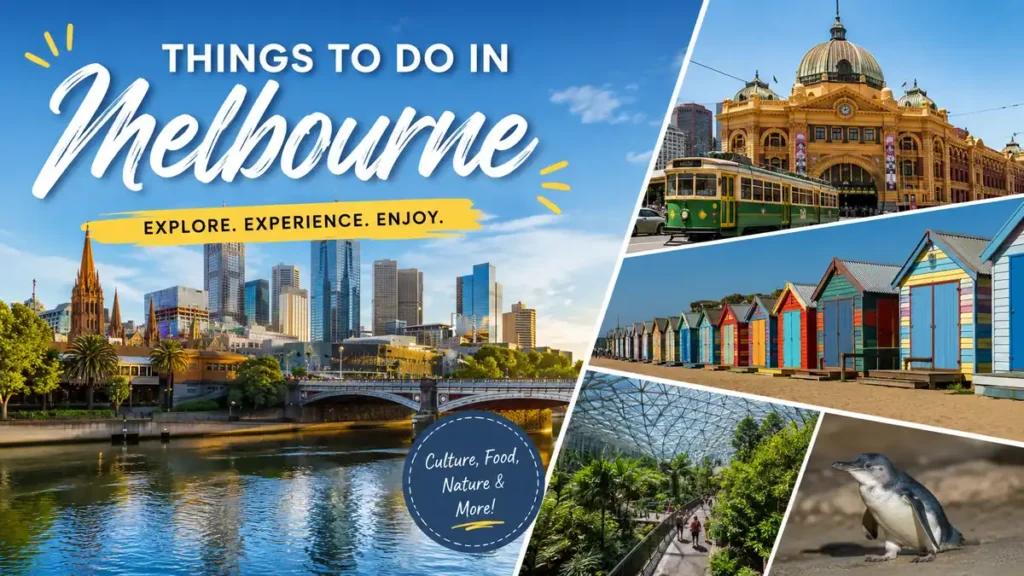
The best things to do in melbourne include exploring the CBD’s laneways, visiting Federation Square and the National Gallery of Victoria, eating at Queen Victoria Market, walking through the Royal Botanic Gardens, experiencing the Melbourne Cricket Ground, discovering neighbourhoods such as Fitzroy and St Kilda, and taking day trips along the Great Ocean Road or to Phillip Island.
Known traditionally as Narrm, Melbourne combines Aboriginal heritage, Victorian-era architecture, contemporary art, multicultural food, coffee culture and an extraordinary enthusiasm for sport. Melbourne stands on the lands of the Kulin Nation, and learning about the city’s First Peoples adds important context to almost everything else you see.
The challenge isn’t finding something interesting. It’s deciding what deserves your limited time.
1. Explore Melbourne’s Famous Laneways
If you want to understand Melbourne quickly, start on foot.
The central business district looks fairly orderly on a map, but its personality often hides between the major streets. Narrow lanes and historic arcades contain cafés, restaurants, boutiques, street art and bars that are easy to walk straight past.
Hosier Lane is the obvious starting point for street art. Its walls change continually, so the experience is less about seeing one permanent masterpiece and more about seeing Melbourne’s living street-art culture.
Then keep wandering.
Other streets and lanes worth incorporating into a CBD walk include:
- AC/DC Lane
- Duckboard Place
- Degraves Street
- Centre Place
- Flinders Lane
- Hardware Lane
- Royal Arcade
- Block Arcade
Don’t treat the laneways as a checklist. Give yourself enough time to follow whatever looks interesting.
Tourism Australia identifies Melbourne’s laneways, street art and hidden cafés as one of the city’s defining experiences.
Start around Federation Square


5
Federation Square makes an excellent orientation point because several major Melbourne attractions sit within easy walking distance.
Across the road is the instantly recognisable Flinders Street Station. Nearby you’ll find Hosier Lane, the Yarra River — also known as Birrarung — St Paul’s Cathedral and several important cultural institutions.
Federation Square itself isn’t simply somewhere to photograph. It hosts galleries, restaurants, cultural programming and public events.
2. Visit the National Gallery of Victoria
Art is one of the strongest reasons to spend time in Melbourne.
The National Gallery of Victoria (NGV) operates major collections and exhibitions across NGV International and The Ian Potter Centre: NGV Australia.
NGV International is the place for European, Asian, Oceanic and American art, while the Ian Potter Centre focuses on Australian Indigenous and non-Indigenous art.
Even travellers who don’t usually plan holidays around galleries may find the NGV worthwhile. It gives you an indoor activity for Melbourne’s unpredictable weather and places major international works alongside Australian cultural perspectives.
Allow at least a couple of hours if art interests you.
3. Discover Screen Culture at ACMI
At Federation Square, ACMI offers something quite different from a conventional museum.
Its subject is screen culture: film, television, videogames and digital art. The museum combines exhibitions, interactive experiences, screenings, workshops and events.
General museum entry is free, although some exhibitions and events require tickets. ACMI is currently open daily from 10am to 5pm, with exceptions on certain public holidays.
It’s particularly useful when you need things to do in melbourne on a rainy day without sacrificing half your itinerary.
4. Eat Your Way Around Queen Victoria Market


6
Few attractions combine Melbourne’s food culture, history and everyday life as naturally as Queen Victoria Market.
The heritage-listed market is the largest open-air market in the Southern Hemisphere and contains hundreds of small businesses. You’ll find fresh produce, specialty cheese, baked goods, cafés, clothing, jewellery, flowers and locally made products.
Come hungry.
Instead of buying souvenirs immediately, walk through the food sections first. The Dairy Hall is particularly worth exploring.
Opening days and trading hours vary, so check the current schedule before building your morning around the market.
Experience Melbourne’s coffee culture
Coffee isn’t merely a caffeine stop here. It’s part of the city’s identity.
Melbourne’s modern café culture developed through decades of immigration, particularly strong Italian influence, before evolving into today’s obsession with espresso, flat whites and specialty roasting.
Rather than searching for one supposedly “best coffee in Melbourne,” try cafés in different neighbourhoods.
The CBD, Carlton, Fitzroy, Collingwood, Richmond and South Melbourne all give you plenty of opportunities.
5. Walk Through the Royal Botanic Gardens
For a quieter morning, head toward the Royal Botanic Gardens Victoria, Melbourne Gardens.
The gardens provide a remarkably peaceful green space close to central Melbourne and consistently appear among the city’s leading attractions.
Walk without a complicated plan. Follow the paths, explore different plant collections and find somewhere to sit.
Combining the gardens with the nearby Shrine of Remembrance creates an easy half-day itinerary.
Visit the Shrine of Remembrance
The Shrine of Remembrance is one of Melbourne’s most significant landmarks, commemorating Australians who have served in war and peacekeeping.
Its visitor centre contains exhibitions and interpretive material.
The elevated location also gives visitors another perspective across Melbourne.
6. Experience the Melbourne Cricket Ground
You don’t need to understand cricket to appreciate the Melbourne Cricket Ground (MCG).
Sport occupies an unusually large place in Melbourne’s cultural identity. Cricket, Australian rules football, tennis and other major competitions regularly draw enormous crowds, and official tourism resources describe sport as one of Melbourne’s defining passions.
Seeing an Australian Football League match at the MCG is particularly memorable if your visit falls during the AFL season.
If there isn’t a game scheduled, a stadium tour can still reveal the scale and history of the venue.
Visit Melbourne Park
Melbourne Park is best known internationally as the home of the Australian Open.
During the tournament, the surrounding precinct becomes one of Melbourne’s liveliest areas. Outside tournament season, sports fans can still combine this district with the MCG, Olympic Park and a walk along the Yarra.
7. Explore Melbourne Museum and Aboriginal Culture
Melbourne Museum works particularly well for families and anyone wanting more context about Victoria.
Displays cover natural history, science, local history and culture, and the museum includes Bunjilaka Aboriginal Cultural Centre, an important place for learning about Aboriginal history and living cultures.
The museum’s collections and experiences also include the famous racehorse Phar Lap and displays exploring Koori heritage.
Allow several hours rather than trying to squeeze it between other attractions.
Visit the Koorie Heritage Trust
For a deeper understanding of First Peoples’ history and contemporary culture, include the Koorie Heritage Trust in your itinerary.
This is especially worthwhile because visitors can otherwise experience Melbourne almost entirely through its colonial and modern history while missing the much older cultural story of the land.
The City of Melbourne acknowledges the Wurundjeri Woi-wurrung and Bunurong/Boon Wurrung peoples of the Kulin as Traditional Owners connected to the area.
8. Walk Along the Yarra River — Birrarung
You don’t need to pay admission to experience one of Melbourne’s most enjoyable spaces.
Walk along the Yarra River (Birrarung) through the city centre. The river connects several major attractions and offers views of Melbourne’s mixture of historic and contemporary architecture.
A useful route runs from Federation Square toward Southbank.
Along the way, you can stop for coffee, visit cultural venues or simply watch the city move around you.
Walking here around sunset gives the skyline a completely different character.
9. Ride Melbourne’s Trams
Melbourne and trams are inseparable.
For visitors, they’re also practical. The Free Tram Zone covers central Melbourne, making it possible to move between many CBD attractions without paying a fare.
The City Circle Tram is another well-known option for sightseeing around central Melbourne; Visit Victoria specifically recommends it as a way to hop between major CBD attractions and lesser-known stops.
One common visitor mistake is assuming every tram journey is free. The free zone only covers a defined central area, so you’ll need the appropriate fare arrangement when travelling beyond it.
Quick takeaway: Walk whenever destinations are close, use trams for longer CBD stretches, and don’t spend half your day moving between attractions unnecessarily.
10. Spend an Afternoon in Fitzroy and Collingwood
Some of Melbourne’s most interesting experiences happen outside the CBD.
Fitzroy and neighbouring Collingwood are excellent places to see the city’s more independent side.
Brunswick Street is associated with cafés, restaurants, bars, vintage shopping and independent retailers, while the surrounding streets reward aimless wandering.
Come in the afternoon and stay into the evening.
This is one area where having no rigid itinerary often works better than jumping between bookmarked attractions.
11. Explore Carlton and Lygon Street
Carlton combines university life, Italian heritage, leafy streets and some of Melbourne’s major cultural institutions.
Lygon Street became closely associated with Melbourne’s Italian community and remains a well-known destination for eating and café culture.
You can combine Carlton with Melbourne Museum and the surrounding Carlton Gardens.
The neighbourhood works particularly well for visitors who want to experience Melbourne beyond landmark sightseeing.
12. Relax at St Kilda


6
When city streets start feeling too busy, head toward St Kilda.
The neighbourhood offers a different version of Melbourne: seaside walks, restaurants, entertainment and views across Port Phillip Bay.
St Kilda Pier is one of the area’s focal points and a popular place for a waterfront walk.
Nearby attractions include St Kilda Beach and Luna Park, whose famous entrance has become part of Melbourne’s visual identity.
Late afternoon is an excellent time to arrive. Explore the neighbourhood, walk toward the water and stay for sunset.
13. Photograph the Brighton Bathing Boxes
Farther around Port Phillip Bay, Brighton Beach is famous for its colourful timber bathing boxes.
There are 82 distinctive boxes lining the beach, creating one of Melbourne’s most recognisable coastal scenes.
They’re photogenic, but don’t expect an isolated beach experience. This is a popular visitor stop.
Come early if photographs matter to you, then continue exploring Melbourne’s bayside neighbourhoods instead of immediately returning to the CBD.
14. Visit Melbourne Zoo
Families looking for things to do in melbourne with kids should consider Melbourne Zoo.
The zoo features more than 250 species across environments inspired by rainforests, bushland and underwater ecosystems. Keeper talks and feeding sessions can add considerably to a visit.
Plan several hours rather than treating it as a quick stop.
For another wildlife experience, Werribee Open Range Zoo offers safari-style encounters with animals including giraffes, zebras, rhinos and cheetahs.
Try Scienceworks with younger children
Scienceworks is another strong family option.
Interactive science experiences include space-related exhibits and the Melbourne Planetarium, making it especially useful when children need something more hands-on than another gallery or historical site.
15. See Melbourne from Above
Melbourne looks dramatically different when you see its grid, river and surrounding suburbs from above.
An observation deck is the straightforward choice, but one of the more unusual experiences is a hot-air balloon flight over Melbourne.
Visit Victoria highlights hot-air ballooning over the city among the state’s notable experiences.
It’s expensive compared with walking through the CBD, but sunrise views over a major city are unusual enough to make it a genuine special-occasion experience.
16. Discover Old Melbourne Gaol
For darker history, visit Old Melbourne Gaol.
The former prison held some of Victoria’s most notorious prisoners, including bushranger Ned Kelly. Today, visitors can explore the site and learn about crime, punishment and prison life in colonial Melbourne.
It offers useful historical context that contrasts sharply with Melbourne’s polished contemporary image.
17. Find Free Things to Do in Melbourne
You can experience a surprising amount of Melbourne without spending much.
Good free things to do in melbourne include:
- Exploring Hosier Lane and other street-art areas.
- Walking around Federation Square.
- Visiting free permanent gallery collections where available.
- Walking along the Yarra River.
- Relaxing in public parks and gardens.
- Exploring Carlton, Fitzroy and Collingwood on foot.
- Riding trams within the Free Tram Zone.
- Walking around St Kilda and Port Phillip Bay.
- Exploring Melbourne’s historic arcades.
- Checking the city’s current calendar for free exhibitions and public events.
Melbourne’s official What’s On service maintains a dedicated selection of free events, exhibitions and family activities, so it’s worth checking what coincides with your dates.
18. Experience Melbourne After Dark
Melbourne doesn’t become quiet when galleries close.
The city has a substantial theatre, live-music, comedy and bar scene, ranging from large productions to performances in surprisingly small venues.
Rather than travelling across the entire city for nightlife, pick one district.
The CBD works for theatre and hidden bars. Fitzroy and Collingwood suit live music and casual venues, while Southbank offers restaurants and riverfront evenings.
Current city guides regularly highlight theatre, cabaret, comedy, clubs and cultural events among Melbourne’s evening activities.
19. Take a Great Ocean Road Day Trip


6
Once you’ve experienced central Melbourne, some of Victoria’s most memorable landscapes are within day-trip range.
The Great Ocean Road is the most famous.
The route combines coastal scenery, beaches, forest and dramatic rock formations, with the Twelve Apostles providing the best-known landmark.
It can technically be visited in a day from Melbourne, but don’t underestimate the distances involved.
If you’re driving yourself, an overnight trip is more relaxed. If you only have one day, start early and avoid trying to stop at absolutely everything.
Tourism Australia includes the Great Ocean Road among Melbourne’s signature day-trip experiences.
20. Watch Penguins on Phillip Island
Phillip Island offers one of Victoria’s most distinctive wildlife experiences.
At the Penguin Parade, little penguins return from the sea toward their burrows, providing visitors with an opportunity to observe native wildlife in a managed setting.
The island offers more than penguins, so a full-day itinerary works better than driving there solely for the evening parade.
Because the main wildlife activity happens later in the day, plan your return to Melbourne accordingly.
21. Spend a Day in the Yarra Valley
Wine country sits surprisingly close to the city.
The Yarra Valley is known for vineyards, cellar doors, food and rolling countryside. It provides a slower alternative to the coastal drama of the Great Ocean Road.
You don’t have to be deeply interested in wine to enjoy the region. Food, scenery and small towns can easily fill the day.
Tourism Australia identifies the Yarra Valley as one of the major day trips from Melbourne.
22. Visit the Mornington Peninsula
Another easy escape from urban Melbourne is the Mornington Peninsula.
Beaches, coastal scenery, small towns, food producers and wineries make it flexible enough for different kinds of travellers.
It’s particularly good if your Melbourne itinerary already contains plenty of museums and city walking and you want a day outdoors.
Allow a full day rather than squeezing it into a free afternoon.
23. Experience Melbourne’s Major Events
Melbourne’s calendar can completely change the character of a trip.
Major sporting events include the Australian Open, Australian rules football fixtures and the Melbourne Cup, while festivals, exhibitions, theatre seasons and concerts run throughout the year.
The City of Melbourne describes major events as a central part of the city’s annual entertainment calendar.
Check what’s happening before finalising your itinerary.
Even if you aren’t attending an event, knowing the dates matters because major fixtures can affect crowds, transport and accommodation demand.
24. Know What to Do When It Rains
Melbourne’s weather has a reputation for changing quickly, so build flexibility into your plans.
Good rainy-day choices include:
- NGV International
- ACMI
- Melbourne Museum
- Bunjilaka Aboriginal Cultural Centre
- Queen Victoria Market’s covered sections
- Scienceworks
- Old Melbourne Gaol
- Theatre and cinema
- Melbourne’s cafés and historic arcades
The city’s official What’s On guide specifically recommends museums, workshops and indoor entertainment for wet-weather days.
Keep one indoor activity unassigned when planning each day. Then you can move it around when the forecast changes rather than losing valuable sightseeing time.
25. Build a Melbourne Itinerary That Actually Works
Trying to visit every famous attraction usually produces a worse trip.
Melbourne works best when you group places geographically.
If you have one day in Melbourne
Start around Federation Square and Flinders Street Station.
Walk through Hosier Lane, explore the CBD laneways, stop for coffee and continue toward Queen Victoria Market. Spend the afternoon at the NGV or Royal Botanic Gardens, then walk along the Yarra around sunset.
Visit Victoria similarly recommends combining coffee, CBD wandering and the City Circle Tram when exploring Melbourne in a single day.
If you have three days
Day 1: CBD laneways, Federation Square, ACMI, NGV and the Yarra River.
Day 2: Queen Victoria Market, Melbourne Museum, Carlton, Fitzroy and Collingwood.
Day 3: Royal Botanic Gardens and the MCG, followed by St Kilda and sunset around Port Phillip Bay.
If you have five days
Use the three-day itinerary above, then dedicate one day to the Great Ocean Road and another to Phillip Island, the Yarra Valley or Mornington Peninsula.
That balance gives you time to experience both Melbourne itself and the landscapes surrounding it.
Practical Tips for Visiting Melbourne
Melbourne is relatively straightforward to explore, but a few decisions can save significant time.
Stay somewhere with good public transport
You don’t necessarily need accommodation directly beside Federation Square. What matters more is easy access to trains or trams.
The CBD is convenient for first-time visitors, while areas such as Carlton, Fitzroy and Southbank can work well depending on the type of trip you want.
Walk more than you think
Central Melbourne is particularly rewarding on foot.
Walking exposes the details that disappear when you’re constantly jumping between transport stops: architecture, street art, cafés, arcades and small shops.
Don’t rent a car just for central Melbourne
A car can become more burden than benefit in the CBD.
Melbourne is accessible by tram, train, bus, bicycle and other transport options.
A vehicle becomes more useful when your itinerary expands into regional Victoria.
Leave room for spontaneous discoveries
This might be the most useful Melbourne tip.
Reserve your essential attractions, but don’t schedule every hour. Some of the city’s strongest experiences are difficult to plan: a tiny café, an interesting exhibition, a laneway you hadn’t noticed or a neighbourhood restaurant that catches your attention.
What Are the Best things to do in melbourne for First-Time Visitors?
For a first visit, prioritise Melbourne’s laneways, Federation Square, the NGV, Queen Victoria Market, Royal Botanic Gardens, the Yarra River, the MCG and one neighbourhood beyond the CBD such as Fitzroy, Carlton or St Kilda.
Then add a Great Ocean Road, Phillip Island or Yarra Valley day trip if you have enough time.
That combination captures what makes Melbourne distinctive: art, Aboriginal and colonial history, food, coffee, sport, green spaces, neighbourhood culture and access to some of Victoria’s most impressive landscapes.
The real appeal of the things to do in melbourne isn’t a single blockbuster landmark. It’s how easily completely different experiences fit into the same day — coffee in a hidden laneway, world-class art before lunch, an AFL match in the afternoon and a walk beside Port Phillip Bay at sunset.