Los Angeles can feel less like one city and more like dozens of destinations stitched together by freeways, boulevards, mountains, and coastline. The key to enjoying it is not trying to see everything. Choose a few neighboring areas each day, leave room for traffic, and experience LA neighborhood by neighborhood.
The best things to do in la include watching the sunset from Griffith Observatory, exploring world-class museums, walking from Santa Monica to Venice, experiencing Hollywood’s film culture, eating across the city’s diverse neighborhoods, and hiking in the Santa Monica Mountains. First-time visitors should allow at least three full days and group attractions geographically.
Best things to do in la for first-time visitors
These essential experiences reveal different sides of Los Angeles: its natural landscape, entertainment history, art, architecture, beaches, and food culture.
1. See the city from Griffith Observatory
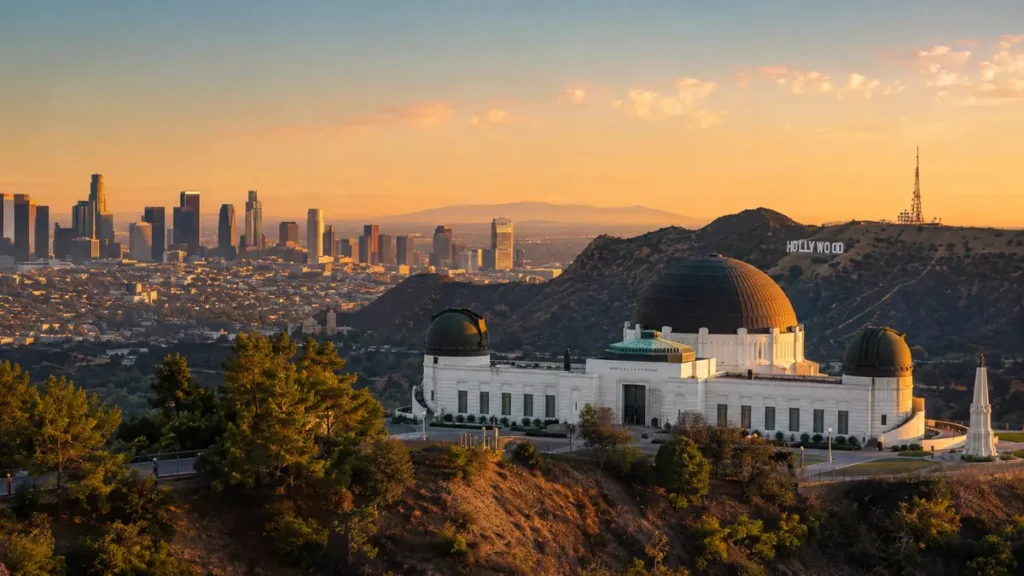
Griffith Observatory delivers one of the most complete Los Angeles experiences in a single stop. From its terraces, you can see Downtown LA, the Los Angeles Basin, surrounding mountains, and the Hollywood Sign.
Inside, astronomy exhibits explain everything from planetary motion to the physics of light. The building and most exhibits are free, while shows in the Samuel Oschin Planetarium require paid tickets.
Arrive before sunset if possible. Daylight provides clearer views of the landscape, golden hour transforms the skyline, and nighttime brings the city lights into view. Parking near the observatory can be expensive and limited, so consider the DASH Observatory shuttle from the Vermont/Sunset Metro station.
Griffith Observatory is generally closed on Mondays. Hours, planetarium schedules, parking rules, and telescope access can change, so confirm them before visiting.
2. Hike through Griffith Park
At more than 4,000 acres, Griffith Park is one of the largest urban parks in the United States. It contains hiking trails, picnic areas, the Los Angeles Zoo, the Autry Museum of the American West, and several famous viewpoints.
The West Observatory Trail is a manageable option for visitors who want exercise without committing to a long backcountry hike. More ambitious walkers can explore trails around Mount Hollywood or approach viewpoints near the Hollywood Sign.
Bring water, sun protection, and shoes with reliable grip. Trails can feel much hotter than the reported temperature because shade is limited. During periods of extreme heat, poor air quality, or elevated fire risk, choose an indoor activity instead.
3. Walk the Santa Monica Pier and beach
Santa Monica combines a broad sandy beach with a walkable downtown and an old-fashioned oceanfront amusement pier. Pacific Park’s Ferris wheel, arcade games, street performers, fishing platforms, and ocean views make the pier especially lively around sunset.
The historic end-of-route marker for Route 66 is another popular photo stop. For a quieter experience, walk south along the beach path or north through Palisades Park, which follows the bluff above the Pacific Ocean.
Santa Monica is reachable on Metro’s E Line, making it one of the easiest coastal destinations to visit without a car.
4. Explore the Venice Beach Boardwalk
Venice Beach is louder, stranger, and less polished than Santa Monica—and that is precisely its appeal. The Ocean Front Walk brings together street performers, vendors, murals, skateboarders, musicians, and people from almost every imaginable subculture.
Watch experienced skaters at the Venice Skatepark, see the outdoor training area associated with Muscle Beach, and wander toward the Venice Canals for a calmer view of the neighborhood. Abbot Kinney Boulevard offers boutiques, cafés, and restaurants away from the boardwalk crowds.
Santa Monica and Venice work well as a single coastal day. The beachfront path between them is roughly three miles, and you can walk or cycle rather than moving your car.
5. Visit the Getty Center
The Getty Center pairs European art with modern architecture, landscaped gardens, and panoramic views of Los Angeles. Its collection spans medieval manuscripts, decorative arts, sculpture, drawings, and paintings by artists including Vincent van Gogh, Claude Monet, and Rembrandt.
The Central Garden is as memorable as the galleries. Architect Richard Meier’s hilltop campus also rewards visitors who are more interested in design and photography than traditional art.
Admission is free, although timed reservations may be required and parking costs extra. Allow at least three hours. Trying to squeeze the Getty Center into a packed sightseeing day usually means missing the gardens, architecture, and changing exhibitions.
Travelers planning far ahead should verify operating status: the Getty Center has announced a major closure beginning in March 2027, with reopening expected before the 2028 Olympic and Paralympic Games.
6. Experience Hollywood Boulevard selectively
The Hollywood Walk of Fame stretches for more than a mile, so there is little benefit in walking its entire length. Focus on the area around Hollywood and Highland, where you will find the TCL Chinese Theatre, the Dolby Theatre, and clusters of well-known stars.
The handprints, footprints, and signatures in the TCL Chinese Theatre forecourt are often more interesting than the Walk of Fame itself. A theater tour can add context about Hollywood premieres and movie-palace architecture.
Expect crowds, souvenir stores, costumed characters, and aggressive sales pitches. Photographing a street performer may lead to a request for payment. Hollywood Boulevard is worth seeing once, but most visitors need only one or two hours unless they are attending a show or taking a studio tour.
7. Tour a working movie studio
A studio tour shows how Los Angeles became synonymous with film and television. Warner Bros. Studio Tour Hollywood focuses on production history, soundstages, backlots, costumes, props, and recognizable filming locations.
Universal Studios Hollywood blends filmmaking exhibits with a theme park. Its Studio Tour passes working production areas and large-scale effects sets, while the rest of the park offers rides and entertainment based on popular franchises.
Paramount Pictures also operates tours of its historic Hollywood lot. Tour routes and accessible sets depend on active productions, so no two visits are guaranteed to be identical.
Choose Warner Bros. or Paramount for a production-focused experience. Choose Universal Studios when rides and full-day family entertainment are the priority.
Free things to do in la
Los Angeles can be expensive, but many defining experiences cost nothing. Parking, special exhibitions, tours, and reservations may still carry fees.
8. Browse contemporary art at The Broad
The Broad in Downtown LA houses a major postwar and contemporary art collection featuring artists such as Jean-Michel Basquiat, Andy Warhol, Roy Lichtenstein, Kara Walker, and Jeff Koons.
General admission is free, but advance timed tickets are useful during busy periods. Yayoi Kusama’s Infinity Mirror Rooms may use a separate reservation or timed-entry system.
Across the street, Walt Disney Concert Hall provides a striking contrast in architecture. Its stainless-steel exterior, designed by Frank Gehry, is worth viewing even if you are not attending a Los Angeles Philharmonic performance.
9. Explore Grand Central Market
Grand Central Market has served Downtown Los Angeles since 1917. Its food stalls reflect the city’s changing population through tacos, pupusas, noodles, breakfast sandwiches, seafood, pastries, and other specialties.
It works best as a flexible lunch stop rather than a formal restaurant destination. Members of a group can order from different vendors and meet at a shared table.
After eating, cross the street to ride Angels Flight, the short orange funicular linking Hill Street with California Plaza. The nearby Bradbury Building is known for its skylit Victorian interior, although public access may be limited to the ground floor.
10. Walk through historic Downtown Los Angeles
Downtown LA rewards visitors who explore individual districts instead of treating it as one attraction. El Pueblo de Los Angeles Historical Monument and Olvera Street introduce the area’s early civic history near Union Station.
Little Tokyo offers Japanese American history, restaurants, bakeries, shops, and the Japanese American National Museum. The Arts District combines converted industrial buildings with galleries, murals, coffee shops, and breweries.
The Los Angeles Central Library, Grand Park, City Hall, and the Broadway Theatre District provide additional architecture and public spaces. Conditions can change considerably from block to block, so plan a clear route and stay aware of your surroundings.
11. See outdoor art at LACMA and Hancock Park
Chris Burden’s Urban Light, an installation of restored streetlamps outside the Los Angeles County Museum of Art, has become one of the city’s most photographed artworks. It is accessible without entering the museum and looks particularly atmospheric after dark.
Nearby Hancock Park contains the outdoor features of the La Brea Tar Pits, an active Ice Age fossil site in the middle of the city. The museum building closed in July 2026 for a planned two-year renovation, but selected outdoor areas, excavation sites, and guided experiences remain available.
Because construction can affect pathways and access, check the current status before building an entire day around the Tar Pits.
12. Wander through colorful neighborhoods
Some of LA’s most rewarding experiences are ordinary neighborhood walks:
- Los Feliz: Independent businesses, vintage architecture, cafés, and easy access to Griffith Park.
- Silver Lake: Reservoir views, hillside streets, boutiques, and a strong coffee culture.
- Echo Park: A lake, historic homes, music venues, and streets that reveal the city’s layered development.
- Koreatown: Korean barbecue, bakeries, nightlife, spas, and late-night dining.
- Leimert Park: A center of Black arts, music, commerce, and cultural life.
- Boyle Heights: Murals, Mariachi Plaza, family-run restaurants, and deep Mexican American history.
- San Pedro: Harbor views, maritime history, local seafood, and the Korean Bell of Friendship.
These areas are not theme parks. Visit respectfully, support local businesses, and remember that residential streets are people’s homes.
Los Angeles museums and cultural attractions
The city’s museums cover art, science, automobiles, cinema, local history, and ancient civilizations.
13. Discover film history at the Academy Museum
The Academy Museum of Motion Pictures examines filmmaking through costumes, cameras, storyboards, production design, animation, sound, performance, and visual effects.
Its exhibitions are valuable because they treat film as both art and collaborative labor. The museum also operates theaters that screen restorations, retrospectives, international cinema, and special-format presentations.
Allow two to three hours for the galleries, longer if you add a screening. The museum sits on Museum Row near LACMA, the Petersen Automotive Museum, and the La Brea Tar Pits, making the area suitable for a full cultural day.
14. Tour the Petersen Automotive Museum
The Petersen Automotive Museum is immediately recognizable by its red-and-silver exterior. Inside, exhibitions cover automotive engineering, racing, design, cinema vehicles, motorcycles, and the cultural influence of the automobile.
Car enthusiasts should investigate the Vault tour, which provides access to additional vehicles stored below the main galleries. It typically requires a separate ticket and takes extra time.
Even visitors with only a casual interest in cars can appreciate the design and entertainment-history collections.
15. Spend a day at Exposition Park
Exposition Park brings several major attractions together near Metro’s E Line:
- The Natural History Museum of Los Angeles County
- California Science Center
- California African American Museum
- Exposition Park Rose Garden
- Los Angeles Memorial Coliseum
The California Science Center’s permanent galleries are generally free, though special exhibitions and IMAX presentations may require tickets. Its space-shuttle display is undergoing a major transformation around the future Samuel Oschin Air and Space Center, so verify which exhibits are open.
Families can easily spend a full day in this district without returning to the car between attractions.
16. Visit the Getty Villa
The Getty Villa in Pacific Palisades focuses on the art and cultures of ancient Greece, Rome, and Etruria. Modeled after a Roman country house, it includes colonnaded courtyards, gardens, fountains, mosaics, and galleries filled with antiquities.
Admission is free, but timed entry is generally required and parking is paid. Its location makes it a natural partner for a Malibu drive rather than a same-day visit to the Getty Center.
Check current road and access conditions before traveling through the Pacific Palisades and Malibu area, particularly after severe weather or wildfire-related disruptions.
17. Explore The Huntington
The Huntington Library, Art Museum, and Botanical Gardens sits in San Marino, northeast of central Los Angeles. Its extensive grounds include Chinese, Japanese, desert, rose, subtropical, and Australian gardens.
Inside, collections encompass rare books, manuscripts, European art, and American art. The scale is easy to underestimate; serious garden lovers can spend most of a day here.
Summer afternoons can be intensely hot. Arriving early makes the outdoor areas more comfortable and leaves the galleries for later in the day.
Outdoor and coastal experiences
LA’s mountains and ocean are not merely scenery. They are central to how the city lives.
18. Watch sunset from El Matador State Beach
El Matador, part of Robert H. Meyer Memorial State Beach in Malibu, is known for sea stacks, caves, cliffs, and narrow strips of sand. It is one of the most dramatic sunset locations near Los Angeles.
Access involves a steep trail and stairs, which may not suit every visitor. High tide can reduce the usable beach, while waves may enter caves unexpectedly. Check tide and weather conditions, and never turn your back on the ocean.
For easier facilities and broader sand, consider Zuma Beach or Will Rogers State Beach.
19. Hike Runyon Canyon
Runyon Canyon is popular because it is close to Hollywood and offers quick access to city views. Some routes are steep, exposed, and busier than first-time visitors expect.
Go early, carry water, and do not treat it as a casual midday stroll during hot weather. Limited shade and dusty slopes can make even a short hike tiring.
Travelers primarily interested in scenery may prefer Griffith Park. Runyon is better for a compact workout and a glimpse of local fitness culture.
20. Drive through Malibu and the Santa Monica Mountains
A drive along Pacific Coast Highway can include Malibu Pier, Surfrider Beach, coastal viewpoints, and trailheads leading into the Santa Monica Mountains.
Do not attempt to cover every stop in one afternoon. Coastal traffic can be slow, and parking rules are strictly enforced. Select one beach, one walk, and one meal rather than spending the day searching for parking.
Road closures, landslides, wildfire recovery work, and construction can affect Malibu routes. Check official conditions on the day of travel rather than relying on an old itinerary.
21. Relax at Echo Park Lake
Echo Park Lake offers skyline views, lotus beds, walking paths, lawns, and pedal boats. It is a gentler alternative to LA’s larger attractions and works well between Downtown and neighborhoods such as Silver Lake.
The loop is short enough for an easy walk. Visit in daylight, combine it with a nearby meal, and avoid leaving visible belongings inside a parked vehicle.
Food experiences worth building into your itinerary
Los Angeles is one of the world’s great eating cities because its strongest food traditions are spread across communities rather than concentrated in one tourist district.
22. Follow a taco trail
There is no single “best taco” that represents Los Angeles. The city offers regional Mexican styles including tacos al pastor, birria, carnitas, barbacoa, seafood, and carne asada.
Food trucks and street stands can be as significant as established restaurants. Look for busy operations with fast ingredient turnover, visible pricing, and a steady local customer base.
Neighborhoods such as Boyle Heights, East Los Angeles, South LA, Highland Park, and the San Fernando Valley all have respected options. Bring a payment card, but keep some cash because smaller vendors may not accept every digital method.
23. Eat through Koreatown
Koreatown is one of LA’s best districts for an evening meal. Korean barbecue may be its most famous experience, but the neighborhood also offers tofu stews, noodles, fried chicken, dumplings, bakeries, cafés, and late-night restaurants.
Parking can be difficult and valet service is common. Metro’s D Line and rideshare services may be simpler, especially if your group plans to drink.
At Korean barbecue restaurants, confirm whether the menu is à la carte or all-you-can-eat. The latter can involve time limits and rules about unfinished food.
24. Explore the San Gabriel Valley
The San Gabriel Valley, east of central Los Angeles, is essential for understanding the region’s Chinese and broader Asian food culture. Monterey Park, Alhambra, San Gabriel, and Rosemead offer dim sum, regional Chinese cooking, Taiwanese food, Vietnamese dishes, desserts, and tea shops.
This area is geographically separate from Hollywood and the beaches. Treat it as a dedicated meal excursion or combine it with The Huntington rather than crossing the city during rush hour.
25. Visit a farmers market
The Original Farmers Market at Third and Fairfax is a historic collection of permanent food stalls and shops beside The Grove. It is convenient for visitors exploring Museum Row, West Hollywood, or Beverly Hills.
For a more local, produce-centered experience, consider certified markets in Hollywood, Santa Monica, or other neighborhoods. Days and operating hours vary, and some markets close streets temporarily.
Things to do in la with kids
Families should prioritize attractions that combine movement with hands-on learning. The California Science Center, Natural History Museum, Griffith Observatory, Santa Monica Pier, Los Angeles Zoo, and Universal Studios Hollywood are reliable choices for different age groups.
A balanced family day might include one museum before lunch and an outdoor destination afterward. Avoid stacking several large institutions together simply because they appear close on a map.
For younger children, leave space for meals, traffic delays, and downtime. A drive that looks short can take much longer during commuting hours, and crossing the city twice in one day can exhaust everyone.
How to plan a Los Angeles itinerary
Geography matters more in LA than the number of attractions on your list. Organize each day around one part of the city.
| Area | Attractions that work well together |
|---|---|
| Hollywood and Griffith Park | Walk of Fame, studio tour, Griffith Observatory |
| Westside | Getty Center, Santa Monica, Venice Beach |
| Downtown LA | The Broad, Grand Central Market, Angels Flight, Little Tokyo |
| Museum Row | Academy Museum, Petersen Museum, LACMA, Hancock Park |
| Exposition Park | Natural History Museum, Science Center, Rose Garden |
| Malibu | Getty Villa, Malibu Pier, beach, coastal viewpoints |
A practical three-day itinerary
Day 1: Hollywood and Griffith Park
Start with a studio tour or a focused visit to Hollywood Boulevard. Have lunch in Los Feliz or Thai Town, then visit Griffith Observatory in the late afternoon and stay for sunset.
Day 2: Downtown and Museum Row
Begin at The Broad, walk past Walt Disney Concert Hall, and eat at Grand Central Market. Spend the afternoon at the Academy Museum or Petersen Automotive Museum before seeing Urban Light after sunset.
Day 3: Santa Monica and Venice
Take the E Line or drive to Santa Monica in the morning. Explore the pier and beach, follow the coastal path toward Venice, visit the canals, and return to the shore for sunset.
With four or five days, add the Getty Center, The Huntington, Exposition Park, Malibu, or a San Gabriel Valley food excursion.
Getting around Los Angeles
A rental car provides flexibility for Malibu, the Getty Center, the San Gabriel Valley, and scattered trailheads. It also brings parking costs, traffic, and the risk of wasting time moving between distant districts.
Metro rail is useful for Downtown, Hollywood, Koreatown, Santa Monica, Universal City, and Exposition Park. Buses and local DASH routes fill many gaps. Use the official LA Metro app or Trip Planner for live arrivals, routes, and service alerts.
TAP cards and supported digital payment options simplify fares. Check current prices and fare-capping policies before traveling because transit rules can change.
Rideshare works well for evenings or one-way neighborhood trips, but surge pricing can become expensive after concerts, sporting events, and theme-park closing times.
Never judge distance by mileage alone. A 12-mile trip can take less than half an hour or well over an hour depending on the route and time of day. Avoid long cross-city drives during weekday morning and afternoon peaks whenever possible.
Practical tips for a better LA visit
- Reserve popular museums, studio tours, theme parks, and special exhibitions in advance.
- Confirm official hours on the day of your visit; many museums close on Mondays or Tuesdays.
- Carry layers because beach temperatures can feel much cooler than inland neighborhoods.
- Use sunscreen and bring water for any hike, even when the route appears short.
- Do not leave luggage, electronics, passports, or shopping bags visible in a parked car.
- Read parking signs carefully; restrictions may change by time, day, and street-cleaning schedule.
- Check air-quality, fire-weather, tide, and trail alerts before outdoor activities.
- Allow extra travel time before timed tickets, performances, and airport departures.
- Ask permission before photographing vendors or performers at close range.
- Choose restaurants and shops in the neighborhoods you visit rather than eating only in tourist zones.
Los Angeles becomes far more enjoyable once you stop treating it as a checklist. The most memorable things to do in la combine one major landmark with time to walk, eat, and notice the character of the surrounding neighborhood. Pick one area for your first day, confirm current access details, and let the city unfold at a realistic pace.