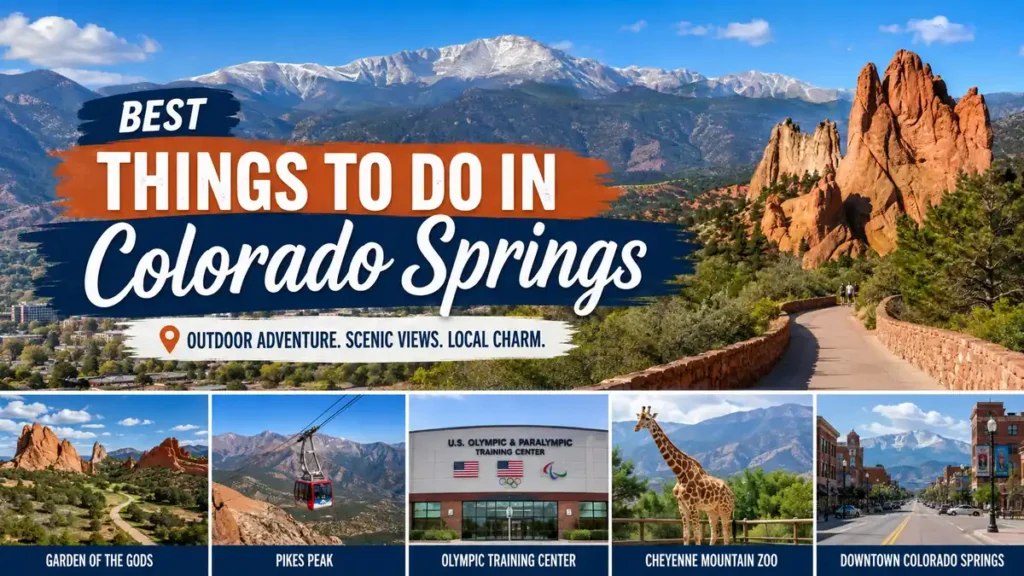
Colorado Springs is the kind of place where you can walk among towering red-rock formations in the morning, stand above 14,000 feet in the afternoon, and finish the day exploring a lively downtown. The challenge isn’t finding something worthwhile to do. It’s deciding what deserves your limited vacation time.
If you’re searching for the best things to do in colorado springs, start with Garden of the Gods and Pikes Peak, then add experiences that match your interests: the Cheyenne Mountain Zoo for families, the Manitou Incline for serious hikers, Seven Falls for scenery, and the U.S. Olympic & Paralympic Museum for an excellent indoor attraction.
Colorado Springs sits at the eastern foot of the Rocky Mountains and serves as the gateway to the wider Pikes Peak Region. The area combines mountain scenery, unusual geology, hiking, aviation and Olympic history, wildlife attractions, historic neighborhoods, and easy day trips. The official tourism organization lists more than 55 attractions across the region.
Here are the experiences most worth building into your trip.
1. Explore Garden of the Gods
For a first trip, Garden of the Gods belongs at the top of the list.
Massive red sandstone formations rise dramatically against Pikes Peak and the surrounding Front Range, creating one of Colorado Springs’ most recognizable landscapes. The park contains both paved and natural-surface trails, making it accessible to casual sightseers as well as hikers.
Garden of the Gods is free to enter, as is its Visitor & Nature Center. The park opens early year-round, which makes sunrise an especially rewarding time to visit before the busiest part of the day.
The Central Garden area is the easiest introduction. From there, look for formations such as Balanced Rock, Kissing Camels, Steamboat Rock, and Siamese Twins.
Rock climbing is also permitted in designated areas, although climbers must follow the park’s registration and safety requirements.
Quick takeaway: If you have only a few hours in Colorado Springs, prioritize Garden of the Gods. It combines scenery, hiking, photography, geology, and easy access without an admission fee.
2. Reach the Summit of Pikes Peak
Pikes Peak — America’s Mountain — rises to 14,115 feet and dominates the western skyline.
The mountain is closely associated with Katharine Lee Bates and the inspiration for “America the Beautiful.” More importantly for modern visitors, reaching the summit is surprisingly accessible compared with many Colorado fourteeners.
There are several ways to experience it.
Ride the Pikes Peak Cog Railway
The scenic cog railway from Manitou Springs is one of the classic choices for travelers who want the summit experience without driving or completing a strenuous hike.
You get mountain views throughout the journey while avoiding the concentration required for driving a steep mountain highway.
Drive the Pikes Peak Highway
Driving gives you more control over your schedule and allows stops at viewpoints along the route.
Mountain weather can change rapidly, however. Check current road and summit conditions before leaving, even when conditions in Colorado Springs appear warm and sunny.
Hike to the summit
Experienced hikers can reach the summit via Barr Trail. This is a serious high-altitude undertaking rather than a casual tourist walk, so prepare appropriately for distance, elevation gain, weather changes, and the return journey.
Whatever route you choose, bring layers. Conditions at 14,115 feet can be dramatically different from those in the city below.
3. Visit Cheyenne Mountain Zoo
Families wondering what to do in Colorado Springs with kids should put Cheyenne Mountain Zoo high on their list.
Built into the slopes of Cheyenne Mountain, it combines animal exhibits with sweeping views over Colorado Springs. One of its signature experiences is the giraffe area, where visitors can get remarkably close to the animals.
The elevation and hillside layout make the zoo feel different from a conventional flat urban zoo.
Advance timed tickets are currently required for visitors, so this is one attraction you should plan rather than treating as a spontaneous stop.
Allow at least half a day if you’re traveling with children. The slopes also mean you’ll do more walking than you might expect.
4. Discover The Broadmoor Seven Falls
Seven Falls brings waterfalls, canyon scenery, stairs, hiking, and history together in one outing.
The attraction sits within a steep 1,250-foot-walled box canyon. Seven separate cascades tumble through the canyon, while a staircase of 224 steps provides access toward the upper section and connecting trails.
Visitors who don’t want to tackle the full staircase can still enjoy canyon views and use the elevator to reach the Eagle’s Nest observation platform.
A typical visit lasts roughly two to two-and-a-half hours, with extra time needed if you hike above the falls. Visitors park at the designated parking area and use complimentary shuttle transportation rather than driving directly to the falls.
It’s particularly appealing if you want mountain scenery without committing to a long wilderness hike.
5. Challenge Yourself on the Manitou Incline
The Manitou Incline is not a normal hiking trail.
It climbs approximately 2,000 vertical feet in less than a mile using 2,768 steps constructed along the route of a former cable railway.
That makes it one of the most physically demanding popular outdoor activities in the Colorado Springs area.
Free online reservations and a signed waiver are required. The city specifically recommends the trail for physically active visitors who are prepared for the altitude and intensity.
Bring plenty of water, start early, and watch the weather. Summer thunderstorms and lightning can develop quickly.
Visitors arriving directly from low elevations may be better off saving the Incline until later in their trip, after they’ve had time to acclimatize.
For most recreational hikers, this is a fitness challenge first and a sightseeing walk second.
6. Hike Red Rock Canyon Open Space
Want red-rock scenery with fewer visitors?
Red Rock Canyon Open Space is one of the best alternatives to Garden of the Gods. Its trail system passes sandstone formations, old quarry areas, ridges, and open landscapes just west of central Colorado Springs.
The area supports hiking, mountain biking, horseback riding, and permitted rock climbing. There are also designated off-leash dog areas and connections to longer routes including Section 16 and the Intemann Trail.
Try the Contemplative Trail or Mesa/Greenlee loop for a relatively approachable outing.
The big advantage here is flexibility. You can take a short walk or link several trails together for a much longer hike.
7. Experience Olympic City USA
Colorado Springs has an identity you won’t find in most American mountain destinations: Olympic City USA.
The city is home to both the U.S. Olympic & Paralympic Museum and the U.S. Olympic & Paralympic Training Center, making Olympic history an important part of the local experience.
U.S. Olympic & Paralympic Museum
Located downtown, the museum follows Team USA through Olympic and Paralympic history with galleries centered on athletes, competitions, achievements, and the evolution of the Games.
It is open daily and makes a particularly good choice for a rainy, snowy, or excessively hot afternoon.
The museum’s downtown location also makes it easy to combine with restaurants, public art, and other central Colorado Springs attractions.
8. Explore Downtown Colorado Springs
Don’t spend your entire trip driving between mountain attractions.
Downtown Colorado Springs deserves several hours of its own. Tejon Street and the surrounding blocks contain restaurants, cafés, shops, galleries, public art, and historic buildings.
The city’s bike-share system also makes it possible to explore parts of the center without constantly moving your car.
A simple afternoon plan works well:
- Explore Tejon Street on foot.
- Visit the U.S. Olympic & Paralympic Museum.
- Walk through nearby public spaces and historic blocks.
- Finish with dinner downtown.
This also provides a useful low-altitude day between more strenuous mountain adventures.
9. Step Into Local History at Colorado Springs Pioneers Museum
The Colorado Springs Pioneers Museum is an easy addition to a downtown itinerary.
Founded as a collecting institution in 1896, the museum preserves and interprets the cultural history of Colorado Springs and the Pikes Peak Region. It is housed at 215 S. Tejon Street in the city’s historic former courthouse.
Admission is free, and exhibits are wheelchair accessible.
This is a particularly useful stop if you want context for the landscapes and communities you’re seeing elsewhere during the trip rather than simply moving from attraction to attraction.
10. Visit the National Museum of World War II Aviation
Aviation enthusiasts could easily spend several hours at the National Museum of World War II Aviation.
Its collection includes restored aircraft, vehicles, artifacts, and historical documents connected with World War II aviation. The museum reports a collection of 28 fully restored flying aircraft along with ongoing restoration projects and more than 4,000 artifacts and historical documents.
That focus on operational and restored aircraft makes the experience particularly interesting for visitors who want to understand the engineering and human stories behind military aviation.
It’s also one of the strongest indoor things to do in Colorado Springs when mountain weather disrupts outdoor plans.
11. Explore the U.S. Air Force Academy
The United States Air Force Academy occupies an enormous campus north of Colorado Springs, set against the Front Range.
The Academy encompasses roughly 18,500 acres and combines military history, striking architecture, athletic facilities, and mountain scenery.
A new visitor center now operates outside the Academy’s North Gate and can be accessed without entering the base.
If you intend to enter the installation itself and do not have a Department of Defense ID, current procedures require requesting a visitor pass and undergoing the appropriate access process.
Check current security requirements before your visit rather than relying on older travel guides, as access policies can change.
12. Spend Time in Manitou Springs
Manitou Springs feels distinct enough from Colorado Springs to justify a dedicated visit.
The historic town sits between Colorado Springs and Pikes Peak and serves as the starting point for several major regional adventures, including the Manitou Incline and Pikes Peak Cog Railway.
Downtown itself is worth exploring for its walkable streets, historic character, local shops, cafés, mineral springs, and old-fashioned atmosphere.
If you’re traveling with children or teenagers, the classic arcade experience is another reason to stop.
Manitou Springs works especially well paired with Cave of the Winds or an Incline hike.
13. Go Underground at Cave of the Winds Mountain Park
Cave of the Winds offers something completely different from the region’s mountain overlooks.
Guided cave experiences reveal underground passages and formations while introducing visitors to local geology and cave history. Above ground, the mountain park offers additional adventure activities.
Seasonal experiences can include zip lines and via ferrata routes, while the cave attraction itself operates year-round.
It’s a good choice for families because different members of the group can choose different levels of adventure rather than everyone committing to a difficult mountain hike.
14. Hike North Cheyenne Cañon
North Cheyenne Cañon Park is where Colorado Springs begins to feel much wilder.
The canyon provides access to forested trails, creeks, rock formations, mountain scenery, and connections into a larger network of hiking routes.
It is part of the city’s extensive system of parks and open spaces, which also includes Palmer Park, Ute Valley Park, Stratton Open Space, Blodgett Peak Open Space, and Red Rock Canyon.
For visitors who prefer trails over ticketed attractions, North Cheyenne Cañon can easily occupy half a day.
Start early during summer. Afternoon thunderstorms are a recurring concern throughout the Colorado mountains.
15. Explore Rock Ledge Ranch Historic Site
Rock Ledge Ranch adds human history to a Garden of the Gods visit.
The living-history site near the park entrance explores different periods of regional life, including Indigenous history and later settlement. Lonely Planet specifically highlights it as a worthwhile complement for visitors interested in Native American and 19th-century homesteading history.
Because of its location, you don’t need to dedicate an entirely separate day.
Pair the ranch with Garden of the Gods and you get both the geological and cultural story of the area in one itinerary.
16. Discover Paint Mines Interpretive Park
For one of the most unusual day trips from Colorado Springs, drive east to Paint Mines Interpretive Park near Calhan.
The landscape contains colorful clay layers, gullies, spires, and hoodoo-like formations that look dramatically different from the alpine and red-rock environments west of the city.
The approximately 750-acre park contains around four miles of trails, and archaeological evidence indicates human activity in the area extending back thousands of years.
Admission is free.
This is also a fragile environment. Visitors must stay on designated trails, and climbing or scrambling on the formations is prohibited. Pets, horses, bicycles, and drones are also prohibited. There is no drinking water on site, so bring your own.
17. Try Rock Climbing
Colorado Springs isn’t merely surrounded by rocks to photograph.
Garden of the Gods and Red Rock Canyon Open Space both provide established climbing opportunities, while Cave of the Winds offers more structured adventure experiences.
Red Rock Canyon requires permits for climbing, and Garden of the Gods has its own registration requirements.
If you’re new to outdoor climbing, use a qualified local guide rather than treating the formations like an indoor climbing wall.
The local sandstone can demand different judgment and techniques from other rock types.
18. Go Mountain Biking
Cyclists have access to a huge variety of terrain around Colorado Springs.
The official tourism organization reports more than 350 miles of scenic trails in the area, ranging from relaxed routes to demanding adventures.
Red Rock Canyon Open Space is one accessible starting point, with dirt trails open to bicycles and a designated bike-only area.
More experienced riders can explore the wider trail network in the foothills.
Altitude matters here too. A ride that looks moderate on a map can feel considerably harder at Colorado Springs elevations.
19. Experience Whitewater Rafting
If your trip extends beyond the city, whitewater rafting can become one of the most memorable outdoor adventures in the Pikes Peak Region.
Trips on the Arkansas River range from relatively gentle family-oriented excursions to much more intense rapids.
The best choice depends on the season, river conditions, age of participants, and experience level.
Use an established professional outfitter and be realistic about the level of trip your group will enjoy. A technically harder section isn’t automatically a better experience, particularly with younger children or first-time rafters.
20. Take a Trip to Royal Gorge
Royal Gorge is farther from central Colorado Springs, but it’s one of the region’s most popular extended excursions.
The dramatic gorge of the Arkansas River can be experienced through viewpoints, adventure attractions, rafting, and the Royal Gorge Route Railroad.
The official Colorado Springs tourism site also highlights experiences such as the Royal Gorge zip line and via ferrata, along with the scenic railroad through the Colorado Rockies.
Treat Royal Gorge as a substantial day trip rather than squeezing it between Colorado Springs attractions.
21. Find Free Things to Do in Colorado Springs
A Colorado Springs vacation does not need to revolve around admission tickets.
Some of the region’s strongest experiences cost nothing.
Garden of the Gods is free, including the park and Visitor & Nature Center. Red Rock Canyon Open Space provides extensive hiking opportunities without becoming a paid attraction. Paint Mines Interpretive Park is also free.
The Colorado Springs Pioneers Museum offers free admission as well.
For a low-cost day, combine a sunrise walk at Garden of the Gods with downtown sightseeing and the Pioneers Museum.
22. Look for Family-Friendly Activities
Some of the best things to do in Colorado Springs with kids require very little hiking experience.
Cheyenne Mountain Zoo is an obvious choice, while Cave of the Winds adds geology and adventure. Garden of the Gods lets families choose short paved walks rather than committing to a major hike.
For older children and teenagers, the Olympic & Paralympic Museum can be surprisingly engaging because it focuses on athletes, competition, and Team USA stories rather than functioning like a traditional artifact-only museum.
A practical family combination is:
| Morning | Afternoon | Evening |
|---|---|---|
| Garden of the Gods | Cheyenne Mountain Zoo | Downtown |
| Pikes Peak | Manitou Springs | Arcade and dinner |
| Cave of the Winds | Manitou Springs | Garden of the Gods sunset |
| Olympic Museum | Pioneers Museum | Downtown |
Avoid scheduling every hour. Mountain travel, parking, weather, and tired children can quickly turn an ambitious itinerary into a frustrating one.
23. Find Romantic Things to Do in Colorado Springs
Couples don’t need a special attraction marketed as “romantic.”
The scenery does most of the work.
Try an early Garden of the Gods walk, a scenic journey toward Pikes Peak, or an evening around downtown Colorado Springs. Seven Falls can also make a memorable shared outing if you want a more structured attraction.
For active couples, hiking Red Rock Canyon Open Space gives you considerably more space and flexibility.
The simplest plan is often the best: one major outdoor experience, a relaxed meal, and enough unscheduled time to enjoy the scenery.
24. Experience Colorado Springs in Winter
Colorado Springs remains a viable destination outside summer, but your priorities should change with the weather.
Indoor attractions such as the U.S. Olympic & Paralympic Museum, Colorado Springs Pioneers Museum, and National Museum of World War II Aviation become especially useful.
Garden of the Gods remains open year-round, although weather and trail conditions can affect how you explore it. Cave of the Winds also operates year-round.
Pikes Peak conditions can be dramatically different from those downtown, so always check current access before building a winter day around the summit.
Carry layers even when the forecast looks mild.
25. Slow Down and Enjoy the Pikes Peak Region
One of the most common mistakes visitors make is trying to turn Colorado Springs into a checklist.
Garden of the Gods, Pikes Peak, Seven Falls, Cheyenne Mountain Zoo, the Manitou Incline, museums, and Royal Gorge cannot all be meaningfully experienced in one rushed day.
A better approach is to group attractions geographically.
If you have one day
Start early at Garden of the Gods, explore Manitou Springs around midday, and devote the afternoon to either Pikes Peak or another major attraction.
If you have two days
Use the first day for Garden of the Gods, Manitou Springs, and Pikes Peak.
On day two, choose Cheyenne Mountain Zoo or Seven Falls before spending late afternoon and evening downtown.
If you have three days
Day 1: Garden of the Gods, Red Rock Canyon, and Manitou Springs.
Day 2: Pikes Peak plus the U.S. Olympic & Paralympic Museum or downtown.
Day 3: Cheyenne Mountain Zoo and Seven Falls, or take a longer excursion to Paint Mines or Royal Gorge.
More days give you room for the Manitou Incline, mountain biking, rafting, aviation museums, and longer hikes.
What Is the Best Time to Visit Colorado Springs?
There isn’t one universally best season.
Late spring through early fall provides the broadest selection of hiking and outdoor activities. Summer is excellent for mountain access but can also bring crowds and afternoon thunderstorms.
Fall often combines comfortable hiking weather with changing foliage, while winter provides a quieter atmosphere and snow-covered mountain scenery.
Spring can be unpredictable. Warm sunshine at lower elevations doesn’t necessarily mean summer-like conditions on Pikes Peak.
The practical rule is simple: plan around elevation rather than just the city forecast.
How Many Days Do You Need in Colorado Springs?
Three days is a strong starting point for first-time visitors.
That gives you enough time for Garden of the Gods and Manitou Springs, a Pikes Peak experience, and another full day for attractions such as Cheyenne Mountain Zoo, Seven Falls, or the Olympic & Paralympic Museum.
Four or five days are better if hiking and outdoor recreation are priorities.
You can technically see the highlights faster, but Colorado Springs rewards slower travel. Driving between attractions, adapting to altitude, weather changes, and trail time all make aggressive schedules harder than they appear.
Is Colorado Springs Worth Visiting?
Yes, particularly if outdoor scenery is a major reason you’re visiting Colorado.
Few cities offer this combination of accessible geological landmarks, high-altitude scenery, museums, wildlife attractions, historic sites, and challenging trails within such a compact region.
Garden of the Gods alone makes a strong case for stopping, while Pikes Peak turns the destination into something much bigger than a city break.
The range is what makes the destination work. You don’t have to be a serious hiker to enjoy it, but adventurous travelers can easily fill several days.
Practical Tips Before You Go
Colorado Springs sits at roughly 6,000 feet above sea level, while many popular activities take you considerably higher. Give yourself time to adjust if you’re arriving from near sea level.
Drink water regularly and don’t underestimate sun exposure. The combination of dry air, elevation, and physical activity can catch visitors off guard.
For mountain activities, start earlier in the day when possible. Check forecasts immediately before leaving rather than relying on what you saw several days earlier.
Reservations also matter more than many older Colorado Springs guides suggest. The Manitou Incline currently requires a free reservation and waiver, while Cheyenne Mountain Zoo requires advance timed tickets.
Finally, don’t assume every attraction follows the same access model. Garden of the Gods is free, Seven Falls is ticketed, and access procedures for the U.S. Air Force Academy can involve additional security requirements.
Making the Most of the Best things to do in colorado springs
The best things to do in colorado springs aren’t confined to one type of traveler. You can hike among 300-million-year-old geological landscapes, climb thousands of steps above Manitou Springs, see wildlife on the side of a mountain, explore Olympic history, study restored World War II aircraft, or simply spend an afternoon wandering downtown.
For a first visit, build your trip around three anchors: Garden of the Gods, Pikes Peak, and one experience that reflects your interests.
Choose Cheyenne Mountain Zoo for a family trip, the Manitou Incline for a physical challenge, Seven Falls for accessible mountain scenery, the Olympic & Paralympic Museum for sports history, or Red Rock Canyon for a quieter trail day.
Then leave some room in the schedule.
Colorado Springs is at its best when you have enough time to stop at a viewpoint, follow an unexpected trail, or watch the light change across Pikes Peak instead of racing toward the next attraction.